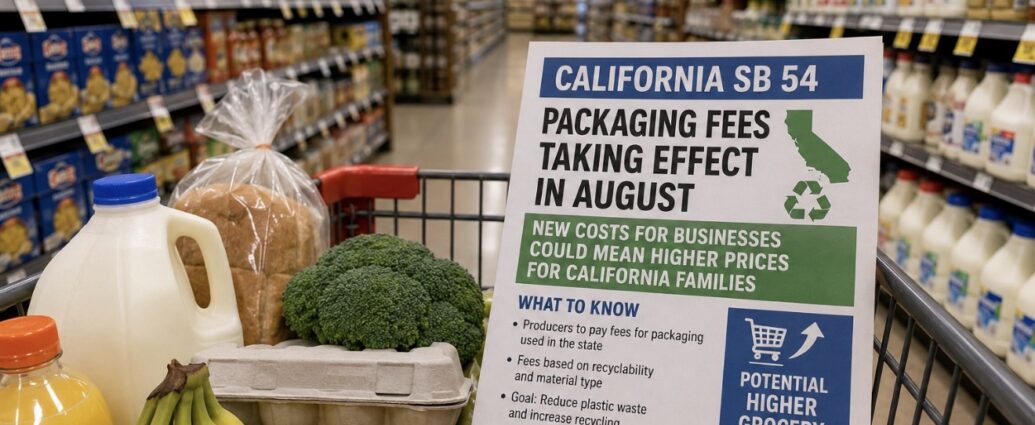
California will begin collecting its first producer fees under its landmark packaging law next month, opening a combative new phase for the rules — even as a multistate lawsuit and a repeal push from California’s own farm sector move to blunt them before consumers feel the effects at the register.
The Plastic Pollution Prevention and Packaging Producer Responsibility Act, signed in 2022, requires companies that sell single-use packaging and plastic food service ware in the state to help fund the recycling and disposal of those materials. The stated goal is to make all covered packaging recyclable or compostable by 2032, shifting cleanup costs from local governments and taxpayers onto the producers who create the waste. Fees are tiered: materials that are harder to recycle carry higher rates than compliant ones.
An important distinction is getting lost in much of the early coverage. The fees arriving in August are preliminary. CalRecycle, the agency overseeing the program, does not require companies to be fully compliant with the regulations until 2027 — the same year the state’s designated producer responsibility organization begins remitting $500 million annually into a state plastic-pollution fund. The permanent regulations were finalized on May 1, and a public comment period on the draft program plan runs through August 14.
What producers pay — and what shoppers ultimately absorb — is where the estimates diverge sharply. CalRecycle projects households will pay an added $66 to $190 per year, and calculates that if businesses passed along only 30 percent of the costs rather than the full amount, the figure would fall to roughly $20 per person annually. The agency also estimates that more than 546,000 businesses could see the cost of goods rise, at an average of about $4,806 each per year.
Critics put the household number far higher. Katie Davey, executive director of the Dairy Institute of California, has said Californians could pay around $1,300 more a year once the rules take hold, warning the state is only getting more expensive. A coalition of California agriculture groups, in a July 6 letter to Governor Gavin Newsom and legislative leaders, pegged the potential grocery hit near $1,400 annually and called for the law to be repealed and replaced. Assemblyman Carl DeMaio, a vocal opponent, has floated a lower but still substantial figure of roughly $200 per family.
Smaller operators get some relief. Businesses with gross annual sales under $1 million are exempt from many of the requirements — an estimated 7,874 producers that CalRecycle says would face only modest recordkeeping and application costs averaging about $155 a year.
The fee rollout arrives against a widening legal and political fight. On June 22, a 17-state coalition of Republican attorneys general, led by Nebraska’s Mike Hilgers, joined the National Association of Wholesaler-Distributors in a federal lawsuit seeking to block enforcement. The association’s litigation director, Karen Harned, argued the entire producer-responsibility model is “completely unconstitutional,” contending it hands quasi-governmental power to a private organization without due process.
That organization, the Circular Action Alliance, was selected by the state as its sole producer responsibility organization and is now assembling the program. Chief executive Jeff Fielkow has pushed back on the constitutional framing, saying the group holds no enforcement authority and operates strictly within limits set by the state. “That’s not our role,” he said, describing the work as building the system rather than policing it.
The stakes reach well beyond California’s borders — the angle that should matter most to tri-state grocers, distributors and manufacturers watching from afar. Because many companies use identical packaging nationwide, opponents argue that firms may redesign products to meet California’s rules rather than run a California-only line, effectively exporting the compliance costs into supply chains across the country. Industry groups tracking the rollout project price increases beginning to surface as early as September and October.
For now, the law’s near-term reality is narrower than the headlines suggest: a first round of fees, a comment window still open, and a courtroom challenge that could reshape or delay what comes next. Whether the eventual cost to a California family lands closer to twenty dollars or fourteen hundred may depend less on the statute itself than on how producers choose to respond — and on whether the federal suit lands before 2027.
JBizNews Desk | Sacramento, Calif.
© JBizNews.com All Rights Reserved. Reproduction or distribution without written permission is prohibited.