By JBizNews Desk
OTTAWA — May 29, 2026 — Canada has officially fallen into recession for the first time since the COVID-19 pandemic after Statistics Canada reported Friday that the economy contracted for a second consecutive quarter, weighed down by U.S. tariffs, elevated oil prices, and a sharp slowdown in population growth.
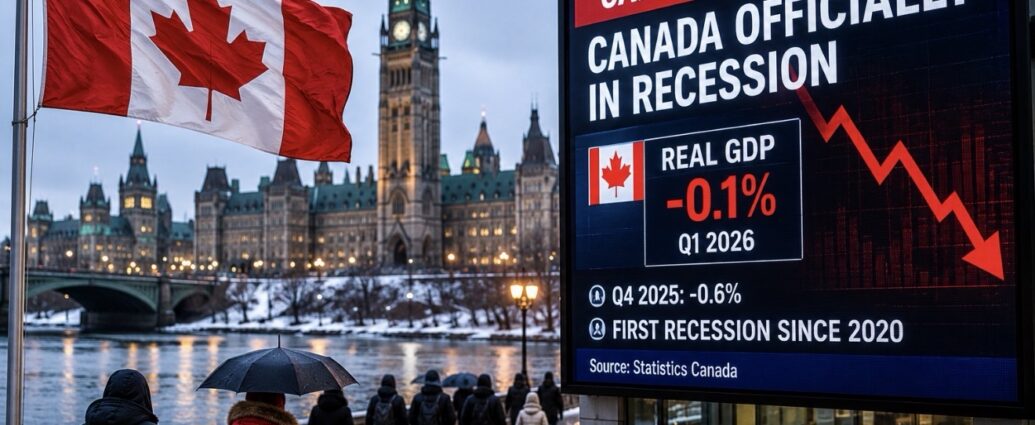
According to Statistics Canada, real gross domestic product declined 0.1% in the first quarter of 2026, following a 0.6% contraction in the fourth quarter of 2025. The back-to-back declines meet the commonly accepted definition of a technical recession and mark Canada’s first recession since 2020.
The figures came as a surprise to economists and policymakers. The Bank of Canada had projected growth of approximately 1.8%, while Statistics Canada’s preliminary estimate issued last month pointed to growth closer to 1.7%.
The weaker-than-expected result underscores how quickly economic conditions have deteriorated amid growing trade tensions and global uncertainty.
Trade Pressures Mount
A major factor behind the downturn has been the impact of U.S. trade measures imposed by President Donald Trump, which have affected several key Canadian industries including steel, aluminum, copper, lumber, and automobiles.
Export demand has softened as tariffs increase costs and create uncertainty for manufacturers and investors. Businesses have responded by delaying expansion plans and reducing capital expenditures while awaiting greater clarity on the future of North American trade relations.
Although Canada’s manufacturing sector showed signs of life earlier in the quarter, helped by a rebound in auto production, output remains below year-earlier levels.
Oil Shock Creates Mixed Impact
The conflict involving Iran, the United States, and Israel has added another layer of economic pressure.
Crude oil prices have climbed sharply since the outbreak of hostilities, boosting revenues for energy-producing provinces such as Alberta while simultaneously increasing fuel, transportation, and operating costs across the broader economy.
Higher energy prices are helping some sectors but squeezing consumers already dealing with elevated living costs and persistent inflation pressures.
Seasonal maintenance activity in Canada’s oil and gas industry further weighed on economic activity during March, contributing to the quarter’s negative result.
Population Growth Reverses
Another major shift has emerged in Canada’s demographic outlook.
After years of rapid population expansion fueled largely by immigration and temporary resident programs, growth has stalled as the federal government moves to reduce immigration levels and temporary resident numbers.
A slower-growing population means fewer workers entering the labor force and fewer consumers driving demand, reducing one of the key engines that supported Canada’s economy during recent years.
Labor Market Weakening
For many Canadians, the recession may feel like a continuation of trends already visible in the labor market.
Employment growth has slowed significantly, and job losses earlier this year ranked among the steepest outside previous recessionary periods. The national unemployment rate has remained near 6.7%, considerably above recent lows.
Consumer confidence has also softened as households contend with higher borrowing costs, housing affordability challenges, and concerns about economic stability.
Bank of Canada Faces Difficult Choice
The recession now places additional pressure on Bank of Canada Governor Tiff Macklem and policymakers.
The central bank’s benchmark interest rate currently stands at 2.25%, and officials face competing concerns.
On one hand, a contracting economy traditionally argues for lower interest rates to stimulate growth. On the other hand, rising oil prices threaten to push inflation higher, making aggressive rate cuts potentially risky.
The latest GDP figures strengthen the case for monetary easing, but policymakers remain cautious about reigniting inflationary pressures.
Business Investment at Risk
The recession designation could further dampen business sentiment.
Companies often respond to economic contractions by slowing hiring, reducing expansion plans, and preserving cash. Economists warn that weaker confidence could become self-reinforcing if businesses and consumers pull back simultaneously.
Residential construction also remains under pressure as housing demand softens and affordability challenges persist.
Can Canada Recover Quickly?
Despite the disappointing headline, economists note that the downturn remains relatively shallow compared with previous recessions.
Canada still posted 1.7% growth for full-year 2025, one of the stronger performances among G7 economies, and many forecasters believe growth could resume if trade tensions ease and energy markets stabilize.
Whether that happens depends largely on factors beyond Ottawa’s control.
For now, Canada has crossed an economic threshold it had avoided for nearly six years, and attention is turning toward how long the contraction lasts and whether policymakers can prevent a deeper downturn.
The immediate challenge facing Canada is clear: navigating a trade dispute with its largest customer while absorbing the economic fallout from a volatile global energy market.
Canada — JBizNews Desk
© JBizNews.com All Rights Reserved. Reproduction or distribution without written permission is prohibited.