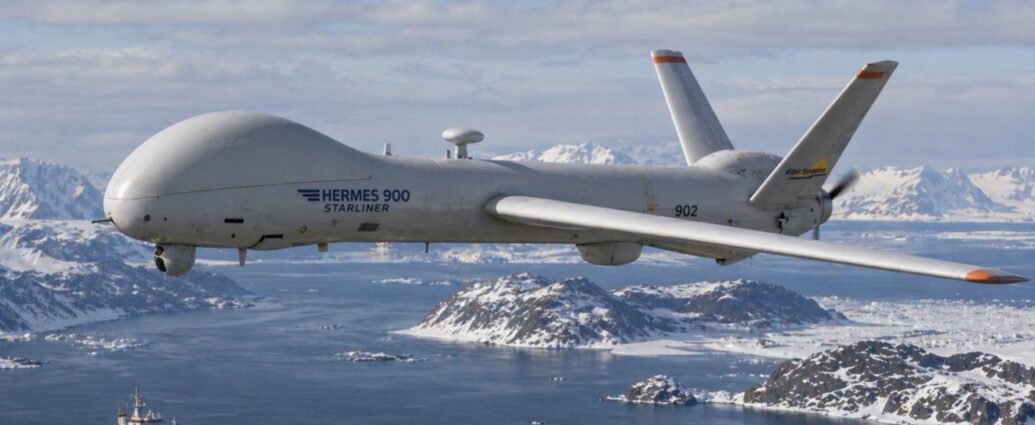
Canada will test Elbit Systems’ Hermes 900 Starliner unmanned aerial vehicles this summer as part of Coast Guard operations in the Arctic, according to CBC, as Ottawa moves to strengthen surveillance capabilities while facing delays in the delivery of U.S.-built drones.
The evaluation, led by Canada’s Department of National Defence, comes as the country seeks reliable, long-endurance platforms capable of operating across vast, remote northern regions. The trials are expected to focus on maritime patrol, search-and-rescue support, environmental monitoring, and persistent intelligence gathering.
“The Arctic demands endurance, reliability, and advanced sensing capabilities,” said Ken Herbert, Managing Director at RBC Capital Markets, noting that unmanned systems are uniquely suited to cover large territories at lower cost than manned aircraft.
The Hermes 900 Starliner is a medium-altitude, long-endurance (MALE) UAV designed for extended missions, with a range exceeding 1,000 kilometers and endurance that can approach 30 hours depending on configuration. The platform can operate at altitudes of up to 30,000 feet, allowing wide-area coverage while remaining above adverse weather conditions.
“Elbit’s advantage is the combination of endurance and multi-mission capability in a single system,” said Seth Seifman, Aerospace & Defense Analyst at J.P. Morgan, highlighting that fewer platforms are needed to achieve continuous coverage.
The drone is equipped with a sophisticated suite of sensors, including electro-optical and infrared imaging systems, maritime patrol radar, synthetic aperture radar (SAR) for all-weather imaging, and signals intelligence (SIGINT) payloads. These systems enable real-time detection, tracking, and identification of vessels, infrastructure, and activity across both sea and land environments.
“Sensor fusion is what makes these systems powerful,” said Ron Epstein, Aerospace and Defense Analyst at Bank of America, noting that integrating multiple data streams allows operators to build a comprehensive operational picture.
The Starliner variant is also designed to meet NATO and civilian aviation standards, allowing it to operate in shared airspace with commercial flights. This capability is particularly important for Canada, where missions may span both controlled and remote airspace.
“Airspace integration is becoming a key requirement for Western militaries,” said Noah Poponak, Aerospace Analyst at Goldman Sachs, adding that platforms able to operate without segregated airspace have a strategic advantage.
Elbit Systems has established itself as a major global UAV manufacturer, with its Hermes 450 and Hermes 900 platforms widely deployed across defense and security operations. Industry rankings place the company among the top UAV developers worldwide, based on innovation, R&D investment, and operational deployment.
“Scale and experience matter in this market,” said Myles Walton, Aerospace & Defense Analyst at Wolfe Research, pointing to Elbit’s broad international customer base of more than 20 countries.
The Hermes systems have been used in a wide range of operational scenarios, including border security, maritime patrol, and high-intensity environments, demonstrating adaptability across mission types.
“Platforms that have been tested in real-world conditions tend to perform better in procurement evaluations,” said Alex Macheras, aviation analyst, emphasizing the importance of proven reliability.
Canada’s interest in the Starliner is also driven by timing. The country has experienced delays in receiving MQ-9B drones from General Atomics, creating an immediate need to evaluate alternative or complementary systems.
“Procurement gaps often lead to interim solutions becoming long-term options,” said Richard Aboulafia, Managing Director at AeroDynamic Advisory, noting that strong performance in trials can reshape acquisition plans.
The Arctic itself presents unique operational challenges, including extreme cold, limited infrastructure, and vast distances between monitoring points. UAVs like the Hermes 900 are designed to operate with minimal ground support while maintaining continuous data links via satellite communications.
“The ability to stay airborne for extended periods is critical in the Arctic,” said Francesco Garofalo, Defense Analyst at IHS Markit, noting that fewer sorties reduce operational costs and improve mission efficiency.
Beyond defense, the platform could support civilian missions such as search and rescue, ice monitoring, fisheries enforcement, and environmental surveillance, expanding its utility across multiple agencies.
Looking ahead, the outcome of the summer trials will be closely watched as Canada evaluates how best to build a modern unmanned capability tailored to Arctic conditions. If successful, the Hermes 900 Starliner could play a significant role in shaping the country’s long-term surveillance strategy in one of the world’s most strategically important regions.
JBizNews Desk