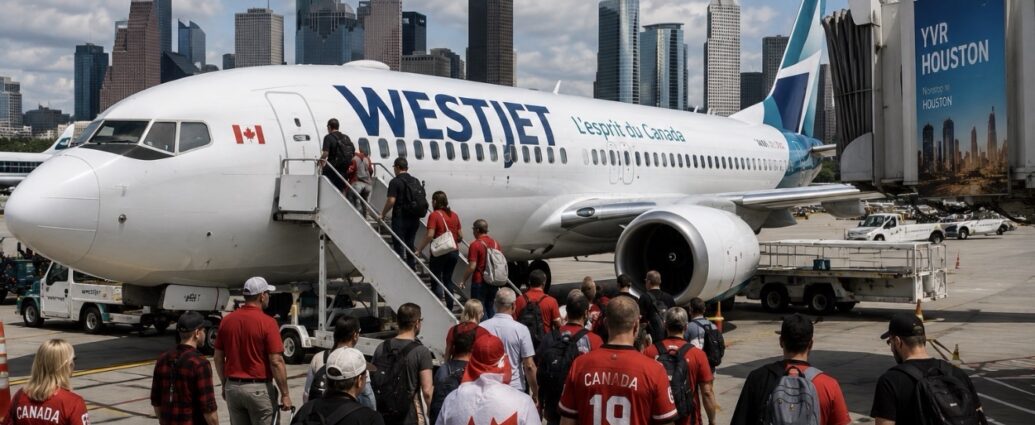
WestJet Airlines, owned by Onex Corp. and partners including Delta Air Lines, is adding capacity on flights to Houston after Canada’s national soccer team advanced to the Round of 16, triggering a rush of fans eager to follow the team into Texas.
Canada defeated South Africa 1-0 in the Round of 32 on Sunday, extending its deepest run of the tournament after already drawing international attention with a 6-0 victory over Qatar during group play.
Canada’s next match is scheduled for Saturday, July 4, with Houston expected to receive an influx of Canadian supporters.
In response, WestJet has begun adding seats on flights serving the Texas market.
The move illustrates how modern airlines increasingly adjust schedules in real time to match changing demand.
Based in Calgary, WestJet has developed the ability to shift aircraft and seating capacity quickly when major sporting events, weather disruptions, or unexpected travel trends emerge.
For the airline, Canada’s tournament success creates a valuable commercial opportunity through fuller aircraft, higher ticket prices, and increased visibility tied to national pride.
The adjustments come amid one of the airline industry’s largest logistical challenges.
The 2026 FIFA World Cup, expanded to 48 teams competing across 16 host cities in the United States, Canada, and Mexico, is expected to move more than five million travelers during the tournament.
Airlines including American Airlines, Air Canada, United Airlines, Qatar Airways, and GOL have expanded schedules, deployed larger aircraft, and introduced World Cup travel packages to capture the demand.
Industry analysts expect the tournament to generate billions of dollars in travel-related revenue, with particularly heavy traffic flowing through cities including Houston, Dallas, New York, Los Angeles, Miami, and Toronto.
For travelers, however, success on the field often translates into higher prices.
Industry forecasts suggest airfare between World Cup host cities could rise 20% to 40% during the group stage, with even larger increases during the knockout rounds as available seats become scarce.
A surprise victory such as Canada’s advancement often triggers last-minute booking surges that can quickly push fares substantially higher.
The economic impact extends well beyond airlines.
Every traveling fan also books hotel rooms, eats in restaurants, uses rideshare services, purchases merchandise, and spends money throughout the host city.
Hotels near stadiums frequently raise prices alongside airlines, while local businesses benefit from the sudden influx of visitors.
For Texas cities hosting World Cup matches, an unexpected wave of Canadian fans provides an additional boost during one of the busiest travel periods of the summer.
The unpredictability remains one of the industry’s biggest challenges.
Airlines and hotels cannot accurately forecast which teams will continue advancing, meaning demand can shift dramatically from one weekend to the next.
An unexpected elimination may leave aircraft seats and hotel rooms empty, while a surprise victory forces travel companies to react almost immediately.
Managing that volatility has become an essential part of operating during the world’s largest sporting event.
For WestJet, the calculation is straightforward.
Canadians want to support their national team as it continues its historic World Cup run, and the airline intends to fly them there.
Whether Canada’s tournament ends in the Round of 16 or continues even further, the episode demonstrates how quickly success on the field can translate into measurable business activity—filling airplanes, raising fares, and generating new spending across the travel industry.
JBizNews Desk
© JBizNews.com All Rights Reserved. Reproduction or distribution without written permission is prohibited.