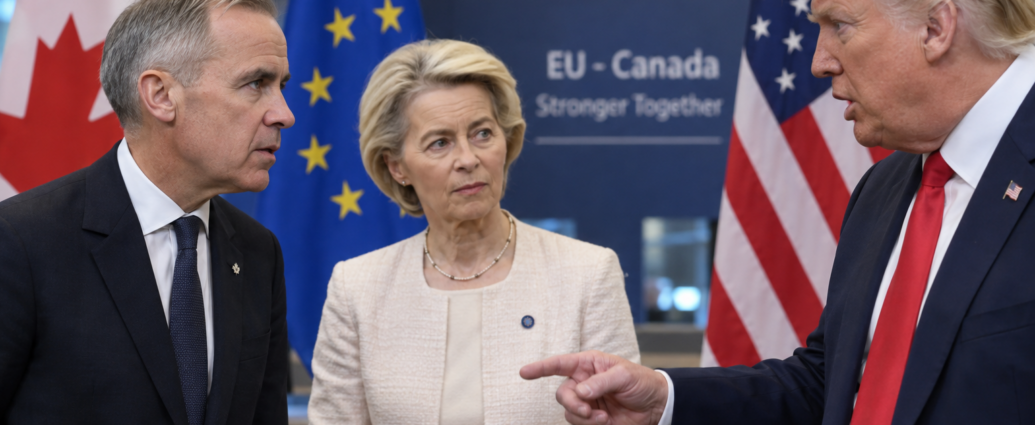
Canadian Prime Minister Mark Carney’s push for a much closer economic and strategic relationship with Europe is opening another front in an already strained relationship with President Donald Trump — and raising the possibility of additional tariffs that could eventually reach American businesses and consumers.
The latest dispute began after European Commission President Ursula von der Leyen floated the idea of Canada becoming the European Union’s first “associate member,” part of a broader effort to deepen cooperation between Canada and Europe on trade, defense, energy, technology and critical minerals. The proposed status is unprecedented and has not yet been formally defined.
Carney welcomed the broader ambition during an address to the European Parliament in Strasbourg on Thursday, while stopping short of saying Canada was seeking conventional EU membership.
“Canada welcomes this ambition,” Carney said while discussing von der Leyen’s proposal. His government has framed the European push as part of an effort to diversify Canada’s economic relationships and reduce its vulnerability to any single trading partner.
Trump responded with a warning.
Speaking to reporters, the president suggested that allowing Canada to become an EU associate member could amount to a “hostile act” depending on Europe’s intentions. He threatened “very heavy tariffs” against Europe if he concluded the arrangement was aimed against the United States.
That threat matters well beyond the diplomatic dispute.
If Washington ultimately places additional tariffs on European products, American companies importing affected goods would generally be responsible for paying those duties at the border. Businesses could absorb some of the expense, shift suppliers or pass part of the additional cost through to customers.
For households, that means another tariff confrontation could potentially affect prices on imported goods ranging from machinery and industrial components to consumer products, depending on which products Washington targets.
Canada Looks Beyond the U.S.
The confrontation comes as Canada is deliberately trying to diversify its economic relationships.
During his European Parliament address, Carney argued that Canada and Europe have complementary strengths. Europe brings a massive consumer market, advanced manufacturing and research capabilities, while Canada offers energy, critical minerals and expertise in areas including artificial intelligence, quantum computing, finance and space technology.
The two sides already have a substantial economic foundation through the Canada-European Union Comprehensive Economic and Trade Agreement, or CETA.
But von der Leyen’s proposal would potentially go further.
Exactly what “associate membership” would mean remains unresolved because no such formal category currently exists within the EU framework. Creating it could require extensive negotiations among European governments, and potentially legal or treaty changes.
That makes the proposal more of a strategic direction than a completed agreement.
Still, the political message is significant: Canada is looking for ways to become less dependent on the United States.
A Trade Relationship Already Under Pressure
The dispute arrives only weeks after U.S.-Canada trade negotiations collapsed.
The United States imposed 50% tariffs on roughly $20 billion in selected Canadian goods in August. Canada subsequently announced dollar-for-dollar countermeasures covering C$27.6 billion of U.S. imports, with Canadian tariff rates of 15%, 25% or 50% depending on the product.
Those measures cover industries including steel and aluminum, dairy products, appliances, agricultural equipment, pulp and paper, plastics and electronics.
The consequences can be much larger for individual companies than the headline trade numbers suggest.
Small manufacturers, farmers and specialty businesses that built supply chains around an open U.S.-Canada border can suddenly face substantially higher costs or lose customers when retaliatory duties make their products less competitive.
The political relationship has deteriorated alongside the trade dispute.
Trump has repeatedly suggested Canada could become the 51st U.S. state. In August, he also signed an executive order directing U.S. federal agencies to rename Lake Ontario “Lake America” for federal purposes — a change that does not determine what Canada or other countries call the lake.
Why American Businesses Should Pay Attention
Canada remains deeply integrated with the American economy, meaning prolonged trade friction can travel quickly through supply chains.
Companies that import tariff-covered Canadian products face higher border costs. U.S. exporters whose products are targeted by Canadian retaliation can become more expensive for Canadian customers.
Businesses can respond by absorbing those expenses, renegotiating contracts, changing suppliers or raising prices. None of those adjustments is painless.
The proposed European partnership also points toward a longer-term shift.
Carney has made diversification a central part of Canada’s economic strategy, arguing that the country needs stronger relationships with Europe and other markets regardless of how its relationship with Washington develops. His government says Canada is seeking greater strategic autonomy rather than economic isolation.
That could matter for American companies long after the current tariff dispute ends.
If Canadian companies redirect investment, energy exports, critical minerals or procurement toward European partners, some commercial relationships that traditionally flowed north and south across the U.S.-Canada border could increasingly move across the Atlantic instead.
For now, however, associate membership remains a proposal rather than a completed agreement.
What is already real are the tariffs.
American and Canadian companies are operating under new trade barriers while Canada and Europe explore a potentially much deeper relationship — and Trump is warning that further movement toward Europe could trigger another round of U.S. trade restrictions.
That leaves businesses facing two separate uncertainties at once: how far Canada will move toward Europe, and how Washington will respond if it does.
JBizNews Desk | Washington, D.C.
© JBizNews.com All Rights Reserved. Reproduction or distribution without written permission is prohibited.