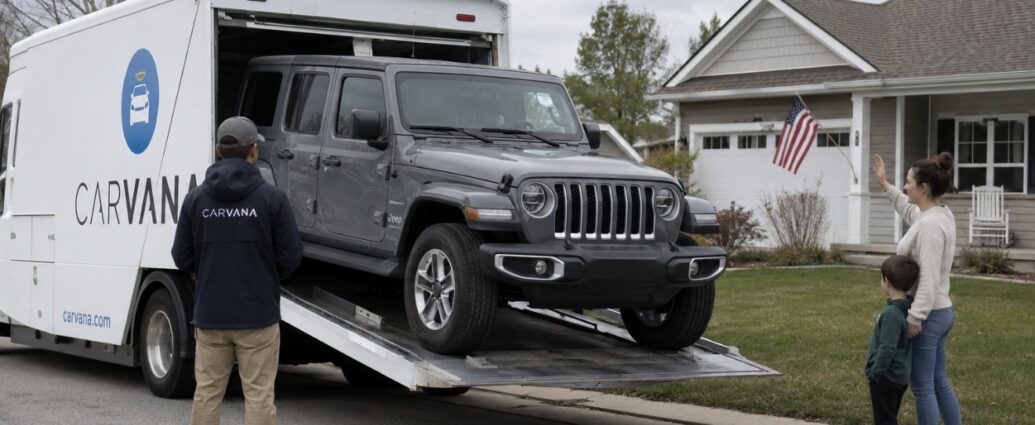
Carvana Co., the Tempe, Arizona-based online used-car giant, has emerged in recent weeks as perhaps the most disruptive force to hit the U.S. new-car retail market in decades, rapidly expanding into franchised dealership ownership at a pace that has alarmed automakers, dealer associations, and traditional retailers across the country.
The company has completed its seventh acquisition of a franchised Chrysler-Dodge-Jeep-Ram dealership in just 14 months, according to public dealer-acquisition disclosures and industry tracking by CBT News and CDG Circles. The buying spree has become so aggressive that Stellantis NV, parent company of Chrysler, Dodge, Jeep, and Ram, reportedly imposed an unprecedented one-store-per-year cap on Carvana’s future expansion inside its dealer network.
Carvana now operates franchised new-car dealerships in Arizona, Texas, California, Georgia, Ohio, and the Boston area. The latest acquisitions — including a Sacramento dealership purchased from Nouri/Shaver Automotive Group, an Avon Lake, Ohio location near Cleveland, and another in suburban Boston — closed in rapid succession over the past several months.
The move represents a dramatic escalation in Carvana’s ambitions. The company originally built its brand around online used-car sales, vending-machine vehicle towers, home delivery, and fully digital transactions. Now it is entering the far larger and politically protected new-car business, testing whether century-old franchise laws can withstand an online-first retail model backed by Wall Street capital.
“This is the kind of defensive measure an automaker imposes when a single capital-rich buyer is reshaping the local economics of a region’s car-retail market faster than franchised dealers can adapt,” one industry executive familiar with the Stellantis restrictions told industry analysts.
Customers increasingly appear willing to embrace the model.
Joshua Higginbotham, a 43-year-old buyer from the Kansas City area, recently purchased a new $51,000 Jeep Wrangler online through a Carvana-owned dealership located more than 1,000 miles away from his home.
“I don’t want to spend a whole day in a dealership, and they always like to make it take an entire day,” Higginbotham said after completing the transaction from his living room couch.
That frustration is becoming one of Carvana’s biggest competitive weapons.
The company’s model eliminates traditional showroom negotiations, finance-office upselling, and lengthy dealership visits. Buyers browse inventory online, receive financing digitally, sign paperwork electronically, and schedule home delivery or pickup. For younger buyers especially, the experience increasingly resembles buying electronics on Amazon rather than navigating the traditional auto-retail process.
The challenge for the dealer establishment is that Carvana is now attempting to bring that model into a regulatory system specifically designed to protect franchised local dealerships.
State franchise laws — among the most heavily defended commercial regulations in America — were largely built over the last century to prevent automakers from bypassing local dealers or consolidating excessive market power. Dealer associations argue the system protects consumers through local competition, warranty support, service infrastructure, and employment stability.
Carvana’s expansion is testing those assumptions directly.
The company began buying Stellantis franchise stores in February 2025 with the acquisition of a dealership in Casa Grande, Arizona. Since then, it has rapidly added locations in Dallas, San Diego, Union City, Georgia, Sacramento, the Boston area, and Ohio.
Industry analysts say Stellantis has been particularly vulnerable because of years of declining U.S. market share, inventory imbalances, and weak dealer profitability.
Jack Ballinghoff, chief operating officer at Ourisman Automotive Group and H Street Management, described Stellantis’ dealer network as “battered” by inconsistent product demand and operational strain.
Stellantis is now attempting an aggressive turnaround strategy aimed at reclaiming roughly 8% U.S. market share in 2026, equivalent to approximately 1.1 million annual vehicle sales. Reaching that target would require dealer volumes to rise by roughly 25%, creating significant pressure across the network.
That instability has created an opening for Carvana.
With its stock rebounding from single digits during the 2022–2023 downturn to above $300 per share, the company once again has access to capital markets and acquisition financing powerful enough to expand rapidly.
The economics are deeply unsettling for traditional dealers.
Scott Gruwell, chief executive of Courtesy Automotive Group in Phoenix, has openly acknowledged that many conventional dealerships cannot compete directly with Carvana’s pricing structure.
“One of the unique advantages they have versus normal franchise dealers is they had the ability to actually carry the paper and finance a lot of that back-end dollars,” Gruwell said. “So they could squeeze the price, compress that margin down to nothing or even below. But yet they pick it back up on the finance part.”
That financing advantage is becoming increasingly important.
According to data from One Auction View, Carvana’s listed used-car inventory surged from roughly 53,600 vehicles to 64,700 vehicles over the past three months alone. Pricing has also become increasingly aggressive, shifting from approximately 12% below market averages to nearly 15% below market pricing.
The company reported a 44% year-over-year increase in used-vehicle sales during the third quarter of 2025, reaching 155,941 units sold.
Perhaps most alarming to competitors, two formerly underperforming Stellantis dealerships acquired by Carvana now reportedly rank among the top five nationally in month-to-date sales volume.
Dealer groups and lobbying organizations are now mobilizing.
The National Automobile Dealers Association (NADA) has intensified lobbying efforts in Washington and state legislatures, arguing that the traditional franchise model protects consumers, preserves local jobs, and ensures competitive pricing through independent ownership structures.
State dealer associations from California to Georgia are also reviewing whether existing franchise statutes need tightening to prevent large-scale consolidation by online-first operators.
Carvana has already faced regulatory friction before.
Illinois suspended the company’s dealer license in 2022 after consumer complaints involving title-processing and registration delays. Similar regulatory agreements were later reached with authorities in Michigan and Pennsylvania.
But the broader industry trend may already be moving in Carvana’s direction.
Amazon.com Inc., working alongside traditional dealers, launched Amazon Autos last year, allowing consumers to browse and buy new vehicles online before completing delivery through dealership partners.
Meanwhile, Scout Motors, the new American electric SUV and pickup brand backed by Volkswagen AG, plans to sell directly to consumers under a Tesla-style model that bypasses traditional dealerships entirely. Dealer associations in Texas and South Carolina have already launched legal and political challenges against Scout’s plans.
The financial stakes are enormous.
According to Cox Automotive, Americans spent approximately $655 billion on new vehicles during 2025, compared with roughly $524 billion on used cars. While more used vehicles change hands annually, the new-car market remains the most lucrative segment of automotive retail because of higher transaction prices, warranty servicing, manufacturer incentives, and finance-and-insurance revenue.
Carvana is no longer fighting for a share of the smaller pool.
It is now moving directly into the largest and most profitable part of the automotive business — and doing so fast enough that much of the traditional dealer system is only beginning to grasp the scale of the threat.
The next 18 months may determine whether the century-old franchise model can adapt to a consumer base increasingly comfortable buying cars the same way it buys almost everything else online.
For now, Carvana is accelerating — and millions of traditional dealership customers appear increasingly willing to come along for the ride.
JBizNews Desk