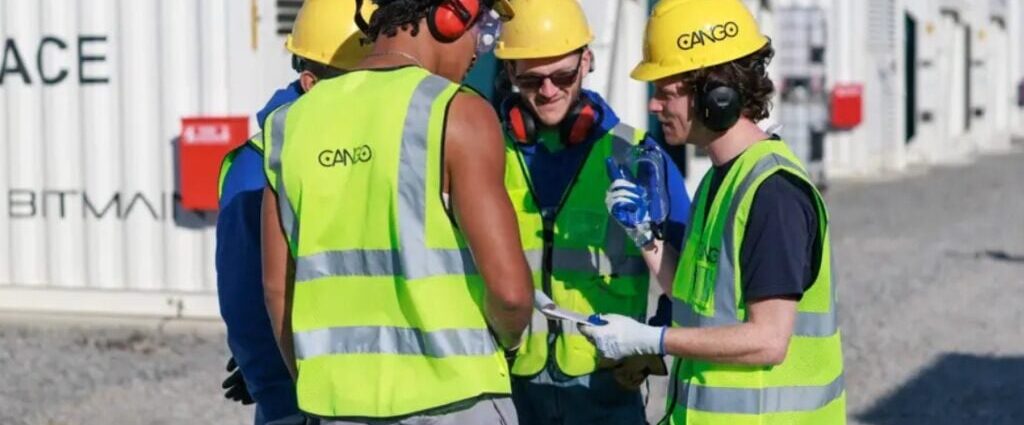
The bitcoin miner took a series of major write-offs last year, many in the fourth quarter, and received some major new investment to shore up its finances heading into a new chapter

image credit: Bamboo Works

Key Takeaways:

  • Cango recorded a $622 million loss last year, much of that from write-downs and other charges, but remained EBITDA positive for the period
  • The company has validated and is now preparing to scale up a new business that converts idle bitcoin mining space to use for high-performance AI computing

When the history books are written, the end of 2025 and beginning of 2026 are likely to be remembered as a pivotal time for Cango Inc. (NYSE:CANG). If current trends continue, history will show that’s when the company began to sharply scale back its year-old bitcoin mining business and race full throttle into a newer, more stable business providing high-performance computing (HPC) services for AI companies.

That newer business has taken some key steps forward lately, including the establishment of a U.S.-based subsidiary led by an industry veteran experienced in the type of distributed computing that will become Cango’s new focus. The company said it has also validated a “plug-and-play” model that allows for quick conversion of former bitcoin mining space into capacity usable for HPC clients, many of those smaller businesses running AI applications.

Cango discussed such a move as early as the middle of last year, back when bitcoin was still trading near record highs. But back then it portrayed the shift as more gradual, with bitcoin mining and HPC services serving as the company’s dual engines.

Fast forward to the present, when Cango’s latest quarterly report for the fourth quarter of 2025 shows the transformation has taken on sudden urgency, as the company shores up its balance sheet to prepare for its new chapter. That financial cleanup became necessary following a plunge that saw Cango’s bitcoin holdings lose half of their value in a matter of months, as the cryptocurrency tumbled from a record high of about $124,000 last October to a trough of about $63,000 in February.

Cango revealed the extent of its internal cash-crunch in its latest report, and detailed steps it took to strengthen its …

Full story available on Benzinga.com

This post was originally published here

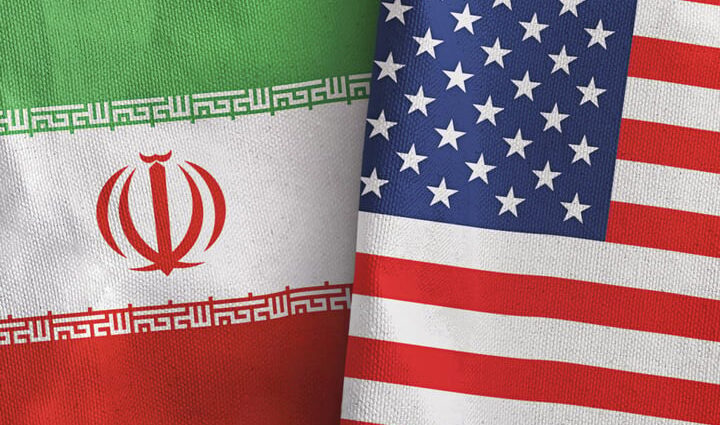
The Iran war has rattled the global flow of oil, with steeper fuel costs already straining households worldwide. And in the U.S., drivers are now facing the highest prices they’ve seen at the pump in about two and a half years.

According to motor club AAA, the national average for a gallon of regular gasoline jumped over $3.84 on Wednesday, up from $2.98 consumers were paying before the U.S. and Israel launched the war with joint attacks against Iran on Feb. 28. The last time gas prices were as expensive as they are now was in September 2023.

“It’s pretty hard. I mean, times are tough for everybody right now,” Amanda Acosta, a Louisiana resident, told The Associated Press while filling up her car’s tank this week. “I’m getting way less gas and paying way more money.”

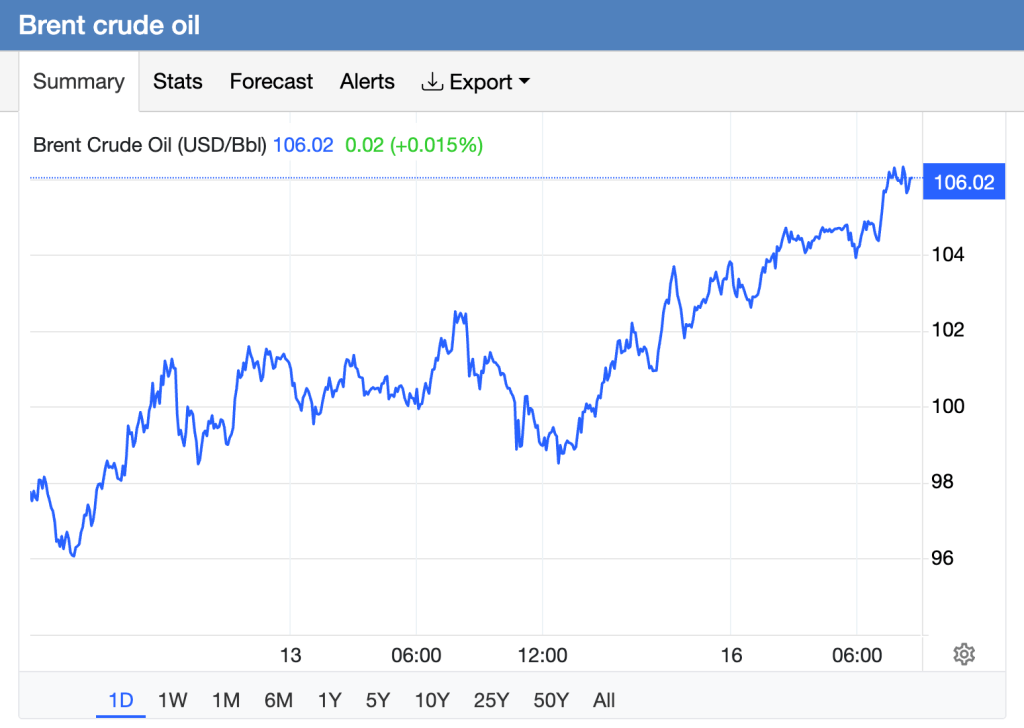
She isn’t alone. Pain at the pump has been one of the most immediate economic impacts of the conflict, because the price of crude oil — the main ingredient in gasoline — has soared and swung rapidly in recent weeks, due to supply chain disruptions and cuts from major producers across the Middle East. Brent crude, the international standard, was trading at nearly $108 a barrel Wednesday, up from roughly $70 just weeks ago. And benchmark U.S. crude is now going for almost $98 a barrel.

Many eyes are on the White House. Before the war, President Donald Trump once bragged about keeping gas prices low. But he’s since pivoted to try and paint high oil prices as a positive outcome for the U.S. Last week, Trump said that because the U.S. is now largest crude producer in the world, “when oil prices go up, we make a lot of money.”

Companies that supply oil benefit from higher prices. But steeper costs always pinch consumers’ wallets — and today’s prices arrive as many households continue to face wider cost of living strains. It could also push up already stubborn inflation, at least in the short run, and potentially hammer the economy more significantly if rising costs drag on. Experts say that could apply more pressure on the Trump administration, particularly as affordability continues to stay at the top of voters’ minds.

Drivers see impact of higher fuel prices

“I just want all of it to end. I just want to get out of there, out of Iran,” said Meghan Adamoli, a New Jersey resident who was among customers filling up at a Multani station on Tuesday. While Adamoli said she can personally “roll with the punches” when it comes to gas prices, she knows that a lot of others can’t.

Dan Bradley, a flatbed truck driver from Pennsylvania, said he’s felt the rising prices for both his work and personal vehicles. Beyond regular gasoline, the U.S. average for diesel neared $5.07 a gallon on Wednesday, per AAA, its highest level since 2022. Before the Iran war started, diesel was averaging at about $3.76 a gallon.

“It sucks when you’re filling up,” said Bradley. “What are you going to do, not get gas?”

Meanwhile, Texas resident Clay Plant said rising oil costs is good for the economy of his town, Lubbock. He sees more people work as drilling picks up.

“It’s kind of a good sign for us in west Texas,” Plant said. “I look at it as my friends and family get to eat and they get to go to work.”

Search for more supply and uncertainty ahead

The U.S. is now a net exporter of oil — and other parts of the world that rely more heavily of fuel imports from the Middle East, notably Asia, have seen starker energy shocks amid the war. But that doesn’t mean America is immune to price spikes.

Oil is a globally-traded commodity. And most of what the U.S. produces is light, sweet crude — but refineries on the East and West coasts are primarily designed to process heavier, sour product. So the country also needs imports.

The road ahead is uncertain, and prices could worsen if the war drags on. Iran has effectively halted nearly all tanker movement in the key Strait of Hormuz, where roughly one-fifth of the world’s oil once sailed through on a typical day. That’s led to cuts from some major producers in the region, because their crude has nowhere to go. Trump has demanded that other countries send warships to reopen the waterway, but has yet to garner sign-ons as many ask for more clarity about America’s next steps for the war. Meanwhile, Iran, Israel and the U.S. have all struck oil and gas facilities.

All of this has left countries scrambling for other supply. Last week, the International Energy Agency pledged to release 400 million barrels of oil from its member nations’ stockpiles. Trump, who previously downplayed the need for reserve oil, later confirmed that the U.S. would pull 172 million barrels from the Strategic Petroleum Reserve as part of this effort. The administration also announced it will temporarily free up Russian oil from U.S. sanctions for its war on Ukraine.

Still, analysts say these efforts will be a short-term bridge. Refineries buy crude oil in advance, and it takes time for new supply to trickle down to consumers. While steep crude costs is the top driver of gas prices today, a handful of other factors are also on the table. U.S. gas prices typically tick up a bit at this time of year, as more drivers hit the road and the warming weather brings a shift to “summer blend” fuel, which is more expensive to make than winter blend.

As always, some states also have pricier averages than others, due to factors ranging from nearby supply to differing tax rates. On Wednesday, California had the highest average of over $5.56 per gallon, while Kansas had the lowest of about $3.23.

Experts warn all of this could eat into wider spending. As consumers pay more to cover necessities like gas, many households — particularly those that are middle or low income — will be forced to cut their budgets in other places, explains Francesco D’Acunto, a finance professor at Georgetown University. More expensive fuel also impacts other sectors, from transporting groceries to household utility bills.

These combined inflation shocks, and overall high uncertainty during times of war, also “makes many houses and consumers freeze,” D’Acunto added. He said that could cause some to hold off on bigger financial decisions — like buying a car or house — farther down the road. “So potentially even that will have such an effect on the overall economy.”

________

AP Journalists Stephen Smith in Madisonville, Louisiana, Geoff Mulvihill in Cherry Hill, New Jersey, and Mingson Lau in Claymont, Delaware, contributed.

This story was originally featured on Fortune.com

This post was originally published here


Bitcoin (CRYPTO: BTC) is holding above $70,000 for now, but prominent analyst Trader Mayne foresees a broader macro downturn.

Bitcoin Still Holding Key Levels

In a Mar. 17 podcast, Mayne said Bitcoin’s recent rebound appears to be a countertrend move rather than the start of a sustained bull run.

He argued the broader market structure remains bearish, warning that a loss of support around $70,000 could open the door to further downside.

While he acknowledged that holding this level could support a bullish case, Mayne said his base view is that the market has not yet reached its bottom.

He

Full story available on Benzinga.com

This post was originally published here

Polymarket, one of the two leading prediction market sites, built its platform on blockchain rails—a design that offers efficiency but that can also add a layer of unwanted complexity.  On Wednesday, the fast-growing company took a step that will help it tuck those blockchain elements further into the background: Polymarket announced it is acquiring Brahma, a startup that specializes in providing crypto and DeFi infrastructure for businesses and individuals managing digital assets. The financial terms of the deal were not disclosed. 

“Building reliable infrastructure across blockchain networks and traditional financial rails is hard—there are no shortcuts,” said Shayne Coplan, founder and CEO of Polymarket, in an email to Fortune. “The Brahma team has shown they can design, operate and scale complex products for sophisticated users.”

While Polymarket expects the acquisition will improve its user experience, the move also signals the company—which has quickly grown to a reported $20 billion valuation—is doubling down on its crypto roots. Polymarket has been using blockchain rails since its inception, whereas its main competitor Kalshi functions largely with fiat currency. 

One way that Brahma could help Polymarket is by bringing additional liquidity to smaller wagers. Larger event contracts, like those in sports or politics, easily bring lots of money into the pool. But smaller wagers focused on niche areas such as, for instance, the outcome of a bowling match in Spain, struggle to amass a sizable amount of liquidity. Brahma’s experience in DeFi, a decentralized field of crypto defined by rapid trading and users with a high capacity for risk, could help draw in additional capital to more thinly traded contracts.

Alessandro Tenconi, one of the co-founders of Brahma, said in an interview with Fortune that his startup could remove the friction for Polymarket users when it comes to creating a wallet, depositing and converting shares, and redeeming outcome tokens.  

Brahma, started in 2021 by Tenconi and his co-founders Akanshu Jain and Bapi Reddy Karri, has helped both businesses and individuals use DeFi at scale. The startup says that it has processed more than $1 billion in transactions. When it joins Polymarket, Brahma will wind down its projects with other companies and individuals. 

This is not the first time that Polymarket has sought to expand by hiring talent through an acquisition. In February, the prediction market platform acquired Dome, a Y Combinator backed startup, to bolster its developer tools. Polymarket also acquired a boutique executive search firm called Lunch in February.

Tenconi says that one night in September, at 1 AM, he got a Telegram message from someone saying that Coplan, the CEO of Polymarket, wanted to talk to him. Ten minutes later, the two were on a call. He says that Coplan was looking for people who could build fast, build quality, and who had the chops. “It was like builders talking to builders,” Tenconi said, about that first phone call. “The rest happened very naturally.”

This story was originally featured on Fortune.com

This post was originally published here


U.S. equity markets slipped into the red on Wednesday in early morning trading in New York as hotter-than-expected February producer price data reignited inflation fears just hours before the Federal Reserve is set to deliver its rate decision and updated economic projections, while Brent crude surged above $108 a barrel following an Israeli strike on Iran’s South Pars natural gas processing complex.

South Pars Strike Marks Major Escalation

Israel struck Iran’s South Pars gas processing facility in Assaluyeh on Wednesday morning, hitting tanks and infrastructure at the complex.

South Pars is Iran’s largest natural gas field and the source of roughly 70% of the country’s gas output. It shares a reservoir with Qatar’s North Field — the world’s largest natural gas deposit.

Iran’s Revolutionary Guards immediately issued evacuation warnings for several Gulf energy facilities. Iranian state media declared that Gulf energy sites are now “legitimate targets.” Iran’s Foreign Ministry said Tehran would retaliate. Qatar’s foreign ministry called the strike “a dangerous and irresponsible step amid the current military escalation.”

Prediction odds of the Strait of Hormuz reopening by April 30 fell to 25%, as tracked by Polymarket.

Brent crude surged 4.8% to $108.50 a barrel. WTI crude – as tracked by the United States Oil Fund

Full story available on Benzinga.com

This post was originally published here

U.S. companies will be allowed to do business with Venezuela’s state-owned oil and gas company after the Treasury Department eased sanctions, with some limitations, on Wednesday as the Trump administration looks for ways to boost world oil supplies during the Iran war.

The Treasury issued a broad authorization allowing Petróleos de Venezuela S.A, or PDVSA, to directly sell Venezuelan oil to U.S. companies and on global markets, a massive shift after Washington for years had largely blocked dealings with Venezuela’s government and its oil sector.

The move highlights the increased pressure that the Republican administration is under to ease soaring oil prices as the United States, along with Israel, wages a war with Iran without a foreseeable end date. Global oil prices have since spiked as Iran halted traffic through the narrow Strait of Hormuz, where one-fifth of the world’s oil typically passes through from the Persian Gulf to customers worldwide.

The U.S. action is designed to incentivize new investment in Venezuela’s energy sector and is intended to benefit both the U.S and Venezuela, while increasing the global oil supply, a Treasury official told The Associated Press. The official was not authorized to discuss the matter publicly and spoke one condition of anonymity.

Since the ouster and arrest of Nicolás Maduro as Venezuela’s president during a U.S. military operation in January, President Donald Trump has said the U.S. would effectively “run” Venezuela and sell its oil.

The Treasury Department’s license provides targeted relief from sanctions, but does not lift the penalties altogether. The license allows companies that existed before Jan. 29, 2025, to buy Venezuelan oil and engage in transactions that would normally be banned under American sanctions, reopening trade for a major oil producer to global markets.

There are some limits.

Payments cannot go directly to sanctioned Venezuelan entities such as PDVSA, but must be sent instead to a special U.S.-controlled account. In other words, the U.S. will allow the oil trade but will control the cash flow.

Additionally, deals involving Russia, Iran, North Korea, Cuba and some Chinese entities will not be allowed. Transactions involving Venezuelan debt or bonds will not be allowed.

The license is expected to give a massive boost to Venezuela’s oil-dependent economy and help encourage companies that have been apprehensive to invest. The decision is part of the Trump administration’s phased-in plan to turn around Venezuela. But critics of the acting Venezuelan government argue that the move rewards Venezuela’s leadership -– all loyal to Maduro and the ruling party -– while repression, corruption and human rights abuses continue.

Many public sector workers survive on roughly $160 per month, while the average private sector employee earned about $237 last year, when the annual inflation rate soared to 475%, according to Venezuela’s central bank, and sent the cost of food beyond what many can afford.

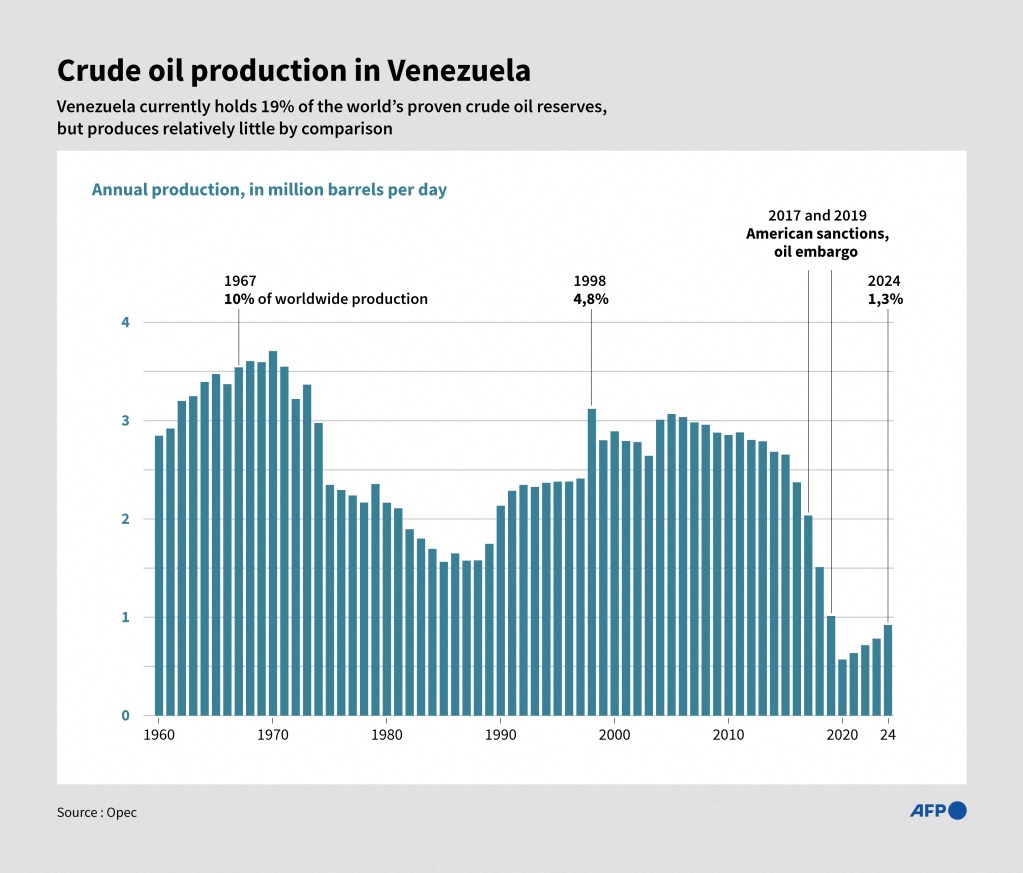
Venezuela sits atop the world’s largest oil reserves and used them to power what was once Latin America’s strongest economy. But corruption, mismanagement and U.S. economic sanctions saw production steadily decline from the 3.5 million barrels per day pumped in 1999, when Maduro’s mentor, Hugo Chávez, took power, to less than 400,000 barrels per day in 2020.

A year earlier, the Treasury Department under the first Trump administration locked Venezuela out of world oil markets when it sanctioned PDVSA as part of a policy punishing Maduro’s government for corrupt, anti-democratic and criminal activities. That forced the government to sell its remaining oil output at a discount — about 40% below market prices — to buyers such as China and in other Asian markets. Venezuela even started accepting payments in Russian rubles, bartered goods or cryptocurrency.

The new license does not allow payments in gold or cryptocurrency, including the petro, which was a crypto token issued by the Venezuelan government in 2018. __

Garcia Cano reported from Caracas, Venezuela.

This story was originally featured on Fortune.com

This post was originally published here

The war in Iran has already transformed the world’s energy map. It might yet redraw America’s auto market.

Now in its third week, the U.S. and Israeli military campaign in Iran has escalated to involve targets across the Middle East, including the Strait of Hormuz — a narrow waterway at the mouth of the Persian Gulf that serves as the world’s most critical fossil fuel chokepoint. The war has effectively closed the oil tanker traffic that used to navigate the strait, which on a normal day carries up to 20% of the world’s traded petroleum.

Fuel costs worldwide have soared as a result. Average gas prices in the U.S. are now $3.79 a gallon, up from $2.92 a month ago, reminding drivers of the 2022 energy shortage and even of the devastating oil shocks of the 1970s.

But unlike during those crises, the world now possesses a massive, rapidly scaling, and for the most part readily available asset to soften the blow: the electric vehicle.

The global EV fleet has been growing for years, gradually chipping away at the world’s oil consumption as drivers turn to charging ports instead of gas stations. Last year, EVs worldwide avoided the consumption of 1.7 million barrels of oil per day, according to a report published Wednesday by Ember, an independent energy think tank based in the U.K. That’s roughly 70% of the 2.4 million barrels Iran exported daily through the Strait of Hormuz in 2025.

While the crisis has sent global oil prices soaring, the declining need for petroleum in transportation is providing a critical cushion in some countries. And the longer fuel prices remain elevated, the more attractive EVs become to buyers.

“Oil is a particularly tricky resource to replace,” Daan Walter, a researcher at Ember and the report’s lead author, told Fortune. “It has been for 125 years now, except for the past five or six years, when we’ve had this new competitive lever in electric vehicles.”

Electrifying demand

In the U.S., EV purchases hit a wall over the past few months as President Donald Trump rescinded many of the subsidies and incentives the Biden administration had installed to facilitate the transport sector’s electrification. Those measures mostly expired in September, and EV sales for the year ended up falling by 2%.

But the Iran conflict has sparked a revival of consumer interest. Search traffic for EVs during the first week of the conflict jumped 20%, according to CarEdge, a car shopping platform, with interest in popular models like the Tesla Model Y and Chevrolet Equinox nearly doubling.

For now, the conflict in Iran and higher gasoline prices are likely to only influence drivers who were already in the market for a new car, Elaine Buckberg, a senior fellow at Harvard University’s Salata Center for Climate and Sustainability and a former chief economist for General Motors, told Fortune.

But that could change if prices stay high for much longer. “Gasoline prices are one of the biggest elements of people’s perception of inflation because you buy it so regularly,” Buckberg said. “It takes three to six months of persistently higher prices before people say, ‘Maybe I should go out and switch cars to one that’s more fuel efficient, including an EV.’”

EV drivers outside the U.S. already know how much they might be able to save. In the U.K., EV drivers saved an average of £870 ($1,162) a year by charging their cars instead of fueling up, according to an analysis published last week by the nonprofit Energy & Climate Intelligence Unit. But if oil prices remain above $100 a barrel, as they have for most of the conflict, those annual savings could jump to £1,000 ($1,336).

In the U.S., the costs of owning and charging an EV depend on several factors, including local electricity prices and whether drivers can charge their cars at home. And for now, buying an electric car tends to be more expensive than buying a gas-powered one, although prices are falling due to greater competition and more choices of lower-priced models.

But EV drivers are likely to be rewarded over the course of their car’s lifetime—the New York Times found last year that driving 100 miles in a home-charged EV costs on average a little more than $5, while the same distance in a standard gas-powered car costs on average $12.80.

Nowhere to hide

The Trump administration has framed the pain Americans are feeling at the pump as a short-term problem, and claimed that the U.S. is insulated from the oil crisis because it is a large producer in its own right. But being a net exporter of oil does little to shield the U.S. from volatility, according to Ember’s Walter.

“In some ways, no one is safe,” he said. “Even if you live between a gas well and a refinery, even then your prices are going up.”

Oil is a global commodity, and unless a government enacts export bans, a barrel of oil produced in the U.S. will go to whoever pays the most wherever they are, Walter said. That means American consumers remain tethered to the same price volatility as the rest of the world, regardless of how much crude is pumped from U.S. soil. In Texas, for example, one of the world’s largest oil-exporting regions, gasoline prices have risen 25% since the war began, faster than in oil-importing nations like the U.K. and France during the same period, Walter said.

Because volatile gasoline prices have such a significant bearing on consumer sentiment, experts have long argued that transportation reliant on locally generated electricity can be an economic and political hedge.

“A shift towards EV basically would protect the economy from downside,” Buckberg said. “That link from oil geopolitics to oil prices to gasoline prices could be broken.”

The last time a global geopolitical shock sparked an energy crisis was in 2022, when Russia’s invasion of Ukraine sent global oil and gas markets into a frenzy. A lot has changed since then to make EVs a more palatable option as gasoline prices rise, Buckberg said. For one, the world is no longer limited by a microchip shortage that strained EV manufacturing in the early 2020s. 

But electric and hybrid vehicles have also become more affordable and accessible to a wider variety of consumers, particularly in emerging markets in East and Southeast Asia, according to previous Ember research. In China, the world’s biggest EV market, the country’s existing electric car fleet accounts for more than $28 billion a year in avoided oil imports, Ember’s latest report found.

“We’re no longer living in a world of risk-free fossil fuels. We’re living in a world where everything is risky and it now becomes a question of which risks do you want to take,” Walter said. 

This story was originally featured on Fortune.com

This post was originally published here

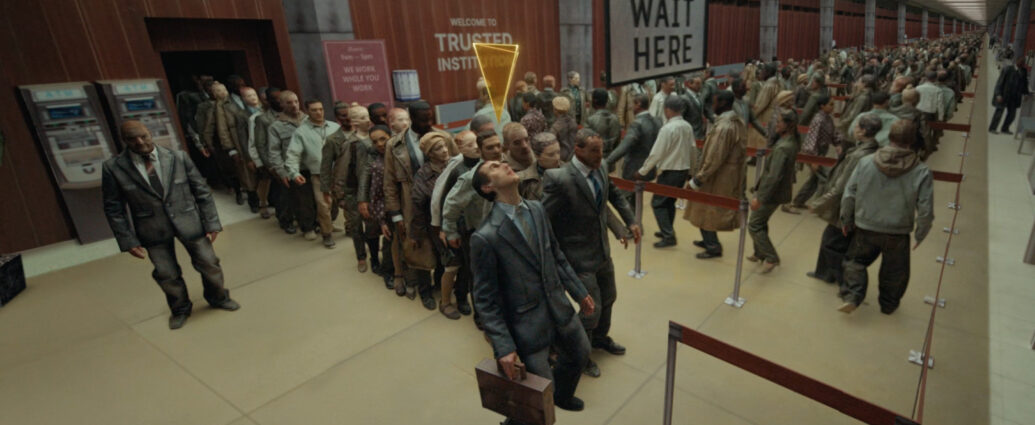
Coinbase’s 60-second spot, “Your Way Out,” drops viewers into a low-resolution video game world where everyone moves in a loop: commuting, working, spending. The protagonist is an NPC, a non-playable character, stuck inside a system he didn’t build and can’t control, until he strains against his preprogrammed slumped over state and breaks free. The environment shifts from pixelated game world to the full color of reality as he gains agency, set to Sammy Davis Jr.’s “I’ve Gotta Be Me.” The ad only reveals itself to be about Coinbase at the end, with a single tagline: “Your way out of their system.”

The ad is extraordinary for what it captures in the culture: an ever-gnawing desperation to escape what’s become known as the “permanent underclass.” The phrase, once niche Silicon Valley gallows humor, has become a genuine cultural fixation. As leaders of AI companies boast that their technology will replace most jobs within the next decade, people are worried they’ll be sorted into a category Karl Marx once called the lumpenproletariat: the lowest stratum of the industrial working class itself.

Only it’s 2026, and the word for it is the permanent underclass, a world with no upward mobility. Online, the term is lobbed at people who aren’t heeding AI’s headwinds, the kinds of FOMO-stoking posts that happen to work very well for selling. Which, of course, is what Coinbase is doing.

“Today, because of the maturity of Coinbase, we have a broader set of products that we think can offer true alternatives to an outdated system,” Catherine Ferdon, Coinbase’s CMO, said in a statement sent to Fortune.

The whole thing was shot using real actors and no CGI, Toby-Treyer Evans, the founder of the advertising agency that produced it, wrote in advertising trade site Muse by Clio. The game-world look was built in-camera, using suits with printed-on fabric details and pixelated set design made to look indistinguishable from a video game. Extras were trained to walk like game characters, Treyer- Evans wrote. It’s a genuine feat of filmmaking, and it isn’t Coinbase’s first. The company has built a reputation for splashy, viral big-event ads, including their memorable Super Bowl ad.

The ad’s central metaphor, the NPC, is a cultural artifact of that same corner of the internet. “Non-playable character” started as a gaming term, then by 2018 became a political meme to describe people who parrot talking points without thinking. Now, it’s Gen-Z’s default insult for anyone who appears to be on autopilot: going through the motions, lacking agency, playing by someone else’s rules. It sounds like the classic complaint the youth have always had about the status quo: “you’re the system, man!”

But this is different. These fears are shared by most Americans, and validated by the very people building the technology everyone’s afraid of. The noise around AI and its potential effects has grown so loud that you don’t need to be a 17-year-old dorm-room philosopher to conclude: a lot of people are about to lose control of their financial lives and not even realize it.

Coinbase’s answer, naturally, is to trade cryptocurrency. The pitch is compelling because it’s true that crypto has created real wealth for people bold enough, and lucky enough, to invest at the right time. The number of crypto millionaires globally hit nearly 242,000 last year, up 40% in twelve months, according to Henley & Partners. An entire subculture has formed around the shared belief that the traditional financial system was never going to let them in anyway. Those “crypto bros” are now perfectly positioned to capitalize on the broader anxiety about AI and displacement.

But for every crypto millionaire minted in the past two years, there are retail investors who lost their savings in the FTX collapse, got liquidated on leveraged bets they didn’t fully understand, or watched memecoins they bought on hype go to zero. FTX itself ran a Super Bowl ad in 2022—the same year as Coinbase’s famous ad—starring Larry David dismissing crypto as a fad. The company turned out to be a multibillion-dollar fraud. 

So even if the permanent underclass may or may not be coming, the ads for it are already here.

This story was originally featured on Fortune.com

This post was originally published here

Bitcoin (CRYPTO: BTC) has been unable to durably break $75,000 despite landmark SEC and CFTC joint guidance clarifying crypto token classifications and seven consecutive days of ETF inflows totaling over $1.4 billion.

The SEC/CFTC Framework

The SEC and CFTC issued joint interpretive guidance dividing crypto tokens into five categories: digital commodities, digital collectibles, digital tools, stablecoins, and digital securities. 

The framework marks a shift from case-by-case enforcement, clarifying which tokens are securities and which fall under lighter CFTC oversight.

“The practical effect is a more coherent and less burdensome regulatory environment,” Tagus Capital said. “Legal uncertainty declines, the risk of retroactive enforcement is reduced, and compliance becomes more predictable.”

The guidance supports institutional participation, exchange development, and product innovation while improving market structure through …

Full story available on Benzinga.com

This post was originally published here

Sri Lanka has just introduced a four‑day workweek—not to boost work‑life balance, but because the war in Iran is threatening to drain its petrol tanks dry.  

The government has declared every Wednesday a holiday for most public institutions in a desperate bid to slash petrol use, as war in the Middle East threatens vital oil shipments through the Strait of Hormuz.

All state institutions, along with schools and universities, will shift to a four-day work week, starting this Wednesday. Essential services like hospitals will stay open, but everyone else is being told to stay home, log on where possible, and use as little gas as they can. 

Even the private sector is being asked to follow the mandate, too.

Officials say Sri Lanka has roughly just six weeks of fuel reserves left. That’s why they’ve rolled out the four‑day week almost overnight, suspended public ceremonies, and launched a National Fuel Pass to ration how much petrol people can buy. And they’re not the only country introducing these emergency measures to avoid running out of fuel. 

There’s a pattern worth naming here. The three major crises since 2020—the pandemic, the 2022 European energy shock, now the Iran war—have each pushed governments to reach for the same lever: send people home, cut the commute, compress the week. And every time, some portion of that change proves permanent. Workers adjust. Productivity holds. And the five-day, in-office standard quietly loses a little more of its claim to inevitability. Look around Asia to see how Sri Lanka is far from alone.

Pakistan, the Philippines, and other Asian nations are welcoming a 4-day week and remote work

Across Asia, governments are quietly cutting working days, commutes, and non‑essential travel in a bid to stretch fuel supplies as far as possible.

Pakistan has already implemented a four-day week for some government offices and shut schools, as well as imposing a ban on in-person meetings. Meanwhile, all public and private firms are being mandated to ask 50% of their workforce to work from home. 

The Philippines is also adopting a four-day work week for government staff, and urged workers more generally to work from home where possible. Vietnam is also telling citizens to stay home, as well as to ride bikes, carpool, and use public transport, and restrict personal vehicle usage.

Other Asian nations are taking quirkier energy-saving steps. In Thailand, the government is urging office workers to ditch suits for short‑sleeved shirts so buildings can dial down the air‑conditioning. It’s also called on people to take the stairs instead of elevators

Myanmar is limiting private cars on alternate days. Bangladesh has introduced early Ramadan holidays and India has asked consumers not to panic, because hoarding—or turning to the black market—will only make the situation worse. 

Where the four‑day work week is here to stay

While these emergency measures are temporary, elsewhere, the four‑day work week has been introduced under far less dramatic circumstances—and often with surprisingly positive results. 

The U.K. ran the world’s largest four‑day week pilot in 2022, involving dozens of companies that paid staff 100% of their salary for 80% of the time in exchange for a commitment to maintain performance. A year later, 89% of participating firms were still operating a four‑day week and just over half had made the switch permanent—citing higher revenues, better retention, and employees who were less burned out and more loyal. And many other countries have been trialling shorter weeks across dozens of companies with strong early feedback on productivity and quality of life.

Across Europe and beyond, the idea is slowly moving from a rare perk to a mainstream policy experiment. Belgium passed legislation allowing workers to compress a full‑time job into four longer days, the UAE shifted its public sector to a four‑and‑a‑half‑day week, and even companies that don’t want to make permanent changes have launched “recharge days” and Summer Fridays.  

Sri Lanka’s emergency measures may be lifted the moment oil flows freely again. But the precedent—that a shorter week is a policy tool, not just a perk—is becoming established across three continents and counting.

This story was originally featured on Fortune.com

This post was originally published here

Good morning. Agentic AI could be the catalyst that gets most finance chiefs on board with using AI to support the finance function.

Aneel Bhusri, cofounder and CEO of Workday, an enterprise HR and finance platform with AI, returned to the role last month, two years after stepping down, succeeding Carl Eschenbach, Fortune reported. “I think there’s a lot of misinformation out in the marketplace about AI and SaaS applications,” Bhusri said during a virtual press conference on March 12. “There’s this idea that AI is going to replace a lot of these applications with things like vibe coding. I’m a technologist, and I’ve been in this space for a long time. I just don’t see that happening.”

There will exist a hybrid world, where the best of enterprise apps are paired with the best of AI, and where low-level, rote work gets replaced by agents that drive business processes underneath, Bhusri said. In his first month back as CEO at Workday, he spent time with many financial customers and prospects—and found that many accounting departments are still “running old systems like the one I was part of at PeopleSoft,” he said.

Cloud computing improved software and user experience, but finance teams were slower to adopt it because their systems served fewer users and were heavily customized. But AI is different: it can cut costs, automate complex work, and even enable near real-time audits, he said. “That was not possible with either the legacy on-premise systems or the newer cloud systems,” he said. “They were still business process automation systems, not reasoning and probabilistic engineering systems.”

That distinction is resonating with finance chiefs. For CFOs, “the agentic story and solutions are really what are catching their eye right now,” Bhusri said. “CFOs look at it as, ‘The new way to differentiate how we do business. We need to embrace AI.’” And that, he said, is the reason many will finally move from a legacy system to an AI-driven cloud system.

The shift appears to be gaining momentum more broadly. Gartner recently predicted that 40% of enterprise applications will be integrated with task-specific AI agents by the end of 2026, up from less than 5% in 2025 — a sign that agentic AI is moving from concept to corporate priority.

Workday (No. 455 on the Fortune 500) is moving quickly to capture that momentum. On Tuesday, the company launched Sana from Workday, a new AI tool that can answer questions, complete tasks, and automate routine work across HR and finance. It uses AI agents that can carry out multi-step tasks on their own, for example, reviewing email for receipts and submitting them for approval , and works across apps like Gmail, Outlook, Salesforce, Google Drive, and SharePoint while following company security rules. The tool is based on Workday’s $1.1 billion acquisition of Sana Labs, completed in November 2025.

AI could be the catalyst to spur some finance teams to modernize.

Sheryl Estrada
sheryl.estrada@fortune.com

This story was originally featured on Fortune.com

This post was originally published here

Bitcoin‘s (CRYPTO: BTC) rally to $76,000 follows the same pattern as the 2022 and 2018 midterm years, where February lows led to March rallies that ultimately formed lower highs before crashes, according to prominent analyst Benjamin Cowen.

The Stablecoin Dominance Pattern

Stablecoin dominance (USDT + USDC) exploded from 8.5% to 12.5% after sweeping prior highs, exactly as Cowen predicted two months ago when Bitcoin traded above $90,000. 

The current pullback in stablecoin dominance mirrors patterns seen in Bitcoin dominance, palladium, and the Hang Seng Index over the past four years.

“When I look at stablecoin dominance, I would have to say objectively, it’s hard to say that this won’t just be a higher low,” Cowen said. 

“If it takes out the low, then I’m wrong. But for now, this simply looks like what we’ve previously seen in other markets that exhibited a very similar pattern,” he added.

The pattern works like this: an asset sets a high, sells off, sets …

Full story available on Benzinga.com

This post was originally published here

With alarming headlines coming out of the Middle East, economists will be wary of sharing forecasts that might unnecessarily spook consumers or investors. Nonetheless, while Wall Street has remained calm(ish) about the disruption to global oil and energy supplies, Moody’s Mark Zandi warns that the longer-term macroeconomic picture has taken a turn for the worse.

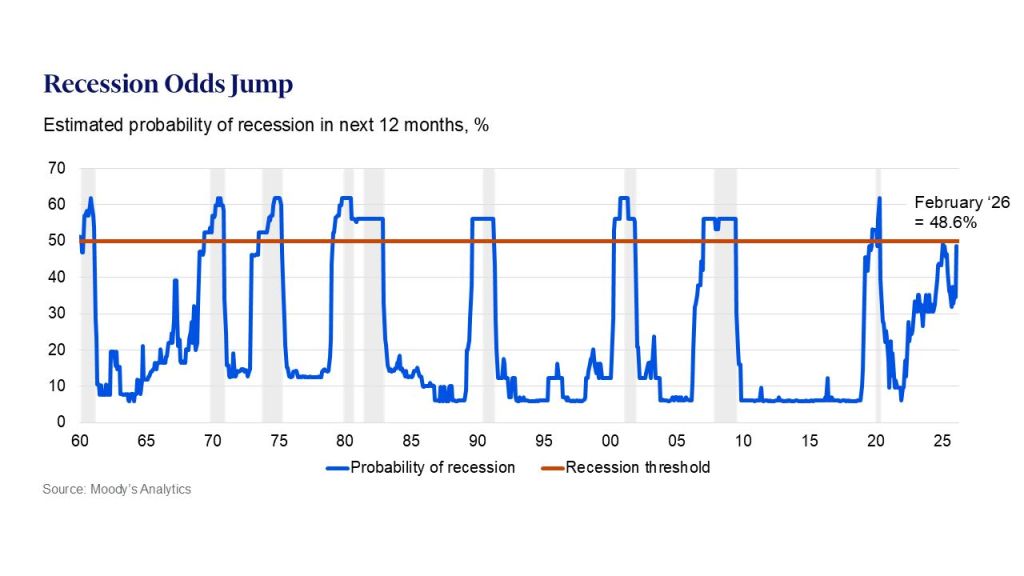
Zandi shared that, even prior to the U.S. and Israel launching strikes on Iran, recession odds for the economy had crept up to an alarming threshold. The latest reading on Moody’s economic indicator model—for February, prior to the military action—placed odds of a recession at 49% over the next 12 months.

“Behind the recent jump are primarily the weak labor market numbers, but almost all the economic data have turned soft since the end of last year,” Zandi wrote in a note. Indeed, an image Zandi shared of the Moody’s recession indicator shows that historically, it has been fairly accurate. The indicator spiked above a benchmark of 50 in 2020, in 2007, and 2001—all of which were followed by recessions as defined by the Federal Bank of St Louis.

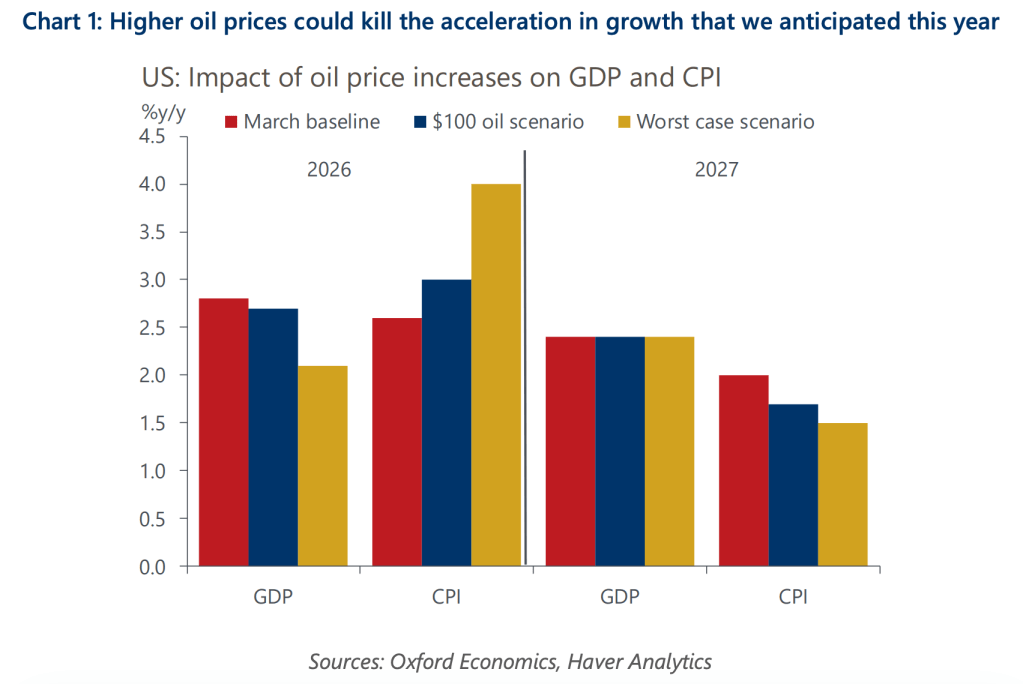
“It isn’t a stretch to expect the indicator to cross the key 50% threshold amid the Iranian conflict and the resulting surge in oil prices,” Zandi continued. “Oil prices are an important variable in the model, and with good reason: every recession since WWII, save the pandemic recession, has been preceded by a spike in oil prices.”

Moody’s recession call is higher compared to many on Wall Street, where most estimates say the likelihood is growing but is perhaps not in 50/50 territory. Indeed, Oxford Economics’s modelling suggests that oil prices would have to hit $140 a barrel over a two-month period to plunge the world economy into a recession. The strength of the subsequent recovery following a resolution of conflict in the Middle East depends on how quickly shipping through the Strait of Hormuz is normalised.

“The rebound in financial markets has been quick following past major military conflicts in the Middle East since the 1990s, but this time it could be more gradual,” noted Ben May, director of global macro research at Oxford Economics, and Ryan Sweet, chief global economist.

Zandi agrees with the premise, saying higher oil prices won’t level the same amount of economic damage as years prior because production and consumption are better aligned, but added consumers will suffer a significant uptick in the cost of living when they “were already increasingly nervous spenders.”

The Moody’s chief economist said his peers “will be loath to utter the word ‘recession,’” despite evidence to support such a statement, because many were proven wrong when they called a downturn calls over Fed policy a couple of years ago. But Zandi added: “If oil prices remain elevated for much longer (weeks and not months), a recession will be difficult to avoid.”

Happier odds

Some investors feel significantly more optimistic about the probability of a recession. Indeed, while economists generally go by the rule that a recession might happen once every five years, if not more frequently, Apollo Investment’s chief economist Torsten Slok suggests economic downturns are becoming less frequent.

“Between recessions, investors should prepare for sector-specific cycles, such as the current downturn in software, where one or two subsectors face distress while the rest of the economy is fine,” Slok wrote in a note published yesterday. “The bottom line is that credit opportunities arise not just during recessions, but also when there are sector-specific cycles during expansions.”

Oxford Economics’ latest Global Risk Survey is similarly more buoyant. The survey, conducted between February 26 and March 11, found there had been a sharp downturn of expectations since the outbreak of the conflict. However, odds of a global recession still stand at a 1-in-6 chance.

The war has driven scepticism over the prospects of the U.S. economy, Oxford notes. Prior to the military action, three-quarters of respondents felt the recent period of U.S. exceptionalism would continue, but that figure fell significantly as the conflict continued, with little more than half the 174 clients surveyed now expecting the U.S. to remain the fastest-growing G7 economy this year.

Indeed, Wall Street is more widely inclined to agree with lower recession odds. David Mericle of Goldman Sachs wrote this week that the bank’s outlook odds had increased, up by 5 percentage points to 25%, while JP Morgan predicted at the end of last year that the likelihood of a 2026 recession was 35%.

This story was originally featured on Fortune.com

This post was originally published here

Bitcoin continues to trade around $73,000, following $199.4 million in net ETF inflows on Tuesday, while Ethereum ETFs reported $138.25 million in net inflows.  


Cryptocurrency
Ticker Price
Bitcoin (CRYPTO: BTC) $73,071
Ethereum (CRYPTO: ETH) $2,273
Solana (CRYPTO: SOL) $92.13
XRP (CRYPTO: XRP) $1.50
Dogecoin (CRYPTO: DOGE) $0.09903
Shiba Inu (CRYPTO: SHIB) $0.056050

Meme coin market capitalization is down 1.1% over the past 24 hours to $35.7 billion.

Trader …

Full story available on Benzinga.com

This post was originally published here

Good morning. In today’s Fortune:

  • It’s Fed day—expect Powell to keep rates at 3.5%.
  • Iran: As Trump rages against his allies, Republicans want to know what the plan is.
  • Chaos in the Gulf is producing ‘butterfly effects’ far away.
  • Why the U.S. doesn’t have enough minesweepers to open the Strait of Hormuz.
  • Prediction markets see the war getting longer.
  • Nvidia might pay engineers in AI tokens
  • Exclusive: AI isn’t destroying consultants, Capgemini says.
  • Exclusive: Hinge CEO on the ‘dating recession.’

This story was originally featured on Fortune.com

This post was originally published here

Jensen Huang’s Nvidia GTC is kind of like tech’s Super Bowl Halftime Show. 

Everyone wants to be there, and if you’re not there, you inevitably end up hearing about it. And on Monday afternoon, Huang hit on agentic AI, the fast-approaching future of compute, offered a chip demand outlook, and emphasized the idea of “AI factories.” For startups and growing private companies, here are a few things to consider:

Talk to Nvidia’s agent. First, say hello to NemoClaw: The perennially leather-jacket-clad Huang unveiled NemoClaw, a new open source platform focused on agentic AI. The name is seemingly intentional, likely referencing the recent success of viral AI agent OpenClaw, while giving companies enterprise-grade privacy and security controls. “Every company in the world today needs to have an OpenClaw strategy, an agentic system strategy,” Huang told the audience. “This is the new computer.”

Physical AI has arrived. Huang emphasized that physical AI, especially robotics, is Nvidia’s next major market, perhaps worth one trillion or more. Many VCs would agree with Huang’s assessment, as billions of venture dollars have flowed into AI-era robotics companies like industrial-focused Skild AI and humanoid builder Apptronik. 

Nvidia wants to do it all. Fortune’s Sharon Goldman says it all comes down to how Nvidia sees its own future. She writes: “Nvidia made it clear at GTC that it is positioning itself not just as a chipmaker but as the provider of entire AI computing systems powering the new “inference” phase of AI. (Inference is about powering AI outputs, not just training, and it will require an enormous new round of infrastructure investment.) That ambition goes beyond Nvidia’s traditional “picks and shovels” role.”

Read on Sharon’s take about why Nvidia hasn’t seen more AI-fueled backlash here.

Fortune Term Sheet podcast hosted by Allie Garfinkle graphic with photo of Allie, links to YouTube video

Term Sheet Podcast… This week’s guest is someone I’ve been wanting to meet in person for some time: Winston Weinberg, Harvey CEO and cofounder. Harvey’s a legal AI leader, and the company’s 3.5 years old with an $11 billion valuation. Winston and I talked about Harvey’s rise, AI’s “partner and compete” paradigm, and his formula for finding focus. Watch the episode here.

See you tomorrow,

Allie Garfinkle
X:
@agarfinks
Email: alexandra.garfinkle@fortune.com

Submit a deal for the Term Sheet newsletter here.

Joey Abrams curated the deals section of today’s newsletter. Subscribe here.

This story was originally featured on Fortune.com

This post was originally published here

RunSybil, an AI cybersecurity startup that uses AI agents to automatically hack company software to find security weaknesses, has secured $40 million in venture capital funding.

The round was led by Khosla Ventures, with participation from S32, the Anthology Fund from Anthropic and Menlo Ventures, Conviction and Elad Gil, along with angel investors including Nikesh Arora, Amit Agarwal, Jeff Dean, and other founders and leaders from companies including OpenAI, Palo Alto Networks, Stripe and Google

The company did not disclose the valuation it achieved in the new funding round.

The company’s AI agent, Sybil, conducts continuous autonomous penetration tests against live applications—finding, exploiting and documenting real security vulnerabilities without humans in the loop. That’s different from other security tools currently making headlines, such as Claude Code Security, which analyzes source code in applications for known vulnerabilities before it is deployed.

RunSybil instead tests software that is already running, probing live systems the way a hacker would—by exploring systems, chaining vulnerabilities together and testing authentication boundaries to find paths to sensitive data.

Automating ‘ethical hacking’

Companies have long relied on a mix of penetration tests—where outside security experts, or “ethical hackers,” try to break into their systems; bug bounty programs that reward independent hackers for reporting flaws; and internal “red teams” that simulate real cyberattacks. RunSybil says its AI system can automate much of that work, continuously probing applications for vulnerabilities as new code is deployed.

RunSybil argues this kind of automation is becoming necessary as AI reshapes how companies operate. Procurement, legal, finance, engineering and operations are all being rebuilt with AI—including the growing use of AI agents. Yet security testing is still often treated as a discrete, scheduled event managed by a separate team on its own timeline. That mismatch can be especially challenging for highly regulated industries such as finance, insurance and health care, which face strict legal and audit requirements around cybersecurity.

RunSybil was co-founded in 2023 by Ari Herbert-Voss, who joined OpenAI as its first security research hire in 2019, and Vlad Ionescu, who previously led offensive security red teams at Meta. Together, they say they represent a rare intersection: people who understand how to build frontier AI systems and how to hack into complex software.

“We check every box that needs to be checked—for auditors, regulators and compliance teams,” Herbert-Voss said. But the real work, he said is transforming where, when and how customers discover and fix security issues: “Not as a project, but as a permanent capability embedded in how they build.”

‘On the edge’ of the AI security frontier

Vinod Khosla, who made an early bet on OpenAI in 2019 and often invests in companies he considers to be on the technological frontier, told Fortune that “what it takes to add security and penetration testing to the AI world is definitely frontier—RunSybil is on the edge.” There is currently little competition in this part of the offensive security market, he said, though security incumbents such as Palo Alto Networks may eventually move into the space.

For now, “nobody’s really knowledgeable about it except individuals like [Herbert-Voss],” he said, adding that he has long been concerned about AI’s cyber capabilities falling into the hands of adversaries such as China. “We invest in founders who tackle large, unsolved problems with technically ambitious solutions,” he added. “[Herbert-Voss and Ionsecu] are building exactly the kind of platform security teams will need as software complexity and AI-driven development accelerate.”

Herbert-Voss has long been steeped in both hacking and AI. Growing up in a mostly Mormon community in Utah, he said he was drawn to the online hacker scene in middle and high school but pivoted away after friends “started getting arrested.” While pursuing a Ph.D. at Harvard University studying machine learning and ways to make algorithms more efficient, he first heard about OpenAI.

He dropped out of Harvard, he said, after becoming convinced that the rapid scaling of AI models—training larger systems with more data and computing power—would unlock powerful new capabilities.

Evolving cyber capabilities with LLMs

“Once OpenAI dropped GPT-2, I said wow, this changes everything about the economics of what it would take to run a cyber campaign,” he explained. He sent a couple of hacker demos to OpenAI CEO Sam Altman and Jack Clark, then-head of policy at OpenAI who went on to co-found Anthropic. Both of them expressed their concerns about the potential misuse of LLMs and asked Herbert-Voss to come on to do security research.

But by 2022, Herbert-Voss said he also began to see how quickly offensive cyber capabilities could evolve once powerful language models became widely available, including to malicious actors. Those same advances, he said, could dramatically expand cyber threats. That led to Herbert-Voss’s decision to leave OpenAI and start RunSybil as a research project.

RunSybil currently works with startups including Cursor, Turbopuffer, Notion, Baseten, and Thinking Machines Lab, as well as what the company says are major financial institutions and Fortune 500 companies. (The company declined to name any of those Fortune 500 or financial customers.) Herbert-Voss said that customers have already reported finding critical vulnerabilities that had gone undetected using traditional methods.

This story was originally featured on Fortune.com

This post was originally published here

  • In today’s CEO Daily: How CEOs are protecting their pay packages by lowering their goals
  • The big leadership story: Whether Meta’s reported 20% layoffs will encourage a new wave of job cuts
  • The markets: A big Asia rebound
  • Plus: All the news and watercooler chat from Fortune.

Good morning. Call it the Hall of Blame. One time-honored tradition in business is to take credit for what goes well, blame disappointing results on factors beyond your control and lower the bar in tough times to be able to clear it so that your pay package remains intact.

When Apple set performance targets for fiscal 2025 for CEO Tim Cook and his executive team last year, the board set goals at or below the prior year’s result, citing “trade policy” and an “uncertain macroeconomic outlook.” As my colleague Amanda Gerut points out, that essentially guaranteed that Cook would take home a $12 million bonus, no matter how well he did. (Apple handily surpassed the modest targets.)

With wobbly markets, rising oil prices, war and fears of a global recession, keep an eye on compensation packages. What I look for:

Reduced targets—In an analysis of 50 public companies by Compensation Advisory Partners (CAP), published Friday, researchers found that boards set lower targets, wider performance curves and flatter payout ranges to protect CEO pay last year. The result: Pay rose 8% and bonuses were up 4% in the group while revenue rose slightly and earnings were down. CEOs collected 87% of their target bonuses, up from 77% in 2024.

Selfless rhetoric—While good times are ‘me’ time, bad times are all about ‘we.’ When taxpayers rescued big banks during the 2008 financial crisis, some characterized this as privatizing the gains and socializing the pain. But in bad times, few are above turning to the government for support. If you’re not too big to fail, you might be mission-critical, a social good or a bulwark against China. Masters of the universe become ordinary people blown by the winds of fate when those winds are in their face.

Blame—Dexin Zhou of Emory University published a fascinating study in 2014 called The Blame Game, in which he analyzed 70,000 earnings transcripts to track leaders who blamed factors in the economy or their industry for poor results. Those who blamed external factors deflected attention from themselves were less likely to be fired than those who held themselves accountable for the results. When times are bad, it seems, the pain doesn’t start at the top.

Contact CEO Daily via Diane Brady at diane.brady@fortune.com

This story was originally featured on Fortune.com

This post was originally published here

Solana (CRYPTO: SOL)-based memecoin Pippin (PIPPIN), after defying bear market conditions, has crashed dramatically this week.

This Analyst Saw PIPPIN’s Decline Coming

PIPPIN has plunged over 25% in the past day and 67% over the week. The decline wiped out nearly $290 million from the token’s market capitalization, knocking it out of the top ten memecoins list.

Widely followed cryptocurrency analyst and trader Ali Martinez sarcastically pointed to their late February prediction about the memecoin’s sell-off, stating, “I wish someone had predicted this.”

Full story available on Benzinga.com

This post was originally published here

Giving away billions sounds easy. Write a check and change the world. But Elon Musk, the world’s richest man, admitted last year that, actually, “it is very difficult to give money away for the reality of goodness.” And perhaps surprisingly, a nonprofit boss has said he’s not wrong.

Liz Baker, the CEO of Greater Good Charities—a global nonprofit that has distributed more than $1 billion in impact across 121 countries since 2006—has been navigating the complexity of giving away other people’s money for over a decade. And she’ll tell you Musk is only scratching the surface of how hard it really is.

“I wish I had a billion dollars to give away, but as somebody who’s responsible for giving away money, yeah, it’s hard, because there’s a really big responsibility that goes with that,” Baker exclusively told Fortune. “If you give me $1, I’m going to spend it the way that you want it spent. But there’s all this stuff that goes into it—geopolitical stuff, you don’t want to create dependencies in communities—like, what is the right avenue, and what are things that are really needed?”

Baker, who has led Greater Good Charities since 2012, oversees an organization that spans crisis and disaster response, humanitarian relief, biodiversity, and animal health and well-being across more than 120 countries. Under her watch, it has earned a 100/100 score from Charity Navigator and a Platinum Rating from GuideStar for transparency—the nonprofit equivalent of straight A’s.

Her critique isn’t that giving is impossible—it’s that most people dramatically underestimate what it requires. 

Unlike a normal transaction—where a donor gets something tangible in return, a product, a deliverable, a number they can point to—philanthropy asks you to fund a vision: here’s the problem, here’s the solution, here’s the hoped-for outcome. And then you have to wait years to see if you were actually right.”You can’t just go at a problem and be like, here’s a billion dollars, figure out the problem,” Baker said. “It’s too complicated. It doesn’t work like that.”

Essentially, it’s one thing to sign away a big paycheck, but as Musk says, it’s another thing to actually create tangible change for good with that money.

The antidote? Perhaps a more trial-and-error approach. What doesn’t happen enough, in her view, is the kind of nimble, honest reckoning with failure that good philanthropy demands. “Being able to pivot and being able to say, okay, this didn’t work—what do we do differently? A lot of testing,” she said. “You can’t just go at a problem, it’s too complicated.”

Stop waiting for billionaires. Do something yourself.

Billionaire pledges are great—in theory. 

“A pledge is a promise, right?” Baker said, when asked whether such commitments mean anything in practice. “Our experience with pledges is that most of the time donors will come through—not all of the time, though.”

Indeed, many remain little more than a name on an open letter. Just look at The Giving Pledge—the commitment, co-founded by Bill Gates, Melinda French Gates and Warren Buffett, that asks the ultra-wealthy to donate at least 50% of their fortunes—has attracted more than 250 signatories since its launch in 2010.

The number who have actually followed through? A handful—less than 10. Most only fulfilled the pledge after their deaths. Out of the U.S. signatories, just one couple, John and Laura Arnold, fully complied with the commitment they signed. 

It’s why Baker doesn’t think we can wait on billionaires to solve the world’s problems. “I think if everybody did something to help in their community, we wouldn’t have the issues that we have.”

How can everyday people be more philanthropic right now?

Baker’s not naive about most people’s economic reality. Cost-of-living pressures have squeezed household budgets to the point where even six-figure earners report struggling to afford basics

But making a difference doesn’t have to come at a cost. “Everybody can chip in—and it doesn’t even have to be money. Like, do something.”

“Even if you’re like, I have one hour a week to solve this problem in my community that I care about,” Baker said. “Figure out how to do that. Most local nonprofits need help.”

The worst thing you can do, in her eyes, is just complain. “There are people that are just like, well, I don’t like to see homeless people sitting on the corner, but I’m not willing to do anything about it except complain,” she said. “Innovate, people. Come on. Everybody’s good at something. Everybody cares about something.”

And she practices what she preaches. Despite running a multimillion-dollar organization and being a mother, Baker volunteers outside of her CEO role—showing up not as an executive but simply as someone with something to give back. “I volunteer—not as a CEO—as a person who has something to give back,” she said. “In a way, that’s like showing up and doing the work very differently than what I do here.”

“If everybody did that, we wouldn’t be in the situation we’re in.”

This story was originally featured on Fortune.com

This post was originally published here

Anthony Scaramucci, the founder and managing partner of SkyBridge Capital, labeled Strategy Inc.‘s (NASDAQ: MSTR) preferred stock issuance an “iPhone moment” that would trigger widespread Bitcoin (CRYPTO: BTC) adoption.

Setting The ‘Clock On Global Adoption’

In an X post, Scaramucci said that Strategy’s high-yield instrument, Perpetual Stretch Preferred Stock (NASDAQ: STRC), has set the “clock on global adoption” and is indeed the “iPhone moment” Saylor once hyped.

Scaramucci predicted the impact will be so explosive that skeptics’ “faces will melt off,” and their dying words will be “Saylor was right.”

Full story available on Benzinga.com

This post was originally published here

The Solana (CRYPTO: SOL) ecosystem cheered on Tuesday after the Securities and Exchange Commission issued an interpretation clarifying that most cryptocurrency assets are not securities.

Solana Among Several Cryptos Declared Securities

Solana’s official handle took to X, pointing to the latest guidance that resolved a long-standing uncertainty over the fate of cryptocurrencies.

“After more than a decade of uncertainty, this interpretation will provide market participants with a clear understanding of how the Commission treats crypto assets under federal securities laws,” SEC Chair Paul Atkins said. “It also acknowledges what the former administration refused to recognize – that most crypto assets are not themselves securities.”

Full story available on Benzinga.com

This post was originally published here

Leading cryptocurrencies pulled back, while stocks extended their rally on Tuesday as traders priced in little to no possibility of rate cuts.

Cryptocurrency 24-Hour Gains +/- Price (Recorded at 9:10 p.m. ET)
Bitcoin (CRYPTO: BTC) -1.48% $73,996.91
Ethereum (CRYPTO: ETH)
               
-0.82% $2,329.69
XRP (CRYPTO: XRP)                          -1.74% $1.51
Solana (CRYPTO: SOL)                          -0.56% $94.71
Dogecoin (CRYPTO: DOGE)              -2.50% $0.1004

Crypto Rally Halts

Bitcoin cooled down after Monday’s spike, retreating to the $73,000 region, while trading volume fell 20% over the last 24 hours.

Ethereum‘s rally also halted, as the second-largest cryptocurrency wobbled in the $2,300 region. XRP and Dogecoin also faced a correction.

Shares of Strategy Inc. (NASDAQ:MSTR) and Coinbase Global Inc. (NASDAQ:COIN) closed up 1.87% and 3.40%, respectively.

Over $200 million was liquidated from the cryptocurrency market over the past 24 hours, hitting long positions hardest, according to Coinglass data.

Open interest in Bitcoin futures fell 3.94% in the last 24 hours. More than half of Binance’s retail derivatives traders positioned short on Bitcoin, contrasting with the majority of whale traders who favored the longs.

“Fear” sentiment prevailed in the market, according to …

Full story available on Benzinga.com

This post was originally published here

Dell’s workforce has fallen by 10% for a third year in a row, according to annual reports filed Monday. 

As of Jan. 30, the Texas-based tech giant reported a headcount of 97,000 employees, down roughly 11,000 from its previous year of 108,000. 

The reductions were primarily driven by cost-cutting measures, including employee reorganizations, restricted external hiring and facility consolidation to better align investments.

“Throughout Fiscal 2026, we remained committed to disciplined cost management in coordination with our ongoing business modernization initiatives and continued to take certain measures to reduce costs,” the company said. 

ORACLE EXPECTED TO SLASH THOUSANDS OF JOBS AS MASSIVE AI SPENDING CREATES FINANCIAL CASH CRISIS

Over the years, Dell has implemented numerous cost-cutting measures, including employee reorganizations, restrictions on external hiring and other steps to better align its investments with strategic and customer priorities.

In its most recent reports, Dell highlighted the extensive integration of AI and machine learning technologies across its operations, including IT management, software solutions and the use of specialized servers.

Dell, whose shares have risen roughly 20% so far this year, said in February the company expects revenue from its AI-optimized server orders to double by 2027.

META EYES MASSIVE 20% WORKFORCE CUT AS AI INFRASTRUCTURE COSTS CONTINUE TO SOAR ACROSS OPERATIONS: REPORT

According to its fiscal 2026 report, Dell recorded total severance charges of $569 million, compared with $693 million in 2025 and $648 million in 2024. These payments primarily affected the selling, general and administrative departments, followed by cost of net revenue and research and development each year.

While Dell reported a staff count of 97,000 in 2026, the company had 133,000 employees in 2023. 

In 2023, Dell announced a workforce reduction of roughly 5% to navigate a challenging global economic environment.

The following year, Dell’s headcount fell by 13,000, a 9.8% decrease in its workforce.

In 2025, Dell again recorded a 10% reduction in staff, representing 12,000 fewer employees. 

Most recently, the company reported a 10.2% decline in 2026.

META CUTS OVER 1,000 JOBS IN MAJOR METAVERSE RETREAT

Silicon Valley workers have grown increasingly concerned about AI-driven disruption as tech companies such as Meta and Oracle have reportedly planned mass layoffs.

GET FOX BUSINESS ON THE GO BY CLICKING HERE

Earlier this month, Meta reportedly considered a massive 20% workforce reduction as AI infrastructure spending continues to rise. Oracle has also reportedly weighed cutting tens of thousands of jobs amid soaring AI spending and mounting financial pressures.

Reuters has also linked workforce decline to the demands of competing in the high-growth AI infrastructure sector, pressuring companies to offset expenses.

Reuters contributed to this report.

This post was originally published here

U.S. Senator Kevin Cramer (R-ND) is urging U.S. lawmakers to pass the Clarity Act quickly, emphasizing that regulatory uncertainty risks driving the digital asset industry the country.

We Cannot Allow Innovation To Leave

In a Mar. 17 interview, Cramer stressed the need for clear regulatory “guardrails” to define:

  • Securities vs. commodities
  • Traditional banking vs. digital asset platforms

He acknowledged concerns from banks about crypto firms offering yield products, sometimes through intermediaries like PayPal, but argued that regulation must strike a balance between oversight and innovation.

Cramer warned that without clarity, the U.S. …

Full story available on Benzinga.com

This post was originally published here

Amazon announced Tuesday that customers in select locations can now receive even faster deliveries in as little as one or three hours for an additional fee.

The e-commerce giant noted that Prime members benefit from significantly lower service costs than non-members for the ultra-fast delivery option. 

Members will pay $9.99 for the one-hour delivery and $4.99 for the three-hour option. Meanwhile, customers without a membership will pay $19.99 for the one-hour shipping and $14.99 for the three-hour alternative. 

“These new delivery options save customers time by bringing the selection typically available in local supercenters straight to their doorsteps,” the company said. 

MAJOR TECH COMPANIES BACK TRUMP PLEDGE TO PAY MORE FOR DATA CENTER ELECTRICITY AHEAD OF SIGNING

According to the Seattle-based company, the one-hour delivery option is already available in hundreds of U.S. cities and towns, while the three-hour window has expanded to more than 2,000 locations.

The one-hour option is available in several major and smaller cities, including Los Angeles; Chicago; Houston; Washington, D.C.; Nashville; Oklahoma City; Des Moines in Iowa; Boise in Idaho; and American Fork in Utah. 

The broader three-hour delivery network covers large, mid-size and smaller cities, as well as surrounding suburbs, including Cornwall, Pennsylvania; Harrah, Oklahoma; and Arabi, Louisiana.

GOOGLE COMMITS $1B TO NORTH CAROLINA DATA CENTERS AS AI DEMAND SURGES

Customers can find eligible items using the app’s new “In 1 Hour” and “In 3 Hours” search filters. The company’s user interface and dedicated storefront page also highlight items that qualify for one- and three-hour delivery. Shoppers can also confirm exactly which options are available in their area by visiting www.amazon.com/getitfast. 

Both accelerated shipping tiers will be available for more than 90,000 products, including everyday essentials and retail items such as pantry goods, beauty products, over-the-counter medications, electronics, toys, clothing, and home and garden supplies.

The faster delivery options reportedly leverage predictive AI inventory placement algorithms — which help forecast customer demand and strategically position products — alongside Amazon’s existing Same-Day Delivery sites, locations that already act as highly efficient all-in-one fulfillment hubs. 

GET FOX BUSINESS ON THE GO BY CLICKING HERE

Amazon is also testing a service called “Amazon Now” in select locations to offer everyday essentials and fresh grocery items in 30 minutes or less.

The service, which was launched in December 2025, is available in parts of Seattle and Philadelphia. 

Prime members can expect discounted delivery fees starting at $3.99 per order, while non-Prime customers pay $13.99.

FOX Business reached out to Amazon for more information.

This post was originally published here

American renters got some price relief in February as the national median asking rent dipped to the lowest level in four years, with some metro areas seeing notable declines.

An analysis by Realtor.com found that the median asking rent for 0 to 2-bedroom properties in the 50 largest metro areas declined for the 30th consecutive month, with the metric falling $29, or 1.7%, compared to a year ago in February. 

The median asking rent in those markets was $1,667 – down 5.1% from its peak in summer 2022 but still14.2% higher than its pre-pandemic level. All 50 metro areas analyzed in the report had median asking rents below their peak level.

Realtor.com found that there were 15 markets that had median asking rents down at least 10% from their peaks as of February 2026, as renters in those metro areas have seen the most significant relief since the pandemic era.

RENO SURPASSES LAS VEGAS AS TOP DESTINATION FOR CALIFORNIA HOMEBUYERS SEEKING AFFORDABILITY

The steepest decline in the median asking rent from the pandemic peak was in Austin, Texas, which had seen the rental price decline 18.2% from its peak and 7.1% year over year.

Birmingham, Alabama, ranked second with a 17.1% decline from the peak, while the median asking rent was down 3.4% from a year ago. 

The Memphis, Tennessee, metro area has seen a 16.1% decline, which ranked as the third deepest, while the rent declined 3.8% from last year.

MIAMI OVERTAKES LOS ANGELES AND NEW YORK AS WORLD’S RISKIEST HOUSING MARKET FOR BUBBLE RISK

Other cities in the Sun Belt were among those that saw the largest decline in median asking rent, with Phoenix, Arizona, down 15.6% from its peak including a 4.4% decrease from a year ago.

Atlanta was down 15.2% in February from the market’s peak, with prices down 2% from last year. 

Las Vegas had similar figures, with a 14.8% decline in the median asking price from its peak and 1.8% from a year ago.

AMERICA’S 10 MOST EXPENSIVE ZIP CODES REVEALED

San Diego has also seen a notable decline in the median asking rent from the pandemic peak, with it down 14.3% from its high and 3.7% from a year ago.

Five metro areas have seen much more modest declines in the median asking rent when compared with the pandemic-era peak.

The metro area with the smallest decrease as of February was Virginia Beach, Virginia, which was down just 1.7% from the peak – in part because the median rent rose 4.5% in the last year.

GET FOX BUSINESS ON THE GO BY CLICKING HERE

Kansas City was down 1.8% from the peak and had the median asking rent rise by 1% from a year ago, while Baltimore’s rental figure was down 2.4% from its peak and up 0.8% in the last year.

This post was originally published here

Bitcoin (CRYPTO: BTC) on Tuesday morning hit $76,000 after eight straight green days, a pattern that has only occurred 15 times in Bitcoin’s history and not seen in three years.

The Rare Eight-Day Streak

The eight consecutive green days pushed Bitcoin up 15%-16% from crisis lows, breaking through key resistance despite testing back to $74,000. 

The last time this pattern occurred, it led to a massive correction, but historically it has been a positive signal, especially approaching key resistance levels.

CoinShares head of research James Butterfill says the rally appears to be driven by a short squeeze that may be ending. 

“There’s been a bit of a short flush out and we’re at the end of that, so the rally doesn’t have legs to it,” Butterfill said.

The Whale Selling Pressure

Bitcoin …

Full story available on Benzinga.com

This post was originally published here

Bitcoin moved swiftly above $74,000 on Tuesday, buoyed by strong institutional demand and improving sentiment.

Cryptocurrency Ticker Price
Bitcoin (CRYPTO: BTC) $74,633.94
Ethereum (CRYPTO: ETH) $2,334.78
Solana (CRYPTO: SOL) $95.09
XRP (CRYPTO: XRP) $1.53
Dogecoin (CRYPTO: DOGE) $0.1008
Shiba Inu (CRYPTO: SHIB) $0.056067

Notable Statistics:

  • Coinglass data shows 110,029 traders were liquidated in the past 24 hours for $385.31 million.
  • SoSoValue data shows net inflows of $201.6 million from spot Bitcoin ETFs on Monday. Spot Ethereum ETFs saw net inflows of $35.9 million.
  • In the past 24 hours, top gainers include Kaspa, DeXe and MemeCore.

Notable Developments:

Full story available on Benzinga.com

This post was originally published here

A new Vanity Fair feature published on Tuesday gathered a group of crypto billionaires alongside Polychain Capital’s Olaf Carlson-Wee at a luxury Manhattan hotel.

Michael Novogratz showed up hungover from a 4 a.m. trip to a Burning Man-themed nightclub wearing a full-length silver puffer jacket.

Danny Ryan, who runs a company trying to bring Wall Street onto the blockchain, wore pants with a hole in the crotch and went barefoot.

Meltem Demirors arrived layered a diamond cross, a leopard print coat, and a black sweatsuit with “Believe in Something” bedazzled across her rear.

Cathie Wood, the ARK Invest CEO, sat for her portrait in a dark cardigan, black trousers, and a single gold brooch, in sharp contrast to the others.

They are collectively billions poorer on paper.

The total crypto market cap has shed roughly $1.4 trillion since its December 2024 peak, and Bitcoin (CRYPTO: BTC) is trading near $73,700, about half its all-time high.

Demirors had her own take on the investors who sold: “They’re all p****es.”

The Market Doesn’t Care About Your Valentino

Galaxy Digital

Full story available on Benzinga.com

This post was originally published here

The U.S. Postal Service on Tuesday will tell Congress that it’s facing a serious financial crisis and is on pace to run out of cash in less than a year without significant reforms.

Postmaster General David Steiner testified before a House Oversight subcommittee and told lawmakers that the USPS needs higher stamp prices and the ability to borrow more money along with other reforms – including changes to pension funding and liabilities calculations, workers’ compensation and retirement fund investment strategies.

Steiner has put forward possible options for cutting costs, including ending six-day-a-week deliveries, closing post offices or raising first-class mail stamp prices from the current 78 cents to $1 or more.

“In order to survive beyond the next year, we need to increase our borrowing capacity so that we don’t run out of cash,” Steiner said in prepared testimony. “The failure to do this could lead to the end of the Postal Service as we know it now.”

POSTAL SERVICE CAN’T BE SUED FOR INTENTIONALLY NOT DELIVERING MAIL, SUPREME COURT RULES IN 5-4 SPLIT

Stamp prices have risen 46% since early 19, when they were 50 cents. Steiner argues that those prices are still far lower than postage costs in other countries.

USPS has also reached its current borrowing cap of $15 billion, precluding the agency from taking out additional loans.

Reuters previously reported in December that Steiner thought the USPS was on track to run out of money as soon as early 2027 amid mounting losses. 

USPS has reported net losses of $118 billion since 2007 as volumes of its most profitable product, first-class mail, fell to the lowest level since the late 1960s.

POSTMASTER GENERAL LOUIS DEJOY STEPPING DOWN AMID US POSTAL SERVICE FINANCIAL TURMOIL

Steiner said that if USPS were to reduce deliveries to five days a week, it would save the agency about $3 billion per year, while closing small post offices in remote areas would save about $840 million.

However, Steiner cautioned that both of those options “may not be palatable to Congress or the American public.”

USPS currently delivers to more than 170 million U.S. addresses on a six-day-a-week schedule.

USPS COULD SLOW SERVICE IN CERTAIN AREAS AS IT SEEKS TO CUT COSTS

The Government Accountability Office (GAO) is set to tell lawmakers on Tuesday that it’s critical to “address USPS’s unsustainable business model before it will be responsible for billions in new annual expenses for retiree healthcare, likely in 2031.”

USPS’ peak postage volume was 213 billion pieces of mail in 2006, while that figure has fallen by more than half to 104 billion pieces of mail in 2025. 

Steiner noted that at current stamp prices, that translates to a loss of $81 billion. He added that in the years since 2006, USPS “was thrown overboard and instead of tossing us a life jacket, we were thrown an anchor.”

GET FOX BUSINESS ON THE GO BY CLICKING HERE

Congress in 2022 provided USPS with $57 billion in financial relief over a decade and required the agency’s future retirees to enroll in a government health insurance plan.

Reuters contributed to this report.

This post was originally published here

McDonald’s is rolling out its cheapest value menu in years, a move that could speak more to the state of the American economy than it does fast food.

Even as sales rose for the quarter, executives at the world’s largest burger chain acknowledged in its February earnings call the fast food environment, which has pulled back in recent quarters, would “remain challenging” in 2026. Despite the company’s own progress attracting lower-income customer in the company’s fourth quarter, this tier of consumers, who have been dealing with stubborn inflation for years, are broadly pulling back on spending.

To address this issue, CEO Chris Kempczinski said during the company’s latest earnings call the restaurant chain would double down on its commitment to value and deeper discounts.

“McDonald’s is not going to get beat on value and affordability,” Kempczinski said during the call last month.

As part of the company’s latest effort to reach these consumers, McDonald’s is reportedly launching a new value menu in April with items like a 4-piece Chicken McNuggets or Sausage Biscuit priced at $3 or less. It is also revealing a $4 breakfast bundle that includes a McMuffin, hash brown, and a coffee, among other options, The Wall Street Journal reported. The new $3 menu will replace the McValue platform it launched in January 2025 that offered customers the choice of adding a second item to their full-priced order for just $1 more. 

McDonald’s did not immediately respond to Fortune’s request for comment.

McDonald’s move to value meals matches the K-shaped economy

McDonald’s newest value menu fits squarely into the trend of the K-shaped economy. While high-income people have fared well during the multi-year-stock bull run of the past few years, lower-income people have been hit by higher prices and stagnating wages. The same is happening at McDonald’s, according to Kempczinski. While high-income customer traffic is stable, the CEO warned, “lower-income consumers are particularly sensitive to value and affordability.”

McDonald’s is not the only restaurant chain looking to target these lower-income customers: Wendy’s, Burger King, and Taco Bell have all rolled out aggressive value promotions over the past year, to reach a shrinking pool of budget-conscious diners who have grown increasingly selective. 

To win over these picky consumers, Mark Wasilefsky, head of restaurant and franchise finance at TD Bank, told Fortune chains are increasingly looking for a way to provide value to consumers.

“Lower-priced options, when chosen carefully, priced at an acceptable level, and marketed aggressively, create perceived value and can generate a long-term customer,” he said.

McDonald’s value meals signal a bigger economic problem 

While Kempczinski last month touted the company’s affordability moves as part of the company getting back to its roots, some worry the new $3 menu could be indicative of broader economic problems to come.

A post by prediction market Kalshi mentioning the $3 menu racked up more than 4 million views on X, with many users jumping on the news to declare an economic downturn is near. One user who quoted the Kalshi post on X got 2.6 million views for the declaration: “Oh it’s a RECESSION recession.”

McDonald’s is betting a $3 meal will bring lower-income customers back, and yet, that may be difficult when Americans are increasingly betting that the future could hold more economic pain.

A Pew Research survey last month found 72% of people rate economic conditions as fair or poor, and nearly 40% believe conditions will be worse a year from now, compared to 31% who think they will improve. 

This pressure, Wasilefsky argues, has made value perception that much more important for chains seeking lower-income consumers, or at least those with the financial flexibility to slash prices without gutting margins.

“For those brands who can afford to do so, this is an excellent time to convince existing customers and new customers of your brand’s value and its right to have a share of your shrinking wallet,” he said.

This story was originally featured on Fortune.com

This post was originally published here

When Changhan Kim, CEO of the South Korean gaming company Krafton, decided he needed a way out of a costly acquisition deal, he didn’t call his lawyers—he opened ChatGPT. The result is one of the most striking cautionary tales about AI-assisted decision-making in corporate America, and it ended with a Delaware judge ordering the company reverse everything it had done.

A Delaware judge found Kim used ChatGPT to engineer the removal of Unknown Worlds Entertainment—the indie studio responsible for the underwater survival game Subnautica—CEO Ted Gill from the company to dodge a $250 million bonus payout. 

“Fearing he had agreed to a ‘pushover’ contract, Krafton’s CEO consulted an artificial intelligence chatbot to contrive a corporate ‘takeover’ strategy,” Delaware’s Court of Chancery Vice Chancellor Lori Will wrote in a ruling on Tuesday. 

In 2021, Krafton, the publisher behind the global phenomenon PUBG: Battlegrounds, acquired Unknown Worlds Entertainment for $500 million. As part of the deal, Krafton agreed to pay an additional $250 million earn-out bonus if the studio’s hotly anticipated sequel, Subnautica 2, hit certain sales targets. The contract also guaranteed that Unknown Worlds would remain independent, with cofounders Charlie Cleveland and Max McGuire, along with Gill, retaining operational control—and only being removed for cause.

Usually, it’s a good thing to hit and even exceed sales targets, but for Krafton, trouble started when their own internal sales projections showed Subnautica 2 was well on track to trigger that payout. When Maria Park, Krafton’s head of corporate development, told Kim a “dismissal with cause” would not rid the company of its $250 million bonus obligation without exposing the company to “lawsuit and reputation risk,” Kim looked toward an AI chatbot for guidance. 

Kim, spooked by what he privately called a “pushover” deal, bypassed his own legal team and turned to ChatGPT for help. When the AI chatbot responded that the earnout would be “difficult to cancel,” the ruling read, Kim didn’t accept the answer. He pushed further—and the chatbot obliged with a detailed, multi-stage corporate takeover strategy dubbed “Project X.”

Project X

ChatGPT advised Kim to form an internal task force to renegotiate the earnout or force a studio takeover; if negotiations failed, to “lock down” Steam and console publishing rights and control over the game’s code; to frame the entire conflict as being about “fan trust” and “quality” rather than money; and to prepare systematic legal defense materials while logging all communications. The chatbot even suggested drafting a public-facing message to win over Subnautica fans—a message Kim then asked ChatGPT to write. It backfired spectacularly, alarming the gaming community and heightening suspicions that something was deeply wrong at the studio.

Throughout this process, Kim’s own team warned him the strategy was dangerous, but Kim pressed ahead anyway. Cleveland, McGuire, and Gill were all removed from their roles without what the court determined was legitimate cause.

site reading "temporarily offline"
Krafton website reading “temporarily offline.”
Krafton

Will found Krafton had improperly ousted the Unknown Worlds leadership, and noted company executives are expected to exercise independent human judgment—not outsource good-faith decisions to an AI. Gill has now been ordered reinstated as CEO, with the authority to bring back the cofounders. The earnout period has been extended to account for the disruption.

Neither Krafton nor Unknown Worlds responded to Fortune’s requests for comments. As of Tuesday morning, Krafton’s contact page was “temporarily offline.”

This story was originally featured on Fortune.com

This post was originally published here

Ross Stores is ramping up store growth in 2026 as demand for discount apparel and home goods remains resilient, with the retailer opening 17 new locations and planning more than 100 additional sites this year.

The company said the latest openings – 13 Ross Dress for Less stores and four dd’s Discounts locations – mark the start of its 2026 rollout, which targets approximately 110 new stores in total, including about 85 Ross locations and 25 dd’s Discounts stores.

The expansion follows solid performance from stores opened in 2025, reinforcing management’s expectations that value-focused retail will remain a key draw for consumers.

COSTCO RECALLS POPULAR MEATLOAF MEAL KIT OVER SALMONELLA CONTAMINATION FEARS ACROSS 26 STATES

Off-price retailers have continued to benefit as shoppers seek lower-cost alternatives for apparel and home goods, particularly as price sensitivity persists across discretionary categories.

Geographically, Ross expanded its namesake brand across the Mountain, Midwest and Northeast regions, while also strengthening its presence in key Sunbelt markets.

For dd’s Discounts, the company added locations in its core markets of California and Texas, along with its first store in Utah, signaling expansion into new territory.

The new stores are also expected to support local job creation and broader economic activity tied to store development.

Looking ahead, Ross said it sees a long-term opportunity to grow to approximately 2,900 Ross Dress for Less stores and 700 dd’s Discounts locations nationwide – or about 3,600 stores in total – underscoring confidence in sustained demand for discount retail.

CLICK HERE TO GET FOX BUSINESS ON THE GO

In conjunction with each opening, the company said it is supporting community initiatives through donations to local Boys & Girls Clubs or First Book literacy partners focused on underprivileged youth.

This post was originally published here

As pressure builds on Iran’s ruling regime, exiled Crown Prince Reza Pahlavi remains in contact with figures inside the country who could help ensure a “stable transition,” according to his chief of staff.

“He’s in touch with forces within the country, including within the state bureaucracy, who, at the right moment, are ready to pull away from this regime and to ensure a stable transition,” Cameron Khansarinia said.

EXPERT SAYS IRAN DRONE ATTACK ON CALIFORNIA COAST WOULD BE ‘VERY EASY’ TO STOP

Khansarinia, Crown Prince Reza Pahlavi’s chief of staff, joined FOX Business’ Maria Bartiromo on “Mornings with Maria” to discuss the latest developments inside Iran and the growing movement among Iranians who oppose the current leadership.

Khansarinia said the recent elimination of a key Iranian security figure, Ali Larijani, marked a significant moment for the country, arguing that the official had played a major role in maintaining the regime’s grip on power and overseeing violent crackdowns against protesters.

“Larijani played a critical role in holding up this criminal regime,” Khansarinia said.

He added that the official had been closely tied to the suppression of demonstrations following calls by Pahlavi for Iranians to take to the streets.

According to President Trump, more than 32,000 innocent and peaceful protesters were slaughtered,” he said.

CRUISE LINES FACE FUEL COST SURGE AS OIL PRICES JUMP ON IRAN TENSIONS

Khansarinia said many Iranians are preparing for the right moment to mobilize again, noting that supporters are waiting for a signal from Pahlavi before launching another nationwide wave of protests.

“The prince has told them that he will issue the final call to take to the street, to take down this regime when the time is right,” he said.

Khansarinia also pointed to what he described as widespread public support for the exiled crown prince as the country looks toward a potential post-regime future.

“The crown prince absolutely has the majority support of the Iranian people,” Khansarinia said. “That’s been proven time and time again on the streets, when at his call millions of Iranians took to the streets… chanting his name… calling for his leadership of the transition to the ballot box, to his true secular democratic system, which has always been his mission in life.”

IRAN REGIME ‘ABOUT TO COLLAPSE,’ PRINCE REZA PAHLAVI SAYS AS ECONOMIC CRISIS DEEPENS

He added that Pahlavi has been working to prepare for a stable transition should the regime collapse.

“The prince is really the one person who can unite Iranian society from the armed forces… and ensure stability going forward,” Khansarinia said.

CLICK HERE TO GET FOX BUSINESS ON THE GO

This post was originally published here

Morgan Stanley’s Mike Wilson spent years insisting a “rolling recession” was hiding in plain sight while Wall Street celebrated what appeared to be a boom. Now he’s back with another contrarian call: half the stock market is already in a bear market, the correction has been grinding for six months, and investors panicking this week arrived late.

In a note published Monday, Wilson — Morgan Stanley’s chief U.S. equity strategist — argued that the dramatic volatility roiling markets recently is not the beginning of a selloff. It’s closer to the end. “This correction is mature in time and price,” he wrote, anchoring the call with a striking data point: 50% of all stocks in the Russell 3000 are now down at least 20% from their 52-week highs, and among S&P 500 members, the figure exceeds 40%.​

The backdrop is important. Wilson spent years arguing, often in isolation, that the economy was much weaker for many companies and consumers than what the headline economic statistics (nominal GDP or employment) suggested. Rather than a single crash, he said, weakness had moved sector by sector — tech first, then consumer goods, then the broader economy — meaning the usual markers of recession, soaring unemployment and plummeting GDP, remained muted while pain mounted underneath. He called it a “rolling recession.” Most of Wall Street thought he was wrong.​

He wasn’t. Wilson identified April 2025 — when the White House’s Liberation Day tariff announcement triggered a market capitulation — as the recession’s trough. Earnings revisions breadth staged a dramatic V-shaped rebound from that point, payroll revisions improved, and layoff data peaked and rolled over. The early-cycle recovery he had forecast was underway. And critically, it’s that recovered, reaccelerating backdrop that shapes Wilson’s read on the current turbulence.​

This week’s sell-off, he argued, has been a “correction within a bull market” — not a new downturn. It began last fall, when liquidity tightened, well before crude oil prices spiked and the VIX lurched higher in recent weeks following the escalation of the conflict in Iran. The geopolitical shock served as a “final blow” — the kind of capitulatory event that typically marks an ending rather than a beginning.​

The numbers back him up on the damage already done. Software and services stocks have been the hardest hit, with 97% of S&P 500 members in that sector trading at least 10% below their 52-week highs. Semiconductors, consumer discretionary, and financial services stocks tell a similar story. The index-level S&P 500 decline of roughly 15% from peak is real — but it dramatically understates how widely the carnage has spread beneath the surface.​

But what if the war just keeps on going?

What distinguishes today from the darker chapters of the rolling recession era, according to Wilson, is that the fundamental engine is firing. S&P 500 earnings are growing at +13% and accelerating — the opposite of the deteriorating earnings environment that accompanied prior oil-shock recessions. The crude rally is running around 40% year-over-year, well short of the 100%-plus spikes that have historically derailed business cycles. Fiscal support is substantial, with personal income tax refunds running 17% higher year-over-year, and the Fed has turned expansionary again after shrinking its balance sheet through much of last year.​

The issue, of course, is that Wilson’s analysis assumes the Iran conflict stays contained, oil stays below $100 a barrel, and the geopolitical situation resolves in “weeks, not months.” Those are enormous assumptions given the intractable nature of the Iran War, which, by all outward appearances, will go on for longer than the 3 weeks President Trump publicly estimated. History suggests geopolitical shocks have a nasty habit of defying neat timelines for resolution.

Wilson himself acknowledges the Strait of Hormuz disruption is blocking roughly 20 million barrels per day of tanker flow, and that tapping strategic petroleum reserves will only replace a fraction of that volume. If crude breaks and holds above $100 for a sustained period — which Wilson concedes would change his view entirely — the dynamic shifts from “correction in a bull market” to something more serious. The bear case isn’t some remote tail risk. It’s one escalation away.

There is one area where Wilson’s critics should be careful: his track record on calling inflection points. He was right about the rolling recession when the consensus laughed. He was right that Liberation Day marked the trough. Those calls weren’t lucky — they were built on a rigorous framework of leading indicators, breadth of earnings revisions, and liquidity tracking that most strategists missed.

This story was originally featured on Fortune.com

This post was originally published here

A lesser-known crypto ETF is quietly outperforming the broader markets. The T-Rex 2X Long CRCL Daily Target ETF (BATS:CCUP) has risen nearly 300% in the last 30 days.

• T-REX 2X Long CRCL Daily Target ETF stock is charging ahead with explosive momentum. What’s fueling CCUP momentum?

The catalyst for this incredible move is a company called Circle Internet Group Inc (NYSE:CRCL), which has seen its stock more than double in the last 30 days, fueling this incredible move in CCUP.

Stablecoin Engine, Not Speculation

Unlike other crypto ETFs that tend to move due to fluctuations in cryptocurrency asset prices, this move is due to underlying company fundamentals.

Circle Internet, which issues a stablecoin called USDC (CRYPTO: USDC), …

Full story available on Benzinga.com

This post was originally published here

Prominent trader Taiki Maeda says the crypto market may have already bottomed, arguing that a new fixed-income product tied to Bitcoin (CRYPTO: BTC) could make further downside increasingly difficult.

‘Bottom Is In’ As Bearish Sentiment Peaks

In his Mar.17 podcast, Maeda noted that market sentiment is extremely bearish, with many traders expecting a final capitulation toward $45,000.

However, he sees this as an overcrowded trade, choosing instead to aggressively accumulate Bitcoin.

His thesis is not based on macro or technicals, but on crypto-native capital flows, which he believes are shifting in a way that supports price stability.

At the center of this view is Strategy (NASDAQ:

Full story available on Benzinga.com

This post was originally published here

When Bernstein analyst Mark Shmulik sent a note to clients about Meta’s reported plans to cut 20% or more of its roughly 79,000-person workforce, he issued a warning. If Meta succeeds in redrawing the blueprint for an AI-enabled organization, he wrote, “others will rush to replicate it,” potentially triggering “a cascade of hurried pivots, half-formed strategies, and reactive restructuring across the ecosystem.”

The math alone is striking. Even at a 20% headcount reduction, Shmulik estimates Meta could realize $2 billion to $4 billion in cost savings this year and $5 billion to $8 billion in 2027 — translating to 3%–5% EPS upside in 2026 and 4%–7% in 2027. But he was quick to note the savings are more likely to be redeployed into AI infrastructure than returned to shareholders. Meta is already planning to spend $600 billion on data centers by 2028 and recently acquired AI startup Manus for at least $2 billion.

What makes the moment significant isn’t the scale of the cuts, but the context. Less than three weeks ago, Jack Dorsey laid off nearly half of Block’s 4,000-person workforce and made a blunt prediction to investors: within a year, most companies would reach the same conclusion. He didn’t have to wait the whole year.

Zuckerberg has been telegraphing the same logic. In January, he said he was starting to see “projects that used to require big teams now be accomplished by a single very talented person.” Reuters reported Friday that Meta is now targeting a 50:1 employee-to-manager ratio — unthinkable against the 7-to-15:1 long considered standard.

The competitive pressure is already visible elsewhere. Amazon confirmed 16,000 job cuts in January. Salesforce CEO Marc Benioff has said he “needs less heads” after cutting 4,000 from his customer support workforce. Economist Anton Korinek previously told Fortune the trend could mark “the beginning of a new era where white-collar jobs become threatened more seriously by AI. Once a few companies start the trend, competitive forces may induce others to follow suit.”

The central question Shmulik raises — and leaves open — is whether these cuts are genuinely AI-driven or whether AI is providing convenient cover for belt-tightening that would have happened anyway. “Fat exists in every organization,” he wrote, “but it’s usually not as clean as being concentrated in specific teams or individuals.”

“This is speculative reporting about theoretical approaches,” a Meta spokesperson told Fortune. That theoretical approach, of course, could set off a cascade of cuts.

This story was originally featured on Fortune.com

This post was originally published here

Scott Galloway doesn’t want the markets to go up. He said so out loud, live at South by Southwest, and the audience—skewing young—didn’t boo him. They cheered.

“At some point,” Galloway told the crowd during a taping of the Prof G Markets podcast on Monday, “We have to stop propping up the markets with young people’s credit cards.”

It was a throwaway line dropped near the end of a longer riff about war, oil prices, and the mechanics of economic decay. But it landed like a thesis statement—and it inadvertently explained the entire psychology behind Gen Z’s flight into prediction markets, meme stocks, crypto, and speculative gambling.

Here’s Galloway’s argument, stripped to its core: for the last 40 years, every time a genuine economic shock threatened to destroy capital—the dot-com crash, the 2008 financial crisis, the COVID collapse—the U.S. government intervened. Not to protect workers. To protect assets. To protect owners. The debt and stimulus that financed those rescues lands on younger generations.

“Rather than let assets collapse and take money from the owners and give advantage back to the earners,” Galloway said, speaking directly to Gen Z, “we’re going to pull out your credit card and ensure, in the form of debt and stimulus, that I stay rich.”

“The reason I’m economically secure,” he explained, goes back to the 2008 collapse. Yes, the government bailed out the banks, but they let the markets collapse, and as a result Galloway said he got to buy stock in Apple, Amazon, and Netflix for between $8 to $12 per share each. Looking at today’s market, he asked, “Where do you find value right now?” Gen Z already knows the answer—and it’s not in equities.

The Dow and S&P as proxies for wealth

The Dow and the S&P, Galloway argued, are not indicators of economic health. They are “effectively a proxy for how the rich are doing. And spoiler alert—they’re doing really well.” A market correction, Galloway said, would be a feature, not a bug—a recalibration in which housing prices would fall, stocks would become affordable, and capital flows would go back from owners to earners.

New data released this month by Northwestern Mutual found that nearly a third of Gen Z investors have been exposed to prediction markets, and the cohort leads all generations in meme coin activity and usage of speculative platforms like Polymarket. The study attributed the trend to a belief that previous rules of growth and finance broke down creating a generation of investors who suspected market manipulation and tried to seek better returns in new markets. Bloomberg, surveying the same data, called it “financial nihilism.”

But nihilism implies irrationality. What Galloway described at SXSW is the rational engine underneath the behavior. If the traditional system is structurally designed to enrich those who already own assets — and if every crash is backstopped before young buyers can get in at the bottom — then the conventional playbook isn’t just unappealing. It’s a trap. Prediction markets, meme coins, and speculative bets aren’t signs of recklessness. They are the logical response of a generation that has concluded the casino is rigged and decided to find a different one.

Intergenerational wealth transfer

To be sure, not all of it is rational. Gen Z also leads all generations in sports betting participation, online casino usage, and scratch ticket purchases—not as defensibly rational as other alternative investments. And Galloway’s argument overlooks the fact that the humble index fund, boring as it sounds, has still compounded at roughly 10% annually over the long run, through every bailout and moral hazard Galloway has catalogued.

Still, Galloway is right that the intergenerational wealth transfer is real, that bailouts produce moral hazard, and that young people have been handed an objectively harder economic hand than their parents. All of that is true and worth saying loudly.

The moral hazard Galloway decries at the institutional level has been perfectly replicated at the retail level. When banks learn that catastrophic risk-taking carries no real consequence, they take more of it. When a generation watches that dynamic play out across three major crises—with the government each time choosing to protect portfolios over people—they draw the obvious inference: downside risk is something the system absorbs for the already-wealthy, and the only way to break through is to bet big and early. Polymarket is, in a sense, the free-market correction that fiscal and monetary policy has refused to allow.

Galloway has argued separately that for the first time in American history, a 30-year-old is not doing as well economically as their parents were at the same age—and that this intergenerational wealth gap is the root cause of the political and social volatility now convulsing the country. ​

“A certain amount of disruption and drawdowns in the market is a healthy thing,” Galloway said at SXSW, “that transfers and seeds power, leverage, and capital back from owners to earners.”

Galloway is right. They just stopped waiting for the market to do it on its own—and opened a Polymarket tab instead.

This story was originally featured on Fortune.com

This post was originally published here

He’s a 45-year-old former Army Special Forces officer. He’s a former politician with ties to far-right conspiracies. He’s also out of a job.

Meet Joe Kent, who up until this morning, was serving as the director of the National Counterterrorism Center. In a now-viral post on X, Kent officially resigned from his role due to a disagreement with how President Donald Trump was handling the U.S. and Israel war with Iran—saying the country should have never been involved in the first place.

Iran “posed no imminent threat to our nation,” he said, adding the war was launched “due to pressure from Israel and its powerful American lobby.”

Kent’s departure from one of the country’s most sensitive intelligence posts marked a dramatic break from a man long considered among Trump’s most committed loyalists.

Kent spent two decades in the military

Kent enlisted in the U.S. Army at age 17, completed Airborne School and the Ranger Indoctrination Program, and earned his Green Beret as a Special Forces Weapons Sergeant in 2003 after arriving at the qualification course just days after the 9/11 attacks. Over 20 years, he rose through the ranks to become a Warrant Officer and was selected for a Special Missions Unit—an elite tier-one designation comparable to Delta Force—deploying across Iraq and Yemen.

He deployed on 11 combat missions primarily in Iraq before retiring in 2018 with six Bronze Stars. He then became a paramilitary officer with the CIA and later served as a counterterrorism advisor to Trump’s 2020 reelection campaign. After leaving the government, he became a fixture on conservative cable shows and podcasts and ran twice for Congress, in 2022 and 2024. He ran in Washington’s 3rd Congressional District and lost both times to Democrat Marie Gluesenkamp Perez. 

Kent’s ties to the Far Right

His political career was defined as much by his extremist associations as his military record. During his 2022 campaign, a political consultant arranged a call that included Nick Fuentes—a white nationalist who participated in the 2017 “Unite the Right” rally in Charlottesville; praised Hitler; and even said Jews hold the U.S. “hostage.” Fuentes later claimed in a livestream he told Kent “I love what you’re doing” and his network actively boosted Kent’s social media following. Kent denied any formal agreement and claimed he was barely aware of who Fuentes was, saying at the time: “The last, whatever, 24, 48 hours is really the biggest, deep-dive I’ve done on him.” He said this despite his chief consultant, Matt Braynard, having attended Fuentes’ America First Political Action Conference that same year. Kent also paid a Proud Boys member for consulting work and collaborated with the founder of the Christian nationalist group Patriot Prayer.

Beyond his associations, Kent spread rhetoric the DCCC described as adjacent to the “Great Replacement Theory,” backing calls to halt all legal immigration for 20 years. He called for a national abortion ban with no exceptions for rape, incest, or the life of the woman, and compared abortion access to slavery and segregation. He also described COVID-19 as a China-designed “vehicle” to suppress freedoms. While he later said he rejected all “racism and bigotry,” he declined during Senate confirmation hearings to distance himself from his 2020 election denialism.

He believes in anti-Interventionism for a personal reason

Kent’s foreign policy worldview is shaped by personal tragedy. His first wife, Navy cryptologist Shannon Smith, was killed by a suicide bomber in Syria in 2019 while aiding in the U.S. fight against ISIS, with her death hardening his skepticism of U.S. foreign intervention. During the chaotic U.S. withdrawal from Afghanistan in 2021, he tore into the defense industry and Washington’s “permanent ruling class,” arguing the wars had been prolonged “on the backs and dead bodies of U.S. soldiers” by people “making money and making their careers at the other end of it.”.

His appointment and subsequent resignation

In February 2025, Trump nominated him to lead the National Counterterrorism Center, praising him as someone who would help “eradicate all terrorism, from the jihadists around the World, to the cartels in our backyard.” He was confirmed in July on a 52-44 vote that split almost entirely along party lines.

The Iran Resignation

That anti-interventionist conviction ultimately ended his tenure in the Trump administration. In his resignation letter, he accused “high-ranking Israeli officials and influential members of the American media” of running a “misinformation campaign” to push the U.S. into conflict, language critics noted drew on antisemitic tropes about Jewish Americans’ political influence. 

It was a striking end for someone Senate Democrats had unanimously opposed at confirmation—every Democrat citing his right-wing ties—and who even one Republican, Sen. Thom Tillis of North Carolina, had voted against.

For this story, Fortune used generative AI to help with an initial draft. An editor verified the accuracy of the information before publishing.

This story was originally featured on Fortune.com

This post was originally published here

The U.S. wealth gap has grown so wide, even America’s billionaires can’t help but notice.

In the third quarter of 2025, the top 1% of U.S. households owned a whopping 31.7% of U.S. wealth, according to Federal Reserve data released in January. It’s more or less as much as what the bottom 90% of Americans hold, the widest the gap has been since the Fed started collecting data in 1989. And although headline figures are relatively strong, the U.S. economy doesn’t feel like it’s working for everyone, according to one person who has been treated very well by it. 

“This is 100% completely unsustainable as a society,” Peter Mallouk, the CEO of Creative Planning, a wealth management firm overseeing around $700 billion in assets, wrote on X Monday.

The gap has manifested in everything from asset ownership to how different households spend money, with real repercussions for the economy and even national politics. Mallouk even posted a graph from a December Financial Times article about the country’s widening wealth gap and growing evidence of a K-shaped economy, where households that own assets see their net worth rise while the majority of Americans are unable to build wealth. 

The graph, based on a Moody’s analysis from September, showed that the wealthiest 10% of Americans account for almost half of all consumer spending, a departure from 20 years ago, when spending was more evenly distributed across income groups. 

“Nearly 50% of all consumer spending now comes from the top 10% of earners,” Mallouk wrote. “The bottom 80%? Their share keeps falling.”

Mallouk’s post underscores the growing risk of America’s K-shaped reality. Wealth concentration at the top has accelerated since the pandemic, driven by booming stock markets and uneven wage growth favoring high earners. 

Pay for high and middle-income earners rose 3% last year, compared to 1.5% for low-income households, according to a January report from Bank of America, a reversal from the early pandemic recovery days when low-income households posted much faster wage growth than wealthier peers. Today, most middle and lower-income households are struggling to build enough wealth to stay afloat, unable to muscle their way into homeownership and concerned about their ability to buy basic necessities.

Mallouk isn’t the only wealthy voice sounding the alarm. Last year, Ray Dalio, the billionaire Bridgewater Associates founder, said the widening wealth gap in the U.S. and other rich nations was causing populism to rise and risked creating “irreconcilable differences” in society that democratic order would not be equipped to handle. Some ultrawealthy, like Salesforce CEO Marc Benioff, have also pushed for higher corporate taxes to fund education and housing.

This growing inequality is in spite of a relatively positive state of the U.S. economy, at least according to topline numbers. In addition to a strong stock market, unemployment and GDP growth were both relative success stories last year by historical standards, although the economy might have entered a slowdown toward the end of 2025. Last month, Moody’s chief economist Mark Zandi warned markets and the real economy had become “increasingly disconnected.”

“This is why the economy can look strong in the data while millions of people feel like they’re falling behind,” Mallouk wrote.

This story was originally featured on Fortune.com

This post was originally published here

Just a few short years ago, AI was a novel concept generating uncanny, sloppy photos and videos that appeared across your social media feeds. Today, it’s seemingly ubiquitous. New models are popping up almost every month. There’s AI integration in pockets of Hollywood. And even if it’s so far failing to boost your productivity at the office, AI has most likely already appeared in your workplace. That sprawling expansion requires enormous infrastructure investment. And Nvidia CEO Jensen Huang said his company is expecting to deliver those building blocks at a massive scale.

During his keynote address Monday at Nvidia’s GTC conference in San Jose, Huang said the company doubled its demand forecast within the next year. “I see through 2027 at least $1 trillion,” he said. “In fact, we are going to be short. I am certain computing demand will be much higher than that.”

And he’s already preparing for that reality with an unusual incentive to attract top talent and wring more computing power from his workforce: offering engineers AI tokens worth nearly half their salary.

The AI boom is pushing infrastructure investments to new heights. Tech companies are investing a staggering $700 billion into the data center buildout, a sum that rivals the GDP of developed economies like Sweden, and is more than double the total inflation-adjusted cost of the Apollo missions—projects that sent humans to the moon. Nvidia is a critical supplier in that buildout, providing the processors that power AI factories. The $1 trillion demand figure is further proof that the buildout is all gas, no brakes, even as competitors like Advanced Micro Devices (AMD) struggle to close the gap. All of this comes despite looming fears of an AI bubble, as flagged by business leaders like Microsoft CEO Satya Nadella and “Big Short” investor Michael Burry.

Huang made the prediction alongside claims that AI agents could soon run the world, as well as announcements around space-based computing designed to launch AI into orbit, a concept Elon Musk has spotlighted as a potential solution to the energy demands of expanding data centers.

“We are completely resetting and starting the largest buildout of human history,” Huang said. “Most of the world’s industries building AI factories, building chip plants, building computer plants are represented here today.”

The company’s recent earnings reports have added credibility to Huang’s claims. Last month, Nvidia posted $215.9 billion in revenue for fiscal 2026, up 65% from a year ago, the highest annual result ever. Data center revenue alone rose 75% from a year ago, reaching $62.3 billion.

AI tokens: the future of pay?

As business leaders aim to harness AI to boost worker productivity, Huang offered a glimpse at how Nvidia plans to operationalize that ambition: paying engineers in tokens—the currency of AI—to amplify their output. 

“I could totally imagine in the future every single engineer in our company will need an annual token budget,” he said. “They’re going to make a few 100,000 a year as their base pay. I’m going to give them probably half of that on top of it as tokens so that they could be amplified 10 times.”

Tokens are the basic units of data or words that AI models use to process language and recognize patterns, making them critical to the future of AI deployment. AI company OpenAI estimates that one token is equal to approximately four characters, with a single one-to-two sentence prompt requiring about 30 tokens. “Fortune Magazine,” for example, may be broken down into five tokens: “For” “tune” “Mag” “az” “ine.” 

At the allowance levels Huang described, engineers would have access to billions of tokens annually, unleashing a torrent of compute power. In Huang’s scenario, tokens would be an added employment perk for engineers at his firm, arming them with the power needed to conduct deep research for the company.

The Nvidia CEO said other tech firms will quickly follow suit and use tokens as a recruiting tool to attract top industry talent. 

“It is now one of the recruiting tools in Silicon Valley: how many tokens come along with my job,” he said. “The reason for that is very clear because every engineer that has access to tokens will be more productive.”

This story was originally featured on Fortune.com

This post was originally published here

Hello and welcome to Eye on AI. In this edition…Nvidia sees $1 trillion in AI chip sales by the end of 2027…Meta delays the debut of its latest AI model (again)…Moonshot AI develops a new architecture for large neural networks…and why we may soon be worrying about ‘moral crumple zones.’

Since the advent of ChatGPT in November 2022, one of the professions that people often claim is now toast is consulting. After all, what is it that consultants do? They advise companies on strategy; they help them restructure their businesses to create new organizational designs and processes, often with the help of technology from third-party vendors; and they act as providers of outsourced services, or at least conduits to outsourced services, such as customer support or software development. Well, a frontier AI model can offer strategic advice. It can also advise on how to restructure an organization and about which software to buy. AI agents can actually help stitch some of those systems together too. Finally, AI agents can also now handle coding and customer support. So it’s lights out for consultants, right?

Well, it hasn’t turned out that way so far. AI companies have discovered that they need consultants, or “systems integrators” as they are sometimes called in the software world, to help them sell their AI agents, as a story in last week’s Wall Street Journal highlighted. The reason is that using AI agents effectively often requires quite a lot of organizational transformation—cleaning up data, redesigning workflows, and thinking about how to redeploy human workers—as well as strategic thinking about how AI might be used to provide a real competitive advantage.

The AI model vendors have found they don’t have the resources to provide this kind of advice at scale—OpenAI only has about 70 so-called “forward deployed engineers” who go on site with customers to help them implement solutions based on their AI models; Anthropic is thought to have a similar number. And while it is possible that AI itself could serve this function, AI still suffers from a trust deficit—most boards would still rather put their faith in advice from McKinsey or BCG than ChatGPT. (A more cynical take: CEOs still like to use consultants to justify their own decisions to boards, as well as to have someone else to blame if it all goes wrong.)

OpenAI has formed what it calls its Frontier Alliance with McKinsey, Boston Consulting Group, Capgemini, and Accenture to help clients use its Frontier platform for building and managing AI agents. (You can read my coverage of that announcement here.) Anthropic has struck similar deals with Deloitte, Accenture, and Cognizant and is reportedly in talks with private equity groups, such as Blackstone, to implement Claude-based solutions in their portfolio companies.

I recently caught up with Capgemini’s Chief Strategy Officer Fernando Alvarez to talk about how his firm is viewing the future of consulting in an AI world.

Domain expertise matters

First, Alvarez says that while every client wants to use AI agents, they also recognize the need to govern those agents, make sure there is adequate cybersecurity around them, and ensure they can interact with legacy systems and fragmented data sources. Advising clients on all of that stuff and often helping them build it has been Capgemini’s bread and butter. He says clients still want Capgemini to provide these services. They aren’t ready to hand it off to AI.

The other big selling point for the consulting firms, Alvarez says, is deep industry and domain expertise. The frontier AI labs don’t have the expertise in how to optimize a pharmaceutical manufacturing plant or the best way to run logistics for a fast-fashion retailer. Consulting firms do. And that makes a difference when trying to use AI agent successfully. Alvarez says the conversations clients want to have are not about how many agents you can spin up or how you orchestrate them. “The conversation is, do you have the domain expertise to understand my problem?” he says.

‘People want the cake, not the recipe’

That doesn’t mean that Capgemini itself isn’t using AI to help serve clients. Alvarez says the big shift that Capgemini, as well as some competitors such as Accenture, are trying to make is to move from selling technology and advice, to selling outcomes. In this model, the consulting firm takes on the risk of trying to figure out how to deliver, say, better customer support, whether that is through business process outsourcing to humans in lower wage countries, such as the Philippines or India, or through AI agents.

“At the end, people want the cake,” he says—not a tour of the ingredients or the recipe. The new pitch boils down to a simple proposition: “Here is the problem. Here is the risk I’m willing to take, and this is the outcome I give you.” The client pays for the outcome: improved KPIs like successful customer issue resolutions and improved net promoter scores. The difference too is that the consultants in this model charge for the outcome, not by the number of people deployed on a project as some consultants have traditionally billed.

Alvarez says that AI is also enabling Capgemini and other consulting firms to move into market segments, such as midmarket companies, that it couldn’t service previously because the economics didn’t make sense. The engagements often required more staff and cost than the client was willing to pay for. But now AI has lowered those staffing and cost requirements, meaning that Capgemini can offer a solution at a price point that is attractive to midmarket companies while maintaining a decent enough profit margin. 

Perhaps the biggest challenge for consulting firms, though, is retraining their own people to work alongside AI agents. “Some people will make it, some people will not,” Alvarez says.

For all the disruption, Alvarez is unmistakably energized. He calls this moment “probably the best opportunity I’ve seen in the history of technology.” The question now is whether Capgemini and other consultants can rewire themselves as fast as the technology demands—which is, of course, exactly what they are advising their clients to do.

With that, here’s more AI news.

Jeremy Kahn
jeremy.kahn@fortune.com
@jeremyakahn

This story was originally featured on Fortune.com

This post was originally published here

The AI boom helped make the world’s 500 wealthiest people $2.2 trillion richer in 2025. To Bill Gurley, one of Silicon Valley’s sage investors and a general partner at Benchmark, those astronomical gains in wealth are a sign of an inflating AI bubble that is bound to pop.

The AI boom is following the pattern of other eras of technological growth, in which early gains for some tech firms have sparked a wave of spending that will ultimately be unsustainable for dozens of companies, Gurley said in an CNBC interview on Monday. Companies will soon have to curtail their spending and revise their valuations, or otherwise risk failing.

“When people get rich quick, a whole bunch of people come in and want to get rich too, and that’s why we end up with bubbles,” Gurley said. “One day we’re going to have an AI reset, because waves create bubbles, because interlopers come in.”

The venture capitalist added that investors should “start gobbling [software-as-a-service stocks] up” following the reset. The sector has been hit particularly hard by AI disruptions as a result of AI agents being able to automate workflows more cheaply than existing SaaS tools. Salesforce and ServiceNow stocks have lost more than 20% of their respective value since the start of 2026. 

Signs of AI strain

Gurley said the exorbitant amounts of money being spent on AI are a warning sign for a potential bubble burst.

“One day, I just think we trip and run out of money on those things,” he said. “I do think that moment stands in front of us.”

This wave of AI spending is set to exceed the capital expenditure-to-sales ratio from the dot-com era as a result of hyperscalers pouring money into data centers used to train and deploy vast large language models and other AI systems, according to Morgan Stanley analyst Todd Castagno. In a note to clients last month, Castagno said capex-to-sales will reach 34% this year and 37% in 2028, dwarfing the 32% recording near the turn of the century. That spending, about $2 trillion between 2026 and 2028, would represent 40% of the Russell 1000.

Hyperscalers may push this ratio even higher, to 38% this year and 45% by 2028, if they continue to finance data centers with leases, the note said. Indeed. Amazon, Meta, Alphabet, Microsoft, and Oracle amassed nearly $1 trillion in total undisclosed future lease commitments, or leases for data centers that have yet to be built, according to a February report from Moody’s Ratings. About $662 billion of that total is for leases that have yet to commence, which companies are not required to recognize as liabilities on their balance sheets under generally accepted accounting principles.

These infrastructure buildouts are often in partnership with startups like OpenAI and Anthropic, which have fuelled these ambitious data center investments. Last month HSBC estimated OpenAI would need an additional $207 billion in funding by 2030 in order to afford its cloud computer rental from Microsoft and Amazon. Analysts estimated $280 billion in total cash burn by 2030. Anthropic’s CFO said in a recent court filing the company spent more than $10 billion training models that generated half that total in cumulative revenue.

Gurley compared those figures with Uber’s annual burn rate of $2 billion when he was involved in the company—a sum he said gave him “high anxiety.” (Benchmark was an early investor in Uber, and Gurley served on the company’s board of directors at the time of ex-CEO Travis Kalanick’s 2017 ousting.)

“God bless them,” Gurley said of OpenAI and Anthropic. “It’s a scary way to run a company.”

AI’s impact on labor

AI companies’ astronomical spending has been accompanied with bold claims about the future of the labor market, with ServiceNow CEO Bill McDermott anticipating an eventual 30% unemployment rate for Gen Z college graduates as a result of the technology

Tech companies have already attributed mass layoffs to AI, including Oracle, which is reportedly reducing thousands of roles, touting efficiencies of its AI tools. Meta will lay off about 20% of its workforce following heavy AI spending, according to a Reuters report. Gurley said these claims and attributing mass layoffs to AI productivity is overdone.

“I’m not that big of a doomer, he said. “I think these waves come, and especially with AI, there have been a lot of people pumping kind of miracles into it … .They get this kind of apocalyptic view. We’ve had technology disruption before.”

Gurley noted CEOs announcing layoffs are going to blame AI, rather than take responsibility for “being bloated” or making tactical missteps. Analysts say companies like Oracle are slashing headcounts as a way to conserve cash following massive waves of investment. To Gurley, these cuts will become the new normal.

“We’re going to see a ton of these announcements,” he said. “But it’s a normal thing that we’ve been through before.”

This story was originally featured on Fortune.com

This post was originally published here

Clad in his trademark leather jacket, Nvidia CEO Jensen Huang took the stage yesterday at San Jose’s SAP Center before nearly 20,000 people at the company’s annual GTC conference, known in recent years as the Super Bowl of AI.

Once again, Huang essentially declared a blowout, forecasting a staggering $1 trillion in orders for Nvidia’s most sophisticated AI chips through 2027, driven by the explosion of AI infrastructure now being built around the world.

Yet for someone whose company has become the world’s most valuable—with a roughly $4 trillion market cap—by powering the global AI buildout, Huang has somehow avoided the kind of public criticism that has been leveled at other prominent AI CEOs.

It takes only a cursory glance at social media to find posts calling OpenAI CEO Sam Altman “evil,” while companies like Anthropic, Meta, and Google increasingly face criticism over AI’s risks—from job losses and copyright lawsuits to misinformation and the growing push to deploy AI in military systems.

Nvidia’s CEO, by contrast, remains largely celebrated as the engineer-builder behind the boom. That’s been true even though the massive AI data centers now rising across the country and generating a good deal of local opposition are packed with Nvidia chips.

In fact, every major move in AI—from chatbots and agents to applications in the workplace, schools, and the military—runs on Nvidia hardware, software, and systems. Nvidia has also invested billions to support the AI ecosystem, partnering with both OpenAI and Anthropic, as well as funding data center companies and AI startups.

So why isn’t Huang—and Nvidia as a whole—a target of the AI backlash?

The answer is that the companies supplying the “picks and shovels” of technological booms rarely attract the same scrutiny as the miners. Oil companies drew criticism during the fossil fuel era, not the manufacturers of drilling equipment. Railroad barons faced public backlash, not the companies supplying steel rails. And in the internet era, cloud providers like Amazon Web Services powered companies such as Airbnb and Uber that reshaped entire industries—yet the criticism largely focused on the platforms, not the infrastructure behind them.

Still, Nvidia made it clear at GTC that it is positioning itself not just as a chipmaker but as the provider of entire AI computing systems powering the new “inference” phase of AI. (Inference is about powering AI outputs, not just training, and it will require an enormous new round of infrastructure investment.) That ambition goes beyond Nvidia’s traditional “picks and shovels” role. These days, Nvidia is increasingly trying to control the entire swath of systems, software and platforms that power the AI economy. 

The centerpiece of Huang’s keynote was the launch of the company’s Vera Rubin platform, which combines multiple chips and system components designed to run large AI models and “agentic AI” systems. The platform includes seven new chips and several rack-scale systems intended to power extremely large AI clusters containing hundreds of thousands of GPUs.

Nvidia also introduced NemoClaw, an open-source platform for building enterprise AI agents, allowing companies to create agents, connect them to corporate data, and deploy them on Nvidia hardware.

At the same time, Nvidia is continuing to invest aggressively across the AI ecosystem. The company has poured billions into dozens of AI startups over the past year. Most recently it invested $2 billion in AI cloud company Nebius and is backing former OpenAI CTO Mira Murati’s new venture, Thinking Machines, with plans for more than 1 gigawatt of Nvidia-powered compute capacity.

The company is also continuing its push into autonomous vehicles, where Nvidia chips and software platforms are increasingly being adopted by carmakers building self-driving systems.

Finally, Huang used GTC to promote what he called AI’s “five-layer cake.” The AI economy, he argued, depends on five layers—energy, chips, infrastructure, models, and applications—all of which must scale together to support the massive buildout now underway. Nvidia, not coincidentally, sits squarely in the middle of that stack—connecting most of those layers together.

For now, Nvidia still benefits from the traditional insulation of a picks-and-shovels supplier. But as the sprawling AI data centers rising across the country fill with Nvidia hardware—and as the company pushes deeper into the systems powering them—the company may find itself far more exposed to the debate over AI’s consequences.

This story was originally featured on Fortune.com

This post was originally published here

An advocacy group hoping to expand support for child and elder care plans to spend $50 million to back Democrats in congressional races, tying the costs of caregiving to the nation’s affordability debate.

The Campaign for a Family Friendly Economy, created a decade ago, aims to make caregiver issues more salient in elections. The announcement comes as the cost of child care continues to rise and as waiting lists for federal child care subsidies, which support working families in poverty, continue to grow.

Sondra Goldschein, executive director of the campaign and its political action committee, said child care and elder care are important to the affordability conversation, especially as child care costs exceed what families pay for housing. Then there is the pressure on the “sandwich generation,” composed of middle-aged people who are caring simultaneously for their own children and parents.

“When child care can cost more than your rent or a mortgage, or you have to sacrifice a paycheck in order to be able to take care of a loved one,” that can motivate how people vote, said Goldschein. “Each election cycle, we see candidates recognizing that more and more.”

She hopes the message will resonate as families face a slew of rising costs, including climbing gas prices driven by a war in the Middle East that is unpopular with many voters.

The campaign plans to pour support for Democrats into Senate races in North Carolina, Georgia, Michigan, Maine and Ohio and into House races in Iowa and Pennsylvania. It is also slated to dispatch volunteers to talk with voters about caregiving.

The National Republican Congressional Committee did not immediately respond to a request for comment.

Republicans have begun to back child care as an issue crucial to growing the workforce, but their proposals tend to be less dramatic than those offered by Democrats. Last year, through President Donald Trump’s One Big Beautiful Bill, Republicans made an estimated 4 million more families eligible for a child care tax credit. The law also increased child care aid for military families and tax credits for employers who provide child care to their workers.

Before 2020, many candidates rarely spoke about child care. But the pandemic laid bare the child care industry’s precarity and necessity. Preschools and child care centers were pressed to stay open so parents in front-line jobs — such as those in health care — could return to work.

Then-President Joe Biden successfully persuaded Congress in 2021 to pass $39 billion in aid for child care, allowing states to offer support to more families and subsidizing wages for child care workers. Later that year, Biden sought to create nationwide universal prekindergarten and to vastly expand child care subsidies for families so that none would pay more than 7% of their household income for care. But the proposal narrowly failed in Congress. Since then, the pandemic aid has dried up, and families are feeling the pinch of rising costs.

Now, several candidates have centered their campaigns around child care affordability. New York Mayor Zohran Mamdani, a democratic socialist who won election after pledging to make the city more affordable for middle-class residents, ran on universal child care. Democratic Gov. Mikie Sherrill of New Jersey and Gov. Abigail Spanberger of Virginia won elections after pledging to expand child care subsidies.

Candidates this election cycle are running on universal child care pledges. They include Democrats Janeese Lewis George, who is running for mayor in Washington, D.C., and Francesca Hong, a gubernatorial candidate in Wisconsin. New York Gov. Kathy Hochul, who is up for reelection this year, has pledged to support Mamdani’s ambitions and eventually to expand universal child care statewide.

Neither the White House nor the Department of Health and Human Services, which oversees federal child care programs, responded to requests for comment. In his 2024 campaign, during an address to the Economic Club of New York, Trump said increasing foreign tariffs would “take care” of the expense of child care. That plan, thus far, has not materialized.

In Trump’s current term, the administration has largely focused on cracking down on fraud, after a viral video alleged Somali-run child care centers in Minneapolis were billing the government for children they weren’t caring for.

While there have been prosecutions stemming from child care subsidy fraud, the Minneapolis video’s central claims were disproven by state inspectors. Nonetheless, the Trump administration attempted to freeze child care funding for Minnesota and five other Democratic-led states until a court ordered the funding to be released.

___

This story has been corrected to show Hong is a gubernatorial candidate in Wisconsin, not Iowa.

___

The Associated Press’ education coverage receives financial support from multiple private foundations. AP is solely responsible for all content. Find AP’s standards for working with philanthropies, a list of supporters and funded coverage areas at AP.org.

This story was originally featured on Fortune.com

This post was originally published here

Bitcoin (CRYPTO: BTC) has surged 14% since the Iran war began on February 28, outperforming the MSCI World Index and gold, which are down 4% and 5%, respectively.

Still, analysts warn the rally may fizzle by April and worsen by August.

The Outperformance Numbers

This marks a sharp contrast to the spectacular crash in October 2025, which saw Bitcoin’s value halve from its high above $126,000.

Crude oil surged more than 40%, bullion dropped roughly 5% for the month, and the MSCI World Index fell 4%. 

Bitcoin has been an oasis of calm relative to the volatility in equities, gold, and oil.

“Bitcoin’s resilience here is less about narrative and more about mechanics,” said Rachael Lucas, an analyst at BTC Markets. “Institutional buyers, particularly corporate treasuries, are absorbing supply on every dip.”

The Put Unwind Catalyst

Markus Thielen, head of research …

Full story available on Benzinga.com

This post was originally published here

The national debt is set to reach $40 trillion in the near future if it continues to grow at its current pace. That has caught the attention of the richest man in the world. 

Elon Musk has joined the likes of Bridgewater founder Ray Dalio and Treasury Secretary Scott Bessent in supporting a solution to lowering the national debt, made famous by former Berkshire Hathaway CEO Warren Buffett. 

“I can end the deficit in five minutes,” Buffet said in a 2011 interview with CNBC. “You just pass a law that says that anytime there’s a deficit of more than 3% of the GDP, all sitting members of Congress are ineligible for reelection. Now, you’ve got the incentives in the right place.”

The plan received Musk’s full endorsement. “This is the way,” he wrote in June, sharing the interview in a post on X.  

Last year, the national debt ballooned by $2.6 trillion, and currently stands at $38.9 trillion, or 124% of the economy, according to the U.S. Treasury.

Buffett is far from the only one sounding the alarm on the national debt. 

Recently, the nonpartisan think tank Committee for a Responsible Federal Budget (CRFB) warned the average interest rate on the national debt could exceed economic growth by fiscal year 2031. 

“Once interest rates exceed the growth rate…primary deficits will lead debt to grow indefinitely,” the CRFB warned in a blog post on March 9.​ The committee also endorses the 3% of GDP target. 

While members of Congress haven’t warmed to the idea of being replaced over the national debt, a bipartisan group of representatives in January introduced a resolution to lower the deficit to 3% of GDP.  

What Warren Buffett’s 5‑minute plan to cap the deficit at 3% of GDP would actually do

In 2024, under the Biden administration, Buffett predicted higher taxes were coming for businesses. 

“They may decide that someday they don’t want the fiscal deficit to be this large, because that has some important consequences. And they may not want to decrease spending a lot, and they may decide they’ll take a larger percentage of what we earn, and we’ll pay it,” he said at Berkshire Hathaway shareholders meeting in May 2024. 

At that point, the national debt was more than $34 trillion, or 122% of GDP. Buffett has rebuffed companies that search for the smallest loopholes to reduce their tax burden. Since the first Trump administration, corporations have paid a maximum tax rate of 21%, compared to 35% previously. This tax rate was not changed the Biden administration. 

“My best speculation is that U.S. debt will be acceptable for a very long time, because there is not much alternative,” Buffett said.

This story was originally featured on Fortune.com

This post was originally published here

Bitcoin (CRYPTO: BTC) is beginning to stand out as a true “borderless asset” as geopolitical tensions rise, according to Professional Capital Management CEO Anthony Pompliano.

Bitcoin Diverges As Chaos Hedge

Pompliano highlighted in his weekly podcast update that Bitcoin and oil are the two assets currently showing strength.

While oil’s rally is driven by supply disruptions, Bitcoin’s move is more notable, rising roughly 10% since the first signs of escalation, even as traditional markets struggle.

He offered two interpretations for Bitcoin’s resilience:

  • Chaos hedge thesis: Bitcoin is behaving as expected, acting as a hedge during global instability
  • Retail-driven rally: …

Full story available on Benzinga.com

This post was originally published here

Miami has officially been crowned the most at-risk housing market in the world, surpassing notoriously expensive hubs like Los Angeles and New York.

While Florida’s tax-friendly climate continues to lure billionaires fleeing high-tax states like California, local homeowners are facing a perfect storm of record-low affordability, massive condo repair bills and surging insurance premiums, according to a new report.

UBS’ Global Real Estate Bubble Index for 2025 puts Miami in the No. 1 spot for the real estate market with the highest bubble risk, with a score of 1.73, well above the 1.5 threshold for “high risk.” That figure exceeds the peak of the 2006 housing bubble.

“Over the past 15 years, Miami has posted the strongest inflation-adjusted housing appreciation among all cities in the study,” the report says.

MARK ZUCKERBERG AND SERGEY BRIN CLOSE ON MASSIVE MIAMI ESTATES WORTH OVER $220M COMBINED

“Cities with elevated or high bubble risk continued to decouple from fundamentals: over the last five years, inflation-adjusted home prices increased nearly 25% on average, while rents rose about 10% and incomes about 5%,” it continues.

“By contrast, prices in cities with moderate or low risk fell roughly 5%, while rents and incomes were broadly flat. Historically, worsening affordability and widening gaps between prices and rents have served as forerunners of housing crises.”

Although Florida remains attractive for its zero-income tax and a potential zero-property tax, the report notes a regulatory squeeze is hitting the state’s middle class as owners of older condominium units are getting hit with rising maintenance and reserve costs.

“While price growth is expected to turn negative in the coming quarters, a sharp correction appears unlikely at this stage,” says the report.

The Magic City has been a fiscal sanctuary for names like Amazon founder Jeff Bezos, venture capitalist Peter Thiel, Google co-founders Larry Page and Sergey Brin and Meta CEO Mark Zuckerberg – some of whom recently moved out of California ahead of a proposed wealth tax.

GET FOX BUSINESS ON THE GO BY CLICKING HERE

“Miami’s coastal appeal and favorable tax environment continue to attract newcomers from the U.S. West and Northeast, with real estate prices still well below those in New York and Los Angeles,” UBS notes.

Miami and Los Angeles are leading the U.S. in bubble risk, as “law and order” or “quality of life” issues in cities like San Francisco are impacting their housing trajectories, the report adds.

READ MORE FROM FOX BUSINESS

This post was originally published here

Lidl US is recalling its Favorina Chocolate Ladybugs due to an undeclared hazelnut allergen, the company said. 

Consumers with hazelnut allergies risk serious or life-threatening allergic reactions if the product is consumed.

The recall applies to Favorina Chocolate Ladybugs – German-Style Nougat 3.52 oz boxes with UPC 20304492.

E. COLI OUTBREAK LINKED TO RAW CHEDDAR CHEESE ALLEGEDLY SICKENS 7 PEOPLE ACROSS MULTIPLE STATES

The products were distributed between Jan. 28, 2026, and March 11, 2026, at Lidl store locations in Delaware, the District of Columbia, Georgia, Maryland, New Jersey, New York, North Carolina, Pennsylvania, South Carolina and Virginia.

The recall was initiated after the company discovered the chocolate products, which contain tree nuts, were sold in packaging that did not disclose the presence of hazelnuts.

Customers are advised not to consume the product and to return it to any Lidl store for a full refund. A receipt is not required. Customers with questions can contact Lidl US by phone.

CLICK HERE TO GET FOX BUSINESS ON THE GO

No illnesses have been reported to date. FOX Business reached out to Lidl US for additional comment.

This post was originally published here

AI tools are already spurring fierce job competition among Bambi-legged Gen Zers hoping to land their first entry-level job out of college. And the situation could get even worse, one tech boss is warning.

“I think young people coming out of university today [are experiencing] 9% unemployment,” Bill McDermott, the CEO of AI-driven software company ServiceNow, recently told CNBC. “I think it could easily go into the mid-30s in the next couple of years.”

When evaluating what is disrupting the budding workforce, the boss of the $123 billion American tech giant pointed the finger at AI agents. McDermott predicted that there will be about three billion digital, non-human agents added to enterprises by 2030, which have the ability to automate routine tasks typically done by entry and mid-level employees. 

“What’s happening now, for the non-differentiating roles, [is] so much of the work is going to be done by agents,” the ServiceNow CEO continued. “So it’s going to be challenging for young people to differentiate themselves in a corporate environment.”

Already, around 5.6% of recent U.S. college graduates aged 22 to 27 are unemployed, compared to 4.2% of the general population, according to the Federal Reserve Bank of New York. And looking ahead, CEOs and experts alike are hesitant that entry-level hiring will make a comeback anytime soon. McDermott added that if other leaders follow ServiceNow in giving AI agents use cases humans were once assigned, “that will definitely put a damper on who you need to hire.”

Fortune reached out to ServiceNow for comment. 

Fresh-faced graduates are caught in the crosshairs of an AI work revolution 

Tech leaders with a front-row seat to the AI-driven workforce revolution have been sounding the alarm of a job takeover. The “godfather of AI” Geoffrey Hinton warned that unemployment will balloon because “rich people are going to use AI to replace workers”; Anthropic CEO Dario Amodei predicted that half of white-collar jobs would be automated by 2030; and OpenAI leader Sam Altman said the advanced tech is already giving entry-level workers a run for their money. 

“Today [AI] is like an intern that can work for a couple of hours, but at some point it’ll be like an experienced software engineer that can work for a couple of days,” Altman said during a panel with Snowflake CEO Sridhar Ramaswamy last year. 

As AI continues to advance at a breakneck pace, employment for vulnerable young workers has taken a turn for the worse. Since ChatGPT took the world by storm in 2022, U.S. job postings have plummeted by nearly 32%, according to a November 2025 analysis of Federal Reserve data. And 2026 reports have failed to drum up optimism, as the American economy unexpectedly shed 92,000 jobs in February, marking the biggest decline since last October.  

And just as McDermott observed, young inexperienced workers are most susceptible to the shift. About 58% of Gen Z students who graduated in 2024 and 2025 were still looking for their first job, compared to just 25% of millennial and Gen X graduates in previous years, according to a Kickresume report released last year. Job postings on early-career talent platform Handshake also fell more than 16% between August 2024 and August 2025, while the average number of applications per role has jumped 26%.

Hiring is down for Gen Z grads, even in tech

Even industries that are famous for plucking young, spry talent right out of college and putting them in high-paying jobs are reeling back. 

Hiring for new graduates in the tech sector at 15 of the largest companies fell by over 50% since 2019, according to a 2025 report from VC firm SignalFire. Before the pandemic, these Gen Z grads made up 15% of Big Tech hires—now, they only account for 7%.

Leaders are split on whether the current job market, marked by massive layoffs and stalled hiring, is reflective of AI automation or a correction of pandemic-era overhiring. But many can agree on one thing: entry-level jobs are the most endangered by AI. J. Scott Davis, assistant vice president of the Dallas Fed, believes young workers primarily have book smarts easily automatable by AI tools—unlike work experience. 

“Returns on job experience are increasing in AI-exposed occupations,” Davis recently wrote. “Young workers with primarily codifiable knowledge and limited experience will likely face challenging job markets.”

This story was originally featured on Fortune.com

This post was originally published here

For many observers, Donald Trump’s prosecution of the war against Iran has been nothing short of confounding — contradictory remarks, a seemingly improvisational strategy, and a nonchalance toward risks and costs that would paralyze a traditional commander-in-chief.

A century and a half ago, author John Churton Collins advised, “In prosperity our friends know us; in adversity we know our friends.” America’s allies are confused. Pundits are reeling. But the surprise is misplaced.

Trump’s approach to the Iranian conflict is not an anomaly. It is lifted directly from a consistent playbook he has relied on for decades. The president’s actions are rarely the random impulses they appear to be. Instead, they follow consistent, discernible patterns of behavior. Here are five of what we call Trump’s Ten Commandments, as we lay out in our new book of the same title. He’s exhibited them throughout his career, and he’s displaying them again in his conduct of this war.

1. Centralizing All Power

Unlike previous military engagements — which typically followed careful interagency planning with input from domain experts — Trump has bypassed the traditional national security apparatus entirely. Instead, he is managing the entire war through his signature “hub-and-spokes” leadership model. In Trump’s universe, he must be the sun around which everything revolves. Rather than deferring to seasoned military leaders, the intelligence community, or veteran foreign service officers, Trump has centralized war-making authority squarely in his own hands, relying on a tight circle of close advisors while other high-ranking officials — in his own administration and across foreign governments — learn what is happening by watching the news.

Freed of institutional constraints, the result is a war directed not by consensus but by singular, unconstrained instinct of Trump and Trump alone — limited, arguably, only by what financial markets will tolerate and how long the munitions stockpile will last.

2. The Punch in the Face

Where traditional diplomacy builds trust incrementally, Trump starts by striking the first blow and staking out the most maximalist position imaginable to create immediate leverage. By decapitating Iran’s leadership and neutralizing core infrastructure on day one, Trump bypassed standard diplomatic escalation ladders entirely. It is the geopolitical equivalent of his classic real estate strategy — inflicting maximum blunt trauma as the opening move, not the last resort.

3. Divide and Conquer

Trump has long viewed the traditional coalitions built by his predecessors — NATO, the EU — as constraints on his own authority rather than assets.

It is entirely consistent, then, that Trump went to war without consulting many of America’s historical allies in Europe, who were left in the cold. Eschewing multilateral consensus, he publicly chastised several allies for their “lukewarm” enthusiasm, demanding they deploy warships and police the waterway themselves. At the same time, he has kept Israel and the Gulf nations close, coordinating carefully in what Israeli President Isaac Herzog described as NATO-like in its intimacy, while talking nearly daily with top Gulf leaders according to New York Times reporting. In this way, he treats foreign nations much like he treats his own subordinates — pitting them against one another so that he alone rises above the chaos as the all-powerful arbiter.

4. The Wall of Sound

To control the narrative, Trump relies on what might be called a Perpetual Noise Machine — an overwhelming barrage of sudden moves and outrageos statements designed to distract and disorient. The sheer scale of the Iran strikes has dominated news coverage since the conflict began, erasing prior negative news cycles from domestic affordability concerns to foreign policy friction over Venezuela and Greenland.

By feeding contradictory remarks to the press practically hourly and issuing escalating threats against Iran’s oil infrastructure — will he or won’t he strike? — Trump keeps the media and international community focused entirely on his unpredictable next move. This relentless cascade ensures he dominates the news cycle, exhausts opponents, and prevents any cohesive counter-strategy from forming.

5. Donald the Great

Trump views himself in messianic terms — the leader who alone can accomplish what no predecessor could. By framing the 2026 war as the decisive strike to prevent Iran from acquiring nuclear weapons and the culmination of 40 years of Iranian aggression, he casts himself as a historic savior. Critics and supporters alike note that he appears increasingly convinced there is nothing he cannot do. Where traditional presidents weigh constitutional constraints, congressional approval, and allied consultation, Trump views those guardrails with the same dismissiveness he has applied to institutional limits his entire career, as Gulliver viewed the Lilliputians.

Trump’s war with Iran is not an anomaly. It is the ultimate expression of a leadership style decades in the making. The most useful thing global leaders — and observers — can do right now is stop being surprised. The playbook has always been visible. The only question is whether those on the receiving end are finally willing to read it.

The opinions expressed in Fortune.com commentary pieces are solely the views of their authors and do not necessarily reflect the opinions and beliefs of Fortune.

This story was originally featured on Fortune.com

This post was originally published here

Traditional paths to stable careers are undergoing a massive shift. Fields like computer science—once considered the safest bet for a high-paying job—are now facing new uncertainty. At the same time, some business leaders warn that entry-level roles could be hollowed out by AI, leaving many Gen Z workers questioning where opportunity still exists.

Jaime Teevan, Microsoft’s chief scientist, believes the answer may lie in an unexpected place: the liberal arts.

“Metacognitive skills will be very important—flexibility, adaptability, experimentation, thinking critically, being able to challenge things. Developing critical-thinking skills requires friction, doing things that are hard, doing deep thinking,” Teevan told The Wall Street Journal

“For that, a traditional liberal-arts education is really important.”

Teevan, who leads the research direction of the company’s experiences and devices division, including Office, Windows, Surface, and Teams, said the shift reflects a deeper change in how humans interact with technology. And for her, the stakes are personal: she has four sons, ages 17 to 21, all navigating higher education decisions in real time.

“Think of what AI does. It used to be that communicating with a computer was deterministic: You press this button, and this thing happens. Now it’s based on natural language, providing context, expressing intent and thinking critically.”

In other words, while liberal arts majors—such as anthropology, psychology, and education—have long been among the worst-paid majors, the very skills often taught in those career paths are becoming more valuable, not less.

 As AI handles more technical and repetitive tasks, the ability to exercise judgement, communicate nuance, and take responsibility is emerging as a differentiator. And it may be just what Gen Z needs to land a job in today’s market.

In today’s AI era, Gen Z may need to take an ‘insurance policy’ on their education

For years, educators and employers pushed students toward STEM fields, pointing to degrees like computer engineering as pathways to six-figure salaries. But early signs suggest that even those once-reliable routes are facing pressure.

The unemployment rate for computer engineering majors has climbed to 7.8%—the highest of any major except anthropology, according to the Federal Reserve Bank of New York, underscoring how quickly the job market is shifting in the AI era.

It’s a concern echoed by Ethan Mollick, a professor at the University of Pennsylvania’s Wharton School known for his AI research. With so much uncertainty, Mollick argued that overspecialization can be risky. Instead, he emphasized the value of broad, foundational learning—an approach central to liberal arts education—where students build critical thinking, problem-solving, and communication skills across disciplines. 

“Take an insurance policy by being broadly educated, being deeply educated, being flexible in the face of change, maybe saving money to get through the disruptions—the things you’d do in any time of uncertainty,” he told the WSJ. “A liberal-arts education matters more than ever.”

Employers are on the hunt for liberal arts graduates

The shift to hiring liberal arts majors is already showing up in the hiring process.

At McKinsey, candidates are now being evaluated in part on how well they can work alongside AI tools—a signal that technical knowledge alone is no longer the primary differentiator. The firm’s CEO admitted its hiring priorities have changed, with a new focus on “looking more at liberal arts majors, whom we had deprioritized.”  

It’s an idea echoed by Ravi Kumar S, the CEO of IT firm Cognizant Technology Solutions Ravi Kumar S, who said he’s also changed his hiring practices in the wake of AI.

“We are now going to hire non-STEM graduates,” he told Fortune. “I’m going to liberal arts schools and community colleges.”

Even leaders building out AI systems said human-centered skills are becoming more—not less—critical. Daniela Amodei, cofounder of AI firm Anthropic, said studying the humanities will be “more important than ever.”

“The things that make us human will become much more important instead of much less important,” she told ABC News last month. “And what I mean by that is when we look to hire people at Anthropic today, we look for people who are great communicators, who have excellent EQ and people skills, who are kind and compassionate and curious and want to help other people.”

This story was originally featured on Fortune.com

This post was originally published here

Joe Kent, the director of the National Counterterrorism Center, announced his resignation on Tuesday, citing his concerns about the justification for military strikes in Iran and saying he “cannot in good conscience” back the Trump administration’s war.

Kent said on social media that Iran “posed no imminent threat to our nation, and it is clear that we started this war due to pressure from Israel and its powerful American lobby.”

Kent, a former political candidate with connections to right-wing extremists, was confirmed to his post last July on a 52-44 vote. As head of the National Counterterrorism Center, he was in charge of an agency tasked with analyzing and detecting terrorist threats. His resignation reflects unease within Trump’s base about the war and shows that questions about the justification for the use of force in Iran extend to the right of President Donald Trump’s base and to senior members of the administration.

Trump has offered shifting reasons for the strikes and has pushed back on claims that Israel forced the U.S. to act. Earlier this month, House Speaker Mike Johnson, R-La., suggested that the White House believed Israel was determined to act on its own, leaving the Republican president with a “very difficult decision.”

A spokesperson for Director of National Intelligence Tulsi Gabbard did not immediately respond to questions about Kent’s resignation. The White House also had no immediate comment on Kent’s resignation.

Before entering Trump’s administration, Kent ran two unsuccessful campaigns for Congress in Washington state. He also served in the military, seeing 11 deployments as a Green Beret, followed by work at the CIA.

Democrats strongly opposed Kent’s confirmation, pointing to his past ties to far-right figures and conspiracy theories. During his 2022 congressional campaign, Kent paid Graham Jorgensen, a member of the far-right military group the Proud Boys, for consulting work. He also worked closely with Joey Gibson, the founder of the Christian nationalist group Patriot Prayer, and attracted support from a variety of far-right figures.

During his Senate confirmation hearing, Kent also refused to distance himself from a conspiracy theory that federal agents instigated the Jan. 6, 2021, attack at the Capitol, as well as false claims that Trump won the 2020 election over Democrat Joe Biden.

Democrats grilled Kent on his participation in a group chat on Signal that was used by Trump’s national security team to discuss sensitive military plans.

Still, Republicans praised Kent’s counterterrorism qualifications, pointing to his military and intelligence experience.

Sen. Tom Cotton, the GOP chair of the intelligence committee, said in a floor speech that Kent had “dedicated his career to fighting terrorism and keeping Americans safe.”

This story was originally featured on Fortune.com

This post was originally published here

The idea sounds outlandish, if not downright impossible.

Leaders at the World Anti-Doping Agency are considering adopting a rule that could bar President Donald Trump and all U.S. government officials from attending major international events — even if they take place on American soil.

A few coming up are as big as they get: this summer’s World Cup; the LA Olympics in 2028; the Winter Games in Utah in 2034.

This is not a fight of Trump’s choosing, but rather one being pursued by WADA itself, which has been the subject of bipartisan and virtually universal disapproval in Congress, in the Trump and Biden administrations and in the offices of the U.S. Anti-Doping Agency for most of this decade.

The proposal, on the agenda for Tuesday’s meeting of the WADA executive committee, is the latest and most extreme maneuver in a yearslong exchange of rhetoric, threats and fighting between all parties. It stems from the U.S. government’s refusal to pay its annual WADA dues.

The U.S. has held back a total of $7.3 million over 2024 and 2025 in protest of WADA’s handling of a number of issues over the years, most recently, a case involving Chinese swimmers who were allowed to compete despite testing positive for a banned substance. WADA took Chinese regulators’ word that the athletes had been accidentally contaminated.

WADA spokesman James Fitzgerald said the rule, if passed, would “not (be) applied retroactively so World Cup, LA and SLC Games would not be covered.” However, the proposal, a copy of which was obtained by The Associated Press, does not include language to that effect.

Fitzgerald did not respond to a series of follow-up questions sent Monday, including one asking how a rule being considered for passage this year would not be applied retroactively to events that have not taken place. Fitzgerald did say last week that the final decision wasn’t due until November, after the World Cup, though correspondence between WADA and European officials indicated that decision could come sooner.

Here’s a look at how they got to this point and where they might go next.

What is WADA?

WADA came into existence in 1999 and was charged with writing the rules that governed anti-doping in sports and making sure they were executed correctly.

In recent years, with the onset of more troubling and complexdoping sagas, WADA has gotten more involved in investigating doping allegations — a function that has largely been handled by the dozens of organizations that oversee the use of performance enhancers in certain countries and sports.

WADA’s funding comes equally from two places — governments of countries that participate in the Olympic movement and the International Olympic Committee. Representatives on WADA’s key decision-making bodies are generally divided equally between sports and government.

What gives WADA the power to ban Trump?

Part of sending teams to major international events, such as the Olympics and the World Cup, requires everyone involved to pledge to follow WADA’s rules, whether they’re directly related to doping or to administrative issues, the likes of which the latest proposal covers.

Sports organizations — for instance the IOC and the governing bodies of individual sports — are considered “signatories” to the WADA code.

Governments are tethered to WADA as part of an agreement they sign with the United Nations Educational, Scientific and Cultural Organization (UNESCO) Like sports organizations, the UNESCO arrangement includes the governments agreeing to pay dues and follow WADA’s rules,.

Could WADA really prevent Trump from attending an event in his own country?

It’s hard to see how. Rahul Gupta — the drug czar during the Biden Administration who was every bit as critical of WADA as is his successor, Sara Carter — called the idea “ludicrous.”

Gupta said that’s not just because it would be logistically impossible to restrict where the U.S. president goes, but it would also send the wrong message to a host nation, which oversees the games and ensures the proper investments are made in security, venues and other infrastructure.

“That’s the responsibility of the government, not so much WADA,” Gupta said. “It’s clear that WADA attempting to propagate any rules-based system that interferes with a government, especially a host government — that would be a concern to any government.”

Trump’s people aren’t happy with this. What about other U.S. politicians?

While Trump has not weighed in on this specifically, Carter, his drug czar, said the U.S. government “will continue to stand firm in our demand for accountability and transparency from WADA to ensure fair competition in sport.”

WADA has had the rare effect of bringing together politicians from both sides of the aisle. A bill adopting the doping-fighting Rodchenkov Act, key parts of which were strongly opposed by WADA, passed without a dissenting vote in Congress six years ago.

More recent attempts to hold WADA accountable, which resulted in the dues being held up, have drawn bipartisan support in both houses of Congress.

After the latest news, Sen. Marsha Blackburn, R-Tenn., said on social media that the proposal was “Further proof we’re doing the right thing by demanding accountability and defunding WADA.”

What is WADA’s reason for proposing such a rule?

WADA runs on a budget of around $57.5 million and the U.S. chunk is significant, though hardly the only payment that has gone missing over the years. One analysis of dues payments, obtained by the AP, showed that only 49% of African countries had paid their WADA dues for 2025.

But no country has been more critical of WADA than the United States, which has floated the idea of holding back dues since 2020 and finally followed through two years ago.

WADA says this idea is ‘nothing new.’ What does that mean?

That’s true.

WADA has been examining this idea since 2020 — around the time the threats from the U.S. started getting louder. In 2024, the idea actually came to the executive committee. Gupta was on that panel back then and led the move to reject it. The U.S. no longer has a representative on the executive committee.

So why is it coming up now?

WADA hasn’t provided answers to this one, other than to say the rule wouldn’t apply “retroactively” and that the World Cup, LA and Utah Olympics would not be impacted.

WADA says the next meeting of its foundation board – the group that would have to formally adopt any recommendation approved by the executive committee — isn’t until November, four months after the World Cup ends.

But in a Q&A with European officials about the rule, a copy of which was obtained by AP, WADA told the officials that such a rule “could be implemented without due delay.”

If this has already been rejected once, why try again?

The Europeans asked WADA that same question. The future of the rule had been delegated to a WADA “discussion group” that was supposed to report back to the executive committee but hasn’t done so yet.

WADA’s answer said that legal issues involving fining countries that don’t pay their dues have been resolved (the fine portions have been removed).

“Little meaningful progress was made in the latest meetings of the Discussion Group and there is no reason (given the foregoing) not to bring this matter to the ExCo as a decision-making organ of WADA,” it said.

___

AP Olympics: https://apnews.com/hub/2024-paris-olympic-games

This story was originally featured on Fortune.com

This post was originally published here

The foil-embossed invitation for a destination wedding on a tropical island hits your mailbox, and the instinct is familiar: make an excuse, and quietly hope no one asks why. For tens of millions of Americans, that excuse has a name, and it’s not one they’re willing to say out loud.

Two-thirds of Americans have skipped at least one social commitment in the past two years because they just can’t afford it, according to a new survey from the CFP Board shared with Fortune. The events they’re missing out on aren’t always luxuries. They’re birthday dinners, concerts, holiday gatherings, as well as group vacations and weddings. 

But in most cases, people hide the real reason they can’t accept the invitation. Of those who declined invitations, 56% never told their friends or family that money was the reason why they couldn’t attend, according to the report. CFP Board, the professional body for personal financial planners, surveyed more than 1,100 Americans aged 25 to 64 in January for the study.

Most Americans are skipping social events to save money—and staying silent about it

The silence is telling, and it’s only making Americans lonelier and anxious about sharing their financial status with friends and family.

“Lately I’ve been turning down invites to hang out because I just can’t afford it, and it’s starting to make me feel guilty,” a Reddit user posted late last year. “I don’t want my friends to think I don’t care about them but even small things like dinner or drinks add up too much right now.”

The problem is so widespread that personal finance creators have even posted guides to politely declining invitations for this very reason.

“You guys know that when you get invited to a wedding or a bachelorette, you can say no,” SoFi’s chief of financial empowerment, Vivian Tu, posted in an October 2025 TikTok video

@yourrichbff No, you don’t actually have to go to every single bachelorette party you get invited to! Here’s how to decline an invite without sacrificing a friendship. #money #finance #financialfreedom #podcast #bachelorette ♬ original sound – Vivian | Your Rich BFF

“One in three people are going into debt for their friends’ weddings,” Tu continued, referencing a New York magazine story about bridesmaids going into debt. She suggests being open and honest about the reasons you have to decline the invitation.

She suggests saying: “Congratulations on your engagement, friend! I’d be honored to be your bridesmaid. But I need to be transparent that I’m paying off my credit card bill and saving for a down payment on a home.”

“And my budget is XYZ,” she continued. “But I don’t want your vision for your special day and big events to be restricted by me, so it’s completely okay if I come as a guest and support you in other ways.”

How financial stress is making America’s loneliness epidemic worse

The U.S. was already grappling with what health officials have called a loneliness epidemic, and the cost-of-living crisis has only intensified it. A November 2025 poll from the American Psychological Association shows more than six in 10 U.S. adults say societal division is a significant source of stress in their lives.

“This year’s findings show that people across the nation are not just feeling divided, they’re feeling disconnected,” Arthur C. Evans Jr., PhD, and CEO of APA, said in a statement. “Research tells us that a sense of isolation and social fragmentation can have real consequences for our ability to manage stress and stay healthy.” 

And a May 2025 study from the University of Southern California found financial strain is directly linked to higher rates of anxiety and loneliness, and those effects compound over time.

“Because this strain is based on how people perceive their financial stability, not just how much they earn or what degrees they hold, it may better reflect the lived reality of daily stress and coping capacity,” said psychologist Deborah Finkel, a research scientist at USC Dornsife’s Center for Economic and Social Research who led the study.

Gen Z and millennials can’t afford their social lives—and it’s getting worse

For younger Americans, the math is especially brutal. A Harvard Kennedy School poll from 2025 found 42% of Americans under age 30 say they’re “barely getting by” financially, and a Bank of America study found more than half of Gen Z says they don’t feel as if they make enough money to live the life they want. 

The new CFP Board data illustrates just how far the social fallout from financial constraints extends. The events Americans are missing include group trips or vacations, dining out with friends, concerts or sporting events, family holiday gatherings, and weddings. Single Americans are more likely to keep quiet about it, with 63% saying they hid the financial reason for their decline, compared with 55% of married people.

CFP Board deems this phenomenon as financial FOMO. It’s not just about missing a good time, it’s about feeling “out of sync” with their friends’ spending, including on housing, travel, career, progress, and debt payoff. Nearly half say the financial situations of people close to them have significantly shaped how they view their own money.

Despite this, the CFP Board also found that financial conversations are still taboo. More than 80% of Americans intentionally avoid at least one money topic with those close to them. A July 2025 AMFM Healthcare survey also found 79% of Americans say money worries have worsened, straining relationships and costing sleep.

But some Americans have recognized the need for more transparency to avoid social isolation.

“I’ve started being honest about it and suggesting stuff like ‘hey, let’s just hang at someone’s place instead’ or go for walks,” another Reddit user posted. “Real friends get it, and the ones who don’t probably aren’t worth stressing over anyway.”

This story was originally featured on Fortune.com

This post was originally published here

XRP (CRYPTO: XRP) is up 9% in a week as rising network activity and expanding partnerships fuel bullish momentum.

Cryptocurrency Ticker Price Market Cap 7-Day Trend
XRP (CRYPTO: XRP) $1.50 $92.2 billion +8.5%
Bitcoin (CRYPTO: BTC) $73,752.68 $1.47 trillion +4.6%
Ethereum (CRYPTO: ETH) $2,317.11 $279.7 billion +12.95%

Trader Notes: Crypto chart analyst Ali Martinez noted XRP is breaking out of a triangle pattern, a structure often associated with strong directional moves. If the breakout holds, technical projections suggest a potential move toward $1.85.

Statistics: Santiment shows XRP adoption continuing to accelerate.

Total holders surpassed 7.7 million for the first time, active addresses surged to 46,767, a …

Full story available on Benzinga.com

This post was originally published here

Mastercard has finally pulled the trigger on a stablecoin acquisition. The payments giant on Tuesday morning announced a deal to acquire the London-based startup BVNK for up to $1.8 billion, with $300 million locked up in “contingent payments.” The deal is expected to close by year end, Jorn Lambert, Mastercard’s chief product officer, told Fortune. He declined to provide more details about the purchase of BVNK, which uses stablecoins to power customer transactions, cross-border payments, global treasuries, and other use cases.

The acquisition concludes an off-and-on negotiations process that saw the stablecoin firm court multiple buyers, including the U.S. crypto exchange Coinbase and Mastercard. Coinbase came close to buying the startup for around $2 billion before the two called off the deal around November. 

Mastercard’s yet-to-be-closed purchase of BVNK eclipses Stripe’s $1.1 billion deal for the startup Bridge in February 2025, making this the largest stablecoin acquisition yet for the crypto industry.

Mastercard’s stock jumped about 2.5% in pre-market trading. 

“This is really about getting the right tools to move after new addressable markets,” said Lambert.

Stablecoin rails

Mastercard’s push into stablecoins comes as the payments giant has fended off speculation over the past year that the rise of the digital tokens, or cryptocurrencies pegged to real-world assets like the U.S. dollar, may eat into its margins. 

Proponents of stablecoins say their use of blockchain-based payment rails reduces fees and allows users to transact more quickly. Investors have seen some validity to that argument. Mastercard saw its shares initially sag after the U.S. Senate passed in June the Genius Act, legislation that regulates stablecoins. President Donald Trump signed the bill into law one month later. 

Mastercard, however, has pushed back on any implications that stablecoins are a threat to its business. “I think most flows will begin and end in fiat,” Raj Seshadri, chief commercial payments officer at Mastercard, said on a July call with analysts.

Still, the incumbent payments network has made moves to keep pace with technological change. In addition to initially courting BVNK, Mastercard was also in talks with the crypto startup Zerohash for a purchase price of between $1.5 billion to $2 billion. That deal reportedly fell through. Lambert, Mastercard’s chief product officer, declined to delve into the payments network’s past ambitions of stablecoin acquisitions.

He also pushed back on the argument that stablecoins threatened Mastercard’s business model. “If you think about our current business, the card business, there’s no problem to be solved,” he said, adding that incorporating stablecoin rails positions Mastercard to more effectively make headway in the remittances market, among other areas.

For BVNK, founded in 2021, the $1.8 billion acquisition price is a large premium over its $750 million valuation in its Series B fundraising round in December 2024. “Needless to say, there’s a big smile on my face,” said BVNK cofounder Chris Harmse, in reference to Mastercard closing the deal to buy his company. 

This story was originally featured on Fortune.com

This post was originally published here

California Gov. Gavin Newsom over the weekend renewed his claim that Florida and Texas are the “real high-tax states,” arguing that lower- and middle-income residents in those states shoulder a heavier tax burden than their counterparts in the Golden State.

Speaking onstage at SXSW in Austin, Texas, the Democratic governor framed the issue in moral terms.

“We have the most progressive tax rates in America. Texas, the most regressive. Texas taxes poor folks more than we tax our richest. The question for you is who’s the higher tax state? California or Texas? Who are you for? Are you just for the 1% or are you for the 98%?” Newsom said, before taking a shot at Florida, which he called the “other regressive tax state.”

“Your middle class pays more taxes in Texas than our middle class in California,” Newsom added. “It’s a great mythology – it’s just ‘the richest of the rich come here because they can avoid paying a damn penny.’”

BILLIONAIRES AND BUSINESSES FUEL GROWING EXODUS FROM BLUE STATES

The remarks drew pushback online, with RealClearPolitics co-founder Tom Bevan calling Newsom’s claim a “blatant, verifiable falsehood.” 

He shared a Wallethub 2025 analysis ranking U.S. states by overall tax burden, with California coming in at 4th overall, behind Vermont, New York and Hawaii. 

The governor, who has made similar arguments before, appeared to be referring to a study from the Institute on Taxation and Economic Policy (ITEP), which ranks Florida as the most regressive state and local tax system in the country and Texas the seventh-most regressive.

RENO SURPASSES LAS VEGAS AS TOP DESTINATION FOR CALIFORNIA HOMEBUYERS SEEKING AFFORDABILITY

ITEP’s analysis focuses on how tax burdens are distributed across income groups rather than overall tax levels. The group argues that states such as Texas and Florida look “low tax” largely because they do not levy a broad-based personal income tax — a structure that disproportionately benefits high earners.

To make up the difference, those states rely more heavily on sales, excise and property taxes, which tend to take a larger share of income from lower-income households. California, by contrast, uses a highly progressive income tax system that places more of the burden on top earners and helps offset regressive taxes lower down the income ladder.

Critics, however, say that framing captures only part of the picture because it focuses on tax burden by income group rather than overall tax climate — where California remains far more burdensome for top earners, investors and many businesses.

California has the highest top marginal income tax rate in the nation at 13.3%, while Texas and Florida have no state income tax. On a per capita basis, California also collects significantly more in state and local taxes than either state, according to data from the Tax Foundation. 

THE STATES WHERE AMERICANS PAY THE MOST – AND LEAST – FOR ELECTRICITY

The debate comes as California has seen continued net domestic outmigration in recent years, while Texas and Florida have attracted new residents and businesses, according to U.S. Census Bureau data.

Florida Gov. Ron DeSantis, who has repeatedly clashed with Newsom over the relative merits of red- and blue-state governance, mocked the Democrat’s remarks on X.

“There are lies, damned lies and statistics. Then there is whatever you’d call the claim that California has lower taxes than Florida,” DeSantis wrote, reposting Bevan. “Even people who like California governance acknowledge CA is a very high tax state: highest sales, income and gas taxes in the nation.”

CLICK HERE TO GET FOX BUSINESS ON THE GO

FOX Business has reached out to Newsom’s office, the Institute on Taxation and Economic Policy and the Tax Foundation for additional comment.

This post was originally published here

As of 9 a.m. Eastern Time today, oil is trading at $102.98 per barrel, based on the Brent benchmark we’ll explain in a bit. That’s 84 cents above yesterday morning’s level and more than $31 higher than where it stood a year ago.

Oil price per barrel % Change
Price of oil yesterday $102.14 +0.82%
Price of oil 1 month ago $68.81 +49.65%
Price of oil 1 year ago $71.10 +44.83%

Will oil prices go up?

No one can say for sure where oil prices will go next. Many forces shape the market—but at the core, it’s still about supply and demand. When risks like a potential recession or war ramp up, oil prices can change direction quickly.

How oil prices translate to gas pump prices

When you buy gas at the pump, you’re covering more than the cost of crude oil. You’re also paying for every step in the process, including refineries, wholesalers, taxes, and the markup your local gas station adds.

Even so, crude oil has the biggest influence on what you pay, often making up more than half the cost per gallon. When oil prices jump, gas prices usually climb right along with them. But when oil falls, gas prices often slip much more slowly—a pattern sometimes called “rockets and feathers.”

The role of the U.S. Strategic Petroleum Reserve

If an emergency hits, the U.S. keeps a backup supply of crude oil called the Strategic Petroleum Reserve. It’s mainly there to protect energy security during crises, such as sanctions, catastrophic storm damage, even war. It can also help cushion the blow when supply shocks send prices soaring.

It’s not meant to solve long-term problems. Instead, it provides quick relief for consumers and helps keep vital parts of the economy moving, like essential industries, emergency services, and public transit.

How oil and natural gas prices are linked

Oil and natural gas are two of the world’s primary energy sources. A big change in oil prices can affect natural gas by extension. For example, if oil prices increase, some industries may swap natural gas for some segments of their operations where possible, which which increases demand for natural gas.

Historical performance of oil

When looking at how oil performs, two main benchmarks stand out:

  • Brent crude oil is the main global oil benchmark.
  • West Texas Intermediate (WTI) is the main benchmark of North America.

Of the two, Brent gives a better picture of global oil performance because it prices a large share of the world’s traded crude. It’s also the go-to for tracking oil’s historical trends. In fact, even the U.S. Energy Information Administration now relies on Brent as its primary reference in its Annual Energy Outlook.

If you look at the Brent benchmark over several decades, oil has been far from stable. It has experienced sharp rises tied to wars and supply cuts, along with steep drops linked to global recessions and oversupply (called a “glut”). For example:

  • The early 1970s delivered the first major oil shock when the Middle East slashed exports and placed an embargo on the U.S. and others during the Yom Kippur War.
  • Prices fell in the mid-1980s due to lower demand and an influx of non-OPEC oil producers joining the market.
  • Prices surged again in 2008 as global demand grew, but then crashed alongside the global financial crisis.
  • During the 2020 COVID lockdown, oil demand plummeted like never before—pushing prices below $20 per barrel.

To sum up, oil’s historical performance has been anything but smooth. Again, it’s heavily influenced by wars, recessions, OPEC whims, shifting energy policies, and much more.

Energy coverage from Fortune

Looking to stay up-to-date regarding the latest energy developments? Check out our recent coverage:

Frequently asked questions

How is the current price of oil per barrel actually determined?

The current price of oil per barrel depends largely on supply and demand, including news about potential future supply and demand (geopolitics, decisions made by OPEC+, etc.). In the U.S., prices also move based on how friendly an administration is to drilling, as it can affect future supply. For example, 2025 saw the Trump administration move to reopen more than 1.5 million acres in the Coastal Plain of the Arctic National Wildlife Refuge for oil and gas leasing, reversing the Biden administration’s policy of limiting oil drilling in the Arctic.

How often does the price of oil change during the day?

The price of oil updates constantly when the “futures” markets are open. A futures market is effectively an auction where people agree to buy or sell oil in the future. As long as people and companies are trading contracts, the oil price is changing.

How does U.S. shale oil production affect the current price of oil?

In short, shale is rock that contains oil and natural gas. Think of shale as energy yet to be tapped. The more shale the U.S. accesses, the more energy we’ll have—and the more easily oil prices can keep from spiking as much thanks to a greater supply.

How does the current price of oil impact inflation and the broader economy?

When oil is expensive, it tends to make everyday items cost more. This can be related to energy (your heating, gas utilities, etc.), but it’s also due to the logistics involved with making those items accessible to you. Shipping, for example, can affect the price of things at the grocery store, as it’s more expensive to get those products from warehouses and farms onto the shelf.

This story was originally featured on Fortune.com

This post was originally published here

On May 8, Instagram will be able to read your DMs again. Meta is ending support for end-to-end encrypted direct messages — reversing a feature it introduced just two years ago — and reopening the door to automated content scanning, AI-powered moderation, and easier compliance with law enforcement requests. TikTok, meanwhile, confirmed it never offered the protection at all. Together, the moves signal that the era of unconditional privacy promises on social media is over.

In the span of two weeks, two of the world’s largest social media platforms have signaled they are done treating privacy as an unconditional promise. Together, the moves mark a decisive reckoning with what private messaging on social media actually costs—and who pays the price.

A TikTok spokesperson told Fortune that the company’s approach to messaging has not changed. “Direct messages on TikTok are secured using industry-standard encryption in transit and at rest,” the spokesperson said, comparing the technology to what Gmail uses. “People’s messages are private and protected. Access to message content is strictly limited, subject to internal authorization controls, and only available to trained personnel with a demonstrated need to review the information as part of safety investigations, legal compliance, or other limited circumstances.” In other words: not end-to-end encrypted, but far from an open book.

The distinction matters. The TikTok spokesperson said the design is deliberate—and that the lack of end-to-end encryption is itself a safety feature. “Messaging on TikTok is not end-to-end encrypted,” they said. “This helps make our platform undesirable for those who would attempt to share illegal material.” Meta had not yet responded to requests for comments.

When Instagram’s encryption sunsets in two months, Meta will regain the technical ability to scan and act on the content of users’ DMs. Right now, under the opt-in encrypted system, even Meta’s own servers cannot see message content. That changes May 8, reopening the door to automated content moderation, AI-powered scam detection, and easier compliance with law enforcement requests.

End-to-end encryption isn’t keeping people safe

Brian Long, CEO and co-founder of Adaptive Security, a firm that trains organizations to defend against AI-powered attacks, including deepfakes and voice cloning, says the calculus both companies are making reflects a necessary course correction. “It’s a challenging place, because on the one side, I think a lot of these companies have leaned into privacy,” Long told Fortune. “But on the other hand, it’s also led bad actors to do anything from run scams in the background to attack consumers. What they’re recognizing is that as great as it sounds for everything to be encrypted, it’s giving a lot of runway to bad actors.”

The regulatory pressure is accelerating that shift. The Take It Down Act, signed into law last year, requires platforms to remove non-consensual intimate imagery—including AI-generated deepfakes—within 48 hours of a valid request, with enforcement beginning May 19, just eleven days after Instagram’s encryption cutoff. Long said that end-to-end encryption had made that kind of compliance nearly impossible. “If it’s all encrypted and they can’t see the messages, it gets harder for them to actually police those actions,” he said. “They’re going to be accountable under the law.”

Beyond legal deadlines, Long argues that internal safety teams and not law enforcement are the first and most important line of defense, and encryption had effectively neutralized them. “The safety team can jump in and flag messages to the consumer before they fall for a scam,” he said. “When everything is protected by encryption, the safety team really can’t do anything. A lot of this stuff should be handled by the company before it hits law enforcement. Otherwise, law enforcement would just be completely overwhelmed.”

Last year, over a million seniors fell victim to fraud, costing them more than $81 billion in estimated losses, according to an FTC report. AI-powered attacks, from deepfakes, voice cloning, and year-long romance scams, are growing at an estimated 17 times year over year. “The scale of the attacks, especially on alternate messaging channels, is something we’re hearing consistently from customers,” Long said. “Those channels where you had encryption historically were particularly ripe for this issue.”

For privacy advocates, lifting encryption is still a serious concession, and one that opens user data to platform surveillance alongside the safety benefits. But for scam prevention professionals, it’s the right call. “I think companies are recognizing there are some potential serious downsides to privacy,” Long said. “At the end of the day, this correction is probably needed in order to stop more of the bad actors. And if privacy is the biggest priority, there are applications available that people can go use.”

This story was originally featured on Fortune.com

This post was originally published here

Amazon said Tuesday that it has started offering faster U.S. deliveries of selected products for a fee, including pantry staples, clothing, over-the-counter medications, cleaning supplies and electronics.

The e-commerce colossus said customers in more than 2,000 cities, towns and suburban areas can now choose to have orders from its speedy-shipment inventory of 90,000 items delivered in three hours. The charge is $4.99 for Amazon Prime members and $14.99 for nonmembers.

One-hour delivery slots are available in hundreds of places, including major metropolitan areas like Los Angeles, Chicago and Washington, and smaller cities such as Des Moines, Iowa and Boise, Idaho, the company said. Prime members will get charged $9.99 for the service, which costs nonmembers $19.99, Amazon said

The Seattle-based company said it started testing the express delivery service late last year and expanding it this month.

“We saw an opportunity to use our unique operational expertise and delivery network to help make customers’ lives a little easier while unlocking even more value for Prime members,” Udit Madan, senior vice president of worldwide operations at Amazon, said in a statement.

Amazon launched its Prime program in 2005, offering members free two-day delivery on a selection of 1 million items, primarily DVDs, CDs, and books. Prime members now have access to over 300 million items across 35 categories, and tens of millions of products are available for free same-day or next day deliveries.

The company has used robotics and artificial intelligence technology to speed up order fulfillment. Regionalizing its U.S. delivery network into eight areas also has helped reduce delivery times, Amazon said.

Amazon is testing an ultra-fast service for deliveries in 30 minutes or less. Amazon Now is available in various cities in India, Mexico and the United Arab Emirates and is being tested in several communities in the U.S. and the United Kingdom, according to the company.

Rival retailer Walmart has focused on faster deliveries too. The Bentonville, Arkansas-based company says it offers same-day deliveries in under three hours to 95% of the U.S. population, compared to 76% three years ago.

This story was originally featured on Fortune.com

This post was originally published here

Twice on Monday, President Donald Trump said he’d wrangled a confession of sorts from an Oval Office predecessor who he said had expressed regret in a private conversation about not attacking Iran the way Trump has been doing for more than two weeks.

But there’s just a little problem: Representatives for the four living former presidents — three Democrats and one Republican — said none have been in touch with Trump recently.

Trump declined to name the former president when reporters asked who it was, saying he didn’t want to “embarrass him.”

The Republican president first told the story during extended remarks about the Iran war as he opened a meeting of the board of trustees of the Kennedy Center. Trump is chairman of the board and held the meeting at the White House.

He repeated that Iran had been a threat to the United States for decades but said he is the only president who had the courage to do something about it.

“Look, for 47 years, no president was willing to do what I’m doing, and they should have done it a long time ago,” he said. “It would have been a lot easier. There’s no president that wanted to do it.

“And yet every president knew. I’ve spoken to a certain president, who I like, actually, a past president, a former president. He said, ‘I wish I did it, I wish I did,’ but they didn’t do it. I’m doing it,” Trump continued.

Asked which former president he’d spoken to, Trump said: “I can’t tell you that. I don’t want to embarrass him. It would be very bad for his career, even though he’s got no career.”

Representatives for each of former Presidents Bill Clinton, George W. Bush, Barack Obama and Joe Biden said they had not spoken with Trump recently. The individuals spoke on condition of anonymity because they are not authorized to discuss the former presidents’ private conversations.

The White House did not immediately respond to a request for comment after being informed that none of the former presidents said he had spoken with Trump recently.

Trump and all four past presidents were last together in the same space for his inauguration on Jan. 20, 2025 — well before the war.

He has been extremely critical of Biden and Obama, often saying Biden is the “worst president in the history of our country” and accusing Obama of negotiating a “horrible deal” with Iran over its nuclear weapons. Trump withdrew the U.S. from that agreement the first time he was president.

But the Republican recently offered sympathetic comments about Clinton, saying it “bothers” him that the former president had been called to give a deposition to Congress about his friendship with convicted sex offender Jeffrey Epstein.

“I liked Bill Clinton. I still like Bill Clinton,” Trump said in a Feb. 4 interview with NBC News. “I liked his behavior toward me. I thought he got me, he understood me.”

Trump repeated his story about discussing Iran with a former president later Monday in the Oval Office, where he announced that Vice President JD Vance will lead a task force that was created to eliminate fraud in federal benefit programs.

“Was it George W. Bush?” a reporter asked.

“No,” Trump said.

“Was it Bill Clinton?” the reporter asked.

Trump said: “I don’t want to say. I don’t want to say,” then added that “it’s somebody that happens to like me. And I like that person, who’s a smart person. But that person said, ‘I wish I did it,’ OK, but I don’t want to get into who, OK. I don’t want to get them into trouble.”

This story was originally featured on Fortune.com

This post was originally published here

Strategy (NASDAQ:MSTR) acquired 22,337 Bitcoin (CRYPTO: BTC) while BitMine (NYSE:BMNR) purchased 60,999 Ethereum (CRYPTO: ETH) during the week ending March 15, marking the largest 2026 purchases for both companies.

The Record Buys

Strategy’s purchase was its largest single-week Bitcoin buy of 2026, following the prior week’s acquisition of 17,994 BTC for $1.28 billion.

Strategy now holds 761,068 BTC worth approximately $55.8 billion but sits on an estimated $1.7 billion in unrealized losses.

The company is underwater by conventional metrics yet doubled down anyway, buying at an average of $70,194 per coin versus its November 2024 record purchase at $88,627.

Meanwhile, BitMine acquired 60,999 ETH for roughly $140 million, edging out the previous week’s haul of 60,976 ETH.

Total holdings now stand at 4,595,562 ETH at $2,185 per token, representing 3.81% of Ethereum’s 120.7 million token supply.

Moreover, Ethereum Foundation sold 5,000 ETH directly to BitMine at $2,042.96 to fund protocol research …

Full story available on Benzinga.com

This post was originally published here

Good morning. Could the next generation of tech giants fit in a single office?

In the coming years, some of the most valuable companies in the world will have “sub-100 employees,” Daniel Nadler, the founder and CEO of OpenEvidence, predicted during a panel session at Nvidia’s GTC 2026 summit on Monday. “I think the world’s not prepared for that,” Nadler said.

OpenEvidence is an AI‑powered medical information and clinical decision support company used by physicians. In January, the startup closed a $250 million Series D funding round, co‑led by Thrive Capital and DST Global, which doubled its valuation to approximately $12 billion.

“Take OpenEvidence, we have sub-100 employees, yet 300 million Americans will be treated this year by a doctor who used OpenEvidence in the loop,” Nadler said. Each employee in his company is indirectly supporting millions of patients, he estimated.

“The scale is unfathomable, and that’s directly a result of what Jensen and Nvidia, and these tools and the people who develop on top of that technology have enabled as the new starting point,” he said, adding, “I think the world economy—and certainly the tech economy—is going to look unrecognizable.”

Leaders across tech are beginning to echo the idea that companies could be built and run by smaller teams. For example, OpenAI CEO Sam Altman has emphasized that AI acts as a collaborator that lets individuals and small teams achieve results that once required much larger organizations, amplifying productivity and creativity. Block recently announced it would cut 40% of the fintech company’s headcount because of gains in AI. The decision was part of a longer transformation, Block CFO and COO Amrita Ahuja recently told me. “This is a two-year journey for us,” she said. “This was not an overnight decision.”

The rise of ultra-efficient, AI-driven teams could require a fundamental restructuring of the workforce, according to new research from McKinsey. To capture the full value of AI, organizations need to go beyond “a piecemeal approach, and push for a double transformation—both technical and organizational—that includes reimagining how work gets done across functions and workflows,” according to the report. It will likely take a lot of work and preparation, along with training and upskilling for employees whose roles may be redefined.

While AI can dramatically increase productivity, fully realizing its potential is a complex and demanding challenge for companies of all sizes.

Sheryl Estrada
sheryl.estrada@fortune.com

This story was originally featured on Fortune.com

This post was originally published here

Oil has cleared $100 a barrel and could be on its way to $150.

The Strait of Hormuz — a narrow waterway through which roughly a fifth of the world’s oil supply passes — has effectively closed to tanker traffic amid the escalating U.S.-Israeli strikes on Iran. Once again, the global economy is discovering the same uncomfortable truth: Modern energy security depends on supply chains that can break overnight.

The pattern is all too familiar. A geopolitical shock hits the global oil supply chain, and prices surge. It happened in the 1970s, in 1990, in 2003. It’s happening now.

The modern energy system was built around a simple assumption: Fuel is produced in a few places and consumed everywhere else. Oil is extracted in one region, refined in another, and shipped thousands of miles through pipelines, canals, and maritime chokepoints before reaching the end user. 

When that chain works, it is remarkably efficient. When it breaks, the effects ripple globally almost overnight. Japan imports roughly 90 percent of its oil from the Middle East. Bangladesh has called for fuel rationing. South Korea has capped gasoline prices for the first time since the Asian financial crisis.

The issue isn’t just oil supply. It’s the structure of the system itself. The world runs on a centralized fuel production model designed for the industrial geography of the 20th century — a handful of massive refineries producing enormous volumes of fuel that must then move through fragile global logistics networks to reach markets. That model made strategic sense when control over oil reserves meant control over energy. But it also created a system where a single blocked canal, damaged refinery, or closed shipping lane can disrupt entire economies.

Today, an alternative is beginning to emerge. Across defense programs, industrial research labs, and energy startups, a new class of fuel systems is being developed that can produce synthetic fuels locally using carbon dioxide, hydrogen, and electricity — manufacturing fuel where it is needed rather than shipping it thousands of miles. The idea sounds radical. In reality, it reflects a broader shift already underway: from centralized production to distributed systems. Solar power decentralized electricity generation. Data centers decentralized computing. A similar shift may now be underway in fuel.

The scale of the system being disrupted is enormous. The world consumes roughly 100 million barrels of oil per day, supporting a multi-trillion-dollar refining, shipping, and storage network built around centralized infrastructure. Even a modest shift toward localized production would represent one of the largest industrial transitions in modern energy history. The rapid expansion of AI infrastructure is already reshaping global energy demand — data centers could consume nearly 1,000 terawatt-hours of electricity annually by 2030, roughly equivalent to Japan’s total electricity consumption — making energy systems that can generate power and manufacture fuel locally increasingly strategically valuable.

The economics of that shift become clearest in environments where traditional logistics break down. In remote or contested regions, the fully delivered cost of diesel or jet fuel can reach $100 to $400 per gallon once transport, protection, and storage are factored in. Military planners have long understood that moving fuel is often more expensive — and more dangerous — than producing it. The Pentagon has identified on-site fuel production as a strategic priority, funding development of deployable systems capable of generating jet fuel or diesel directly in the field. Similar efforts are emerging across Europe and Asia.

Critics are quick to point out that synthetic fuels cost more than conventional ones — and they’re right, for now. But that comparison ignores the full cost of the existing system, including the geopolitical risk premiums embedded in global oil supply chains. One common objection is that synthetic fuel production requires a fully built-out green hydrogen ecosystem before it’s viable. It doesn’t. Production can start today using available feedstocks and gets cleaner as inputs improve.

Every generation experiences its own oil shock. Each time, governments scramble to stabilize supply while markets absorb the economic impact. What’s different today is that the technology to change the structure of the system is beginning to exist. 

Energy security has historically meant securing access to oil reserves. In the next era, it may mean something different: the ability to produce fuel wherever it is needed, using whatever resources are available. 

The nations and industries that develop that capability first will hold a different kind of strategic advantage. They won’t need to control the oil. They’ll simply be able to make the fuel.

The opinions expressed in Fortune.com commentary pieces are solely the views of their authors and do not necessarily reflect the opinions and beliefs of Fortune.

This story was originally featured on Fortune.com

This post was originally published here

Bitcoin is trading at $74,000 after Bitcoin ETFs saw $201.6 million in net inflows on Monday, while Ethereum ETFs reported $35.9 million in net inflows.  


Cryptocurrency
Ticke Price
Bitcoin (CRYPTO: BTC) $73,977.66
Ethereum (CRYPTO: ETH) $2,326.42
Solana (CRYPTO: SOL) $93.71
XRP (CRYPTO: XRP) $1.51
Dogecoin (CRYPTO: DOGE) $0.1001
Shiba Inu (CRYPTO: SHIB) $0.056093

The meme coin market capitalization rose by 4.2% to $35.6 billion.

Trader Commentary:

CryptoLimbo

Full story available on Benzinga.com

This post was originally published here

If you were to ask a regular consumer what a barrel of crude oil costs, they likely wouldn’t know the exact figure. Ask them how much it takes to fill up their car with a tank of gas, on the other hand, they might remember down to the cent.

The visibility of oil price rises in the mind of U.S. consumers is ultimately the factor that will move the needle on the health of the U.S. economy, warns Wharton’s Professor Jeremy Siegel. Indeed, when consumers begin to raise their price expectations is when Wall Street will really begin to worry.

So far, despite the geopolitical consternation in the Middle East since the U.S. and Israel launched strikes on Iran, markets have been volatile but haven’t spiralled too far downward. This is partly because traders, worried about sustained disruption to supply out of the Gulf region, have been betting on hopes that President Trump’s action in Iran will conclude within a matter of weeks.

But the headlines are beginning to trickle into the wallets of U.S. consumers, which is when the knock-on effects of inflation expectations and wage-price spirals (when workers demand higher pay to finance an increased cost of living, pushing up business costs in turn) kick in.

This consumer psychology is the real issue when evaluating the impact of the Middle East conflict, wrote Professor Jeremy Siegel, emeritus professor of finance at the University of Pennsylvania and senior economist to WisdomTree. Writing for the financial platform in a note released yesterday, Professor Siegel noted the key issue is not crude oil: “It is gasoline, the most visible price in the economy for consumers, and when that price jumps it hits psychology immediately.”

Already, Western consumers have been urged not to panic-buy gas in a bid to get ahead of rising prices. The U.S., unlike some of its allied nations, sits on healthy oil reserves, giving it a safety net not afforded to many smaller economies. And the White House has confirmed that for a limited period of time, sanctions on Russian oil will be lifted to increase supply into the market.

However, despite the political furore around affordability in the run-up to the mid-terms, Treasury Secretary Scott Bessent indicated his department can’t and won’t intervene in certain areas if prices spike too high. He told CNBC this week that rumours the administration may intervene in the futures market or use other mechanisms to bring down prices is mere speculation, adding: “When there’s big dynamic price action, that always happens. We haven’t done that.”

The psychology of consumers is what matters, added Siegel: “Even if the broader economic effect is more balanced than the headlines. Imports are getting cheaper with a stronger dollar, and higher oil is also boosting profits in the energy sector. That is the practical benefit of energy self-sufficiency. The consumer feels the pain first, but the economy has offsets that did not exist to nearly the same degree in earlier oil shocks.”

Uncertainty is on the rise, he continued: “The market ended last week with a more cautious tone as rising oil and the widening Middle East conflict bring a fresh layer of uncertainty. I could see the markets experiencing a 10% correction from the recent highs. We are not anticipating a major decline for the S&P 500, but the mood has clearly changed.”

Consumer impact

If consumers are wondering about a pinch, then so too is the Federal Open Market Committee (FOMC), which meets this week. The rate-setting group is widely expected to leave the funds rate unchanged, though dissent is likely to come from the likes of Governors Bowman and Miran.

Indeed, Goldman Sach’s Devid Mericle wrote to clients this week that he expects the FOMC’s statement to say “the war with Iran has increased uncertainty about the outlook and will likely raise inflation and weigh on economic activity in the near term.”

He also noted the Summary of Economic Projections from the Fed for 2026 is likely to change, with GDP marginally down to around 2%, the unemployment rate to nudge higher above 4.5%. and headline inflation to stay above the 2% target.

This story was originally featured on Fortune.com

This post was originally published here

Good morning. In today’s Fortune:

  • There are backchannel talks between U.S. and Iran.
  • In the markets, some welcome relief.
  • Trump says he wants to ‘take’ Cuba.
  • Nvidia’s Jensen Huang crowns himself the ‘token king.’
  • Chart: Global equities pummeled by the war.
  • Byron Allen is now a streaming mogul—he just took an aggressive stake in Starz.
  • Exclusive: How boards lowered the bar for CEO bonuses.

This story was originally featured on Fortune.com

This post was originally published here

In 2017, Darian Shirazi and Zach Bratun-Glennon knew they weren’t exactly working on the coolest new thing.  

“I remember going to happy hours with other startup investors and pre-seed founders,” said Shirazi. “I’d say I was at Gradient, and people would say ‘oh, the AI thing. I haven’t done that. Are there AI startups? I certainly don’t see them and AI doesn’t seem that interesting.’” 

Shirazi and Bratun-Glennon, both engineers by background, were there at the very beginning, as Google stood up Gradient in 2017, expressly for the purpose of backing AI companies early. It was one month after Google’s famed “Attention Is All You Need” paper came out. AI, as a technology, was clearly on the precipice of change. But as a business use case, it was niche at best. 

“You really had to be a nerd to actually realize that this was a big deal,” said Shirazi. “Everyone was talking about crypto and ICOs at the time.”

Bratun-Glennon points out that, even though Gradient in some sense came from Google’s C-suite, “it really was a niche idea at that point and didn’t resonate with everyone right away.” LPs outside Google were wary. “I think people thought we sounded like the quantum computing people, and no one wanted to do a dedicated quantum fund,” said Bratun-Glennon, previously corporate development deal lead at Google. 

Much has changed. The AI boom has taken on a cascading life of its own, and now it seems like every firm is AI-focused. With this backdrop, Gradient closed its $220 million fifth fund, the team confirmed exclusively to Fortune. Gradient, which focuses entirely on seed and pre-seed AI companies, has backed Lambda, Oura, Sona, Writer, Airspace Intelligence, and Krea. The firm’s exits include CentML (acquired by Nvidia reportedly worth more than $400 million), Prepared (acquired by Axon), and Streamlit (acquired by Snowflake for a reported $700-$800 million). Gradient declined to disclose previous fund sizes.

“From 2017 to 2021, we saw 100 companies a year that fit our thesis,” said Shirazi. “And post-ChatGPT, we started to see 1,500 to 2,000, which is now consistently the number of companies we see per year.”

In this clamor, Shirazi and Bratun-Glennon have seen their due diligence process change. They’ve increasingly been leaning more on their own engineering abilities, writing code to test that the products prospective founders are bringing to them are actually working. The two also have hesitations about the frenzy. Gradient won’t, for example, fund foundational model contenders, full stop. The mega-seed rounds also give Shirazi serious pause. 

“Large seed rounds that are $100 million-plus or one billion-plus… I’ve never seen a startup raise more than, say, $10 million in a seed round and be successful,” he said. 

Gradient, in this fifth fund, is in some sense starting over: Google will remain a notable LP, but Gradient has taken on outside LPs for the first time, starting with inbound interest from institutions. Shirazi and Bratun-Glennon also now own the management company. The move came, in part, because of inbound demand, but also with a view to the future. 

“I do believe this is the largest platform shift in history, and the biggest value creation event in technology ever,” said Bratun-Glennon. “Is there an intervening two or three year air gap? There’s a risk to that, but on a ten-year horizon it’s an amazing place to be.”

A long way from the Silicon Valley parties, where people wondered whether AI startups even existed.

See you tomorrow,

Allie Garfinkle
X:
@agarfinks
Email: alexandra.garfinkle@fortune.com

Submit a deal for the Term Sheet newsletter here.

Joey Abrams curated the deals section of today’s newsletter. Subscribe here.

This story was originally featured on Fortune.com

This post was originally published here

A cleaner drug, zero competition, and two binary readouts this year. Plus, Powell and oil near $99.

Three straight losing weeks for the S&P. Oil within spitting distance of $99. Jerome Powell steps to the mic on Wednesday. Jensen Huang kicks off Nvidia’s GTC today. Happy Monday.

The S&P 500 closed Friday at 6,632, down 1.6% on the week and roughly 5% off its January high. Dow at 46,558. Nasdaq at 22,105. Gold above $5,100 an ounce. WTI crude at $98.71. Every member of the Mag 7 is red on the year.

The oil picture keeps getting worse, not better. Bloomberg modeled Strait of Hormuz shutdown scenarios this week: one month puts crude around $105, two months at $140, three months at $165. The Trump administration suspended the Jones Act to try to tame prices. None of it has been enough.

Goldman put a number on the inflation risk: a $10 sustained oil price increase would push year-over-year headline CPI from 2.4% to roughly 3.2% within three months. That’s the backdrop walking into Wednesday’s FOMC decision.

Full story available on Benzinga.com

This post was originally published here

PayPal is dramatically expanding the map of countries where users can send and receive its branded stablecoin. As of this month, customers in 70 nations will now be able to hold PYUSD in their PayPal wallets, May Zabaneh, senior vice president and the company’s head of crypto, told Fortune. Those countries—which are a subset of the approximately 200 in which PayPal operates—include Uganda, Colombia, Peru, and new additions in South America, Africa, and Asia. Previously, only customers in the U.S. and U.K. were able to hold the stablecoin.

In addition to being able to send and receive PYUSD, users abroad will also be able to earn rewards on their stablecoin holdings. Existing holders in the U.S. earn 4% annually.

“Now you’re really opening up not only access—especially in places where they need it most— but also cross-border transfers and volume, where the pain is felt so high,” said Zabaneh.

Across borders

Proponents of stablecoins, or cryptocurrencies pegged to real-world assets like the U.S. dollar, have long touted the tokens’ capacity to reduce fees for sending money cross-border. PayPal’s Zabaneh hopes that the expansion of PYUSD abroad will help realize that potential.

Currently, PayPal users in select countries like Peru can only withdraw money from their accounts in their country’s native currency. If a New Yorker sends $10 over PayPal to someone in Lima, for example, the Peruvian user has to pay a cross-border transfer fee and must take out the money in the Peruvian sol. Now, the ability to send and receive PYUSD enables users to keep funds in what are essentially U.S. dollars and reduce transfer fees, said Zabaneh. 

Moreover, some countries like Malawi don’t let users keep money transfers in their PayPal wallets. Once one Malawian sends money over PayPal to another, that cash is immediately sent to the recipient’s bank account. Opening up access to PYUSD lets users keep that money in their PayPal wallets, as opposed to only their bank accounts, added Zabaneh.

“It unlocks a balance-type concept in these accounts and an earnings concept,” she said.

The fintech’s expansion of access to PYUSD comes as PayPal continues to integrate the stablecoin throughout its various business verticals. Customers like YouTube who use the company’s payouts product can choose to receive payments in the stablecoin. PayPal has also experimented with using PYUSD to transfer funds internationally across its different corporate entities. 

Over the past year, the total market capitalization of PayPal’s stablecoin has more than quintupled to $4.1 billion, according to data from CoinGecko. After initially pausing development amid scrutiny from a New York financial regulator of PayPal’s launch partner, the fintech launched the token in the summer of 2023.

This story was originally featured on Fortune.com

This post was originally published here

Equity compensation can help organizations accomplish two goals at once: It not only incentivizes executives to drive long-term business performance but also contributes to a sense of ownership that can enhance employee retention, engagement, and wider company culture. However, the complexity inherent in equity plans can often mean that even experienced leaders may struggle to fully maximize their equity compensation without guidance and support. 

Despite their financial sophistication, many executives lack a formal personal financial plan1—leaving them less confident and at risk of missing opportunities to better manage their equity awards or achieve personal financial goals. HR and benefits leaders are uniquely positioned to help close this planning gap by embedding tools, targeted guidance, and Financial Advisor access into equity compensation programs. This can help executives make more informed decisions, help boost financial confidence, and ultimately help support both individual and organizational goals.

The Planning Gap: A Hidden Risk in Executive Benefits

Equity compensation, which often includes stock options, restricted stock units, or other equity-based awards, is a powerful tool for aligning the interests of key talent with those of the company. Yet our recent research reveals a surprising disconnect: While executives are often seen as financially savvy, 44% of those participating in their company’s equity compensation plans say they do not have a formal personal financial plan.1 

Why does this matter? Our data shows a direct link between planning and confidence: 73% of executives with a formal financial plan feel confident in achieving their financial goals, compared to just 41% of those without one.1 And even financially savvy executives say they want more guidance—particularly on topics covering investment and wealth management, estate planning and wealth transfer, tax optimization strategies and navigating equity compensation and executive benefits.1 

Why Confidence Matters: Linking Planning to Outcomes

Financial confidence is more than a feeling; it can help drive better decisions and, in turn, outcomes. Executives who are confident in their financial trajectory may be more likely to make informed decisions about their equity grants, vesting, and exercises. For example, Morgan Stanley at Work’s State of the Workplace research shows that equity recipients who understand and engage with their equity benefits are more likely to stay with their employer and make more informed financial decisions.

For HR and benefits leaders, this means that closing the planning gap isn’t just about offering a perk—it’s about supporting business goals, such as retention and engagement.

HR’s Toolkit: Embedding Planning into Equity Programs

How can HR and benefits teams help move the needle to support their executives in planning with equity compensation? First, know that you’re on the right track: 98% of executives are interested in additional, customized guidance for both equity compensation and personal wealth management.1 Second, our research points to several actionable strategies:

  1. On-Platform Planning Modules: Integrate financial planning tools directly into the equity compensation platform, making it easy for participants to model scenarios, set goals, and track progress.
  2. Targeted Nudges at Key Moments: Use data-driven prompts at critical equity events—such as vesting, exercise, or blackout periods—to encourage participants to review or update their plans.
  3. Financial Advisor Access: Offer access to dedicated Financial Advisors who can provide personalized guidance, validate participants’ strategies, and help them navigate complex decisions from a more comprehensive financial perspective.
  4. KPIs for Success: Track plan adoption rates, participant confidence (via surveys), and the quality of equity-related decisions as key performance indicators.

When individuals receive clear insights that confirm whether they are on track to meet their goals, along with actionable recommendations as needed, it can greatly enhance their confidence in the equity planning process. A supportive, comprehensive approach can be a decisive factor in encouraging engagement and trust in HR-led equity programs. Work with your providers to find the strategy and resources that are the right fit for your organization.

Measuring Impact: From Planning to Performance

To achieve meaningful results, consider tracking how many equity participants create formal financial plans and monitor any changes over time to gauge program effectiveness. Assess confidence levels before and after. 

Evaluate the accuracy and timing of equity-related decisions—grants, vesting, and exercises—to measure the impact of education and planning resources. Analyze retention rates to understand participant engagement and satisfaction. These metrics can help show program value and guide continuous improvements for better support of organizational goals and participant needs.

The financial planning gap among executives creates an opportunity for equity programs to add value and strengthen engagement. In a competitive talent market, closing this gap can help boost financial confidence, drive stronger personal financial outcomes, and position your organizations as an employer of choice.

  1. Morgan Stanley at Work. Connecting the Dots for Executives: Insights on the Intersection of Work and Wealth. Nov. 2025.
  2. Morgan Stanley at Work. The State of the Workplace  2025 Financial Benefits Study. May 2025.

Employee stock plan solutions are offered by E*TRADE Financial Corporate Services, Inc., Solium Capital LLC, Solium Plan Managers LLC and Morgan Stanley Smith Barney LLC (“MSSB”), which are part of Morgan Stanley at Work.

Morgan Stanley at Work services and stock plan accounts are provided by wholly owned subsidiaries of Morgan Stanley.

Morgan Stanley at Work stock plan accounts were previously referred to as Shareworks, StockPlan Connect or E*TRADE stock plan accounts, as applicable.

In connection with stock plan solutions offered by Morgan Stanley at Work, securities products and services are offered by MSSB, Member SIPC. E*TRADE from Morgan Stanley is a registered trademark of MSSB. All entities are separate but affiliated subsidiaries of Morgan Stanley.

Content and services available to non-US participants may be different than those available to US participants.

The laws, regulations, and rulings addressed by the products, services, and publications offered by Morgan Stanley and its affiliates are subject to various interpretations and frequent change. Morgan Stanley and its affiliates do not warrant these products, services, and publications against different interpretations or subsequent changes of laws, regulations, and rulings.

Morgan Stanley and its affiliates do not provide legal, accounting, or tax advice. Always consult your own legal, accounting, and tax advisors. 

© 2026 Morgan Stanley Smith Barney LLC, Member SIPC.

CRC# 5073104  1/2026

This story was originally featured on Fortune.com

This post was originally published here

Bridgewater Associates founder Ray Dalio published a dire warning Monday: the conflict between the United States, Israel, and Iran will be a decisive confrontation over the Strait of Hormuz, and the outcome will determine far more than the price of oil. It will determine whether the American-led global order survives.

“It all comes down to who controls the Strait of Hormuz,” Dalio wrote in a lengthy post on X. If Iran retains the ability to control, or even negotiate over, who passes through the Strait—through which roughly a fifth of the world’s oil supply flows daily—Dalio argues the U.S. will be seen as having lost the war, regardless of how the conflict is resolved.

Dalio compared a potential U.S. failure at Hormuz to Britain’s humiliation during the 1956 Suez Canal Crisis, a moment widely regarded by historians as the end of the British Empire’s global imperialism. He pointed to a pattern he says has repeated across 500 years of history: a rising power challenges the dominant empire over a critical trade route while the world watches, and money and alliances shift fast toward whoever wins.

When that dominant power, the holder of the world’s reserve currency, is “overextended financially,” as Dalio has often argued (including recently in Fortune) and then “reveals its weakness” by losing control over the conflict. “Watch out for allies and creditors losing confidence, the loss of its reserve currency status, the selling of its debt assets, and the weakening of its currency, especially relative to gold,” he wrote. 

The post arrives at a moment of confusion around who has control over the Strait of Hormuz. The Strait has been effectively closed for its third week, though there are signs that a small trickle of vessels getting through. President Trump disparaged American allies throughout the weekend, and then again on Monday afternoon for failing to provide military support to help secure the waterway. He then reversed course and said that the U.S. didn’t “need anybody” and was the strongest country in the world. Iranian Foreign Minister Abbas Araghchi said on Sunday that the Strait of Hormuz “is open and only closed to enemies.” Unresolved questions remain on whether Iran mined the Strait, which would be an irreversible escalation if true. 

Dalio framed both sides as locked into a conflict with no diplomatic exit. “While there is talk of ending this war with an agreement, everyone knows that no agreement will resolve this war because agreements are worthless,” he wrote, adding that whatever comes next—whether the U.S. takes control of the strait or leaves it to Iran—”is likely to be the worst phase of the conflict.”

The core problem, Dalio said, is motivational asymmetry. For Iran’s leadership, the war is “existential,” a matter of regime survival, national pride, and religious commitment. For Americans, it’s about gas prices, and for U.S. politicians, it’s about the midterm elections. Dalio was clear over which side that calculus favors in a prolonged fight: “In war, one’s ability to withstand pain is even more important than one’s ability to inflict pain.”

Iran’s strategy, he says, is to inflict that pain for as long as possible, then wait for the U.S. to quit, just as it has done in Vietnam, Afghanistan, and Iraq.  

Trump is now calling on allied nations to join a multinational escort operation through the strait, though for the most part, they haven’t yet been receptive. Dalio says it remains to be seen whether that effort can serve as a potential “solution” to getting the waterway reopened.

“If President Trump demonstrates his and the U.S.’s power to do what he said he would do, which is win this war by having free passage through the Strait of Hormuz and eliminating Iran as a threat to its neighbors and the world, it will greatly bolster confidence in his and the U.S.’s power.”

But if he doesn’t, the ripple effects, on everything from trade flows, to capital markets and the dollar’s reserve currency status, could irreparably damage American hegemony. Tehran has also threatened the dominance of the petrodollar by reportedly agreeing to open the Strait of Hormuz to a limited number of oil tankers that trade in yuan rather than dollars.  

“Both sides know that the final battle, which will make clear which side won and which side lost, still lies ahead,” Dalio wrote.

This story was originally featured on Fortune.com

This post was originally published here

For most of modern history, human worth was measured by output — how much you produced, how fast you moved, how efficiently you performed. The modern economy was built on this premise. Factories needed workers who could produce more units. Corporations rewarded leaders who optimized systems. Knowledge work elevated those who could analyze faster and process more. In a world where intelligence and information were scarce, productivity created advantage.

But something fundamental has changed. For the first time in history, we are creating machines that can out-produce us in the very domains where productivity once defined human value. AI can analyze faster, generate more ideas, and process vastly more information than any human mind. According to the World Economic Forum, 85 million jobs may be displaced by AI-driven automation by 2025 — while the skills most in demand are shifting toward judgment, creativity, and leadership.

The age of the “human doing” — the professional defined entirely by cognitive output and execution speed — is ending.

This shift is unsettling for leaders whose identities have been built on cognitive performance — the smartest analyst, the fastest strategist, the most productive executive. When machines can outperform humans at doing, a deeper question emerges: what remains uniquely human? The answer isn’t intelligence, knowledge, or speed. It’s wisdom.

In my book The Last Book Written by a Human, I describe wisdom as something fundamentally different from intelligence. Intelligence processes information. Wisdom integrates experience. Intelligence answers questions. Wisdom knows which questions actually matter. And wisdom cannot be automated. It emerges from lived experience — through reflection, relationships, responsibility, and the slow accumulation of perspective that no dataset can fully replicate.

AI can summarize the world’s knowledge, but it cannot feel the weight of a hard decision, carry responsibility for another human being, or sit with moral tension when the right path isn’t obvious. Those aren’t bugs in the system. They are the very conditions through which wisdom is formed.

Wisdom: The New Competitive Advantage

For business leaders, this shift has enormous implications. For decades, leadership culture rewarded speed and optimization — executives were expected to process massive information and make rapid decisions. But when intelligence becomes automated and abundant, the source of competitive advantage changes. In an era of infinite “doing” generated by algorithms, the most valuable asset on any balance sheet may be the one that can’t be measured: the human capacity for discernment. Intelligence is becoming a commodity. Wisdom remains scarce.

The leaders who thrive in the AI era will not simply be those who understand technology best. They will be the ones who can see clearly amid overwhelming information — who know when to move fast and when to pause, when to optimize and when to protect something more human.

The Wise Leader

If wisdom is the advantage, three qualities will increasingly define effective leadership:

Discernment: The ability to recognize what truly matters amid an explosion of data, predictions, and automated recommendations.

Reflection: The discipline to pause before reacting — to consider long-term consequences instead of chasing short-term optimization.

Human-Centered Judgment: The courage to make decisions based not only on efficiency, but on how those decisions affect human flourishing.

This isn’t abstract philosophy — it has direct implications for how organizations operate. Many companies today run inside a culture of constant reaction: perpetual urgency, relentless optimization, pressure to move faster at every turn. But in a world saturated with intelligence, speed alone is no longer the differentiator. The real advantage may come from building a culture of reflection, where leaders are rewarded not only for rapid execution but for thoughtful judgment. Sometimes the most valuable decision a leader can make is to say no — to resist a short-term optimization that undermines long-term health.

AI as the Catalyst

None of this means AI is the enemy — in fact, it may be the catalyst that forces this evolution.

Artificial intelligence is, in many ways, a mirror reflecting our current state of consciousness. If we feed it our obsession with speed, efficiency, and profit at any cost, it will amplify those instincts. But if we use this technological disruption as an opportunity to rethink leadership — to rediscover discernment, empathy, and reflection — AI could free humans to focus on what we do best.

The irony is that this future may look strangely familiar. Before the industrial age, many cultures understood the difference between knowledge and wisdom — elders were valued not because they could produce more, but because they had lived long enough to see more clearly. Modern economies replaced elders with experts. Now AI is replacing experts, which may finally create space for wisdom to return.

The Return of the Human Being

AI will continue expanding what organizations are capable of, and businesses will still need efficiency, innovation, and execution. But the deeper question leaders must now confront is this: if machines increasingly handle the doing, what is the role of the human being? The answer lies in qualities machines cannot replicate — meaning-making, ethical judgment, empathy, presence, and the ability to hold complexity without rushing to resolution. In other words, the capacity to be fully human.

For centuries, humans have been conditioned to behave like machines — optimizing productivity, minimizing inefficiency, maximizing output. Now that machines are surpassing us at those tasks, we face a profound invitation: to remember what we really are. Not human doings. Human beings. In the age of AI, that distinction may become the most valuable leadership capability of all.

The opinions expressed in Fortune.com commentary pieces are solely the views of their authors and do not necessarily reflect the opinions and beliefs of Fortune.

This story was originally featured on Fortune.com

This post was originally published here

America does not look like a nation in fiscal distress—and that’s exactly the problem.

The S&P 500 has more than doubled in the past five years. Unemployment is at a multi-decade low. Social Security checks are going out.

But moments like these can hide deeper vulnerabilities. Rising tensions in the Middle East, including the conflict with Iran, are a reminder of how quickly economic conditions can shift. A disruption to global oil supplies could send energy prices higher, reigniting inflation and pushing interest rates upward. For a country already carrying more than $38 trillion in debt and spending more on interest than on national defense, that kind of shock would put even greater strain on federal finances.

And the underlying trend is already troubling. The national debt is on track to reach levels never seen outside of wartime—projected to climb to roughly 120% of GDP within the next decade. That means that the federal government would owe more than the entire annual output of the US economy.

That trajectory will not trigger an alarm bell overnight. As Ernest Hemingway wrote, bankruptcy happens “gradually and then suddenly.” The same can be true of fiscal decline.

A bipartisan fiscal commission offers a structured, credible forum for lawmakers to put everything on the table and produce a package of reforms capable of stabilizing the nation’s finances before gradual erosion becomes genuine crisis.

The US has over $38 trillion of national debt. We now spend more annually on interest than on the military. The primary trust funds for Social Security and Medicare are also projected to become insolvent within the next seven years, requiring an automatic benefit cut or even more deficit spending to backfill these programs. These pressures will intensify as the population ages, health care costs rise, and economic growth slows.

For American businesses, the looming debt crisis carries tangible, real-world consequences. High levels of government debt require the federal government to spend more on interest payments, leaving fewer resources available for infrastructure, education, national defense, and social programs. If investors begin to view US debt as riskier, interest rates could rise further, increasing borrowing costs for expansion, hiring, and investment.

The U.K. offered a preview. In 2022, Prime Minister Liz Truss announced some of the largest tax cuts in decades primarily financed via deficit spending, financial markets were rattled, causing precipitous declines in the value of the pound and threatening the solvency of British pension funds. Within weeks, the prime minister and the country’s finance head were forced to resign. The U.S. economy is larger and the dollar holds reserve currency status—but the dynamic of confidence lost suddenly after building gradually is the same.

Establishing a bipartisan fiscal commission in Congress to address the debt crisis would not solve the problem overnight, but it could break partisan logjams, focus both political parties on finding a solution, bring bipartisan credibility to reforms, and encourage public awareness and support. It would bring bipartisan credibility to reforms and build the public mandate needed for Congress to act.

The commission’s three primary strategic objectives should be to improve the long-term fiscal condition of the federal government, hold the expected debt-to-GDP ratio to a more sustainable level (such as 100%), and address the long-term solvency of the Social Security and Medicare Trust Funds.

For a commission to be successful, everything must be on the table. The commission should undertake a top-to-bottom review of all federal spending and revenue sources. To avoid losing political momentum, the law establishing the commission should include strict timelines and commitments for votes on the House and Senate floor. Following enactment, Congress should adopt strong enforcement mechanisms for future fiscal decisions to avoid altering the new fiscal trajectory.

The American people must understand the stakes. A public education campaign should explain the fiscal crisis, invite broad input, and build the political will needed for Congress to act. This effort should focus especially on groups most vulnerable to a debt crisis—younger generations, low-income communities, and the “sandwich” generation.

The U.S. debt crisis is already here. Forming a bipartisan fiscal commission is an immediate first step in developing a comprehensive plan to address the national debt and forcing action in Congress. Only then can we preserve our national prosperity for future generations.

The opinions expressed in Fortune.com commentary pieces are solely the views of their authors and do not necessarily reflect the opinions and beliefs of Fortune.

This story was originally featured on Fortune.com

This post was originally published here

  • In today’s CEO Daily: Phil Wahba on Chip Wilson’s fight with the athleisure company he founded
  • The big leadership story: Trump’s dealmaking strategy hits a wall in Hormuz
  • The markets: Mixed performance across Asia with S&P 500 futures trending slightly down
  • Plus: All the news and watercooler chat from Fortune.

Good morning. Good morning. Phil Wahba writing this morning from New York. What’s a company to do when the founder has left—but hasn’t moved on? That’s the plight Lululemon, which reports earnings today after the bell today, finds itself in more than a decade after founder Chip Wilson departed its board. Though his methods have varied—full page newspaper ads berating the board, LinkedIn posts criticizing strategy, open letters to shareholders—Wilson has been adamant that leadership is doing just about everything wrong. I delve into the drama in my latest feature for Fortune. But the question I explore is one familiar to any company with a charismatic and dogged leader who sees the company they founded fumble—and can’t stay away. 

There’s even a name for it, “post-founder syndrome,” in which executives who built highly successful companies criticize successors’ perceived stumbles with an “only I can do this properly” attitude. (See: the founders of Starbucks, Papa John’s Pizza, and Nike.) In his Wall Street Journal ad last autumn, Wilson delivered a rather self-aggrandizing disquisition on why Lululemon had drifted: “A company bereft of a visionary loses its singular voice for product and long term strategy,” he intoned.

Wilson’s latest volley was to launch a proxy war, followed by open letters (many of them) to make his case and convince other shareholders to replace three directors at the next annual meeting. He hopes to reshape Lululemon’s board which he blames for letting the company’s culture of innovation disintegrate. 

Things between Wilson and the company went south after he left the board in 2015 (he stepped down as chairman in 2013 in the wake of comments about women’s bodies construed as fat-shaming, creating one of the biggest crises in the company’s history). However in the first nine years following his departure, Lululemon’s revenue proceeded to triple. (It is expected to report $11 billion a year in revenue for 2025.)

Today, though, he does have a lot of company in feeling Lululemon is adrift: shares have fallen 68% from their all-time high in 2023 as its U.S. sales have slid, raising fears that it hasn’t introduced enough new merchandise or uphold the technical leadership in its activewear, and has lost brand cache to brands like Alo Yoga. And in my reporting I found that like many founders, Wilson still wields enormous influence inside the company, especially with long-time employees who saw first hand how he stoked a culture of excellence and pioneering. 

Last week, Wilson went as far to warn any prospective CEO to beware of a board “that it is not equipped to support a visionary leader and the necessary transformation of the Company.” 

Needless to say the CEO who takes on this job won’t just be dealing with a turnaround and a demanding board, they’ll have to manage a post-founder too. You can read the full story here

Contact CEO Daily via Diane Brady at diane.brady@fortune.com

This story was originally featured on Fortune.com

This post was originally published here

An Argentinian court ordered a nationwide block of betting market platform Polymarket on Monday and instructed Alphabet Inc.‘s (NASDAQ:GOOG) (NASDAQ:GOOGL) Google and Apple Inc (NASDAQ:AAPL) to remove access to its mobile applications within the country.

‘Concealed Online Betting System’

The court issued the order in response to an investigation led by a specialized gambling prosecution office, according to a report by Buenos Aires Times.

The investigation …

Full story available on Benzinga.com

This post was originally published here

Retail electricity prices are rising faster than inflation—and the fixes being discussed in Washington and state capitals could make things worse, not better. President Trump has pointed to AI data centers as a contributor, calling rising utility prices an issue that “needs some PR help.” But the real drivers are structural, and popular-sounding policies like rate freezes and blocking new energy permits would only deepen the problem.

Blocking permits for new clean energy keeps cheap supply off the system. Rate freezes and threats to exit competitive power markets would chill investment just at the exact moment a grid built for a 20th-century economy is being asked to support 21st-century demand. So what’s really driving prices up—and what would actually work?

Electricity rates are climbing for several overlapping reasons, and anyone promising a quick fix is either mistaken or misleading you. Power demand is surging, driven in large part by artificial intelligence and energy-intensive data centers. 

Utilities are also spending vastly more on the “poles and wires” side of the system: the Energy Information Administration reports that transmission spending nearly tripled from 2003 to 2023, reaching $27.7 billion, while distribution spending hit $50.9 billion in 2023. On top of that, regulators appear to be approving utility profit rates higher than necessary—right as aging infrastructure demands costly upgrades.

No single policy will bring immediate relief. But one central driver of rising bills is a regulatory model that protects monopolies, limits customer choice, and rewards overspending while deterring innovation. Here are three reforms that would actually help.

Fix 1: Stop Rewarding Utilities for Overspending

Most utilities are regulated monopolists—they don’t compete for customers, so regulators must balance two goals: attracting enough capital to maintain reliable service while preventing utilities from gouging customers who have no other option.

Recent reports suggest that regulators have become overly generous in setting utility returns. One report estimates that excess returns for investor-owned utilities cost customers about $50 billion a year—roughly 13.6% of gas and electric revenue, averaging around $300 per household. Another found that excess returns averaged approximately $7 billion a year for the last thirty years. The data points in one direction: state public utility commissions, which regulate retail rates, should make sure utility returns reflect actual financing costs.

Regulation also creates a perverse incentive to overspend. Under traditional rate-of-return regulation, utilities earn returns on capital investment. If a utility earns an 8% return, it makes $80 on a $1,000 investment—but only $8 on a $100 one—even if the cheaper option delivers the same economic or reliability benefits. With utility spending at $320 billion a year, this “capital bias” is likely having a real effect on customer bills.

So what should regulators do? In addition to reducing returns, regulators should also tie utility profits to specific performance criteria such as lower rates or improved reliability. Performance-based rates have been piloted in the UK, with early signs of success. When properly designed, performance-based regulation can encourage utilities to make better use of the system through energy efficiency, demand response, and grid-enhancing technologies.

Fix 2: Get Power Online Faster

Prices rise when supply doesn’t keep up with demand—and right now, the regulatory system makes it difficult to get resources online quickly. Interconnection queues, which are essentially waiting lists for proposed power generators that want to connect to the grid, face extreme backlogs. The Lawrence Berkeley National Laboratory reports that the typical project built in 2023 took nearly five years from interconnection request to commercial operation. That is up from under two years in 2008.

Although federal regulators have begun to reform interconnection processes, the interconnection queue still moves sequentially, regardless of how much value a generator will deliver to the system and regardless of whether projects are speculative and likely to drop out of the queue.

Two policies could help. First, auction off interconnection positions so that resources that are likely to be built and relieve system stress can skip to the front of the line. Second, projects that are willing to accept operating constraints should be allowed to connect faster. Regulators should let resources connect quickly if they accept curtailment risk (reducing power to maintain system stability) or forgo reliability payments. In short: faster access to the grid, in exchange for accepting some operational risk.

Fix 3: Break Up Utility Monopolies and Plan for the Public Good

Vertically integrated utilities, which own both generation and transmission, profit more when transmission bottlenecks prevent low-cost resources from competing with their generation assets. FERC has rules limiting affiliate transactions, but real reform would go further: if a utility owns transmission and distribution, it should not be allowed to own generation.

A complementary reform would be to give customers credible alternatives when utility bottlenecks raise prices and delay new supply. Why not let customers bring self-supply if they are willing and able to do so? Senator Cotton recently introduced legislation that would make it easier for companies to procure their own generation if they don’t connect to the grid. While this proposal will not solve all the problems discussed above, it deserves serious consideration, since it would expose incumbent utilities to the threat that cheaper off-grid options could challenge their monopoly privileges.

Finally, some essential infrastructure should be treated as a public function. The U.S. has essentially outsourced transmission planning to firms that earn more when they spend more. When this system fails to produce cost-effective transmission, states and the federal government should step in and play a more direct role in planning, financing, and paying for high-voltage transmission. States could, for example, create or expand transmission authorities to participate directly in financing and project development. At the federal level, the Department of Energy and FERC can designate priority transmission corridors, support financing, and directly solicit project proposals for large projects that would help supply get online and increase wholesale market competition. Federal regulators have typically been reluctant to get more directly involved in planning and paying for transmission, but current federal programs authorize billions of dollars of direct financing that could be used to bypass utility-led processes altogether.

The utility model is broken. If regulators don’t improve incentives and clear the path for new supply, rates will keep climbing. Fortunately, the tools to fix this already exist. FERC can cut interconnection delays. DOE can plan and pay for projects when incumbent-led processes fail. State regulators can lower utility returns and deliver immediate rate relief. None of these is a silver bullet. But together, these reforms would go a long way towards addressing the structural failures responsible for rising costs.

The opinions expressed in Fortune.com commentary pieces are solely the views of their authors and do not necessarily reflect the opinions and beliefs of Fortune.

This story was originally featured on Fortune.com

This post was originally published here

Ireland’s Prime Minister, or Taoiseach, Micheál Martin is expected to unveil more than $6 billion in deals Wednesday when he meets with U.S. President Donald Trump in Washington. But the usual St. Patrick’s Day festivities will no doubt be dampened by the Iran war and lingering tensions over trade, tariffs, and Irish policies that the White House has called a “tax scam” for U.S. companies.

Few understand the challenges better than Michael Lohan. As CEO of IDA Ireland, the nation’s foreign direct investment agency, Lohan is charged with attracting companies to a country that has long relied heavily on U.S. capital and companies. “You know, Ireland is closer to Boston today than Berlin,” says Lohan, repeating a long-held trope about its economic similarities to the U.S. in terms of taxes, talent, and ease of doing business. (Technically, Boston is almost three times as far as Berlin.) “Last year was a record year for FDI investment in Ireland—against the backdrop of everything that was happening—and 65% of that investment came from U.S. multinationals.”

That flow of capital is not viewed as a good thing by Trump, who accused Ireland of “taking our pharmaceutical companies” during last year’s St. Patrick’s Day meeting. While his pressure on U.S. companies to double down at home is being heard–U.S. FDI to Ireland dropped 20% in 2024 to $467 billion–America remains the country’s largest investor. Lohan’s job is to attract more of that capital by “telling the story of Ireland” as a place to get talent, agility and easy access to the 27 member states of the European Union.

Pharma-fueled trade surplus

Ireland has proven to be a desirable place to book profits and pay taxes. The country’s 12.5% corporate income tax rate, and prior tax benefits for companies like Apple, have generated both investment and unwanted attention. Among other things, Apple and Microsoft’s intellectual-property rights are held in Irish subsidiaries that collect royalties from elsewhere. Pharmaceutical companies like Eli Lilly manufacture key ingredients of blockbuster drugs like Mounjaro and Zepbound on the emerald isle for the same reason, shipping those drugs to U.S. consumers and booking the revenue in Ireland.

Ireland’s budget watchdog says three U.S. companies accounted for almost half of the country’s corporate tax revenues last year. Although unnamed in the report, they’re known to be Apple, Lilly, and Microsoft. Lilly, for one, paid $6.6 billion in tax to Ireland in 2025, about double what it paid in the U.S.—a country with 65 times the population and the bulk of its customers. With 4,000 employees in Ireland, Lilly’s workforce is also less than a fifth the size of its U.S. operations. Pharmaceutical sales helped Ireland’s exports of goods to the U.S. grow 52% last year to about $132 billion, more than doubling the goods trade surplus to $114.2 billion. (Trade in services between the two countries is essentially the opposite, with Ireland buying more than it sells.)

One man’s trade surplus is another man’s trade deficit, especially if that man is Donald Trump. The U.S. President has paid particular attention to physical goods when it comes to trade flows, and has called out Big Pharma for rising drug costs. Even with the U.S. now at war, Ireland’s reputation as a corporate tax haven is unlikely to escape attention during the White House visit.

That may be why the prime minister, much like his IDA emissary Lohan, has shifted the emphasis from inbound investment to money flowing the other way. Lohan talks about how Ireland invested a historic $389 billion in the U.S. in 2024, making it America’s fifth largest source of FDI. On a per-capita basis, the nation of 5.4 million claims to be number one. “The U.S. continues to be the most innovative economy in the world. It continues to be where capital is readily available and supportive,” says Lohan. “None of those things have really changed.”

What has changed, of course, is Trump’s focus on “America First,” which is why Martin is expected to present $6.1 billion in new Irish investments to the U.S. alongside the traditional bowl of shamrocks. While nurturing European alliances is also not a priority for the White House, Trump’s calls for NATO and Europe to step up in protecting the Iran-controlled Strait of Hormuz could occupy much of Martin’s discussions with Trump. Ireland will begin a six-month stint in holding the presidency of the Council of the European Union in July, which will give it a central role in E.U. decision making.

Martin may want to talk trade this time as the war with Iran is an issue that few leaders want to tackle in public, especially during a White House press conference. IDA’s Lohan is also not oblivious to the fact that consumer sentiment in Ireland is decidedly mixed when it comes to Trump, tariffs, and the tech giants that have raised the cost of housing while putting pressure on the energy grid at home. And Europe’s approach to tech innovation is decidedly different than what’s coming out of D.C.

“We want to push the innovation and technology agenda, but we have to do it safely and ethically,” said Lohan. And that applies to all potential investors, including China.

“We want to see a fair, level playing pitch between China and its counterparts, with Ireland being part of that,” he said. “But I do think we can’t turn our back on what is a very significant economy where there is a significant amount of innovation.”

This story was originally featured on Fortune.com

This post was originally published here

Businesses are pouring billions into AI to boost productivity and cut costs—and to fund it, they’re slashing hiring, training, and employee support. Headcount isn’t safe either: as Jack Dorsey’s Block recently demonstrated, a growing number of executives are citing AI as justification for substantial layoffs.

That approach may lift short-term margins. But it is a dangerous long-term strategy—and the data makes clear why.

As president of SHRM Foundation—the philanthropic arm of the largest HR association in the world— I’ve seen firsthand how organizations thrive when they invest in human potential alongside AI. Technology can accelerate work. Competitive advantage comes from the judgment, adaptability, and trust that only people provide.

The gap is glaring. Nearly three-quarters of knowledge workers globally now use AI at work, yet 60% say they have not received formal training to use it effectively. AI spending is projected to rise 44% in 2026—while training budgets are expected to grow just 5%, and average learning time is actually falling—from 47 to 40 hours per employee. Companies are deploying powerful tools while quietly disinvesting in the humans required to use them.

At the same time, employees are navigating rising pressures inside and outside the workplace. Burnout and stress remain widespread, the specter of AI-driven layoffs is increasing workers’ sense of precariousness, and millions of Americans balance their jobs with responsibilities like caregiving outside of the workplace. Without support, these pressures carry real costs: Gallup estimates disengaged and stressed workers cost the global economy nearly $9 trillion annually. Unaddressed stress drives absenteeism, presenteeism, and turnover — hidden costs that can exceed an employee’s annual salary. Against this backdrop, it’s no surprise that ADP’s employee motivation index just reported its sixth straight month of decline.

In an AI-driven economy, unlocking business potential and long-term growth requires investing in human potential. That means not just keeping workers around, but equipping workers with the skills to use emerging technologies effectively. It also means addressing the conditions that determine whether people can bring their full capacity to work: ongoing skills development, mental health support, caregiving flexibility, financial stability, and workplace cultures that foster trust and psychological safety.

The Business Case Is No Longer Optional

Employers are uniquely positioned to provide this support — and the business case is increasingly clear. Johnson & Johnson’s long-running employee wellness initiatives generate an estimated $250 million in healthcare savings and returns nearly $3 for every $1 invested. Companies providing childcare support have reported returns exceeding 400% through improved retention and productivity. Organizations that support employee well-being and life responsibilities see stronger retentionhigher productivity, and better long-term performance.

By contrast, companies that reshape their workforce around AI and treat workforce investment as discretionary spending often face higher turnoverlost productivity and prolonged vacancies, more safety incidents, and weakened customer experience — costs that compound quietly but relentlessly.

The question for business leaders is no longer “How can AI help us automate more tasks and reduce headcount?” The smarter question is: “Which human capabilities become more valuable as AI absorbs routine work—and how do we redesign roles to strengthen them?”

What Happens When AI Maximizes People Instead of Replacing Them

The productivity upside is real—but only under the right conditions. Research shows tasks completed 25% faster and with 40% better quality60% greater productivity, up to 36% more time for higher-order work, and more effective—and cheaper—learning and development programs. But these gains only materialize when workers are trained, supported, and trusted to apply judgment.

Some companies are already showing what this looks like in practice. IBM CHRO Nickle LaMoreaux, bucking the layoff trend, announced plans to expand entry-level hiring and redesign roles around durable skills.

“The companies three to five years from now that are going to be the most successful,” LaMoreaux said, “are those that doubled down on entry-level hiring in this environment.”

IBM isn’t alone. Amazon has committed more than $1.2 billion to upskill hundreds of thousands of workers for technology-enabled roles. Mastercard has deployed an AI-driven internal talent marketplace to match employees to growth opportunities, reducing external hiring costs while increasing retention. SAP has embedded continuous learning time and wellbeing supports into the workweek to sustain productivity and attract scarce talent.

Short-term gains may come from cutting labor costs and accelerating automation. But long-term performance depends on resilience, trust, institutional knowledge, and the capacity to adapt—all of which are built through sustained investment in people.

AI will shape the future of work. Humans will drive it. The organizations that come out ahead will be the ones that treat workforce investment not as a line item to cut, but as the strategy itself. The $500 billion bet on AI only pays off if the people running it are trained, supported, and set up to succeed.

The opinions expressed in Fortune.com commentary pieces are solely the views of their authors and do not necessarily reflect the opinions and beliefs of Fortune.

This story was originally featured on Fortune.com

This post was originally published here

Cryptocurrency influencer Ran Neuner sparked a debate Sunday by claiming that artificial intelligence has become a major competitor to Bitcoin (CRYPTO: BTC) mining.

Is AI Computing More Profitable Than Bitcoin?

Neuner stated in an X post that AI has “killed Bitcoin forever” by outbidding for electricity.

“Both industries compete for the same thing: electricity. And right now, AI is willing to pay much more for it,” Neuner added.

Neuner cited that while Bitcoin mining revenue per megawatt ranges from $57 to $129, AI data center revenue per megawatt stands between $200 and $500.

“Same electricity. But up to 8x more profitable. That’s why miners are starting to pivot,” they added.

Full story available on Benzinga.com

This post was originally published here

Six of California’s 214 billionaires have been widely reported to have left the state in time to avoid a proposed 5% wealth tax—but that small cohort would have collectively generated $27 billion in tax revenue, roughly a fourth of the initiative’s projected $100 billion haul.

Last November, panic erupted over the announcement of a proposed billionaire’s tax in California. The tax would levy a one-time 5% tax on the net worth of California residents with assets worth at least $1 billion. California’s progressive governor, Gavin Newsom, emerged as the measure’s biggest opponent and vowed to stop the tax to “protect” the state’s tech industry and overall economy. 

Before the Jan. 1, 2026, cutoff proposed in the initiative, Google cofounders Larry Page and Sergey Brin, and venture capitalist Peter Thiel, left California for Miami. Car loan magnate and L.A. native Don Hankey left the state for Las Vegas. Former Uber CEO Travis Kalanick recently announced he had left California for Texas in December. Director Steven Spielberg became a New York City resident on New Year’s Day, according to the Los Angeles Times, although his representative said the Jaws director had long planned to move to be closer to family.  

The tally of departed billionaires likely understates the extent of the flight. Meta CEO Mark Zuckerberg has also reportedly left the state, but not before the Jan. 1 deadline. Venture capitalist David Sacks, whose net worth has been reported to range from $250 million to $2 billion, also left the state as his company Craft Ventures moved to Austin. Zuckerberg would take another roughly $10 billion of tax revenue with him. 

If the state were to tax Page’s $260 billion net worth at 5%, it would rake in $13 billion in tax revenue. Brin’s taxes would bring in about $12 billion. While Thiel, Kalanick, and Hankey may not rank among the top five richest men in the world, together they would have generated $1.775 billion.  

The loss of a fourth of the proposed tax revenue is a major hit to the initiative, which intends to use the funds toward health care, education, and food assistance.   

Billionaires are backing a fight 

Billionaires in and outside of California are working to fight the tax, which has been a harbinger for more wealth taxes across the country. 

Brin donated $20 million to a group called Building a Better California that is giving out $15 to people who sign their three countermeasures. The group’s proposals would prevent retroactive taxes and narrow the definition of California residency to fight against the 2026 Billionaire Tax Act’s application to anyone who lived in the state as of Jan. 1, 2026. 

Two billionaire-backed political action committees, Stop the Squeeze and Golden State Promise, have launched to stop the proposal. 

Chicago-based venture capitalist Daniel Tierney donated $200,000 to Stop the Squeeze, and crypto billionaire Chris Larsen is backing Golden State Promise, the New York Times reported. 

Since the California initiative was announced, other states have proposed higher taxes on their high-earning residents. In January, Rhode Island Gov. Dan McKee backed a 3% tax increase on millionaires. Last week, Washington, which is one of nine states without an income tax, passed a 9.9% tax on personal income above $1 million per year. 

“We’ve got more millionaires and billionaires than we’ve ever had, and they’re paying, effectively, a 4% tax rate,”  Rep. Brianna Thomas, of Seattle, a Democrat who supported the measure, previously told Fortune. “Meanwhile, you got working folks paying 11% of their income, and the lowest-income people paying 14%. Isn’t it unfair for those who have the most, to pay the least, and those who have the least to pay, the most, proportionally?”

This story was originally featured on Fortune.com

This post was originally published here

Earlier this month, Andrej Karpathy, a well-known AI researcher who was one of the founding employees of OpenAI and later headed up AI for Tesla, went viral on X. This alone isn’t so unusual. Karpathy—who now works as an independent AI researcher and is also the founder of Eureka Labs, which says it is creating a new kind of school for the AI era—has 1.9 million followers on X and his reputation is such that almost anything he says about AI is treated as either gospel or prophecy.

But this post was about an experiment he’d run where put an AI coding agent to work running a series of experiments to figure out how to improve the training of a small language model. He let the AI agent run continuously for two days, during which time it conducted 700 different experiments. Over the course of those experiments, it discovered 20 optimizations that improved the training time.

Karpathy found that applying the same 20 tweaks to a larger, but still fairly small, language model resulted in an 11% speed up in the time it took to train the model. Karpathy called the system he built for conducting this experiment “autoresearch.”

Tobias Lütke, the cofounder and CEO of Shopify, posted on X that he tried autoresearch to optimize an AI model on internal company data, giving the agent instructions to improve the model’s quality and speed. Lütke reported that after letting autoresearch run overnight, it ran 37 experiments and delivered a 19% performance gain.

What caught many people’s attention was that the autoresearch is close to the idea of self-improving AI systems that were originally broached in science fiction and that some AI researchers fervently desire and others deeply fear. The concern is that “recursive self-improvement,” where an AI continually optimizes its own code and training in a kind of loop, could lead to what AI safety researchers sometimes call a “hard takeoff” or an “intelligence explosion.” In these scenarios, an AI system rapidly improves its own performance, leading it to surpass human cognitive abilities and escape human control.

Karpathy’s experiment wasn’t quite this. The AI agent at the heart of autoresearch set up isn’t refining its own training set up, it’s adjusting the training code and initial neural network settings for a different, much smaller and less sophisticated, AI model. But Karpathy rightly noted that his experiment had big implications for how AI labs will do research going forward, and this might accelerate their progress.

“All LLM frontier labs will do this. It’s the final boss battle,” Karpathy wrote on X. He acknowledged that “it’s a lot more complex at scale of course,” since his autoresearcher only had to worry about adjusting a model and training process that was contained in just 630 lines of Python code, whereas the training codebase of frontier AI models is orders of magnitude bigger. “But doing it is ‘just engineering’ and it’s going to work,” he continued. “You spin up a swarm of agents, you have them collaborate to tune smaller models, you promote the most promising ideas to increasingly larger scales, and humans (optionally) contribute on the edges.”

He said that while the current autoresearch system he built was designed for a single agent to continually improve a piece of code along a single path, in the future he imagines multiple AI agents will be able to explore different optimizations and different experiments in parallel. “The next step for autoresearch is that it has to be asynchronously massively collaborative for agents,” he wrote. “The goal is not to emulate a single PhD student, it’s to emulate a research community of them.”

Karpathy also said something else about autoresearch which got many people excited. “*any* metric you care about that is reasonably efficient to evaluate (or that has more efficient proxy metrics such as training a smaller network) can be autoresearched by an agent swarm,” he wrote. “It’s worth thinking about whether your problem falls into this bucket too.”

Some commentators pointed out that the basic components of autoresearch could be used for many other agentic systems to optimize a process. Janakiram MSV, principal analyst at Janakiram & Associates, writing in tech publication The New Stack called this “the Karpathy Loop.” It has three components: an agent with access to a single file that it can modify; a single metric, objectively testable metric, that the agent can optimize for; and a fixed time limit for how long each experiment can run. He also highlighted that the instructions Karpathy gave the AI agent in autoresearch were also good models for anyone interacting with any AI agent. The plain text file Karpathy used included clear instructions for what the agent should do, constraints, telling the agent what it should not do or change, and a stopping criteria, indicating how long each loop should run and when the agent should stop looping and report its results.

But some critics said that Karpathy had done little more than rediscover part of a process known as AutoML that researchers at Google, Microsoft, and other AI labs have already been using for years. AutoML also uses an optimization loop and series of experiments to find the best data to use for AI, the best model architecture to use, and to tune that model architecture. But it doesn’t use an AI agent that can read AI research papers and develop hypotheses for which improvement to make. AutoML systems tend to depend on random variations or various evolutionary algorithms to decide which changes to try. 

Karpathy replied to some of these comments, saying that some AutoML methods, such as neural architecture search, which is an automated way to optimize the design of an AI model, were not nearly as powerful as his autoresearch. “Neural architecture search as it existed then is such a weak version of this that it’s in its own category of totally useless by comparison,” he wrote. “This is an *actual* LLM writing arbitrary code, learning from previous experiments, with access to the internet. It’s not even close.”

This story was originally featured on Fortune.com

This post was originally published here

It’s a scene straight out of a science fiction show: robot dogs. Think K9 from the sci-fi series Doctor Who, or Goddard from the cartoon Jimmy Neutron.

Now, robot dogs are standing guard for tech companies, patrolling the massive data centers across the country that power AI operations, according to Business Insider. These four-legged robots, known as quadrupeds, are in high demand from AI firms, according to robotics company Boston Dynamics, which manufactures a quadruped called Spot. These systems are able to navigate complex landscapes on their own, alert authorities about security threats, and can provide around-the-clock video surveillance.

“We’ve seen a huge, huge uptick in interest from data centers in the last year,” Merry Frayne, senior director of product management at Boston Dynamics, told Business Insider, “which is probably not surprising given the investment in that space.”

Companies are pouring nearly $700 billion into the AI infrastructure buildout, a sum that rivals the GDP of developed countries like Sweden. And some data centers are the size of multiple football fields. One data center—Meta’s Hyperion—will sprawl out to about four times the size of Manhattan’s Central Park. Aside from requiring loads of energy and millions of gallons of water, the vast size of the data centers means the cost of security to protect their around-the-clock operations is inspiring some firms to look to alternative security resources.

According to Frayne, Spot’s pricing ranges from $175,000 to $300,000, depending on their client’s needs. But despite that high price, the company estimates that the quadrupeds would compensate for their cost within two years.

The robot dogs are actually capable of doing more than just perimeter patrol. Frayne told Business Insider data center customers are looking for the quadrupeds to conduct industrial inspection, site mapping, and construction monitoring. These tasks could help facility managers to more easily detect hazards, such as puddles or leaks. Boston Dynamics says Spot has “360° perception and athletic intelligence.”

Quadrupeds like Spot have actually existed for some time now, assuming roles in public safety and law enforcement. Another robotics company—Ghost Robotics—advertises quadrupeds as a business solution for construction sites to streamline inspections and enhance safety monitoring. The company also advertises the robots for reconnaissance, intelligence, and surveillance use by the military. 

Forget the age of AI—the dawn of the robotics era

Some tech leaders predict the AI revolution could usher in a new era of robotics, with some predicting they’ll soon outnumber humans. The current state of robotics is a bit far off from that reality. A Deloitte research report titled “AI for industrial robotics, humanoid robots, and drones” found that annual sales of new industrial robots have remained flat since 2021, at roughly 500,000 units. 

But their longer-term projection suggests massive growth in the future, with robot shipments doubling to 1 million by 2030 and revenues of $21 billion. That prediction jumps to $5 trillion by 2050.

In a recent interview with Fortune, Zak Kidd, founder of AI company AskHumans—which has been used by organizations like the World Bank and Fidelity—said that while AI threatens white-collar work, robots could one day poach jobs that require physical labor.

“I see AI as an augmentation of knowledge work,” he said.  “But I see robotics, humanoid robotics, as a replacement for manual work.”

This story was originally featured on Fortune.com

This post was originally published here

U.S. President Donald Trump is considering delaying a key meeting with Chinese President Xi Jinping “by a month or so” as he struggles to manage the surging conflict with Iran.

The meeting was set to take place between March 31 and April 2, building on the two leaders’ previous face-to-face dialogue in South Korea last October

On Monday, Trump pushed back against claims that he was considering postponing his visit to pressure China to intervene in the Strait of Hormuz, a key strategic waterway currently closed by Iran. “I’m looking forward to being with [Xi],” Trump told reporters at the White House on March 16. “[But] it’s very simple, we’ve got a war going on, and I think it’s important that I be here.”

Still, a delay to the meeting will mean that Trump and Xi will have to wait to discuss a number of factors dragging down the U.S.-China relationship, such as China’s continued export controls on critical minerals, the U.S.’s export controls on semiconductors, and U.S. demands that China buy more agricultural products.

Analysts say the U.S. President’s decision appears driven by the Iran conflict—and a need to manage a fast-escalating conflict and the fallout in energy markets—instead of an attempt to pressure China. 

“Trump’s delay seems to be genuinely about managing the Iran war,” argues Kyle Chan, a fellow at the Brookings Institution, an American think tank. “The Iran war has escalated dramatically, and it would make sense for the U.S. commander-in-chief to give this his full attention.”

Kevin Chen, an associate research fellow at Singapore’s Nanyang Technological University (NTU), also thinks the mooted delay is not due to China’s unwillingness to help the U.S. unblock the Strait of Hormuz, especially given that the U.S. Treasury Secretary Scott Bessent and Chinese Vice Premier He Lifeng “just had a very productive meeting in Paris”. 

During the meeting, China expressed willingness to buy more agricultural produce from the U.S., Reuters reported, citing unnamed sources. U.S. officials also said there were discussions about setting up new mechanisms, like a U.S.-China “Board of Trade” to manage the economic relationship between the two countries. 

A shift in priorities

Some Trump officials had suggested withdrawing from some U.S. diplomatic endeavors, like its support for Ukraine, in order to devote more resources and attention to countering China. 

But now analysts say Trump’s move indicates that the Iran war—and the resulting blockage of oil and LNG exports from the Gulf—has eclipsed the U.S.’ other geopolitical priorities. 

“President Trump’s move to delay the late-March summit with Xi reflects a shift in priority towards the ongoing military campaign in Iran,” says Dylan Loh, an international relations expert from NTU. 

The U.S. likely has a narrow window to shape events in Iran. “The next two to three weeks are likely to be the most critical period before the Middle East situation stabilizes,” explains Khuong Minh Vu, a public policy professor from the National University of Singapore, adding that the United States and Israel will try to weaken Iran’s strategic capabilities related to nuclear weapons and missile systems.

Vu adds that Trump may also want the Iran conflict to be resolved prior to his negotiations with China to strengthen his bargaining position, particularly if Trump successfully pressures Iran to accept a negotiated agreement.

China has yet to comment on Trump’s proposal. But Beijing might be pleased with a delay; originally, it had requested a later meeting date to give officials more time to prepare. 

“I don’t think the fallout will be large,” says Loh, from NTU. “China will be patient.”

This story was originally featured on Fortune.com

This post was originally published here

As the Iran war drags deeper into its third week, one seemingly obvious solution for more energy is crude oil from Venezuela after the Trump administration seized former leader Nicolás Maduro and pressed for the reopening of the nation’s oil sector.

The glaring problem is more oil from Venezuela—or any other source around the world—represents only metaphorical drops in the global supply bucket compared to the massive losses each day from the Persian Gulf and the effective closure of the Strait of Hormuz by Iran.

“It’s a math problem,” said Fernando Ferreira, director of the geopolitical risk service at Rapidan Energy Group. “Hormuz flows about 20 million barrels [of oil] a day. Venezuela is currently producing about 1 million [barrels daily].”

The issue is there simply are no alternatives to the de facto closure of the passageway that sees about 20% of the world’s oil and liquefied natural gas trek through it each day.

“Venezuela helps; every little bit helps. But, in the grand scheme of things, it doesn’t change the equation,” Ferreira told Fortune. “There is no medium-term solution other than reopening the straits. Nothing else is going to solve the crisis.”

Arguably the best-case scenario for Venezuelan oil production is it grows from producing nearly 1 million barrels of oil a day late last year to churning out about 1.2 million barrels daily by the end of 2026, said Francisco Monaldi, director of the Latin America Energy Program at Rice University’s Baker Institute for Public Policy.

“I’m expecting less than 250,000 barrels added over the whole year, if at all. That is of course significant for a country that produces just 1 million, but it’s nothing for the world market. It’s less than 0.3%,” Monaldi said, considering the world consumes about 103 million barrels a day. “In particular, it’s very insignificant compared to the disrupted market.”

In the meantime, the White House is aiming to build a coalition of allies to control the strait and escort tankers. The U.S. is also temporarily lifting sanctions on some Russian oil—but that only impacts the destination and prices, not the volumes of oil. And member countries of the International Energy Agency agreed to release a record-high, 400 million barrels of oil from strategic reserves, including 172 million barrels from the U.S.

Pulling that oil from storage will take at least four months however. And while the planned emergency releases are helping keep oil prices from hitting all-time highs, crude oil benchmarks are still hovering near $100 a barrel—up almost 70% from the beginning of the year.

The average price of a gallon of regular unleaded gasoline is $3.80 and rising in the U.S.—up nearly 40% since its January low—but that’s nothing compared to the Asian nations suffering from much higher prices and long lines for fuel, closed schools, and shortened work weeks because of their greater reliance on Middle Eastern oil and Qatari natural gas.

The most successful approach thus far is Saudi Arabia and the United Arab Emirates redirecting as much of their oil flows as they can away from the Strait of Hormuz via the Saudi Arabia East-West Pipeline and the UAE’s Habshan–Fujairah pipeline.

Still, close to 14 million barrels of oil per day remain blocked, according to energy analysts.

“If those pipelines are attacked, then it could be even worse,” Monaldi said.

An Iranian drone attack hit Fujairah on March 16—though not the pipeline itself—triggering the temporary suspension of oil-loading operations.

Getty Images

Positive momentum in Venezuela

Even if Venezuelan supplies won’t help solve the global energy crisis, the country’s oil and gas industry is making notable gains quite quickly, analysts said.

And the growth of oil and gas in South America overall eventually can help the world reduce its reliance on Middle Eastern supplies, Monaldi said.

“In the very long term, it does derisk the oil markets if Venezuela produces much more,” he said, citing other key oil-producing countries. “Venezuela and Brazil and Guyana and Argentina are far away from these geopolitical conflicts.”

Venezuela is still home to the world’s largest proven oil reserves on paper. But the dilapidated industry peaked decades ago with an output of nearly 4 million barrels and needs well more than $100 billion in investments to even approach its past glory. Doing so would take several years to bring to fruition.

“Production is moving up, but it’s moving up gradually. There isn’t a secret pool of oil that Venezuela can tap into and immediately unlock hundreds of thousands of barrels a day,” Ferreira said. “The potential is there, but this is years’ worth of work.”

Momentum is building with Venezuela passing new laws to open the industry to outside investment. Chevron, which was the only U.S. producer that didn’t abandon the country during periods of asset expropriation, has agreed to expand its largest project in Venezuela’s oil-rich Orinoco Belt.

Also, Shell plans to develop gassier regions of Venezuela—both onshore and offshore, which would be closer to Trinidad.

Exxon Mobil plans to send a small team to Venezuela to assess the situation, although CEO Darren Woods drew President Donald Trump’s ire in January when was said Venezuela was currently “uninvestable” until major reforms were enacted.

The ongoing political transition with acting Venezuelan president Delcy Rodriguez is going about as well as it possible could thus far, Ferreira said. Changes should continue and eventually usher in elections.

“Folks that have been to Caracas say it’s open for business,” he said.

This story was originally featured on Fortune.com

This post was originally published here

When Apple CEO Tim Cook and his executive team received their performance targets for fiscal 2025, the board set a modest bar for bonus payouts. The new targets, including sales and operating profit, did not require Apple’s leadership to expand the business—the board set goals at the same level or below the prior year’s results, citing “trade policy” and an “uncertain macroeconomic outlook.”

At the end of the fiscal year, Cook and his team delivered lights-out, extraordinary results anyway, not only blowing past the lackluster bar set by the board, but handily surpassing the prior year’s results, with net sales increasing 6% and operating income increasing 8%.

Cook collected the maximum bonus payout of $12 million—just as he would have, had the company not performed as well, thanks to the safety net offered by Apple’s board.

Apple’s board is hardly unique. An exclusive analysis of pay data from 50 public companies by Compensation Advisory Partners (CAP), published Friday, reveals how corporate boards across America use a range of techniques—more-conservative targets, widened performance curves, and flattened payout ranges—to protect CEO compensation from uncertainties like the chaos of President Trump’s Liberation Day tariffs in 2025. According to CAP’s findings, total pay for CEOs in 2025 rose 8% year-over-year, with annual bonus payouts up 4%. Meanwhile, median financial performance was generally flat to up, with median revenue growing 2.9% and earnings per share down slightly at negative 1.6%, the analysis found. Even among companies with the weakest payouts due to underperformance, CEOs still collected 87% of their target bonuses, up from 77% the year before. The share of companies that landed in the lowest bonus payout tier was down, from 15% in 2024 to 9% in 2025.

Now, with the Iran conflict erupting weeks after most companies finalized their 2026 incentive goals—and global stock markets down roughly $3.5 trillion—some market observers expect that boards will soon be holding the same conversations again.

“They’re not necessarily making decisions today, but they’re just having the conversation about the approaches they might consider at year end, and let’s see how the year plays out,” said Joanna Czyzewski, a co-author of the study and principal at CAP.

To be sure, some of the change among the weakest-performing companies in the CAP report is because of improving results. “Some of it is definitely business improvement,” noted Lauren Peek, a partner at CAP and co-author of the study. But, she said, there are a lot of ways companies can soften the blow of uncertainty and curveballs like tariffs. 

“You might have growth in your targets, you might have widened the curve and the wings,” Peek said. “It’s—for lack of better words—easier to get into the money, because at the end of the day, these executives are trying to do the right thing.”

The Escape Hatch

Among the early-filer companies in the CAP study, their fiscal years end between August and October 2025. That means Trump hadn’t even won the election when they were budgeting and planning for the 2025 fiscal year. Company proxy statements, which include compensation details, provide examples as to how some companies dealt with impending tariffs which later came to fruition on April 2, 2025, before the Supreme Court struck them down last month. (Trump has since imposed a global 15% tariff.)

At personal computer and printing giant HP, the company didn’t wait for tariffs to hit before crafting a plan. In January 2025, at the same time the board locked in HP’s fiscal 2025 performance goals, the HR and compensation committee approved an explicit tariff carveout. Then, when it came time to calculate bonuses for CEO Enrique Lores and his executive team at year-end, the committee stripped out the “net impact of tariff-related costs” from both annual and long-term incentive calculations, the company disclosed in its proxy statement. HP said the adjustments “reflect the net impact of the tariffs after management’s actions, including significant and swift movement of the company’s manufacturing and supply chain along with additional cost reductions and price increases.” That included shifting more than 30% of HP’s manufacturing from China to Southeast Asia and Mexico. 

Ultimately Lores and the executive team earned 67.3% of their target bonus on average. HP described the tariff hit as having “unexpected magnitude” on its financial results and annual and long-term incentive plan calculations after the relevant goals had been set, suggesting that the bonus payouts would have been lower had the tariff impact not been excluded. The compensation committee also used discretion to bring down the executive payouts in line with the broader employee pool, a small acknowledgment of the optics of shielding C-suite executives while the broader workforce takes it on the chin. Lores collected $1.9 million and then stepped down from HP in February and joined PayPal as its new CEO this month. 

HP did not respond to a request for comment. 

Peek, who spoke generally and not about any specific companies, acknowledged the reputational pressure some of these decisions can carry.

“If the company is making these adjustments and giving executives a big payout at the same time as significant layoffs, I’m not sure shareholders would formally comment on that, but the overall optics would be seen in the press,” said Peek. 

Hedging the Goals

Other companies handled uncertainty earlier, back at the goal-setting stage before a carveout would be on the table. Unlike HP, Apple didn’t strip out any costs after the fact, the board made goals conservative at the start.

For the past three fiscal years, Apple’s compensation committee has set at least one bonus target at or below the prior year’s actual results. Bonuses pay out at Apple based on hitting threshold, target, and maximum performance. Hitting threshold earns 50% of the target payout for that measure, hitting the target gets them 100%, and clearing the top rung, the maximum, means executives can double their bonus opportunity. 

For fiscal 2025, Apple’s people and compensation committee appear to have faced a conundrum. Apple’s fiscal year begins in late September and the committee sets goals prior to the start of the fiscal year. President Trump was campaigning against Vice President Kamala Harris and his agenda included massive new tariffs on imports that would hit Apple’s China-based manufacturing significantly. Trump’s tariff rollout wouldn’t happen for roughly another six or seven months when the committee was setting goals. In hashing them out, the committee considered financial results from prior years “as a reference point” but chose goals for 2025 that would “reflect strong financial results commensurate with the projected business and economic conditions for the current fiscal year,” the report in Apple’s 2026 proxy statement reads. 

The fiscal 2024 results were key for determining the goals for fiscal 2025. 

In fiscal 2024—which saw Apple launch its iPhone 16 and $3,499 Vision Pro virtual reality headset—Apple delivered record net sales of $391 billion and operating income results of $123.2 billion. The results were 2% and 8% year-over-year increases, respectively. 

For fiscal 2025, the board set the net sales target at $391 billion—the exact same as the prior year’s actual result. The operating income target was set at $118.5 billion, some $4.7 billion lower than the prior year’s actual result. In doing so, the proxy points to “trade policies and impacts and foreign currency” fluctuations as the rationale for the goal-setting but the committee doesn’t specify a certain anticipated hit to profit margins.

Ultimately, Cook and Apple delivered extraordinary results so strong the structural safety net constructed for the year may have been moot. Net sales in fiscal 2025 swelled to $416.2 billion and operating income was $133.1 billion—bashing past the maximum performance thresholds by more than $14 billion in net sales and $9 billion in operating income.  Cook and the other named executive officers took home maximum payouts on their annual bonuses, which for Cook equated to $12 million, according to Apple’s disclosures. 

The same broad pattern also appeared in fiscal years 2023 and 2024 when Apple set at least one target at or below the prior year’s actual results. During fiscal years 2021 and 2022, the targets were both set above the prior year’s actual results. 

Apple did not respond to requests for comment. 

In the proxy, the compensation committee explained the reasons behind the approach, and wrote that it made the decisions after considering business scenarios “and once again focusing on the underlying business performance rather than the absolute growth rates.”

Generally, companies don’t lower the bar in goal setting arbitrarily, they align targets with their financial budgets to measure performance against what they reasonably anticipate, Czyzewski noted. In setting comp-related goals, companies take into consideration their strategic growth for the year, including growth expectations, and headwinds and tailwinds in the industry and broader economy when they set budgets, added Peek. Target incentive goals are usually set at budget and should “be achievable but stretch,” she said.

“If the goals are too easy, then executive pay may not align with the shareholder experience,” Peek said. “If the goals are too difficult or aspirational, then the award may be demotivating if it is believed that all or most of the award cannot be achieved.”

That’s why board committees have conversations at the beginning of the year about financial metric definitions and possible adjustments, Czyzewski said.

“The intent when goals are set is to ‘get it right’ and account for what is both in and out of the executive team’s control—and set realistic goals,” she said. “But when the unexpected happens, it is good to have a plan and parameters for evaluating results and ensuring pay aligns with performance.”

That way, the conversations at the end of the year will be less about pure board discretion and more about evaluating outcomes within the performance framework.

“If companies are setting targets with their budget,” Czyzewski said, “you’re still aligning them to what finance actually thinks is achievable.”

Taking the Hit

In contrast, not every company reached for tools in the kit, although few businesses have the size and risk profile of Apple.  

TransDigm, which produces pumps, valves, and other parts for aircraft, explicitly told investors that it had the authority to ratchet up payouts by 20%, but didn’t do it in fiscal 2025. The company beat its target goals but did not clear the maximum. CEO Kevin Stein collected $2.6 million. 

Similarly, carbon black manufacturer Cabot told investors it “retains the discretion” to adjust payments, but declined to do it in fiscal 2025. CEO Sean Keohane collected $1.4 million after hitting 90% of target against performance and 130% of target for his individual performance, resulting in a 102% payout. 

Executives at lawn and grounds equipment manufacturer Toro landed between threshold and target for its goals, resulting in a payout of 81.6% for CEO, which translated to $1.3 million for chairman and CEO Richard Olson. 

The Iran Choice

Most companies with a calendar fiscal year approved their 2026 incentive goals in February or the first week of March. Iran erupted days later.

“So even the latest of those probably had those goals approved about two or three days before the news broke about the Iran situation,” said Czyzewski, referring to the fact that calendar year companies did not have an opportunity incorporate the conflict into their goal setting process. “It’s impacting everyone this year, but no one knows how much.”

Whether boards respond the same way they did to tariffs depends heavily on how the conflict unfolds, said Czyzewski. Companies are likely to look for precedent, added Peek— including how boards responded to the Iraq invasion in 2003.

“It would be looking into a crystal ball that we just do not know, because we don’t know how long this conflict is going to last,” she said. 

And, of course, tariffs are still on the table too. 

“If you did not make a carve-out last year, you’re probably not going to make one this year,” said Peek. “But if you did—and you still feel like tariffs are going to significantly impact you—you might still consider using that lever.”

The Compensation Advisory Partners analysis published on Friday covered 50 public companies with revenues ranging from $1.1 billion to $416 billion.

This story was originally featured on Fortune.com

This post was originally published here

Rob Arnott warns that shareholders in U.S. big-caps will make one-fifth the returns over the next 10 years they pocketed since 2016, and those meager gains will barely edge the consumer price index. You may want to take a cold shower, or a shot of tequila, before you hear the convincing logic behind his dour prediction.

Arnott is the founder and chairman of Research Affiliates, a firm that oversees strategies for nearly $200 billion index funds and ETFs for the likes of Charles Schwab and Invesco. He served as editor-in-chief of the Financial Analysts Journal in the early 2000s, and today comanages the Pimco All Asset and All Asset All Authority funds. He’s also the father of “fundamental indexing,” the practice of weighting stocks by their size in the economy rather than chasing expensive “winners” by ranking according to market cap. At RA, Arnott has bred a think tank in its own right featuring sundry PhDs who apply advanced statistical research to forging benchmark-beating vehicles.

So I check frequently with Arnott to get his take on what those buying into the S&P 500, or baskets of big-cap U.S. stocks, are likely to reap in the years ahead. It’s an especially good time to get a sober reading. The S&P has dropped 4.4% from its record close in January, and the Iran war and jump in oil prices and Treasury yields following the attack are raising a new cloud of pessimism.

An advantage to consulting the sage: Though his predictions are based on a sophisticated analysis of past trends, the future math is basic. In our conversation over Zoom, Arnott stressed that returns have three sources: dividends, growth in earnings (that lift payouts in tandem), and expansion in valuations or P/Es. The last 10 years, he avows, were something of a seldom seen golden age for this trio, but especially profits and multiples. “Overall, U.S. large-caps [as reflected in the S&P 500] produced overall gains of 15.5% a year, an extraordinary number,” says Arnott.

The rub: The fantastic profit and P/E performance over the past 10 years virtually guarantees a rough road ahead

Arnott emphasizes the gap between the historic trends in both profits and valuations, and the S&P’s extraordinary outperformance from mid-March of 2016 through today. Earnings per share waxed at over 11% annually, almost twice their long-term average. The S&P multiple ramped by around one-fifth from the low-20s to roughly 27.5, the current number according to FactSet. “In effect, the big returns were front-loaded by that highly unusual scenario,” says Arnott.

But the high times also foreshadowed today’s downside. Starting at these heights in both metrics, he adds, “has the effect of reducing future returns.” The Wall Street market strategists’ view that anything resembling the last decade’s results are repeatable amounts to a fantasy, declares Arnott. “P/Es don’t always go up without limit,” he says. “In no sensible world is that plausible.” Arnott contends that it’s equally illogical to argue that EPS can keep advancing five points or so faster than their long-term average. As everyone from Warren Buffett to Milton Friedman has pointed out, profits can’t outgrow the economy forever, and after they absorb an unusually large portion of national income, shrink back toward the norm going forward.

Here’s the picture Arnott foresees over the next 10 years. Because stocks are so pricey, the dividend yield now sits at a mere 1.2%, way below its contribution in most periods. (The stats are available on RA’s website under “Asset Allocation Interactive.”) As for profits and P/Es, he cites one of the laws governing markets: reversion to the mean. In the RA scenario, earnings will wax at 5.3%, more or less matching their traditional trajectory, less than half the 2016 to 2026 pace. Add those two components, and you get a “plus” of 6.4% a year. That already sounds mediocre. But the big hit’s a shrinkage in multiples that severely reverses the potent upward push that helped generate those 15.5% returns since 2016. Arnott predicts that valuations will shrink by 3.4 points a year, or 40% by 2036. That pressure would reduce today’s P/E of 27.5 to around 17. Although that sounds extremely slender versus what we’ve seen in recent years, it’s more or less the multiple in the boom years preceding the Global Financial Crisis, and close to the 120-year mean.

All told, the overall S&P 500 should then deliver total annual returns of 3.1% (6.5% from dividends and growth, minus 3.4% from a decline in the P/E). That’s one-fifth the mark for the past decade, and exactly one point better than projected inflation of 2.4%. By 2036, the S&P would stand at 8073, just 21% above its reading of 6672 at the close on March 12.

To gauge just how hugely this outlook diverges from the conventional wisdom, consider that the Wall Street consensus calls for the S&P to end this year at between 7600 and 7650, or less than 6% short of where RA expects the index to finish 10 years hence.

Arnott tags the Magnificent Seven and other high-fliers for pulling the big returns forward, and advises to shun them

Arnott also highlights a significant difference in prospects between the S&P value and growth contingents. The RA model predicts 4% annual gains in the former and a shockingly puny 1.4% in the latter, meaning the recent champs’ returns will lag inflation by one percentage point. Much of the drag, he says, arises from the big valuations, on top of earnings so gigantic they’ll be hard to grow big from here. A major reason we saw that double-digit EPS boom rampage, he avows, “is the stupendous growth in the Mag Seven.” Now, he adds, “Valuations for growth stocks are very stretched, driven by the Mag Seven. The market’s saying it’s a foregone conclusion they’ll grow earnings like crazy. But to beat the market, they’d need to grow earnings even faster than those lofty expectations.”

Arnott’s especially skeptical of the premium prices awarded by investors expecting fantastic profits from AI. “The companies making money from AI are the ones selling the tools,” he says. “They’re now lending to their own customers so that those customers can keep buying their stuff. And their customers are having a hard time monetizing that equipment.” Arnott related that he’d just used Perplexity to perform an in-depth study of how various tax increases being proposed would affect marginal rates at different income levels, and paid nothing for the service. “These AI providers will figure out how to make money,” he says. “But not as fast as the expectations that are built into their stock prices. It will be a slow build over a long period, meaning returns on these stocks will be much lower than the market’s baked in.”

Here’s his advice: “If you’ve owned the Mag Seven, say ‘Thank you very much, Mag Seven,’ and get out and don’t ride them back down.” Arnott believes that returns will be much bigger outside the U.S. than stateside. For example, RA posits that developed nation, non-U.S. value stocks will provide 7.4% returns going forward, more than twice the expectation from the S&P 500, and that emerging-markets value shares will do even better at 7.6%. Arnott concludes that the best strategy is to “first, own no U.S. shares or at least lighten up, and second, own no growth stocks anywhere.”

Versus what we’re hearing from Wall Street, and the S&P’s spectacular showing over the past decade, Arnott’s perception is highly contrarian. But the math’s on his side. And when the math contradicts belief and momentum, go with the math.

This story was originally featured on Fortune.com

This post was originally published here

Strong whale buying could be powering Dogecoin (CRYPTO: DOGE) as the memecoin rallied over 9% in a week.

Whale Accumulation Alongside DOGE’s Rally

Widely followed cryptocurrency analyst Ali Martinez highlighted in an X post late Sunday that as many as 470 million DOGE tokens were snapped up by large investors over the last 72 hours. The accumulation totaled roughly $45 million at prevailing prices.

Big Moves In Spot ETFs, Derivatives

Exchange-traded funds echoed the bullish trend, with the Grayscale Dogecoin Trust ETF (NYSE:GDOG), 21Shares Dogecoin ETF (NASDAQ:TDOG), and …

Full story available on Benzinga.com

This post was originally published here

The richest person in the world and the most well-known person leading the cause against creating more people like him have many differing views on taxing the ultrawealthy.

But now, Elon Musk and Sen. Bernie Sanders, two men on opposite ends of the ideological spectrum, are using the same math to make opposite arguments for how much billionaires should be taxed, and how that money should be allocated.

In Musk’s view, collecting every cent billionaires rake in pales in comparison to federal debt, which is now hurling towards $39 trillion and counting.

“Even if you tax every billionaire in America at 100%, it barely makes a dent in the national debt,” Musk wrote on X in 2023. “In the end, the government will be forced to tax everyone to pay the debt.”

Sanders agrees—but he’s not looking to tax billionaires for all their worth and he’s not trying to eliminate the debt. Instead, he wants enough to give nearly three-quarters of the nation a nice check, offset cuts to federal health programs, and fund social services. 

938 people stand in the way of you receiving $3,000 checks

Sanders, along with Rep. Ro Khanna, introduced a billionaire tax earlier this month and suggested there are only 938 billionaires in the country, who, combined, hold a net worth of $8.2 trillion. 

Simple math would prove Musk’s logic correct: $8.2 trillion will barely plug a fifth of the national debt. 

But that’s not what Sanders and Khanna are suggesting: the two put forward the “Make Billionaires Pay Their Fair Share Act,” which proposed an annual 5% wealth tax on individuals with a net worth of $1 billion or more.

Sanders estimates the bill would generate $4.4 trillion over its first decade. And in the first year, that revenue would fund a one-time $3,000 check for every American in a lower- or middle-income household, defined as those earning $150,000 or less annually, or roughly 74% of the nation.

In the years that follow, Sanders believes the revenue from the tax would reverse the $1.1 trillion in Medicaid and Affordable Care Act cuts, establish a $60,000 minimum salary for public school teachers, and cap childcare payments at 7% of household income for working parents.

“At a time of unprecedented income and wealth inequality,” Sanders said in the press release, “this legislation demands that the billionaire class in America finally pay their fair share of taxes so that we can create an economy that works for all of us, not just the 1%.”

The debt as it stands

The U.S. is paying nearly $1 trillion per year just to service the debt—a figure that has nearly tripled over five years and has surpassed what the government spends on Medicare. The Committee for a Responsible Federal Budget projects interest payments will exceed $1.5 trillion by 2032. America is, at an accelerating pace, borrowing money to pay interest on money it already borrowed.

Musk and Sanders are making two different arguments. Musk’s framing casts a billionaire tax as a debt solution, and by that measure, it fails. Sanders’ framing casts taxing billionaires as a redistribution mechanism, a way to put money back in the pockets of working Americans and fund social services. By that measure, a 5% annual wealth tax generating $4.4 trillion over a decade is significant. 

Musk has warned more broadly that America is on a path to going bankrupt “1000%” if spending isn’t curtailed. The debt crisis is structural, rooted in decades of spending that outpaces revenue, and no single tax can undo that. The national debt has grown by more than $11 trillion over the last five years alone.

But Sanders’ counter is equally pointed: the debt crisis and the affordability crisis are not the same problem, and solving one doesn’t require ignoring the other. A $3,000 check won’t fix the national debt. But for a middle-class family barely keeping up with inflation, it may fix something more immediate.

This story was originally featured on Fortune.com

This post was originally published here

Eightco Holdings Inc. (NASDAQ:ORBS) shares rose 1.58% in after-hours trading on Monday, extending a sharp intraday rally. The stock is also trending overnight.

What’s Possibly Driving ORBS?

This spike coincided with a rise in Ethereum’s (CRYPTO: ETH), which forms 19% of Eightco’s $134.56 million cryptocurrency treasury, according to CoinGecko.

The company secured $125 million in institutional commitments last week, including $75 million from BitMine Immersion Technologies Inc. 

Full story available on Benzinga.com

This post was originally published here

Federal regulators announced Sunday that an E. coli outbreak that infected at least seven people in three states have been traced to a raw cheddar cheese product.

Many of the affected individuals are children, ages 3 or younger, across California, Texas and Florida, according to the U.S. Food and Drug Administration (FDA). Of the seven reported cases, five were in California, one in Florida and another in Texas.

“The FDA and CDC, in collaboration with state and local partners, are investigating a multistate outbreak of E. coli O157:H7 infections,” the FDA said. “As of March 14, 2026, a total of 7 confirmed infections have been reported from three states.”

Officials said investigators have traced the outbreak to California producer RAW FARM, a family-owned company recognized as the nation’s largest producer of raw dairy products.

RECALL EXPANDS TO NEARLY 1M FRIGIDAIRE MINIFRIDGES SOLD AT TARGET OVER FIRE HAZARDS

The FDA noted that RAW FARM declined to issue a voluntary recall of its shredded raw cheddar cheese product despite the agency’s recommendation.

In response, the dairy farm denied the allegations on its social media page Monday, claiming that the health agency made “false allegations” against the brand and that no tests have confirmed a positive match for the E. coli strain.

“We disagree 100% with the allegations made by the FDA and CDC,” the company said. “All of our products have been CONFIRMED to be negative for all harmful bacteria, including Ecoli 0157-H7. FDA has found NO Raw Farm products to be tested positive for Ecoli in the marketplace.”

“Inaccurate statements made by the FDA and CDC linking our brand to an outbreak is egregious and extreme harassment towards our brand,” it added. 

E. COLI OUTBREAK IN FOUR STATES SPARKS RECALL IN RAW MILK PRODUCT: CDC

The FDA confirmed that no RAW FARM–brand cheddar cheese products have yet tested positive for E. coli, but said state partners have begun collecting product samples.

They added that investigators were able to track the infections using epidemiological data, a scientific method that analyzes the distribution, patterns, and causes of health-related events.

“Epidemiologic evidence indicates that RAW FARM-brand raw cheddar cheese products made by RAW FARM, LLC are the likely source of this outbreak,” the agency said.

Of the three individuals who were interviewed, all reported eating RAW FARM–brand cheese, federal regulators said, adding that local officials are working to gather additional information for the other four cases.

At least two patients have been hospitalized, but no deaths have been reported in the outbreak, health officials added. 

GET FOX BUSINESS ON THE GO BY CLICKING HERE

Despite the company’s denials, the FDA released a notice urging consumers and retailers to exercise caution with the cheese and to sanitize any surfaces to prevent cross-contamination.

The E. coli strain involved can cause serious, potentially life-threatening conditions, including severe kidney failure, stomach cramps, fever, nausea, vomiting, and bloody diarrhea, the FDA said. Illness typically begins anywhere from a few days up to nine days after consuming contaminated food

FOX Business reached out to RAW FARM for additional comment. 

This post was originally published here

Bitmine Immersion Technologies Inc. (NYSE:BMNR) Chair Tom Lee flagged on Monday veteran trader Peter Brandt’s Ethereum (CRYPTO: ETH) analysis, hinting at the end of the second-largest cryptocurrency’s downtrend.

A Short-Term Bottom For ETH?

Brandt, a technical analyst with nearly 50 years of experience, spotted Ethereum forming a short-term bottom at a “historical” long-term support level, around the $1,800–$2,200 area.

Quoting the analysis, Lee said, “Peter is known for his patience and discipline. To me, its signal that he is highlighting ETH.”

What Are The Signals To Watch?

Ali Martinez, another well-known cryptocurrency trader and commentator, had something similar to say.

“Ethereum just signaled the end …

Full story available on Benzinga.com

This post was originally published here

Leading cryptocurrencies rallied alongside stocks on Monday amid escalating geopolitical tensions over Strait of Hormuz oil shipments.

Cryptocurrency 24-Hour Gains +/- Price (Recorded at 9:35 p.m. ET)
Bitcoin (CRYPTO: BTC) +4.71% $75,983.09
Ethereum (CRYPTO: ETH)
               
+9.03% $2,373.46
XRP (CRYPTO: XRP)                          +9.16% $1.57
Solana (CRYPTO: SOL)                          +4.49% $95.80
Dogecoin (CRYPTO: DOGE)              +6.18% $0.1035

Crypto Extends Gains

Bitcoin almost topped $76,000 in a late evening spike, building on the momentum acquired during the weekend. Trading volume for the leading cryptocurrency nearly doubled over the last 24 hours.

Ethereum outperformed Bitcoin’s rally, soaring 9% to hit its highest value since Feb. 3. XRP and Dogecoin also recorded sharp spikes.

Shares of Strategy Inc. (NASDAQ:MSTR) and Coinbase Global Inc. (NASDAQ:COIN) closed up 5.62% and 3.98%, respectively.

Over $600 million was liquidated from the cryptocurrency market over the past 24 hours, with a whopping $484 million in short positions alone erased, according to Coinglass data.

Open interest in Bitcoin futures soared 10.18% in the last 24 hours, even as Binance retail and whale traders bet against the rally with shorts.

Market sentiment improved from “Extreme Fear” to “Fear,” according to the Crypto Fear & Greed Index here.

Top Gainers (24 Hours) 

Cryptocurrency (Market Cap>$100 M) Gains +/- Price (Recorded at 9:35 p.m. ET)
Fartcoin (FARTCOIN)     +27.66%     …

Full story available on Benzinga.com

This post was originally published here

A Houston woman sued Tesla last month after she says her Cybertruck, allegedly operating in self-driving mode, was captured on camera nearly sending her and her infant off a bridge before ultimately crashing into an overpass barrier. 

The woman, who claims she suffered multiple injuries in the August 2025 incident, is suing Tesla for $1 million in a liability and negligence case, according to the lawsuit.

“On August 18, 2025, our client Justine Saint Amour was driving her Tesla Cybertruck on Houston’s 69 Eastex Freeway with autopilot engaged,” Attorney Bob Hilliard said in a statement to FOX Business.

“Something terrifying happened, without warning, the vehicle attempted to drive straight off an overpass.”

ELON MUSK REVEALS PRICE OF TESLA’S CYBERCAB

In the dashcam video of the incident, driver Justine Saint Amour was in a Cybertruck that was expected to follow a right-hand curve of a Y-shaped overpass. 

The car then appeared to barely turn, continuing straight ahead, before violently crashing into a concrete barrier on the overpass. As it ricocheted from the impact, parts of the vehicle were seen flying off.

Amour’s attorney added that just before the crash, she disengaged the driver-assistance feature and tried to take control of the wheel. However, the vehicle was already too far in motion for any intervention to be effective, the law firm indicated. 

“She tried to take control, but crashed into the barrier and was seriously injured (mostly her shoulder, neck, and back),” Hilliard said. 

Saint Amour suffered serious injuries to her right shoulder, neck and back, including two herniated discs in her lower back and one in her neck, the Austin American-Statesman reported, citing Hilliard Law. Saint Amour also sprained the tendons in her wrist and suffered nerve damage to her right hand, which can cause numbness, a burning sensation and overall weakness, the lawsuit claimed. 

Local outlet Khou 11 added that her 1-year-old child was also in the backseat during the incident but was unharmed.

TESLA DODGES CALIFORNIA LICENSE SUSPENSION AFTER DROPPING MISLEADING ‘AUTOPILOT’ MARKETING TERMS

The lawsuit alleged that Tesla misrepresented the capabilities of its driver-assistance system and was negligent in the design of its “Autopilot” feature. It also claimed that the company failed to incorporate safety mechanisms such as more effective emergency braking systems or liDAR, a sensing technology that measures distances.

“Tesla’s self driving relies on cheap video cameras alone, with no LiDar,” Hilliard said. “The vehicle also lacks a proper driver alert system to ensure drivers are ready to take over driving.”

Hilliard Law posted a statement on social media last Wednesday, saying “Tesla could have avoided all of this by not cutting corners.”  

“Tesla’s decisions made Justine’s accident inevitable,” Hilliard added. “This company wants drivers to believe and trust their life on a lie: that the vehicle can self-drive and that it can do so safely. It can’t, and it doesn’t.”

The lawsuit, filed in Harris County District Court, comes as Tesla was recently forced to comply with California regulations over false advertising claims related to its “Autopilot” feature. 

The case, filed by the California DMV in 2022, alleged that Tesla misleadingly marketed its advanced driver assistance systems as autonomous driving technology under the names “Autopilot” and “Full Self-Driving.”

CLICK HERE TO GET FOX BUSINESS ON THE GO

While the automaker attempted to challenge the ruling, it ultimately adjusted the system’s “Navigate on Autopilot” name to “Navigate on Autosteer,” among other rebranding changes.  

Tesla’s shift is part of a high-stakes effort to protect its business while aggressively expanding its fleet of Robotaxi services, including the recent launch of the Cybercab — a fully autonomous ride-hailing vehicle designed without a steering wheel, pedals or any physical controls. 

FOX Business reached out to Tesla for comment, but did not hear back.

This post was originally published here

Cruise lines are facing headwinds as rising oil prices push their fuel costs higher amid the Iran war, as analysts are warning that Carnival could see the biggest hit to its 2026 profit.

Oil prices have risen over 35% since the war with Iran began amid attacks on oil and transportation facilities as well as threats to oil tankers and other vessels transiting through the Strait of Hormuz.

The prices for West Texas Intermediate crude have risen above $90 a barrel in recent days, while Brent crude has been just above $100 a barrel in that timeframe. Those prices were between $60 and $70 a barrel a month ago before the conflict began.

Cruise lines rely on heavy fuel oil and marine gas and typically try to hedge against volatility in oil prices through financial contracts, though Carnival Corp. is an exception to that practice.

TRAVEL EXPERT WARNS AMERICANS TO ‘BOOK NOW’ AS OIL PRICES THREATEN HIGHER AIRFARES

A 10% change in fuel cost per metric ton would reduce Carnival’s 2026 net income by $156 million, compared with $57 million for its rival Royal Caribbean, according to the latest corporate filings.

Norwegian Cruise Line said it hasn’t updated its fuel hedges from its earnings report in early March, when it indicated the 10% change would cut full-year profit per share by 7 cents. That would be equivalent to a roughly $90 million decrease in net income, according to calculations by Morningstar Research.

The world economy experienced an energy price shock in 2022 when Russia invaded Ukraine. That year, Carnival’s fuel costs were 17.7% of its total revenue, compared with 12.1% for Royal Caribbean and 14.2% for Norwegian.

TRUMP SAYS US ‘LARGEST OIL PRODUCER IN THE WORLD,’ BUT PRIORITY REMAINS STOPPING IRAN NUCLEAR CAPABILITIES

CFRA analyst Alex Fasciano noted that Carnival “owns a larger fleet, meaning the level of consumption is also higher than their counterparts.”

Carnival told Reuters in a statement that the cruise line’s “best hedge against fuel costs is to use less, so we focus on using less fuel in the first place.”

“We’ve cut our fuel use by 18% since 2011 despite increasing capacity by nearly 38% during that time,” Carnival added, noting that it doesn’t see a long-term net benefit in hedging.

AMERICAN FARMERS PINCHED BY HIGH DIESEL PRICES AHEAD OF SPRING PLANTING SEASON

Cruise lines are facing the volatility in oil prices during the industry’s busiest booking period, known as the “wave season,” which runs between January and March and typically sees operators offer special deals and discounts for trips this year.

These cruises tend to run during the third quarter and have a disproportionately large contribution to cruise operators’ incomes, according to Lizzie Dove, analyst at Goldman Sachs.

GET FOX BUSINESS ON THE GO BY CLICKING HERE

Dove noted that the oil shock could impact Americans’ bookings to Europe, particularly for higher-priced transatlantic trips.

Reuters contributed to this report.

This post was originally published here

School districts in several states are facing mandates to incorporate electric buses into their school bus fleets, with the EVs bringing with them different operating costs and posing new challenges.

Several states, including New York and California, have implemented requirements that school districts buy zero-emission school buses with their new purchases. New York’s rule takes effect in 2027 for all new school bus purchases and has a fleet-wide goal of 2035 for the transition, while California’s new purchase mandate will take effect in 2035 with five-year extensions available for rural school districts.

Some school districts are getting ahead of the mandates and are experimenting with electric school buses and a new report on the operating costs shows that electric school buses pose different challenges for school districts than diesel school buses.

NEW YORK PARENTS SAY KIDS ‘FREEZE’ ON MANDATED ELECTRIC SCHOOL BUSES DURING BRUTAL WINTER WEATHER

report by News10NBC of Rochester, New York, examined the financial impact of the Naples Central School District’s experience with electric buses, as the district used federal grants to buy two electric buses and related infrastructure that have now been in use for almost two full school years.

Transportation director and head mechanic Pat Elwell told News10NBC that the EVs that consumers drive as personal vehicles are “ahead of the curve” while electric buses “are not” because the “technology is not there, the batteries are not there.”

ARCTIC BLAST FUELS SCRUTINY OF BIDEN’S $8B ELECTRIC BUS PUSH AS WATCHDOGS CITE OVERSIGHT FAILURES

He said that the district’s drivers report that the electric buses perform better in some respects, such as getting up hills and offering a smoother ride. However, he cautioned that performance is dependent on the temperature as they work best between 20 and 80 degrees, but temperatures outside that range can impact battery life.

Elwell told the outlet that about half of the time this winter, the district opted against using the electric buses since about 20% of their battery charge was going to heating the vehicles and that required a midday recharge to ensure they had sufficient battery for their afternoon routes.

ELECTRIC BUSES ARE SITTING UNUSED IN CITIES ACROSS THE US; HERE’S WHY

The outlet asked about how electric buses compare to diesel school buses in terms of operating costs, and Elwell said the district pays about 36 cents per mile to operate its diesel buses – which he noted is relatively stable because the district can buy fuel through state contracts.

“The electric on the other hand is all over the place because you never know from month to month what it’s going to be, so by the time you start factoring in your kilowatt-hour for the supply and the delivery and all the other charges just the same as you would for your diesel bill, we’re paying $3.18 per mile for an electric bus,” he told News10NBC.

Superintendent Kevin Swartz told the outlet that the difference in costs between an electric bus and a diesel bus is about $300,000 and that because of that differential, the district doesn’t have plans to buy additional electric buses at this time.

GET FOX BUSINESS ON THE GO BY CLICKING HERE

Swartz said in the report that Naples is a “relatively small district who replaces two buses a year. Typically, that’s $600,000 in additional monies that the taxpayers would have to come up with and that’s exclusive of any charging or infrastructure upgrades we’d have to bring in if we went any further.”

This post was originally published here

Messaging is so important in policy and politics. You could have several million parents and children going south on spring break, but then the entire trip can be ruined by waiting three to four hours in TSA lines, all because Democrats won’t finance the Department of Homeland Security bill. After four votes in the Senate, Democrats are willing to ruin your vacation. How many more votes? How many more ruined vacations? Well there’s a couple of messages that Senate Republicans, indeed the entire Republican Party may want to be asking repeatedly.

The former House speaker, Newt Gingrich, is wondering why Democratic senators in Georgia aren’t helping America’s biggest airport and the most profitable airlines based in their home state. I bet a lot of people are wondering whether the Democratic majority leader, Chuck Schumer, gets to go to the front of the line instead of waiting three to four hours. Kind of seems unfair, don’t you think? I’d want to message that, too, if I were a Republican leader.

Then there’s Democratic blockade of the voting rights bill called the SAVE America Act. The Committee to Unleash Prosperity has a list of at least 65 things that you need a photo ID for. These include, say, getting on an airplane, joining a gym, adopting a pet, buying tobacco, adopting a child, buying a cellphone, donating blood, applying for a job, picking up mail, and the list goes on and on and on. There’s only one thing that doesn’t require a photo ID: voting. 

Does that strike you as odd? Sounds to me like Republicans should be messaging it on a daily basis. President Trump is doing it. And there’s gonna be a hell of a fight in the Senate. Yet the polling is about 80 percent to 20 percent in favor of the GOP position. And here’s another messaging thought. A number of presidential spokesmen have talked about how oil and gasoline prices are going to come down after the American military mission in Iran has been successfully completed. And I agree with that. Prices will come down. Yet rather than forecast energy prices, I think a better message would remind Americans what the mission is.

For example, new polls by McLaughlin and Company show tremendous support among likely voters for eliminating Iran’s nuclear threat. And nearly as much support for eliminating Iran’s terrorism threat.

A clear majority wants to end Iran’s nuclear weapons, and their terrorism, and their decades-long hostility to the United States. That majority agrees with Mr. Trump’s mission in Iran. And incidentally, the majority spans independents and even more than a fifth of Democratic voters. Yet a temporary energy price increase is a small price to pay in order to abolish the current Iranian regime, and the 47-year war it has waged against America.

Republicans would be advised to emphasize the mission in Iran, rather than trying to figure out the timing or the ultimate decline in energy prices. Americans are smarter and even more patriotic than politicians and the legacy press seem to think. Whooping Iran is going to be a sleeper issue in the midterms.

This post was originally published here

The AI capital expenditure boom has created a gusher of corporate debt, forcing the Treasury Department to make its bonds more attractive to investors as the U.S. war on Iran adds to the deficit.

Last Tuesday saw the single busiest day on record for U.S. corporate bond sales as President Donald Trump’s hint that the war may end soon briefly calmed markets and sparked a mad dash for companies to issue fresh debt.

By the end of the day, total investment-grade issuance topped $65 billion, exceeding the prior one-day record of $52 billion in 2013. The flood of debt was led by e-commerce giant and AI hyperscaler Amazon, which raised $37 billion, sources told the Financial Times.

That beat the company’s guidance for $25 billion-$30 billion as investor demand far outpaced the available supply, attracting about $123 billion in orders.

The corporate debt surge was enough to move the needle in the Treasury market, where daily trading volume exceeds $1 trillion. Analysts at Deutsche Bank said in a note last week that the bond sales added some upward pressure on the 10-year yield, which climbed 6 basis points to 4.16% at session highs.

Apollo Chief Economist Torsten Slok previously warned the flood of corporate debt could make borrowing more expensive for the federal government.

In a note from January, he pointed out that Wall Street estimates for the volume of investment grade debt that’s on the way in 2026 reach as high as $2.25 trillion.

That’s as the AI boom increasingly sends companies, including hyperscalers and adjacent firms, to the bond market to fund massive investments in data centers and other infrastructure.

“The significant increase in hyperscaler issuance raises questions about who will be the marginal buyer of IG paper,” Slok said. “Will it come from Treasury purchases and hence put upward pressure on the level of rates? Or might it come from mortgage purchases, putting upward pressure on mortgage spreads?”

Much has changed since January. The Iran war is shaping up to be a prolonged conflict that’s sent oil prices spiking. In turn, bond yields are up on exceptions of higher inflation—further adding to borrowing costs.

Bombarding Iran everyday also adds stress to the deficit, which hit $1 trillion in just the first five months of the fiscal year. Pentagon officials told lawmakers last week that the cost for the first six days of the war topped $11.3 billion, according to the New York Times.

Meanwhile, Trump has vowed to boost defense spending to $1.5 trillion a year from $1 trillion, threatening to further blow up the deficit.

The unsustainable trajectory of U.S. debt has raised growing alarms on Wall Street. But for now, investors appear to have a strong appetite for both corporate and government debt.

Days after Amazon’s mega-offering, an auction Thursday for $22 billion in 30-year Treasury bonds drew solid demand, though it was helped by the jump in yields since the war began.

And a Treasury offering last month saw the highest demand ever in the history of 30-year auctions, led by overseas buyers.

“The bottom line is that Treasury auction metrics show that there continues to be very solid demand for the long end in US Treasuries,” Slok said in a note Feb. 20.

This story was originally featured on Fortune.com

This post was originally published here

A federal judge in Boston has temporarily blocked federal health officials from cutting the number of vaccines recommended for every child, and says U.S. Health Secretary Robert F. Kennedy Jr. likely violated federal procedures in revamping a key vaccine advisory committee.

The decision Monday halts an order by Kennedy — announced in January — to end broad recommendations for all children to be vaccinated against flu, rotavirus, hepatitis A, hepatitis B, some forms of meningitis and RSV.

Leading medical groups voiced alarm at the changes. The American Academy of Pediatrics and some other groups amended a lawsuit filed in July, asking the judge to stop the government from scaling back the nation’s childhood vaccination schedule.

The judge also says Kennedy’s reconstitution of the vaccine advisory panel likely violated federal law. He ordered the appointments — and all decisions made by the reformed committee — put on hold.

___

The Associated Press Health and Science Department receives support from the Howard Hughes Medical Institute’s Department of Science Education and the Robert Wood Johnson Foundation. The AP is solely responsible for all content.

This story was originally featured on Fortune.com

This post was originally published here

In its early days, the Elon Musk-led Department of Government Efficiency (DOGE) bragged it could cut up to $2 trillion from the U.S. federal budget. In December, Musk conceded the special advisory only saved $200 billion in “zombie payments” for cancelled contracts or fraudulent unemployment claims. 

But a recent estimation of DOGE’s overall impact indicated any savings it found did little, if anything, for the deficit.

In a deposition video from January, which recently went viral, DOGE employee Nate Cavanaugh said cost-cutting efforts fell far short of its original $2 trillion goal. The deposition was part of a larger lawsuit filed by the American Council of Learned Societies, a nonprofit consortium of scholarly institutions, alleging DOGE used OpenAI’s ChatGPT to identify and then cancel more than $100 million in diversity, equity, and inclusion grants.

“You don’t regret that people might have lost important income…to support their lives?” one attorney asked Cavanaugh regarding the grant cancellations.

“No. I think it was more important to reduce the federal deficit from $2 trillion to close to zero,” said Cavanaugh, who is also the founder of AI-powered accounting firm Flow Finance.

“Did you reduce the federal deficit?” the attorney asked.

“No, we didn’t,” Cavanaugh replied.

The White House did not immediately respond to Fortune’s request for comment.

Judge Colleen McMahon of the Federal District Court in Manhattan ordered videos of the deposition, which also included a deposition of DOGE staffer Justin Fox, to be removed online following social media backlash.

DOGE, formed the first day of President Donald Trump’s second term, was part of an effort to root out so-called “waste, fraud, and abuse” from the federal government. Over the course of the 10 months it was operating under centralized leadership, the group eliminated the roles of more than 300,000 federal employees and claimed to have canceled 13,440 contracts

The recent lawsuit is the latest instance of DOGE coming under scrutiny. Cybersecurity experts warned the group had access to U.S. payroll systems that presented “unprecedented power and control” over Americans’ information, while the mass layoffs could have created opportunities for countries like China and Russia to recruit informants who had access to classified data. Management experts claimed DOGE’s purported savings were completely overblown.

Signs of DOGE increasing U.S. government spending

From the beginning of Musk’s tenure as head of DOGE, which was not a real department but instead an advisory office, economists were skeptical about its ability to slash the federal deficit as the national debt soared beyond $38 trillion. The Brookings Institution Hamilton Project tool tracking federal spending found that as of Dec. 19, 2025, government spending increased nearly 6% to $7.558 trillion from $7.135 trillion a year earlier. 

A Cato Institute report from December 2025 argued DOGE’s failure to shrink overall spending, despite culling more than 9% of the federal workforce, was in part because most federal spending does not come from salaries. Additionally, the government hired contractors to replace employees. The libertarian think tank calculated that a 10% cut in the workforce would result in a savings of only about $40 billion.

Max Stier, chief executive of government efficiency and workforce nonprofit Partnership for Public Service, told Fortune in April 2025 that DOGE’s cuts could actually mount pressure on America’s coffers, estimating the cost to fire, rehire, and put workers on paid leave cost American taxpayers roughly $135 billion. 

“We do need to have our government work better, but the approaches that have been adopted so far are taking us in the exact wrong direction,” Stier said. “The end result will be that the American public will be holding the bag as Elon Musk goes back to his private enterprises.”

A Yale University Budget Lab report from March 2025 similarly forecasted that if 22,000 Internal Revenue Service employees left their roles, the agency would lose $8.5 billion in revenue in 2026 as a result of fewer personnel available to conduct audits. Over a decade, that loss could snowball to nearly $198 billion in lost revenue. (The U.S. Government Accountability Office reported that more than 17,000 IRS employees left the agency last year.)

An IRS employee previously told Fortune the mass layoffs have decreased the efficiency of employees, increasing call times and slowing down the processing of paperwork.

“When we look back historically, we’re going to see that the gutting of the bureaucracy that keeps the government running, that keeps the country functional, will be the trigger that collapses America,” the employee said.

Scott Kupor, the head of the Office of Personnel Management, indicated the workforce reductions last year were overdone. He told The Washington Post earlier this month the administration is planning to rehire several positions in the 2 million-person federal workforce.

“We probably have some skills that we now need to hire back, quite frankly,” Kupor said. “There’s no question anytime you do restructurings … sometimes you over-restructure, sometimes you under-restructure.”

This story was originally featured on Fortune.com

This post was originally published here

CleanSpark Inc (NASDAQ:CLSK) shares are trading higher Monday afternoon as Bitcoin (CRYPTO: BTC) climbed above $74,000, a move that directly benefits the company’s core business. Here’s what investors need to know.

CleanSpark Business Model Explained

CleanSpark is primarily a Bitcoin miner: it owns, leases and operates data centers and power assets across Georgia, Tennessee, Mississippi and Wyoming, and says Bitcoin mining has historically been its principal revenue-generating activity.

As of Feb. 28, CleanSpark reported a peak operational hashrate of 50.0 exahash per second, with an average operating hashrate of 43.2 EH/s and about 235,588 miners deployed across its fleet.

Why Rising Bitcoin Prices Matter For CleanSpark

The company’s business model makes rising Bitcoin …

Full story available on Benzinga.com

This post was originally published here

Bitcoin touched $74,000 on Monday as cryptocurrencies are up more than 10% over the past week.

Cryptocurrency Ticker Price
Bitcoin (CRYPTO: BTC) $74,049.09
Ethereum (CRYPTO: ETH) $2,335.91
Solana (CRYPTO: SOL) $94.43
XRP (CRYPTO: XRP) $1.53
Dogecoin (CRYPTO: DOGE) $0.1023
Shiba Inu (CRYPTO: SHIB) $0.056164

Notable Statistics:

  • Coinglass data shows 117,250 traders were liquidated in the past 24 hours for $530.47 million.
  • SoSoValue data shows net inflows of $180.3 million from spot Bitcoin ETFs on Friday. Spot Ethereum ETFs saw net inflows of $26.7 million.
  • In the past 24 hours, top gainers include Artificial Superintelligence Alliance, Pepe and Zcash.

Notable Developments:

Full story available on Benzinga.com

This post was originally published here

Shiba Inu (CRYPTO: SHIB) rallied more than 5% in a single day amd a rising burn rate and strong network infrastructure activity.

Cryptocurrency Ticker Price Market Cap 7-Day Trend
Shiba Inu (CRYPTO: SHIB) $0.056147 $3.6 billion +13%
Dogecoin (CRYPTO: DOGE) $0.1015  $17.2 billion +11.2%
Pepe (CRYPTO: PEPE) $0.053953 $1.6 billion +19.2%

Trader Notes: Trader World Of Charts explained that Shiba Inu has broken above a counter-trendline, signalling short-term bullish momentum. The next key level is the upper …

Full story available on Benzinga.com

This post was originally published here

Bitcoin (CRYPTO: BTC) could bottom between $50,000 and $60,000 before rallying to $100,000 by year-end, according to major institutional strategists.

The $50,000-$60,000 Bottom Call

Jeff Kendrick, global head of digital asset research at Standard Chartered, says any dip below $60,000 is a buying opportunity with $50,000 as a potential target. 

“I could see us back to $100,000 by the end of this year,” Kendrick said, targeting mid-to-late May as when risk assets might base.

“Everything internally is improving but the price of the stock is going down,” Kendrick added, comparing crypto’s current state to Jeff Bezos describing Amazon in the late 1990s. 

The underlying infrastructure in crypto is performing well, including on-chain borrowing and lending protocols like Aave.

Bitcoin printed a fresh all-time high on October 6, 2025, then collapsed following Trump’s tariff tweet. 

Tech stock weakness drove the plunge to $60,000 two weeks ago, pushing crypto to trade like a weaker version of tech stocks rather …

Full story available on Benzinga.com

This post was originally published here

Union leaders representing Transportation Security Administration (TSA) workers in Atlanta called on lawmakers Monday to end the Department of Homeland Security (DHS) shutdown, saying the stalemate has crippled its members financially as they continue to work without being paid. 

Aaron Barker, the president of AMG local 554, said the union’s members are financially exhausted as they face a range of fiscal difficulties amid a standoff between lawmakers in Washington over DHS funding on the heels of their first missed full paycheck.

“Unlike other federal agencies such as ICE and CBP, TSA employees are working without pay,” Barker said at Hartsfield-Jackson Atlanta International Airport. “Many are coping with eviction notices. Vehicle repossessions, empty refrigerators and overdrawn bank accounts.”

“Every available financial option has been exhausted, yet these officers are still coming to work to protect the traveling public, facing disciplinary action if they do not show up to work,” he added.

HOW MUCH DO GOVERNMENT SHUTDOWNS COST AMERICAN TAXPAYERS?

About 300 TSA agents have quit, Transportation Secretary Sean Duffy said Sunday, and call-outs have doubled.

Duffy has blamed Democrats for the funding standoff, amid a debate over proposed reforms to U.S. Immigration and Customs Enforcement (ICE), which many Republicans oppose. 

DHS has been partially shut down for more than 30 days as Republicans hold out for a budget proposal that fully funds all parts of the agency. Democrats have said they’re willing to fund individual branches within the department, including TSA, but not Immigration and Customs Enforcement (ICE) or Customs and Border Protection (CBP) until the Trump administration agrees to immigration reform.

Meanwhile, Barker said, TSA personnel are bearing the burden of the standoff. 

TRAVEL EXPERT WARNS AMERICANS TO ‘BOOK NOW’ AS OIL PRICES THREATEN HIGHER AIRFARES

“I’ve heard from officers who cannot afford co-payments for cancer treatments or office visits for their sick children,” he said. 

“Requiring employees to work without pay is unconstitutional, and the financial consequences of this shutdown — damaged credit, missed payments and lost housing — will remain ever after the government reopens,” he added. “This is not a partisan issue. TSA employees did not cause this shutdown, yet they are bearing the burden of congressional inaction.”

A DHS spokesperson told FOX Business that 100,000 DHS workers did not receive their first full paycheck last week, amounting to $1 billion in unpaid wages each month.

“American travelers across the country are facing hours-long airport lines, that will worsen as this shutdown continues,” the spokesperson said. “Democrats are shamelessly playing politics with national security, punishing hardworking TSA workers and their families.”

CLICK HERE TO GET FOX BUSINESS ON THE GO

Barker said essential public services shouldn’t be used as leverage in political disputes, especially while members of Congress continue to receive their own paychecks. He said TSA officers have resorted to finding other ways to make ends meet, such as ridesharing.

“To be quite frank, officers are pissed off. And we’re not just talking about here in Atlanta,” said Barker. “We’re talking about nationwide. The officers are pissed off. They want this to end. They’re ready to get back to their some some normalcy or some consistency within their lives.”

FOX Business’ Max Becall contributed to this report. 

This post was originally published here

Donald Trump has spent the better part of 40 years mastering a single, ruthless skill: making other people absorb his losses. He perfected it in Atlantic City, where, as Fortune‘s Shawn Tully reported, his casino empire lost a total of $1.1 billion, twice declared bankruptcy, and wrote down or restructured $1.8 billion in debt, as Trump paid himself roughly $82 million.

Trump also refined his methods in bankruptcy courts over the decades, filing for Chapter 11 protection six times across his business empire and walking away from each implosion with his name still on the marquee. He brought the same instinct to international diplomacy—renegotiating NATO funding commitments, tearing up the original Iran nuclear deal, brandishing tariffs until trading partners blinked. The playbook never changed: manufacture chaos, make everyone else desperate for a way out, then collect.

Now, on the third week of an active shooting war with Iran, Trump has run headlong into something his entire operating philosophy was never designed to handle: a 21-mile-wide chokepoint at the mouth of the Persian Gulf that has no CEO to bully, no bondholder to threaten, and no shareholders to absorb the loss. The Strait of Hormuz carries roughly 20% to 25% of the world’s oil supply every single day. It cannot be restructured. It cannot be taken into bankruptcy. And right now, it is effectively closed.

The Deal That Fell Apart

The story begins, as so many Trump stories do, with a negotiation that went sideways. Through late February, Trump’s envoys conducted round after round of indirect nuclear talks with Iran in Geneva and Vienna, demanding that Tehran renounce uranium enrichment entirely. Trump told reporters he was “not happy” with Iran’s posture and that Iranian diplomats were not willing to go far enough. The familiar script seemed to be playing out—maximum pressure, strategic ambiguity, a deal dangled and then yanked back until the other side folded.

But Iran, unlike Atlantic City bondholders, held a card Trump hadn’t fully priced in. When Trump launched a widely anticipated, yet still seemingly under-rehearsed attack on Iran, alongside Israel, Iranian forces began mining the strait, firing anti-ship missiles at commercial tankers, and deploying drones against vessels traversing the narrow waterway. U.S. Central Command sank 16 Iranian mine-laying vessels in an attempt to clear the passage. It wasn’t enough. Shipping activity through the strait ground nearly to a halt. As of Monday, Iran said traffic was going through the strait—just not for any U.S. allies.

When the Numbers Turn

The economic bill arrived faster than almost any analyst predicted. The International Energy Agency announced an emergency release of 400 million barrels from strategic reserves—a measure rarely deployed—as the conflict severed roughly 8 million barrels per day from global supply. Goldman Sachs revised its 2026 inflation forecast upward by 0.8 percentage points to 2.9% and slashed GDP growth projections by 0.3 points to 2.2%. In a worst-case scenario—a full month of disruption with crude averaging $110 a barrel—Goldman put recession probability at 25%.

For a president who built his second term on the explicit promise of lower prices and economic supremacy, the numbers were damning. The administration had tried diplomatic pressure, strategic reserve releases, and back-channel appeals to OPEC allies. None of it moved the needle. “The U.S. is running out of ways to get oil prices down,” CNBC concluded. “It is up to the military.” In Trump’s world, when a deal goes bad, you find a new counterparty. The global energy market doesn’t work that way.

Make Someone Else Pay

Confronted with an adversary immune to his usual leverage, Trump defaulted to the strategy he knows best: offload the cost onto someone else. On March 15, Trump told reporters he had “demanded” that roughly seven countries join a coalition to police the waterway, warning that any nation that refused would face a “bad future” with the United States.

It was a classic Trump move—the transactional ultimatum, the threat wrapped in a favor. But the response was a portrait of the limits of his brand of coercion. NATO allies rejected the demand outright. China, which continues importing Iranian oil, reacted with studied indifference. Trump suggested he might cancel a summit with Beijing over it; Beijing did not appear alarmed. The dealmaker had issued his terms. The world declined to countersign.

The Adversary That Won’t Blink

On Friday and Saturday, U.S. forces executed strikes on Iran’s Kharg Island—the hub for roughly 90% of Iranian oil exports—hitting 90 military targets in what Trump called one of the largest operations in the history of the Middle East. And yet, he conceded, Tehran could still launch a drone or use mines and missiles in the waterway. The strait remained dangerous. Tankers stayed away.

Foreign policy analyst Matthew Kroenig put it plainly, telling NPR: “As long as Iran has drones and missiles and continues to fire them, I think many commercial shippers are going to think it’s just too dangerous even with an escort to pass through the strait”. Even after any ceasefire, uncleared mines could keep insurers—and thus tankers—away for months. You can’t renegotiate your way past an unswept mine.

Trump said he wasn’t ready to make a deal because “the terms aren’t good enough“. In a boardroom, that’s leverage. In the Strait of Hormuz, it’s something closer to a confession. The Art of the Deal was always premised on the other side wanting something badly enough to eventually fold. The strait wants nothing. It simply is — narrow, contested, and utterly indifferent to the brand of the man trying to reopen it.

For four decades, Trump found someone else to hold the bag when his bets went bad. Standing at the edge of the Persian Gulf, with oil markets convulsing, allies shrugging, and Iranian drones still buzzing over shipping lanes, he is learning what every creditor, contractor, and counterpart he ever stiffed already knew: eventually, the deal comes due.

This story was originally featured on Fortune.com

This post was originally published here

There is a new trend in prediction markets: betting on whether Bitcoin will go up or down in the next five of fifteen minutes. On Polymarket, a five-minute wager on the price of the largest cryptocurrency has garnered more than $60 million in trading volume in a single day, according to Dune Analytics.

The minute-by-minute wagers on Bitcoin highlight the relative simplicity of bets on prediction markets. As opposed to traditional sports betting, which have an array of complex numbers relating to the spread, moneyline, and total points scored, the prediction market interface has a lower barrier to entry. Users can see what percentage of their peers are voting “yes” about a certain wager and how many are voting “no”. 

On Monday at 1pm ET, some 73% of Polymarket were betting that the price of Bitcoin would go up in the next five minutes. After that five minute interval expired at 1:05 PM ET, the platform promptly served up a new wager for the next five minutes of Bitcoin’s performance and so on. Polymarket-rival, Kalshi, meanwhile is offering bets on whether Bitcoin will go up or down every fifteen minutes. About 37% of users predicted the price would go up between 1:00 PM ET and 1:15 PM ET, but of course that percentage is constantly changing as more people join the betting pool, or close out their existing positions.

These quick-hit bets reinforce how, on prediction market platforms, users can bet on practically anything. People can put money on whether the U.S. will confirm that aliens exist before 2027, which already has seen about $12 million in transaction volume, or whether Jesus Christ will return this year, which is at $45 million in transaction volume. 

Sports are the most popular category to wager on in prediction markets, as they comprise roughly 90% of the bets on Kalshi. Betting on culture has become increasingly popular. Over $120 million was placed on bets about last night’s Oscars on Polymarket and Kalshi, according to Forbes

Prediction markets started to receive mainstream attention during the 2024 presidential election, when they correctly predicted Donald Trump’s victory, contrary to many national polls. The two leading platforms, Kalshi and Polymarket, are looking to raise money at a $20 billion valuation, according to The Wall Street Journal

This story was originally featured on Fortune.com

This post was originally published here

Peter Thiel is taking his ecclesiastical and cultural warnings about the Antichrist on the road. His latest stop? The seat of the Catholic Church.

Over the past year, Thiel, the billionaire venture capitalist, has issued some of the most exclusive invites Silicon Valley visionaries could aspire to receive. The Palantir and PayPal co-founder has hosted a series of lectures around the world dedicated to discussing his own views on the biblical Antichrist, and how it relates to the modern-day discussion of technological risk.

Thiel has spoken about his theories publicly—most notably during a New York Times podcast interview last year—but his deepest musings have been reserved for private sessions with selective audiences in San Francisco and Paris over the past few months. On Sunday, Thiel began hosting the latest edition, a planned four-day lecture series in Rome, first reported last week by the Associated Press.

Theory of the end-times

The contents of Thiel’s sessions are private, but likely to follow a similar format to his previous lectures. In Thiel’s telling, the biblical Antichrist figure prophesied to oppose Jesus Christ to bring on the apocalypse might emerge in the form of a reassuring actor who exerts control by promising safety and an end to the “existential risk” of technological development. It’s a theological interpretation that has turned heads among Silicon Valley elites, and caught Thiel in the crosshairs of both the Italian government and the Holy See.

In Thiel’s framing, the Antichrist is not an outwardly malevolent figure, but rather a comforting administrator, one that promises tighter control of innovation to stamp out the risk of runaway technology—particularly artificial intelligence—replacing humanity. This positioning is a farce, in Thiel’s telling, as the Antichrist is in reality quietly consolidating power and control over society. He has criticized groups wary of technological progress, including AI skeptics and environmentalists such as Greta Thunberg, for being pawns of the Antichrist. 

Thiel’s vision paints Silicon Valley technologists not only as architects of humanity’s future, but as protectors of civilization, often grounding his arguments in his Christian beliefs. His argument blends theological language with Silicon Valley’s anxieties over AI, transhumanism, and decay of meaning, and has been greeted with muted praise by some tech figures, such as fellow Palantir co-founder Joe Lonsdale.

Thiel’s frosty Italian greeting

Thiel’s theory has plenty of skeptics too, and it’s not just AI doomers and climate activists. Ahead of his arrival in Rome, government officials and authorities in the Church pushed back against his theological stance.

“Thiel is above all a political theologian operating at the very heart of the Silicon Valley ecosystem,” Paolo Benanti, a priest who has advised two papacies on matters related to technology ethics and artificial intelligence, wrote in an essay published Saturday, adding that Thiel’s theories are best understood as a “radicalization” of Western values including individuality, technological progress, and the spirit of competition.

“Peter Thiel does not believe humanity can be redeemed,” read an article published last week in Avvenire, a newspaper owned by a conference of Italian bishops. It argued that Thiel’s vision favors replacing democracy and the right of law with an elite “superplutocracy” that would “monitor and protect humanity from the arrival of the Antichrist.” The article additionally claims Thiel’s description of the Antichrist applies to “anyone who places limits on unlimited progress.”

The Catholic Church has taken a more assertive stance on technological advancement in recent years, particularly when it comes to AI. Moral regulation of AI was frequently mentioned by the late Pope Francis. Leo XIV, his incumbent successor, similarly urged audiences during a speech last December to “pause and reflect” on how AI might impact children, and how the technology could be guided to serve the “common good.” 

Thiel’s event in Rome was organized in partnership with the Cluny Institute, an organization housed within the Catholic University of America, and the Vincenzo Gioberti Cultural Association, according to the AP. Neither replied to Fortune’s request for comment. 

In a press release last week announcing Thiel’s event in Rome, the association, which has ties to Italy’s far-right, warned of “more or less hidden” forces that were “bent on destroying what remains of the West.” The association praised Thiel for having the “courage and intellectual liberty” to discuss these dangers.

But those same themes have provoked skepticism and even hostility among some Italian politicians for more grounded reasons. During a parliamentary session this month, lawmakers criticized Thiel’s “scandalous ideas,” arguing that they verged on ideological extremism while calling for more transparency on the relationship between the Italian government and Palantir, the defense technology firm Thiel co-founded and currently acts as chairman for. 

Outside parliament, Thiel’s supporters frame his warnings as a defense of Western spiritual identity amid mounting technological disruption. In Italy’s polarized political climate, however, his Antichrist theory has become as much a political flashpoint as a philosophical one.

This story was originally featured on Fortune.com

This post was originally published here

Geopolitical tensions and tightening liquidity could trigger a major sell-off across equities and cryptocurrencies, according to Bloomberg Intelligence senior macro strategist Mike McGlone.

Bitcoin Could Revert Toward Long-Term Mean

McGlone warned in an interview with Cointelegraph on Saturday that escalating tensions between U.S. and Iran could pressure global risk assets.

He predicts U.S. equities could decline by as much as 50%, a scenario that would likely pull crypto markets lower as well.

The Bloomberg Galaxy Crypto Index has already fallen more than 50% from its peak, highlighting weakening momentum across digital assets.

Because cryptocurrencies, such as Bitcoin (CRYPTO: BTC) and Ethereum (CRYPTO: ETH) …

Full story available on Benzinga.com

This post was originally published here

Honda announced a $15.7 billion writedown of its electric vehicle (EV) business last week as the company shifts its U.S. strategy to account for weak consumer demand for EVs.

The second-largest automaker in Japan said Thursday that it will restructure its EV business and cancel three planned battery-powered EV models that were going to be built and sold in the U.S. market.

Demand for EVs has pulled back in recent years as consumers have shown a preference for hybrid vehicles, while President Donald Trump’s administration has pulled back tax credits that helped incentivize EV purchases.

Honda’s move to pull back on its EV plans, as well as to write down the value of some of its operations in China, may cost as much as $15.7 billion, while the company also said it will report its first annual loss in nearly 70 years. The company’s cash outflows stemming from the writedowns will largely be due to the cost of compensating suppliers.

FORD CEO SAYS ‘CUSTOMER HAS SPOKEN’ AFTER EV SHIFT DRIVES MAJOR QUARTERLY LOSS

Honda first unveiled two concept models for its “Honda 0 Series,” including the Saloon sedan, at the CES trade show in Las Vegas in January 2024, and it had expected to roll out the series’ first vehicles this year, starting in North America.

Those plans have now been called off, with Honda canceling the Saloon along with the Honda 0 SUV and the Acura RSX.

Honda will now pivot its U.S. focus to hybrid vehicles and will also look to strengthen lineup and cost competitiveness in India.

ASTON MARTIN TO CUT UP TO 20% OF ITS WORKFORCE

The company also said that it has struggled to compete with newer companies in China that are focused more on short development cycles and software technologies, like advanced driver-assistance systems (ADAS).

“In such a difficult competitive environment, Honda was unable to deliver products that offer value for money better than that of newer EV manufacturers, resulting in a decline in competitiveness,” the company said.

Battery-powered cars accounted for 2.5% of Honda’s 3.4 million global sales last year, or about 84,000 vehicles. 

LAMBORGHINI SCRAPS FIRST EV LAUNCH, CALLS DEVELOPMENT ‘EXPENSIVE HOBBY’

China is the world’s largest auto market and Honda introduced several battery-powered models in the market, but it only sold 17,000 last year, which accounted for just 2.5% of its sales of around 677,000 vehicles in the country and just a fifth of its total EV sales.

Honda said that its initiatives around future EV model introductions will be implemented with flexibility from a long-term perspective while “monitoring the balance between profitability and market trends.”

GET FOX BUSINESS ON THE GO BY CLICKING HERE

The company also said it will announce details related to the reestablishment of its mid- to long-term strategy for its auto business at a press conference in May.

Reuters contributed to this report.

This post was originally published here

More than two weeks into a war President Donald Trump started without asking allies for buy-in, he is now asking for backup, and mostly getting left on read.

Trump spent the weekend demanding that allies, China, and other Asia-Pacific nations send warships to help reopen the Strait of Hormuz, the chokepoint through which a fifth of the world’s oil normally flows. He even warned Sunday that NATO faces a “very bad future” if allies don’t step up, marking another threat just two months after he precipitated an existential crisis for the alliance over Greenland.

Since the U.S. and Iran launched strikes on Feb. 28, Iran has effectively shut the waterway and may have even begun laying mines. Over the weekend, the messaging around the Strait of Hormuz remained muddled: Tehran said that the Strait was “open to all” except America and its allies, while Treasury Secretary Scott Bessent claimed on CNBC Monday morning that it was the U.S. that “allowed” Iranian oil tankers to cross the strait. The price of U.S. oil lowered significantly on Bessent’ s comments, now under $95 a barrel. 

Despite the posturing, only a handful of ships have crossed the Hormuz over the last few days. And the response from the international community to Trump’s calls has varied from a polite silence to outright refusal. 

Germany was very blunt. 

“This war has nothing to do with NATO. It is not NATO’s war,” a spokesperson for Chancellor Friedrich Merz said Monday, adding that Berlin had “not considered” participating before the war began and will not be considering it now. 

Luxembourg’s Deputy Prime Minister Xavier Bettel also laid it on thick, saying that the NATO member is happy to help with satellites and communications but “Blackmail is also not what I wish for.” 

EU foreign policy chief Kaja Kallas said the request falls “out of NATO’s area of action”: a reference to Article 6 of the North Atlantic Treaty, which limits the alliance’s mutual defense obligations to the region north of the Tropic of Cancer.

Still, European officials have their own incentive to keep Hormuz open and fear what Trump may do. Not only does Europe rely on Gulf oil supplies, there’s concern Trump will declare victory in Iran in the coming weeks, pull out of the war, and leave them holding the minesweeper (France and the Netherlands historically have some of world’s best minehunting/sweeping technologies). 

British Prime Minister Keir Starmer offered the warmest language of any leader Monday, saying the UK is “working with allies, including our European partners, to bring together a viable collective plan” to restore navigation, but still committed no ships or timeline. Starmer also defended his refusal to join the offensive, saying he wouldn’t send British forces into a war “without a plan to get us out.”

In Asia, the response has been equally noncommittal. China’s foreign ministry sidestepped questions about sending ships, while Japanese Prime Minister Sanae Takaichi, who visits the White House Thursday, has offered no promise. Trump told the Financial Times he’d like to know Beijing’s position before a planned summit at the end of March—a trip Bessent acknowledged could be delayed, though he insisted any schedule change would reflect logistics as opposed to a rift.

Australia also ruled out sending naval vessels, but said last week it would send a surveillance aircraft to the Middle East. South Korea said it will note Trump’s requests but would be exploring “various measures from multiple angles.”

The one bright spot for Washington is that the UAE doubled down on U.S. ties, showing strength after absorbing nearly 2,000 Iranian projectiles. “We don’t take to being bullied around,” Reem Al-Hashimy, the UAE’s minister for international cooperation, told the ABC.

Meanwhile, the cost of inaction keeps climbing. Oil hit its highest level since July 2022 last week, and U.S. gas prices are already up 20% since the war started. The International Energy Agency called the disruption “the largest supply disruption in the history of the global oil market.” 

This story was originally featured on Fortune.com

This post was originally published here

Bitcoin (CRYPTO: BTC) has cracked $73,000 but remains trapped within a broader range, leaving traders divided on whether the next major move will be higher or lower.

BTC Remains Stuck

According to prominent analyst Trader Mayne, Bitcoin is currently “diddling in the middle” of its range after sweeping liquidity at the lows and bouncing back toward the midpoint.

The key level to watch is $70,000, which roughly aligns with Monday’s high. If Bitcoin holds this level and reclaims the range high, momentum could build for a potential push toward $80,000.

However, the setup remains uncertain. …

Full story available on Benzinga.com

This post was originally published here

For roughly 1,800 years, the world’s largest economy sat somewhere along the Yangtze River. A new chart from the Bank of America Institute — spanning 2,000 years of global GDP data — shows that America’s moment at the top wasn’t destiny. It was an accident of history. And it’s ending.

The United States emerged from World War II as the undisputed economic superpower, accounting for nearly a third of global GDP at its postwar peak. Prophetically, in 1941, Fortune founder Henry Luce dubbed this era “the American century.”

The U.S. spent the better part of the 20th century treating its position at the top of the economic order as something close to a birthright. “American exceptionalism,” the idea that the country was fundamentally distinct from — and often superior to — other nations due to its unique founding principles, political institutions, historical development, and perceived moral mission in the world, dates back to the precolonial days and John Winthrop’s 1630 articulation of the country as a “city upon a hill.”

But in economic terms, America’s exceptional share of global GDP was a very real thing from the 1860s through the 1950s, as calculated by the Bank of America Institute, citing thousands of years of data from the Groningen Growth and Development Centre‘s Maddison Project database, one of the most comprehensive long-run economic datasets in existence.

This is a bit standard for the Dutch research center and its database based on the ideas of Angus Maddison, a pioneering economist who tracked GDP and living standards across centuries and countries, but if you look at the blue chunk of the chart, showing the U.S. shooting up over the centuries, you’d be forgiven for seeing the U.S. as quite exceptional.

The chart also shows, however, that there’s always been one other exceptional country. The chart plots the share of global GDP held by the world’s major powers from the year 1 AD through 2022. What it shows is both humbling and, for anyone paying attention to the current global moment, entirely unsurprising: the world’s economic center of gravity is shifting back toward where it spent most of recorded history. Back toward Asia. Back toward China.​

The long view

The chart’s most striking feature is not a line going up. It’s a line going down — and then, slowly, back up again.

For roughly the first 1,800 years of the Common Era, China and India together accounted for the dominant share of global economic output. The world was, by this measure, an Asian world. The chart supports the narrative in the epic global history of capitalism written by Harvard’s Sven Beckert, who told Fortune in January that his eight years of studying capitalism’s origins reinforced to him how “weak” and “marginal,” yet also truly global, the dominant way of organizing economic life used to be.

Beckert’s book highlights how ancient mercantile communities of capitalists emerged in the Middle East and Asia, for instance, with the Port of Aden, in Yemen, or Cambay, in modern Gujarat, India. Goods left Aden and traded across oceans as early as 1150, and Song-dynasty China invented paper money hundreds of years before Europe did.

When Europe Rose, and America Peaked

The Groningen data show clearly that Europe’s rise — led by the UK, Germany, Italy, France, and Spain — was a 19th-century phenomenon. The United States didn’t register meaningfully on the chart until the late 1800s, and didn’t achieve its peak dominance until the mid-20th century.​

That peak, visible as a bulging arc of American blue across the chart, coincided with a historically anomalous moment: a Europe devastated by two world wars, a China wracked by civil war and Maoist catastrophe, and an India still emerging from colonialism. In other words, the era of American exceptionalism was also, in large part, the era of everyone else’s misfortune.

“These transitions often followed major geopolitical or financial turning points,” BofA Institute noted in its report — a line that, in retrospect, reads less like historical observation and more like a warning.​

Meanwhile, over the weekend, Bridgewater founder Ray Dalio wrote in Fortune that the 2020s feel to him like a movie he’s seen before, with “the rise of a new type of world order” that he sees as “more like many pre-1945 world orders in which there were great powers conflicts and gunboat diplomacy-type geopolitical moves.”

dalio
Ray Dalio at the Fortune Global Forum in Riyadh, Saudi Arabia, October 2025.
Photograph by Iman Al-dabbagh/Fortune

Dalio’s Principles for Dealing With the Changing World Order described his theory of six cycles of successive breakdowns in financial cycles, with stage six being “a period of great disorder.” The last of these began in 1929 and ended in 1945 after World War II, he wrote, resulting in “clear winners, most importantly the United States, which determined how the new orders would work.”

What is implied, of course, is that the winners of this current period will determine how the next world order will work and who will benefit.

China’s correction

China’s share of the global economy — which had collapsed to negligible levels by the mid-20th century — surged back in the early 21st century, more dramatically than that of any other nation on the chart. By 2024, China accounted for roughly 19.45% of global GDP, nearly triple its share in the year 2000, according to Statista. By 2030, the same data projects China’s share will reach 21.7%.​

China’s economy grew 5.0% in 2025, meeting the government’s official target and seizing a record share of global demand through an export boom. Meanwhile, Beijing’s newly unveiled 15th Five-Year Plan (2026–2030) is explicitly targeting the integration of artificial intelligence into the country’s manufacturing base — betting that the same factory floor dominance that powered China’s rise in global trade will now power its rise in the AI economy. China wants its digital economy to account for 12.5% of GDP by 2030, up from 10.5% in 2025. The plan includes dozens of major infrastructure and industrial projects, national 5G upgrades, and a push to build sovereign AI compute capacity.

The exceptionalism trade falters

For the United States, the picture is more complicated. By nominal GDP, America remains the world’s largest economy — $30 trillion in 2024, with financial markets valued at $79 trillion. Goldman Sachs and JPMorgan have argued that U.S. dominance is structural and durable, citing America’s role as the world’s most innovative, diverse, and resilient economy.

But the markets told a different story in early 2025. As the so-called “American exceptionalism trade” began to unravel into the “sell America trade,” the war in Iran paradoxically boosted U.S. assets. Still, the S&P 500 is down roughly 2.5% year-to-date, while the broader MSCI Global Index is up 0.8% and the dollar is up 1.76% year-to-date. ​

The structural pressures are real. U.S. GDP per capita — still above $85,000, compared to China’s $13,000 — reflects a prosperity gap that will take decades to close. But per capita GDP is not the same as geopolitical weight. China’s economy grows at 5.2% per year, while America expands at around 2.1%. At those trajectories, the gap in total economic mass narrows every year.

What the chart really says

The BofA Institute’s report frames today’s shifts as part of a familiar pattern: “renewed focus on affordability, rapid advances in AI, and a broader shift from services back toward manufacturing”. Those three forces — cost deflation, AI disruption, and the reindustrialization of the global economy — all tilt, at least at the margin, toward China’s strengths rather than America’s.​

What the chart ultimately shows is not that American exceptionalism was a myth. It’s that it was a moment — a historically contingent window, opened by catastrophe elsewhere and now gradually closing as the rest of the world heals, industrializes, and competes. For 2,000 years before the American century, the world’s largest economy sat somewhere along the Yangtze River. The line on the chart that shows China’s share plummeting to near-zero and now racing back upward is not a story about China catching up.

It’s a story about the world returning to normal.

This story was originally featured on Fortune.com

This post was originally published here

Elon Musk said he is rebuilding xAI from the ground up just a month after SpaceX acquired his AI startup in one of the biggest mergers of all time.

Following a gradual exodus from xAI, the world’s richest man is trying to reimagine the company with heightened ambitions.

The Tesla and SpaceX CEO added in a post on X last week that xAI was undergoing a process similar to an earlier one at Tesla, which Musk has been CEO of since 2008.

“xAI was not built right first time around, so is being rebuilt from the foundations up,” he wrote in the post.

Musk said the purpose of the SpaceX acquisition is building “orbital data centers,” which he has said are the most cost-effective way of producing AI computing power.

Yet here on Earth, Musk is dealing with a seemingly less lofty, but all-too-important, staffing issue. A pair of xAI cofounders left the company last week and two others bailed last month, Business Insider reported, meaning nine of the original 11 cofounders not named Musk have left the company since 2024. These most recent departures come after an exodus of about a dozen senior engineers.

The precipitous loss of talent has stalled the company’s biggest AI bet. “Macrohard,” its effort to build an AI agent capable of doing anything a white collar worker can do, has reportedly been put on “pause” in the past days as its leader, Toby Pohlen, left the company just weeks after being appointed to head the project.

While all the exits raise questions about the company’s future, Musk has downplayed the brain drain as part of a planned reorganization. Some employees are better suited for the early stage of a venture rather than the later stages, he said at an all-hands meeting last month, according to the New York Times.

Representatives for xAI did not immediately respond to a request for comment.

The xAI CEO is now looking to aggressively hire, albeit from an extremely limited pool of AI-focused workers. Already, the AI company has been able to poach two employees, Andrew Milich and Jason Ginsberg, from AI coding company Cursor, The Information reported.

These hires are key because of the potential growth in the coding tools market, which stood at $7.65 billion as of 2025 and is projected to grow to $22.2 billion by 2030. Cursor itself was valued at $29.3 billion after raising $2.3 billion in a funding round in November.

Despite this successful recruitment, Musk said he and a colleague are looking over rejected xAI applications to look for promising candidates.

“Many talented people over the past few years were declined an offer or even an interview @xAI. My apologies,” he wrote.

This story was originally featured on Fortune.com

This post was originally published here

XRP (CRYPTO: XRP) surged 3.5% as Teucrium CEO Sal Gilbertie said Ripple could become a top 20 global bank by capitalization at $3 per XRP or a top 10 bank at $6 if the company secures a banking license and holds 40 billion XRP on its balance sheet.

The Banking License Math

Gilbertie on Sunday explained Ripple’s potential path to becoming one of the world’s largest banks by capitalization. 

“There’s one of the leading theories that they just hold that on their balance sheet, they get their banking license, and they become a top 20 capitalized bank in the world,” Gilbertie said on the Coin Stories podcast.

“That’s with XRP at $3. XRP goes to some multiple of $3, they become a top 10 bank, or even the top bank in terms of capitalization,” he added.

The …

Full story available on Benzinga.com

This post was originally published here

The war in Iran is pushing oil and gas prices higher, and while the world economy faces a shock from energy prices, an analysis by Goldman Sachs finds that the conflict is unlikely to lead to a broader supply chain crisis like what occurred due to the COVID-19 pandemic.

Economists at Goldman Sachs found that the Iran war is expected to lead to higher oil prices that will reduce global economic growth by 0.3% of GDP while increasing headline inflation by about 0.5 to 0.6 percentage points over the next year, with a smaller 0.1 to 0.2 percentage point boost to core inflation.

The report noted that risks are skewed toward larger impacts as long as the Strait of Hormuz remains closed to shipping. The Strait is a narrow chokepoint that shipping traffic from the Persian Gulf must pass through to access global sea lanes.

Goldman Sachs assessed that global central banks will be particularly sensitive to inflation concerns in the wake of the supply chain disruptions that occurred due to the pandemic and was a key contributor to a surge in inflation. However, the economists’ analysis sees the Iran war supply shock as being limited to energy as opposed to the broader supply chain.

ENERGY SECRETARY WRIGHT SAYS US COULD SOON ESCORT TANKERS IN STRAIT OF HORMUZ, BUT ‘NOT READY’ YET

“A key difference between 2021-2022 and today, however, is that today’s shock is more narrowly concentrated in the energy sector, whereas the energy price increases in 2022 were only one aspect of a much broader global supply chain crisis and inflation surge,” the Goldman Sachs economists wrote.

One of the reasons for the supply shock being confined to energy products is that most of the developed economies around the world have limited non-energy trade exposure to countries in the Middle East.

The report found that less than 1% of imports to the U.S. and other developed markets like the Eurozone, the U.K., Japan and Canada come from the Middle East. By comparison, China and East Asia account for more than 20% of global trade, Goldman’s analysis noted.

TRUMP SAYS US ‘LARGEST OIL PRODUCER IN THE WORLD,’ BUT PRIORITY REMAINS STOPPING IRAN NUCLEAR CAPABILITIES

Another contrast with the 2021-2022 supply chain disruptions is that fewer disruptions of critical inputs and “just in time” inventory management are anticipated, as the analysis found the Middle East’s potential bottleneck exports are focused on certain chemicals and metals that are unlikely to create significant disruptions.

Goldman Sachs said that methanol appears to be the most likely source of production disruptions, as it’s used in making acetic acid, which helps produce industrial adhesives, solvents and paints. 

Iran is the source of about 20% of global production capacity and while the loss of that supply could have an impact over the longer-term, the economists don’t see clear chokepoints at this time.

TRUMP ADMIN INVOKES DEFENSE PRODUCTION ACT, DIRECTS OIL COMPANY TO RESTART CALIFORNIA OPERATIONS

The third reason the firm sees limited supply chain impacts beyond the energy sector is that the Middle East isn’t a significant trade hub where products are re-exported from.

Vessels such as yachts, tugboats and floating cranes are the main goods that are re-exported from Middle Eastern countries.

“In summary, our analysis suggests that the major risk to global supply and inflation is mostly confined to energy, which limits the risk that the severe supply chain disruptions (and associated surge in inflation) and large second-round inflation effects observed in 2021-2022 will re-emerge,” the Goldman Sachs economists said.

GET FOX BUSINESS ON THE GO BY CLICKING HERE

This post was originally published here

The war in Iran has sparked a global energy crisis that has rocked markets and sent oil prices surging to their highest level in four years. The chances of a quick resolution appear to be deteriorating as the conflict escalates, as do hopes that the U.S. economy might escape unscathed.

The war has effectively blocked off the Strait of Hormuz, a vital energy corridor that links oil and gas producers in the Persian Gulf with the rest of the world. The closure has cut off the roughly 20 million barrels of oil that normally flow through the strait each day, according to the International Energy Agency. The IEA estimates the conflict is removing roughly eight million barrels daily from the global supply, making the crisis the biggest oil supply disruption in history. Oil prices have been on a rollercoaster as a result. Brent crude, an international benchmark that cost around $70 a barrel before the war, grazed $120 last week and has since settled between $90 and $100. 

The swings have already caused gasoline prices for U.S. drivers to rise, but it might not be enough to force the severe downturn some economists have warned of. Price levels so far might only have a marginal impact on economic output over the long run, according to a report published Friday by Oxford Economics, an advisory firm. 

But that scenario rides on a relatively quick return to pre-war price levels over the next few months. The longer the strait remains closed and the higher prices rise, the faster the economic situation around the world—including in the U.S.—deteriorates.

Breaking parts of the economy

Oxford Economics uses a standard rule of thumb to estimate the economic impact of pricier oil: Every time oil gets $10 more expensive for a sustained period—determined to be around two months—it amounts to a 0.1% decline in GDP due to higher inflation and slower growth. If prices average $100 for two months, it would erase a few tenths of a percentage point of global GDP growth, but a recession would likely be avoided, according to the report.

The breaking point for the economy, Oxford Economics found, will be if oil prices average around $140 a barrel for two months. At that price, spillover effects would be much harder to contain, and many parts of the world would be flirting with economic decline.

“There are mild contractions in the Eurozone, the UK, and Japan, while the U.S. nears a temporary standstill and layoffs push up the unemployment rate, leaving it close to a recession,” the report’s authors wrote.

The problem with calculating the economic consequences of higher oil prices is that the implications are exponential. The more prices rise, the more knock-on effects could happen to hurt the economy. Higher-for-longer oil and transportation costs would begin to spill over into food and other goods, making inflation an across-the-board problem rather than a primarily fuel and energy-focused one. The Federal Reserve and other central banks would also be more inclined to tighten their interest rate policy if it became clear oil prices would remain high, dampening down economic activity. 

The final complication is more psychological. Sustained high oil prices could lead to a “deterioration in the collective psyche,” according to the report, as expectations of high prices become fixed among consumers. And in the car-dependent U.S., where consumers pay particularly close attention to gasoline prices, fuel inflation would risk crowding out households’ disposable income and lower spending elsewhere, also contributing to a slowdown.

Uncertain outcomes

Under this worst-case scenario, U.S. inflation would likely peak at around 5% in the second quarter of 2026, up from 2.4% currently, according to Oxford Economics’ modeling. This would be the highest inflation since March 2023. Such readings would likely push the Federal Reserve to adopt a more hawkish stance and potentially favor hiking rates this year. The Fed is likely to hold steady on rates this week, but the Iran conflict has also made many forecasters inclined to expect no cuts at all this year.

While the $140 scenario is a serious warning, Oxford Economics notes that the odds of this outcome remain low for now. A more plausible scenario, according to the authors, would be for oil prices to average around $100 per barrel, in line with where prices have fallen for most of the past few weeks. Much depends on when the conflict might wind down and the strait becomes safe to navigate again, allowing oil and natural gas exports to leave the Gulf once again. Trump administration officials recently said several weeks could still pass before hostilities subside.

Oil prices moderated on Monday on the back of several U.S. announcements signaling supply boosts, including the temporary loosening of sanctions targeting Russian oil exports, Iranian tankers receiving permission to leave the Gulf, and President Donald Trump’s pleas to other countries to help secure the strait. The IEA-coordinated release of 400 million barrels of global emergency oil reserves has also helped reassure markets with a limited buffer.

But oil prices have become accustomed to price swings during this war. Early in the conflict’s second week, after Trump wrote on Truth Social that higher oil prices were a “small price to pay” for achieving U.S. goals in Iran, oil prices jumped 25% overnight to just below $120 a barrel, before retreating later in the week.

This story was originally featured on Fortune.com

This post was originally published here

At Sunday night’s Oscars, fan-favorite Sinners struck gold and walked away with four wins. The horror film’s star Michael B. Jordan triumphed as best actor, and its director, Ryan Coogler, took home the award for best original screenplay. But just one decade before the $365 million worldwide box-office success was sweeping the awards ceremony, its director was drowning in student loans.

“I was 200 grand in debt for film school. It was bad,” Ryan Coogler revealed on the WTF With Marc Maron podcast last April. “We don’t come from no money.”

It was 2015, and Coogler was on the verge of breakout success—but his wallet didn’t show it. 

At the time, the director had already filmed the critically acclaimed film Fruitvale Station with Jordan. With the A-list actor as his muse, the budding filmmaker took on the tall task of creating a Rocky spinoff series, also starring Jordan: Creed. 

He began shooting the first movie in the series, which went on to make $42.6 million in its opening weekend on a $35 million budget. 

But the $200,000 in student loans from attending Southern California’s School of the Cinematic Arts was still burning a hole in his pocket. “I wasn’t making no money,” he added. 

How Ryan Coogler went from $200K in debt to a $25M net worth

The 39-year-old director’s win with Creed marked the first of many to come: Creed II and Creed III also shattered ticket sales expectations; Black Panther and its sequel Wakanda Forever did well over $2 billion at the worldwide box office; Judas and the Black Messiah was nominated many times for Golden Globes and Academy Awards; and four time Oscar-winner Sinners brought in at least $365 million at global box offices. 

While he didn’t confirm whether or not his student debt has been wiped clean yet, Coogler is far past worrying about his repayment plan.

After making some of the biggest superhero and sports films, his net worth is estimated at roughly $25 million. None of it may have ever happened if it weren’t for Coogler confiding in his girlfriend at the time—now wife—about how his creative-writing teacher recognized his potential as a screenwriter. 

“[My wife] bought me a screenwriting software, Final Draft,” Coogler said. “I found something that I really loved.”

The world’s most successful people often have rags-to-riches stories

Coogler’s start as a burgeoning creative riddled with debt isn’t an uncommon story. Some of the world’s most successful people have their own rags-to-riches story of how they managed to turn things around.

Queen of television Oprah Winfrey is known for her glitzy audience giveaways and sizable $3.2 billion net worth. She grew up in rural Mississippi in extreme poverty, raised by a single mother. Even when she discovered her passion for radio at just 17, she faced skepticism over her ability to anchor, deemed “unfit for television.” She was demoted from news to daytime TV—which actually proved to be a huge success for the media personality. Thus was born The Oprah Winfrey Show, which reeled in $300 million yearly during its peak. Winfrey later negotiated ownership of the series in 1986, solidifying that her run-ins with poverty would now be a thing of the past.

Do Won Chang, cofounder and CEO of Forever 21, also had rocky beginnings before finding major success. He and his wife, Jin Sook, immigrated to the U.S. from South Korea—their first jobs in L.A. being dishwashing for a coffee shop, and manning a gas station on the side. Chang noticed that most of the men driving the snazziest cars worked in the garment industry, so he took a job at a clothing store. That was the start of his $81 billion love connection with fashion.

“I came here with almost nothing,” Chang said in a 2016 interview with Forbes. “I’ll always have a grateful heart toward America for the opportunities that it’s provided me.”

Airbnb’s Brian Chesky is worth nearly $9.2 billion today—and it’s a far cry from nearly living on the streets back in his twenties. In 2007, Chesky had a problem: He didn’t have enough to cover rent. So he and his roommates hatched a plan that would inspire his empire. They turned their apartment into a bed-and-breakfast, blowing up air mattresses to accommodate guests. Now the CEO’s short-term rental company is worth $78 billion.

“We’re conditioned to avoid taking risks at all the wrong times. Right after college, we’re told to do the safe thing,” Chesky wrote for Fortune in 2014. “But that’s not how life works, and it’s the wrong way to think about risk. Inevitably, things change as you get older.”

A version of this story was published on Fortune.com on April 28, 2025.

This story was originally featured on Fortune.com

This post was originally published here

In nearly 100 years of Oscar history, only three women have ever been nominated for the Best Cinematography category. On Sunday night, Autumn Durald Arkapaw, director of photography for Ryan Coogler’s Sinners, and the first Black woman ever recognized in the category, made all of them matter.

The win at the 98th Academy Awards was a long time coming, as is evidenced by the sheer lack of women in the field. Women made up just 7% of cinematographers on the top 250 films in 2025, according to San Diego State University’s annual Celluloid Ceiling report. Cinematography also consistently ranks among the lowest categories in terms of female representation across all of Hollywood’s behind-the-scenes roles. 

During her acceptance speech, Arkapaw recognized the weight of the history she was making: breaking a glass ceiling for women in filmmaking. 

“I really want all the women in the room to stand up, because I feel like I don’t get here without you guys,” she said. “I really, really, truly mean that. I have felt so much love from all the women on this whole campaign and gotten to meet so many people. And I just feel like moments like this happen because of you guys.”

A cinematographer, also known as a director of photography (DP), is the person responsible for capturing the visual look and feel of a film or TV production. They are essentially the bridge between the director’s creative vision and what actually appears on screen.

In the entire history of this Oscar category, only three women have ever been nominated before Arkapaw: Rachel Morrison for Mudbound in 2018, Ari Wegner for The Power of the Dog in 2021, and Mandy Walker for Elvis in 2022. Arkapaw mentioned in her acceptance speech that she had personally met Morrison.

How Autumn Durald Arkapaw became an Oscar-winning cinematographer

Arkapaw was destined to be a creative. Born on Dec. 14, 1979, in Southern California of Filipino and African American Creole descent, she was raised by a single mom and her mother’s extensive Filipino family. They were “an artistic and talented bunch,” according to a profile of Arkapaw published by the Alliance of Women Film Journalists. She found inspiration in her mother’s work as a photographer and in a large family photo album; she grew up taking pictures and making short films in iMovie.  

But she later majored in art history at Loyola Marymount University, believing her future was in curating art in New York. One genre film class changed her mind, though. When watching Broadway Danny Rose and Raging Bull on the big screen, it “opened up my mind to film in a new way,” she told Vogue in a September 2025 interview.

“I got excited, and I wanted to know how they were made, and who was behind the camera, and what their job meant,” she added. 

After graduating from LMU, she spent three years at AOL-Time Warner—but in a corporate advertising role. She spent weekends shooting an independent short film and eventually committed to a career in cinematography. The small budgets and limited resources she had early on “gave her the creative freedom and confidence that held her in great stead later when she took on large-scale work,” according to the Alliance of Women Film Journalists. She also enrolled in the American Film Institute, where she steadily built her career, even shooting music videos for artists including The Weeknd, Arcade Fire, and Solange, before breaking into feature films. 

“It sounds crazy now because there weren’t as many female cinematographers [at that time],” she told Vogue. “My parents didn’t even know what a cinematographer was. I’m about to quit a good job, go to film school instead, and end up owing the government lots of money?”

Meeting Ryan Coogler changed her career

Her collaboration with Coogler began with Black Panther: Wakanda Forever in 2022, and she later shot Gia Coppola’s The Last Showgirl in 2024 before working with Coogler again on Sinners. 

Arkapaw also broke technical barriers while shooting Sinners, becoming the first female photography director to shoot on large-format IMAX 65mm film. Sinners took home a record-breaking 16 Oscar nominations, and won four: Best Actor for Michael B. Jordan, Best Original Screenplay, and Best Original Score.

Arkapaw’s philosophy of success has always been rooted in self-belief.

“Believe in yourself more than anyone else,” she told Panavision. “If you have confidence in yourself and your ideas, you can achieve your goals. My mother always taught me I could achieve anything with hard work and belief.”

This story was originally featured on Fortune.com

This post was originally published here

The U.S. national debt is hurtling toward $39 trillion, but a Washington fiscal watchdog says the more alarming milestone isn’t a dollar figure—it’s a ratio. And it arrives in just five years.

According to a recent analysis from the Committee for a Responsible Federal Budget (CRFB), the Congressional Budget Office’s latest projections show that by fiscal year 2031, the average interest rate paid on the federal debt will exceed the country’s rate of economic growth. In the dry shorthand of economists, “R will exceed G.” In plain terms, that means that the cost of borrowing will be growing faster than the economy’s ability to pay for it.​

“Once interest rates exceed the growth rate…primary deficits will lead debt to grow indefinitely,” the CRFB warned in a blog post published March 9.​

A guardrail, quietly disappearing

For most of the past 60 years—including all of the last 15—the U.S. has benefited from a structural cushion: interest rates on federal debt stayed below the pace of economic growth. That relationship, which economists measure as R<G, meant that even as the government ran persistent deficits, debt as a share of GDP could remain stable or even shrink. The economy, growing faster than the debt’s carrying cost, was effectively eroding the burden over time.​

Real interest rates on federal debt averaged just 0.9% over the past 15 years, while real GDP growth averaged 2.2%. That buffer is now evaporating, according to the CRFB.​

Since 2023, most newly issued Treasury debt has carried yields between 4% and 5%—rates that exceed the economy’s long-term expected growth rate. As older, cheaper debt matures and gets rolled over at these higher rates, the average interest cost on the entire federal debt stock is creeping upward. CBO now projects that by 2031, both R and G will hit roughly 3.8% nominally—and then diverge, with R pulling ahead.​

The spiral mechanism

The CRFB describes what comes next as a self-reinforcing feedback loop. Higher debt pushes interest rates up and slows economic growth. Slower growth reduces tax revenues. Reduced revenues widen deficits. Wider deficits add more debt. More debt pushes rates higher still. “Over time,” the group warns, “this could lead to accelerating growth in the debt, which could eventually be too rapid to correct, absent a major disruption or crisis.”​

Even CBO’s relatively optimistic “baseline” scenario—which does not model additional tax cuts or spending increases—projects the national debt will balloon to an unprecedented 175% of GDP by 2056. By that year, CBO estimates the interest rate will reach 4.2%, against a GDP growth rate of just 3.5%—a gap of 0.7 percentage points. Closing that gap alone, the CRFB calculates, would require roughly $2.7 trillion in annual spending cuts or tax increases—in 2056 alone.​

The political wildcard

The CRFB’s warning carries an implicit rebuke of Washington’s current fiscal trajectory. If lawmakers continue enacting tax cuts and spending increases—as they did in the One Big Beautiful Bill Act, which CBO estimates will add $4.7 trillion to deficits through 2035—the spiral “could arrive sooner and with greater intensity than projected.”​

The national debt is expected to cross $39 trillion within days, up more than $2.6 trillion in the past year alone. But as the CRFB makes clear, the real danger isn’t the next trillion. It’s the arithmetic of what happens when a country can no longer grow its way out of its debt—and the window to act before that moment closes in just five years.

For this story, Fortune journalists used generative AI as a research tool. An editor verified the accuracy of the information before publishing.

This story was originally featured on Fortune.com

This post was originally published here

BitMEX co-founder Arthur Hayes says he has re-entered his Hyperliquid (NASDAQ:PURR) trade, predicting the asset could surge more than fourfold if the protocol’s growth continues.

Reinvesting In Hyperliquid

In an interview with CoinDesk on friday, Hayes said that that he has reinvested in HYPE after previously exiting his position.

He initially sold his holdings around $50–$55, citing concerns over upcoming team token unlocks that could increase selling pressure, as well as growing competition from decentralized perpetual exchanges offering zero-fee trading models.

However, after HYPE fell to roughly $20 in January 2026, Hayes decided to buy back in, pointing to improving fundamentals.

According to Hayes, …

Full story available on Benzinga.com

This post was originally published here

The spike in oil prices was not a good look politically or economically for President Donald Trump after the U.S. and Israel launched their war on Iran, but the military campaign is going well, according to the Institute for the Study of War.

Crude eased somewhat on Monday on signs that more tankers are passing through the Strait of Hormuz, which Iran has virtually locked up after hitting commercial ships. That comes as Iran’s top source of leverage is fading.

“The war in Iran is currently in a phase in which the military trajectory is relatively positive: The United States is steadily destroying Iran’s ability to use its most essential tool in the war—drone and missile attacks—which in turn underpin the entire Iranian strategy,” ISW said in a report Sunday.

While Iran has inflicted significant damage to U.S. installations in the region and allied infrastructure, the pace of its attacks is plunging and hasn’t come close to its original plan for fighting off an existential threat to the regime with overwhelming retaliation, it pointed out.

For example, drone attacks on the United Arab Emirates collapsed from 332 on the second day of the war to just six on Sunday. Ballistic missile attacks fell from a peak of 137 on the first day to four yesterday.

The U.S.-Israeli bombardment has destroyed hundreds of Iranian launchers, and its missile force troops are reportedly demoralized, deserting, and refusing orders, according to ISW.

“Some individual drones have penetrated air defenses and caused politically unacceptable damage to oil infrastructure, but the overall trend in attacks is overwhelmingly positive,” it added.

There’s also little to no evidence the reduced pace of attacks is due to Iran keeping projectiles in reserve to be used later when the U.S. and Israel will have fewer interceptors, the report said.

Such a tactic would be a major gamble that assumes Iran will still have enough launchers left in the future. It also assumes the Islamic Revolutionary Guard Corps retains enough command and control to execute that kind of coordination after the relentless targeting of its leadership.

ISW also noted the last Iranian attack on merchant shipping was on March 11, though it’s unclear whether that was due to less traffic in the Strait of Hormuz or the degradation of Iran’s military capabilities.

Of course, Iran’s plan was never to defeat the U.S. military, with the focus instead on causing political and economic pain, ISW said. Indeed, soaring crude prices have already made gasoline more expensive, threatening higher inflation and public backlash ahead of U.S. midterm elections.

Iran’s strategy rests on inflicting damage in the Gulf, disrupting shipping, activating proxies, committing terrorism, and launching cyber attacks.

“Iran has likely calculated that if these five prongs cause U.S. casualties, drive up oil prices, and impose economic costs on both the US and its Gulf allies, the United States and Israel would make a political decision to end the war without achieving their objectives,” the report said.

ISW expressed confidence the U.S. Navy can reopen the Strait of Hormuz, despite officials describing it as a “kill box” filled with potential threats, while adding “the risk-tolerance of the market will ultimately determine the length of the disruption in the Strait.”

Meanwhile, Trump has called on other countries to send warships to help escort tankers, even warning NATO failure to help him “will be very bad for the future” of the alliance. But so far, there are no takers.

Despite Iran suffering devastating losses on the battlefield, the burden is still on the U.S. to prevent Iran from using economic and political pressure to turn insignificant tactical moves into strategic successes, ISW warned. Still, Operation Epic Fury is working for now.

“The available evidence supports the assessment that the combined campaign is achieving its military objectives thus far but is not yet complete,” ISW said. “Declaring the campaign a failure at this stage is therefore premature. The collapse of Iranian drone and missile attacks—down significantly since Feb. 28—presents a compelling picture that the military campaign is degrading ballistic missile and drone capabilities.”

This story was originally featured on Fortune.com

This post was originally published here

Efforts to develop domestic rare-earth resources are gaining momentum in Texas as policymakers and industry leaders push to reduce U.S. reliance on China for minerals critical to defense and advanced-technology supply chains.

Texas Land Commissioner Dawn Buckingham joined FOX Business’ Maria Bartiromo on “Mornings with Maria,” Monday to discuss how development of the Round Top rare-earth deposit could help strengthen U.S. national security while generating billions of dollars in revenue for Texas public schools.

Round Top, located in West Texas, is considered one of the richest known deposits of heavy rare-earth minerals in North America. These materials are essential for defense systems, semiconductors and advanced manufacturing. The project has drawn increasing attention as the U.S. looks to challenge China’s long-standing dominance of the global rare-earth supply chain.

TRUMP TO BEGIN STOCKPILING CRITICAL MINERALS WITH $12 BILLION IN SEED MONEY

Buckingham said the state’s mineral resources could play a key role in reshaping that balance while delivering economic benefits in Texas.

“There are 17 rare-earth minerals. We have 15… We’re heavy in the heavies. Those are the really important ones,” Buckingham said, “It’s going to be billions of dollars into public education… We’re breaking China’s stronghold on this market. We are making Texas safer.”

As exploration expands across the region, officials are also focusing on the infrastructure needed to process the minerals domestically.

“We have lots of rare-earth minerals all over the region. We are looking at those deposits right now,” Buckingham said, “It’s going to be billions of dollars to the schoolchildren of Texas, and it’s going to make the United States and the whole world safer.”

CLICK HERE TO GET FOX BUSINESS ON THE GO

This post was originally published here

Scott Bessent has spent 35 years watching markets. He’s seen currencies collapse, housing bubbles burst, and sovereign debt crises detonate in slow motion. So when the Treasury Secretary sat down with Wilfred Frost on The Master Investor Podcast this past week and was asked what actually worries him about markets—not the movements, but the real fear—his answer was deceptively precise.

“Markets go up and down,” Bessent said. “What’s important is that they are continuous and functioning. In my 35-year career, when people panic is when you’re not able to have price discovery—when markets close, when there is the threat of gating, things like that.”

It’s a tidy, veteran-investor definition of systemic risk. Volatility, he implied, is fine. Volatility is information. The true crisis arrives when the mechanism that produces prices breaks down entirely—when buyers and sellers can no longer reliably find each other and agree on what something is worth.

Bessent was talking about bond markets and the Strait of Hormuz. But he might as well have been talking about AI stocks (or lack thereof).

The real problem isn’t the selloff

The AI trade has surged and then unraveled in ways that look superficially like a normal correction but feel structurally different. Nvidia posted revenue up 73% year-over-year last quarter and watched its stock fall. The Magnificent 7 is down roughly 7% year to date. DeepSeek rattled the sector in January 2025, and the tremors haven’t fully stopped. On the surface, this reads as a rotation or a valuation reset. Underneath, something closer to Bessent’s definition is at work.

The problem isn’t that AI stocks are dropping. The problem is that nobody credibly knows what they should be worth—which means price discovery, in any meaningful sense, has been severely compromised for years. And that problem is actually worse than the public market selloff suggests, because the most consequential players in AI have never been subject to market pricing at all.

OpenAI is worth $840 billion—or so its latest funding round implies. Anthropic is valued at $380 billion. xAI at $250 billion. These numbers are not prices. They are negotiated fictions, set in private deals between a small number of investors with massive incentives to mark the sector upward. There is no continuous market, no daily clearing mechanism, no army of short sellers stress-testing the assumptions. There is only the last round, which is whatever the most recent believer agreed to pay. By Bessent’s own definition, this is the condition he fears most: not volatility, but the absence of price discovery entirely.

The tremors are beginning to move downstream. Private credit markets—which rushed in over the past two years to finance AI infrastructure, data center buildouts, and hyperscaler supply chains that traditional bank lenders wouldn’t touch—are sending tremors through markets. Jamie Dimon memorably warned of “cockroaches” in October 2025 when a firm in the space, First Brands, filed for bankruptcy. In February earlier this year, another firm, Blue Owl, rattled markets further by moving to restrict withdrawals. Fortune‘s Shawn Tully warned earlier this month about a potential $256 billion meltdown in the sector.

When the public market begins questioning whether Nvidia’s margins are durable, or whether the $650 billion in projected AI capex actually generates returns, the entire chain of private financing built on those assumptions starts to look shakier. Private credit doesn’t have a ticker. It doesn’t reprice in real time. It reprices in defaults, restructurings, and fund gates—exactly the kind of market event Bessent spent 35 years dreading.

When capital floods a sector on the basis of narrative momentum rather than demonstrated cash flows, prices stop being signals. They become votes. And votes, unlike prices, don’t have to be right. The bill for that distinction, in AI, may be arriving on both sides of the public-private divide at once.

That’s the condition Bessent fears in bond markets: not volatility, but the absence of reliable pricing. AI equities have been living in exactly that condition since at least 2022.

When the crowd is right 85% of the time

Bessent has a framework for this, too—one he shared earlier in the same interview. “The crowd is right 85% or 90% of the time,” he told Frost, describing the macro-investing mindset that made him one of the most successful hedge fund managers of his generation. “It’s really that when things turn, or when you could imagine a different outcome than the consensus, that’s when you can really make a lot of money.”

He cited his bet against the British pound in the Exchange Rate Mechanism crisis (when he and George Soros helped “break” the Bank of England) and his decade-long short of the Japanese yen—both situations where elite consensus had hardened around a mispricing so obvious in retrospect it seems almost embarrassing. In each case, the problem wasn’t that markets were volatile. The problem was that markets had stopped pricing correctly, then snapped back violently when reality reasserted itself.

That’s precisely the tension AI investors are sitting with now. The question is not whether AI is transformative—it almost certainly is. The question Bessent spent his career asking is the one Wall Street forgot to ask for three years: at what price? And more importantly—is there even a mechanism right now to answer that question honestly?

The Lifeguard’s Lesson

At one point in the interview, Bessent reflected on his teenage years as a lifeguard, offering what he called a lesson that carried into both investing and politics. “Drowning people will try to pull you down,” he said. “many drowning people can just be saved by stand[ing] up,” he added, “so, a lot of times people are panicked, in the water.”​

It’s a striking image for the current AI moment. The next time the market thinks it’s drowning, it could just be panicking in shallow water, thrashing against a depth it can’t measure, precisely because the floor—real, grounded, fundamental value—has never been clearly established. Price discovery doesn’t just tell you what something is worth today. It tells you whether you’re standing or swimming.

For this story, Fortune journalists used generative AI as a research tool. An editor verified the accuracy of the information before publishing.

This story was originally featured on Fortune.com

This post was originally published here

A former Colorado funeral home owner who helped her ex-husband hide nearly 200 decomposing bodies in a building is asking for leniency when she is sentenced Monday, saying she was a “scared and desperate mother” who was manipulated to keep the family business operating.

Carie Hallford, 48, faces up to 20 years in prison for taking over $130,000 from families for funeral services, including cremations, and often giving them urns full of concrete mix instead. In two cases, investigators found the wrong body was buried. In August, she pleaded guilty to one count of conspiracy to commit wire fraud and admitted that she and her ex-husband Jon Hallford cheated customers and also defrauded the federal government out of nearly $900,000 in pandemic small business aid.

Carie Hallford decided to get a divorce after she was put back in jail in her state case in November 2024, which put her out of reach of her husband’s constant calls and texts and allowed the “fog in her mind from the years of abuse” to lift, according to a court filing by her lawyer, Robert Charles Melihercik.

Federal sentencing guidelines recommend prison time up to eight years since Carie Hallford didn’t have a criminal history. But lawyers for the government are asking U.S. District Judge Nina Y. Wang to sentence her to 15 years, in part for taking advantage of grieving people following one of the largest discoveries of decaying bodies at a funeral home in the U.S.

Families struggle with guilt, shame and nightmares

Those who entrusted their loved ones to the Hallfords struggled with guilt, shame, nightmares and panic attacks since the bodies were discovered in 2023. They were stacked so high in some places that they blocked doorways. There were bugs and maggots. Buckets had been placed to catch leaking fluids.

Prosecutors also want a longer sentence because the former couple, who had offered “green burials” without embalming, lavishly spent a pandemic-era small business loan on vehicles, cryptocurrency, pricey goods from stores like Gucci and Tiffany & Co. and laser body sculpting rather than on their Return to Nature funeral home in Colorado Springs.

Carie Hallford is asking to be sentenced to eight years. In court documents, Melihercik, said Hallford’s actions were motivated by “fear and severe anxiety.” He said Hallford’s former husband used “classic instruments of domestic violence” to control her, including threatening at times to kill himself and her.

The lawyer who represented Jon Hallford in state court, Adam Steigerwald, declined to comment on the abuse allegations. The lawyer who represented him in federal court, Laura Suelau, did not immediately return a call seeking comment.

Carie Hallford was the public face of the business

Some victims are not sympathetic to Carie Hallford, the public face of the business who met with families and assured them their loved ones would be treated with respect.

Emma Williams, whose family entrusted the Hallfords to take care of her father’s remains in 2022, said Carie Hallford had a choice.

“She continued to stay with the business and take advantage of us out her own greed,” she said.

Crystina Page, whose son’s body was left at the funeral home after he was killed in 2019, said Carie Hallford spent four years “feeding the monster” by continuing to accept more business.

“She is just as guilty as he is, except that he couldn’t have done it without her bringing him the bodies,” Page said.

Defense says a shorter sentence would allow for restitution

Carie Hallford says that much of the lavish spending of the government loan money was the result of “love-bombing” as Jon Hallford attempted to apologize to her. She urged her husband to buy a cremator with the loan money, but was too scared to force the issue, Melihercik said in the court filing.

“Although she will be behind bars for the next decade or more, she finally feels free,” Melihercik wrote. He also said a shorter sentence would allow Carie Hallford to be able to return to work and repay the money the couple took from their victims.

Carie Hallford is also facing 25 to 35 years in prison when she is sentenced in state court on related charges next month.

Jon and Carie Hallford each pleaded guilty in December to nearly 200 counts of corpse abuse in state court. The plea deals require their state and federal sentences to be served at the same time.

Jon Hallford was sentenced to 20 years in the federal case and 40 years in the state case. At his sentencing last month in the state case, he apologized and said he will regret his actions for the rest of his life.

“I had so many chances to put a stop to everything and walk away, but I did not,” he said. “My mistakes will echo for a generation. Everything I did was wrong.”

This story was originally featured on Fortune.com

This post was originally published here

AI isn’t just minting frontier model labs, it’s dragging forgotten venture sectors back into the game.

Healthtech, cybersecurity, biotech, and enterprise SaaS all saw a decisive pickup in early-stage activity in Q4 2025, driven by AI-native startups that look very different from the last cycle’s darlings, according to PitchBook’s latest Emerging Tech Indicator (ETI), which tracks pre-seed through Series B deals done by the top 15 VC firms globally.​

Healthtech is the clearest example of the shift. Health and wellness deals jumped to $678 million across 23 transactions in Q4, more than double the previous eight-quarter average of $332 million and 16 deals. The money is flowing into two buckets: consumer-facing “know your body” platforms and AI tools that make providers’ operations more efficient.​

Function Health, a subscription service that gives members access to a battery of lab tests and personalized insights, raised a $300 million Series B at a $2.5 billion valuation—an 11.5x step-up from its June 2024 Series A. On the enterprise side, Paradigm Health pulled in $78 million for clinical trial management software, while Valerie Health raised $30 million to automate front-office workflows with AI.​

Venture dollars are also returning to brick-and-mortar care, but with an AI angle. Radial Health, a network of mental health clinics, closed a $50 million Series A, and obesity-care chain Knownwell raised $26.1 million. Together, those deals suggest investors are moving away from popular telehealth bets and toward “AI plus services” models that plug into existing care infrastructure rather than trying to replace it.​

Aside from health and wellness, cybersecurity reached a new high. Cyber deals hit a record $643.1 million in Q4 across 15 transactions, with average valuations in the segment jumping to $273.4 million—more than double the previous eight-quarter average of $129.1 million. Ten of those 15 were Series A rounds.

Here, too, the deal list reads like a catalog of “AI + cyber” companies. 7AI raised a $130.6 million Series A for an autonomous threat-detection platform that continuously monitors digital environments. Vega Security secured $120 million for AI-powered threat detection and analytics, while Adaptive closed an $81 million Series B for generative AI–based threat simulations.

Biotech, long out of favor after the 2021 boom, also showed signs of life with deals climbing to 10 in Q4—the most since late 2022. Braveheart Bio raised $185 million in its first financing round to advance cardiovascular drugs licensed from China’s Jiangsu Hengrui Pharmaceuticals, while Expedition Therapeutics secured $165 million for a COPD therapy licensed from Fosun Pharma.​

Even enterprise SaaS—under fire in the public markets for sluggish growth and seat-based pricing—looked surprisingly lively in the emerging tech lens. Q4 SaaS activity reached $313.4 million across 19 deals, with 10 at the seed stage. PitchBook’s analysis argues that what’s getting funded now is “service as software”: products that deliver AI-powered outcomes, not just tools employees have to learn and adopt.​

Against the backdrop of a more cautious overall deal economy—and continued mega-bets on a handful of frontier labs—the ETI data suggests a narrower but sharper playbook at the top of the market. Health, cyber, biotech, and SaaS never truly disappeared from VC portfolios. Elite firms are now willing to lean back into them, so long as the pitch is less “another point solution” and more “AI-native system that moves real-world outcomes.”​

This story was originally featured on Fortune.com

This post was originally published here

European countries on Monday demanded to know more about U.S. President Donald Trump’s plans for the war on Iran and when the conflict might end as they weighed whether to agree to his call to send warships to help shore up security in the Persian Gulf.

Trump has asked allies — including France, China, Japan, South Korea and Britain — to help secure the strait for global shipping. He said the U.S. was talking to “about seven” countries for military support to help reopen the trade route. But he wouldn’t say which ones and gave no indication of when such a coalition might be formed.

Separately, in an interview with the Financial Times, he warned that “if there’s no response or if it’s a negative response I think it will be very bad for the future of NATO.”

As European Union foreign ministers gathered to discuss Trump’s demand, German Foreign Minister Johann Wadephul said it’s important for the United States and Israel to define “when they consider the military aims of their deployment to have been reached.”

“We need more clarity here,” Wadephul told reporters.

German Chancellor Friedrich Merz’s spokesperson, Stefan Kornelius, said underlined “this war has nothing to do with NATO — it is not NATO’s war. NATO is an alliance to defend the alliance area.”

Kornelius said that Berlin “took note” of Trump’s comments, but he added: “The United States did not consult us before this war, and so we believe this is not a matter for NATO or the German government.”

Estonian Foreign Minister Margus Tsahkna also said that U.S. allies in Europe want to understand Trump’s “strategic goals. What will be the plan?”

Their reactions were typical of the cautious response that many in Europe have shown to the U.S.-Israeli war on Iran, although few allies in Europe have openly opposed it. Trump has described his demand for help in the strait as “a very small endeavor.”

Polish Foreign Minister Radek Sikorski invited the Trump administration to go through the proper channels.

“If there is a request via NATO, we will of course out of respect and sympathy for our American allies consider it very carefully,” he said. Sikorski made a reference to Article 4 of NATO’s founding treaty, which allies can invoke if they believe their territory or security is under threat.

‘Not be drawn into the wider war’

As she headed in to chair the meeting of ministers in Brussels, EU foreign policy chief Kaja Kallas said that “it is in our interest to keep the Strait of Hormuz open, and that’s why we are also discussing what we can do in this regard from the European side.”

Kallas said the EU could expand its Operation Aspides naval mission to protect shipping in the Red Sea up into the Persian Gulf. If no agreement is found among the 27 EU countries, those who stand ready to go it alone could form a “coalition of the willing” and provide military support on an ad hoc basis.

The war in Iran, sparked on Feb. 28 airstrikes by Israel and the U.S., has driven up energy prices worldwide, with brent crude up more than 40%. But the conflict has also disrupted the wider global supply chain beyond oil, affecting everything from pharmaceuticals from India, semiconductors from Asia and oil-derived products like fertilizers that come from the Middle East.

Cargo ships are stuck in the Gulf or making a much longer detour around the southern tip of Africa. Planes carrying air cargo out of the Middle East are grounded. And the longer the war drags on, the more likely that there will be shortages and price increases on a wide range of goods.

France has said it is working with countries — President Emmanuel Macron mentioned partners in Europe, India and Asia — on a possible international mission to escort ships through the strait but has stressed it must be when “the circumstances permit,” when fighting has subsided.

French senior officials, speaking anonymously on ongoing talks, said the Netherlands, Italy, and Greece had shown interest and that Spain might be involved in some way.

In London, Prime Minister Keir Starmer said Britain “will not be drawn into the wider war, ” but that it is discussing with the U.S. and allies in Europe and the Gulf the possibility of using mine-hunting drones that the U.K. already has in the region. But he signaled that Britain is unlikely to dispatch a warship.

EU’s refugee concerns

Operation Aspides was formed to thwart attacks to shipping in the Red Sea by Somali pirates and Yemen’s Iran-backed Houthi rebels, who have yet to join the current fray. Saudi Aramco manages a pipeline network that bypasses the Strait of Hormuz to deliver oil to the Red Sea port city of Yanbu.

“If we want to have security in this region, then it would be easiest to actually already use the operation that we have in the region and maybe change a bit,” Kallas said. “There is also talk of coalition of the willing in this regard, but we also need to see what could be the fastest to provide this opening for the Strait of Hormuz, but of course, as you can see, it’s not easy.”

The EU is anxious that a potential refugee crisis in Iran will develop if the war continues.

“Although for now, the conflict has not translated into immediate migratory flows toward the EU, what the future holds remains unclear and necessitates the full mobilization of every migration diplomacy tool we have at our disposal,” said European Commission President Ursula von der Leyen in a statement Sunday.

—-

Associated Press writers Geir Moulson in Berlin, Jill Lawless in London, and Sylive Corbet in Paris contributed to this report.

This story was originally featured on Fortune.com

This post was originally published here

An offshore wind project targeted by the Trump administration has begun sending power to New England’s electric grid, the developer said Friday.

The Danish company Orsted said Revolution Wind is now generating power and will scale up in the weeks ahead until it is fully operational. Orsted is building Revolution Wind with Global Infrastructure Partners’ Skyborn Renewables to provide electricity for Rhode Island and Connecticut, enough to power more than 350,000 homes and businesses.

Revolution Wind was one of five major East Coast offshore wind projects the Trump administration halted construction on days before Christmas, citing national security concerns. Developers and states sued, and federal judges allowed all five to resume construction, essentially concluding that the government did not show that the national security risk was so imminent that construction must halt.

The Biden administration sought to ramp up offshore wind as a climate change solution.

But President Donald Trump, who often talks about his hatred of wind power, has said his goal is to not let any “windmills” be built. He has signed a spate of executive orders aimed at boosting oil, gas and coal.

White House spokesperson Taylor Rogers said Friday night that Trump “reversed course on Joe Biden’s costly green energy agenda that gave preferential treatment to intermittent, unreliable energy sources and instead is aggressively unleashing reliable and affordable energy sources to lower energy bills, improve our grid stability and protect our national security.” Rogers added in a statement to AP that the administration “looks forward to ultimate victory on this issue.”

Orsted said that at a time of growing energy demand, Revolution Wind will provide price certainty and stability, citing a preliminary analysis by the state of Connecticut that estimates it will lower wholesale energy costs by about $500 million per year by 2028.

“Revolution Wind is adding affordable, reliable American-made energy to New England’s grid, helping to meet growing energy demand and lower consumer costs,” Amanda Dasch, chief development officer at Orsted, said in a statement.

Chris Kearns, acting commissioner of the Rhode Island Office of Energy Resources, called the first power milestone a “significant moment for the state’s clean energy landscape.”

Orsted began construction in 2024 about 15 miles (24 kilometers) south of the Rhode Island coast. The wind farm has 65 of the 11-megawatt Siemens Gamesa turbines, and more than 1,000 people have been working on it.

Connecticut Rep. Joe Courtney, a Democrat, said that because this wind energy is directly transmitted off the New England coast, “its price will not be at the mercy of uncertain global energy markets.” The Iran war is disrupting world energy supplies, the global economy and international travel.

Courtney also said Friday’s milestone “never would have happened without talented Connecticut building trades workers, who persevered through the Trump administration’s illegal halt work orders.”

The order in December was the second time the administration halted construction on Revolution Wind. Work was previously paused Aug. 22 over national security concerns. A month later a federal judge ruled the project could resume.

___

The Associated Press’ climate and environmental coverage receives financial support from multiple private foundations. AP is solely responsible for all content. Find AP’s standards for working with philanthropies, a list of supporters and funded coverage areas at AP.org.

This story was originally featured on Fortune.com

This post was originally published here

Southwest Airlines will stop operating flights at Washington Dulles International Airport and Chicago O’Hare International Airport starting this summer.

The airline announced Friday that the change will take effect June 4, 2026. Flights scheduled on or before June 3 will operate as planned.

Despite the exit from the two major hubs, Southwest said it will continue offering significant service in both metro areas through other airports. In the Chicago region, the carrier will maintain operations at Chicago Midway International Airport, while in the Washington area it will continue service at Baltimore/Washington International Airport and Ronald Reagan Washington National Airport.

MORE THAN 1,800 US FLIGHTS CANCELED AS MASSIVE MARCH STORM DISRUPTS TRAVEL

Southwest currently serves 15 markets from Chicago O’Hare. An airline spokesperson told FOX Business that employees affected at the two airports will have the opportunity to bid for open positions elsewhere across its network.

Customers with reservations that include either airport on or after June 4 will need to change their travel plans. Travelers may rebook or travel standby within 14 days of their original travel date without paying a fare difference.

Passengers can also choose to travel through alternate airports. Options include Chicago Midway, Milwaukee and Indianapolis for Chicago-area travel, and Reagan National, Baltimore/Washington International, Philadelphia and Richmond for the Washington region.

CLICK HERE TO GET FOX BUSINESS ON THE GO

Customers may also request refunds for the unused portion of their ticket – even for nonrefundable fares – as well as optional travel charges tied to flights not taken.

Reuters contributed to this report. 

This post was originally published here

The United States’ war with Iran is entering its third week, but Congress has yet to publicly test the Trump administration’s case for the conflict.

Republicans in Congress have so far side-stepped public debate over the war, even as Senate Democrats reach for every tool at their disposal to demand hearings with Trump administration officials. Increasingly frustrated, Democrats are threatening this week to force a series of votes on the war, hoping that the effort to gum up the Senate’s voting schedule will prod Republicans to action.

“We’ve had no oversight whatsoever over what the executive is doing as we’re spending a billion dollars a day, and we have failed to have any real substantive debate or discussion,” said Sen. Cory Booker, D-N.J.

The role of Congress in the deliberations is an unsettled question with enormous stakes, given that lawmakers have the power to shape the trajectory of the conflict as it grows in cost and casualties. So far, 13 military members have been killed and billions of dollars have been spent, but President Donald Trump has not sought congressional approval for attacking Iran.

As the 17th day of the conflict dawned Monday, Republican lawmakers remained mostly resistant to the idea of quickly forcing public testimony before Congress.

How GOP leaders are handling calls for hearings

Senate Majority Leader John Thune told reporters last week that he didn’t expect public hearings specifically on the Iran war, but noted it would inevitably come up in the regular rhythm of testimony on military policy and spending.

“They have briefed us,” Thune, R-S.D., said, pointing to classified briefings from the Trump administration. Those sessions have been held behind closed doors and most lawmakers refuse to disclose more than the broad topics of discussion.

Thune also noted there have been regular news conferences from Defense Secretary Pete Hegseth and Gen. Dan Caine, chairman of the Joint Chiefs of Staff. They are “answering the hard questions that are being asked,” Thune said.

The GOP chairs of committees dealing with national security have also said they don’t have plans in the near term to hold hearings specifically on the war, though some acknowledged the value of lawmaker questioning.

Sen. Roger Wicker, the chair of the Senate Armed Services Committee, argued that the regular run of hearings on Capitol Hill would provide lawmakers with plentiful opportunities to ask questions.

“We’re going to conduct generous oversight, thorough oversight,” said Wicker, R-Miss.

Some Republicans are looking ahead to an expected supplemental budget request from the Trump administration to cover the costs of the war. That request, however, is likely weeks away and faces a difficult path through Congress.

Democrats have pointed out that the Pentagon has already received additional funding from Republicans’ marquee tax cut law that was passed last year and provided funding for GOP priorities, including at the Pentagon.

Wariness growing from some Republicans

Still, agitation from a few Republicans at the lack of high-level responses from the Trump administration is starting to show, especially as they brace for a hefty war bill from the administration.

“I don’t want to just be given the invoice from the Department of Defense, saying this is what it’s going to cost,” said Sen. Lisa Murkowski, R-Alaska. “I want them to be engaged with us.”

She added that it was important for lawmakers to get information both in classified briefings and public hearings “so that the public can better understand this, too.”

Another GOP senator on the powerful Appropriations Committee, Louisiana’s John Kennedy, exited a classified briefing last week fuming that it had been a “total waste of time” because the officials were not able to provide the answers that top-level Cabinet officials could.

Republicans have almost uniformly backed Trump’s decision to launch an attack on Iran, though many are wary of a lengthy conflict. Trump has cycled through different objectives for the war, ranging from crippling Iran’s military capabilities to a demand for “unconditional surrender.”

“I think we have to let the objective play out as far as we can, and if then the effort gets murky on how to get to the objective, that might be a good time to have some hearings, but it’s too early,” said Sen. Cynthis Lummis, a Wyoming Republican.

But as the midterm elections approach, Republicans are also aware that public support for the war remains tepid.

“I wish we could disclose a lot of this publicly because it would make it a whole lot easier to explain to the American people,” said Sen. Mike Rounds, R-S.D., adding that classified briefings were necessary to protect U.S. service members now that the war is under way.

How Democrats may force a debate

Democrats, meanwhile, are threatening to do just about everything in their power to bring attention to the war, even if it means repeatedly forcing votes that fail.

A group of six Democrats has said that unless hearings are scheduled with Hegseth, Secretary of State Marco Rubio and other Cabinet officials, they will call up daily votes on a series of war powers resolutions that if passed would require Trump to gain congressional approval before carrying out any more attacks on Iran. Similar resolutions have already been rejected by both chambers in the Republican-controlled Congress.

The votes, however, would eat up valuable time on the Senate floor and set the ground for a debate on the conflict just as Senate Republicans plan to spend much of the week trying to pass Trump’s priority legislation to impose strict new proof-of-citizenship requirements for voting.

The group of Democratic senators also hinted at using other tactics to slow the Senate’s work on other business.

Sen. Chris Murphy, a Connecticut Democrat, told reporters that unless there is a commitment for public hearings, “We’re not going to let the Senate go on with business as usual. We’re not going to let the Senate be silenced.”

This story was originally featured on Fortune.com

This post was originally published here

Advanced technology isn’t just automating tasks in the white collar world—AI agents and robots are flipping burgers, stocking warehouses, and even doing household chores. Driverless taxis have also entered the mainstream, despite job loss fears from gig workers. But the leader of autonomous vehicle (AV) business Waymo insists the tech isn’t taking human work. 

“Now that we’ve been in a few markets for a few years, it’s great to be able to see that we haven’t eliminated jobs in those markets,” Waymo’s co-CEO, Tekedra Mawakana, recently told The New York Times.

The $126 billion behemoth of industry, which started out as Google’s self-driving car project, has understandably raised eyebrows from human drivers. It’s the largest AV company in the U.S., serving at least 10 cities with around 3,000 robotaxis and counting. And as more companies including Tesla and Amazon-owned Zoox enter the arena, ride-hailing workers are put on edge. 

Even the CEO of Uber himself believes that most of his company’s rides could have a robot behind the wheel in the next couple of decades.

Humans will be needed to rotate tires and operate fleets in the era of self-driving cars

Waymo’s co-CEO says the shift to driverless will open up new jobs. Instead of being in the driver’s seat, humans will be behind the scenes of the whole operation, fulfilling operational and blue-collar business needs. 

And to support the workforce of the future, Waymo is funding tuition scholarships for U.S. technicians, and partnered with Bronx Community College in creating an automotive technology program.

“Humans are still rotating those tires and working on those vehicles,” Mawakana continued. “We have fleet operators, we have fleet technicians. All of our fleets are fully electric. Those charging companies are building the infrastructure, putting them in city centers, pulling those wires from the utility company.”

Justin Kintz, the global head of public policy at Waymo, tells Fortune that the business’ investments in infrastructure and growing services “create opportunities for Americans of all backgrounds, by bringing a wide variety of new, non-college and trades-work roles to communities around the U.S.”

Robotaxis will have an impact on human drivers—but will strengthen blue-collar work

Automated cars are on the rise, much to the dismay of human drivers and passengers who get stuck navigating the errors of the new technology. 

It’s projected that the U.S. robotaxi market will grow from 1,500 in 2025 to around 35,000 in 2030—around a 90% compounded annual growth rate, according to a 2025 Goldman Sachs report. The automated services could account for 8% of the total American ride-share market in just a few short years.

It’s only natural for drivers to fear for their future careers, especially as they see AI gut company workforces and swipe the jobs of thousands of white-collar employees. About 85% of people believe that the rollout of driverless cars will lead to job losses, and another 70% felt unsure of the technology or that it’s a bad idea for society, according to a recent University of California San Diego analysis of Pew Research Center data. 

And industry leaders like Uber chief executive Dara Khosrowshahi have sounded the alarm that the majority of the business’ trips will be “fulfilled by robots of some kind” within 20 years. However, when one door closes, another one opens. 

It’s projected that in deploying 9 million AVs over the next 15 years, more than 114,000 new jobs in AV production, distribution, maintenance, upgrades, and repairs will be created, according to a 2024 study from Chamber of Progress. Humans won’t be totally left out of the process; companies will need about 190 workers to manufacture and service the cars, for every 1,000 AV created and deployed each year.

The co-founder and CEO of $15.2 billion “super-app” company Grab, Anthony Tan, announced it would be rolling out robobuses in its headquarter city of Singapore this year. But in lockstep with making a large investment in driverless technologies, the business is also considering how to upskill human drivers in the shift. And just like Waymo, the company recognized a few work opportunities for people, including vehicle maintenance and data analysis. 

“We see new kinds of jobs emerging,” Tan said in a 2025 Q&A with analysts. For example, drivers could be remote safety drivers, data labelers; they could change LiDARs, cameras, and so forth.”

This story was originally featured on Fortune.com

This post was originally published here

A generation ago, Poland rationed sugar and flour while its citizens were paid one-tenth what West Germans earned. Today, the economy of the country has edged past Switzerland to become the world’s 20th largest with more than $1 trillion in annual output.

It’s a historic leap from the post-Communist ruins of 1989-90 to European growth champion, which economists say has lessons on how to bring prosperity to ordinary people — and that the Trump administration says should be recognized by Poland’s presence at a summit of the Group of 20 leading economies later this year.

The transformation is reflected in people like Joanna Kowalska, an engineer from Poznan, a city of around 500,000 people midway between Berlin and Warsaw. She returned home after five years in the U.S.

“I get asked often if I’m missing something by coming back to Poland, and, to be honest, I feel it’s the other way around,” Kowalska said. “We are ahead of the United States in so many areas.”

Kowalska works at the Poznan Supercomputing and Networking Center, which is developing the first artificial intelligence factory in Poland and integrating it with a quantum computer, one of 10 on the continent financed by a European Union program.

Kowalska worked for Microsoft in the U.S. after graduating from the Poznan University of Technology, in a job she saw as a “dream come true.”

But she missed having a “sense of mission,” she said.

“Especially when it comes to artificial intelligence, the technology started developing so rapidly in Poland,” Kowalska said. “So it was very tempting to come back.”

Breaking out of poverty

The guest invitation to the G20 summit is mostly symbolic. No guest country has been promoted to full member since the original G20 met at the finance minister level in 1999, and that would take a consensus decision of all the members. Moreover, the original countries were chosen not just by gross domestic product rank, but by their “systemic significance” in the global economy.

But the gesture reflects a statistical truth: In 35 years — a little less than one person’s working lifetime — Poland’s per capita GDP rose to $55,340 in 2025, or 85% of the EU average. That’s up from $6,730 in 1990, or 38% of the EU average and now roughly equal to Japan’s $52,039, according to International Monetary Fund figures measured in today’s dollars and adjusted for Poland’s lower cost of living.

Poland’s economy has grown an average 3.8% a year since joining the EU in 2004, easily beating the European average of 1.8%.

It wasn’t simply one factor that helped Poland break out of the poverty trap, says Marcin Piątkowski of Warsaw’s Kozminski University and author of a book on the country’s economic rise.

One of the most important factors was rapidly building a strong institutional framework for business, he said. That included independent courts, an anti-monopoly agency to ensure fair competition, and strong regulation to keep troubled banks from choking off credit.

As a result, the economy wasn’t hijacked by corrupt practices and oligarchs, as happened elsewhere in the post-Communist world.

Poland also benefited from billions of euros in EU aid, both before and after it joined the bloc in 2004 and gained access to its huge single market.

Above all, there was the broad consensus, from across the political spectrum, that Poland’s long-term goal was joining the EU.

“Poles knew where they were going,” Piątkowski said. “Poland downloaded the institutions and the rules of the game, and even some cultural norms that the West spent 500 years developing.”

As oppressive as it was, communism contributed by breaking down old social barriers and opening higher education to factory and farmworkers who had no chance before. A post-Communist boom in higher education means half of young people now have degrees.

“Young Poles are, for instance, better educated than young Germans,” Piatkowski said, but earn half what Germans do. That’s “an unbeatable combination” for attracting investors, he said.

Success of an electric bus company

Solaris, a company founded in 1996 in Poznan by Krzysztof Olszewski, is one of the leading manufacturers of electric buses in Europe with a market share of around 15%. Its story shows one hallmark of Poland’s success: entrepreneurship, or the willingness to take risks and build something new.

Educated as an engineer under the Communist government, Olszewski opened a car repair shop where he used spare parts from West Germany to fix Polish cars. While most enterprises were nationalized, authorities gave permission to small-scale private workshops like his to operate, according to Katarzyna Szarzec, an economist at the Poznan University of Economics and Business.

“These were enclaves of private entrepreneurship,” she said.

In 1996, Olszewski opened a subsidiary of the German bus company Neoplan and started producing for the Polish market.

“Poland’s entry to the EU in 2004 gave us credibility and access to a vast, open European market with the free movement of goods, services and people,” said Mateusz Figaszewski, responsible for institutional relations.

Then came a risky decision to start producing electric buses in 2011, a time when few in Europe were experimenting with the technology. Figaszewski said larger companies in the West had more to lose if switching to electric vehicles didn’t work out.

“It became an opportunity to achieve technological leadership ahead of the market,” he said.

An aging population

Challenges still remain for Poland. Due to a low birth rate and an aging society, fewer workers will be able to support retirees. Average wages are lower than the EU average. While small and medium enterprises flourish, few have become global brands.

Poznan Mayor Jacek Jaśkowiak sees domestic innovation as a third wave in Poland’s postsocialist economic development. In the first wave, foreign countries opened factories in Poland in the early 1990s, taking advantage of a skilled local population.

Around the turn of the millennium, he said, Western companies brought more advanced branches, including finance, information technology and engineering.

“Now it’s the time to start such sophisticated activities here,” Jaśkowiak says, adding that one of his main priorities is investing in universities.

“There is still much to do when it comes to innovation and technological progress,” added Szarzec, the Poznan economist. “But we keep climbing up on that ladder of added value. We’re no longer just a supplier of spare parts.”

Szarzec’s students say more needs to be done to reduce urban-rural inequalities, make housing affordable and support young people starting families. They say Poles need to acknowledge that immigrants, such as the millions of Ukrainians who fled Russia’s full-scale invasion in 2022, contribute to economic development in an aging population.

“Poland has such a dynamic economy, with so many opportunities for development, that of course I am staying,” said Kazimierz Falak, 27, one of Szarzec’s graduate students. “Poland is promising.”

___

David McHugh reported from Frankfurt, Germany.

This story was originally featured on Fortune.com

This post was originally published here

Hyundai has stopped sales of certain 2026 Palisade SUVs and plans a recall after a problem with power-folding seats that the company says may fail to detect contact with an occupant or object.

The announcement comes after a young child died in an incident involving a Palisade that is still under investigation, according to the automaker.

Reuters reported the victim was a 2-year-old girl from Ohio who was killed on March 7.

“Hyundai is aware of a tragic incident involving a Palisade. While Hyundai does not yet have the full details and the incident is still under investigation, a young child lost her life. Hyundai extends its deepest sympathies to her family,” the company said in a press release Friday.

HOUSE GOP SLAMMED BY CONSERVATIVES FOR JOINING DEMS ON CONTROVERSIAL ‘KILL SWITCH’ AMENDMENT

Sales of the 2026 Palisade Limited and Calligraphy trims are currently on hold while Hyundai works with the National Highway Traffic Safety Administration on the recall.

Hyundai said about 68,500 vehicles could be affected, including roughly 60,500 in the United States and nearly 8,000 in Canada.

The automaker said it is developing a recall repair and an interim over-the-air software update designed to improve the system’s ability to detect contact with occupants or objects and introduce additional safeguards.

DRIVERLESS WAYMO VEHICLE STRIKES CHILD IN CALIFORNIA

Hyundai is advising owners to ensure no person or object, including children, is in the seat or seat-folding area before operating the power seat.

“When using the second-row one‑touch tilt‑and‑slide feature to access the third row, customers should avoid pressing the seatback button during entry or exit,” the company said.

CARGURUS BREACH LINKED TO SHINYHUNTERS EXPOSES 12.4M RECORDS

The automaker added that it may offer rental vehicles to affected customers until a permanent repair is implemented.

“Hyundai’s top priority is the safety of its customers, and additional details regarding the interim software update and final recall repair will be provided as they become available,” it said.

This post was originally published here

Researchers on Cape Cod, Massachusetts, recently discovered the oldest known recordings of whale sounds and believe the discovery could help understand how the animals communicate.

The recording is the song of a humpback whale, a species of large whale known for its complex songs. Researchers at Woods Hole Oceanographic Institution in Falmouth, Massachusetts, said the sounds were recorded in March 1949 off Bermuda.

The recording is important because it documents whale song during a time when the ocean was quieter, scientists said.

Here’s a breakdown by the numbers.

20 years

The discovery predates the discovery of whale song by almost 20 years.

The recording predates scientist Roger Payne’s discovery of whale song by nearly 20 years. Woods Hole scientists on a research vessel at the time were testing sonar systems and performing acoustic experiments along with the U.S. Office of Naval Research when they captured the sound.

The sounds were recorded with crude audio equipment, but it was preserved on a plastic disc as opposed to tape. That allowed it to stand the test of time.

90 species of whales

More than 90 species of whales, dolphins and porpoises make sounds.

Sound is critical to whales’ survival and important to how they socialize and communicate. Their sounds come in the form of clicks, whistles and calls.

Scientists who study whales say the sounds also allow the whales to find food, navigate, locate each other and understand their surroundings.

10 times louder

Scientists say some parts of the ocean are 10 times louder than they were in the 1960s.

Research from the Scripps Institution of Oceanography in the mid-2000s found that underwater ocean noise off southern California had increased tenfold compared to the 1960s. The subject of ocean noise and its effect on animal life has been the subject of scientific inquiry in the years since.

The recordings discovered by Woods Hole scientists are from a quieter ocean. Scientists said that can help them better understand how new human-made sounds, like shipping noise, affect the way whales communicate.

55,000-pound singers

The humpback whale is possibly the most accomplished vocalist in the ocean, and those songs come from a giant animal that can weigh more than 55,000 pounds (24,947 kilograms). Over the years, humpback whale songs have been recorded for human listening, with many describing the songs as having a haunting, mournful quality.

100,000 copies

“Songs of the Humpback Whale,” an album, has sold more than 100,000 copies.

Payne produced the album in 1970, as the environmental movement was beginning to blossom. It’s the best selling environment album of all time.

The record also helped spark a global movement to end the practice of commercial whale hunting.

This story was originally featured on Fortune.com

This post was originally published here

Construction is finished on a major Massachusetts offshore wind farm, the first project to reach this stage during President Donald Trump’s time in office.

Offshore construction was completed Friday night on Vineyard Wind with the installation of the final blades, Craig Gilvarg, a spokesperson for the project, said Saturday.

Trump, who often talks about his hatred of wind power, has said his goal is to not let any “windmills” be built. Vineyard Wind was one of five major East Coast offshore wind projects the Trump administration halted construction on days before Christmas, citing national security concerns. Developers and states sued, and federal judges allowed all five to resume construction, essentially concluding that the government did not show that the national security risk was so imminent that construction must halt.

Another one of the five, Revolution Wind, began sending power for the first time to New England’s electric grid on Friday and will scale up in the weeks ahead until it is fully operational.

While Revolution Wind just began delivering power, Vineyard Wind has been doing so for over a year as more turbines were finished. Vineyard Wind is a joint venture between Avangrid and Copenhagen Infrastructure Partners, located 15 miles (24 kilometers) south of Martha’s Vineyard and Nantucket, Massachusetts. It has 62 turbines that will generate a total of 800 megawatts. That is enough clean electricity to power about 400,000 homes.

Massachusetts Attorney General Andrea Joy Campbell has said the completion of this project is essential to ensuring the state can lower costs, meet rising energy demand, advance its climate goals and sustain thousands of good-paying jobs.

The Trump administration has been particularly critical of the Vineyard Wind project because of a blade failure. Fiberglass fragments of a blade broke apart and began washing onto Nantucket beaches in July 2024 during the peak of tourist season. Manufacturer GE Vernova agreed to pay $10.5 million in a settlement to compensate island businesses that suffered losses.

Vineyard Wind submitted state and federal project plans to build an offshore wind farm in 2017. Massachusetts had committed to offshore wind by requiring its utilities to solicit proposals for up to 1,600 megawatts of offshore wind power by 2027. In what might have been a fatal blow, federal regulators delayed Vineyard Wind by holding off on issuing a key environmental impact statement in 2019. Massachusetts Democratic Rep. William Keating said at the time the Trump administration was trying to stymie the renewable energy project just as it was coming to fruition.

The Biden administration signed off on it in 2021, as it sought to ramp up offshore wind as a climate change solution. Construction began onshore in Barnstable, Massachusetts.

The first U.S. offshore wind farm opened off Rhode Island’s Block Island in 2016, at the end of President Barack Obama’s tenure. But with just five turbines, it’s not a commercial-scale wind farm. The nation’s first commercial-scale offshore wind farm officially opened in March 2024, when President Joe Biden was in office. Danish wind energy developer Orsted and the utility Eversource built that 12-turbine wind farm, called South Fork Wind, 35 miles (56 kilometers) east of Montauk Point, New York.

Trump began reversing the country’s energy policies his first day in office with a spate of executive orders aimed at boosting oil, gas and coal. White House spokesperson Taylor Rogers said Friday night that Trump “reversed course on Joe Biden’s costly green energy agenda that gave preferential treatment to intermittent, unreliable energy sources and instead is aggressively unleashing reliable and affordable energy sources to lower energy bills, improve our grid stability and protect our national security.”

___

The Associated Press’ climate and environmental coverage receives financial support from multiple private foundations. AP is solely responsible for all content. Find AP’s standards for working with philanthropies, a list of supporters and funded coverage areas at AP.org.

This story was originally featured on Fortune.com

This post was originally published here

Sen. John Fetterman, D-Pa., detailed his rationale for refusing to support the SAVE Act in its current form despite acknowledging that voter ID requirements are not “unreasonable.”

“It’s needlessly complicated,” Fetterman said Monday on “Mornings with Maria.” 

The Pennsylvania Democrat stressed that while he supports requiring identification to vote, he believes the House-passed bill goes further than necessary and fails to account for the security of existing voting systems, particularly mail-in ballots.

“I have said it’s not Jim Crow, and it’s not extreme things, but mail-in voting is absolutely secure,” Fetterman said. “Some of the best examples in the country are red states like Florida and Ohio.”

TRUMP VOWS BLOCK ON SIGNING NEW LAWS UNTIL SAVE AMERICA ACT PASSES SENATE

Fetterman pointed to Florida as a model, noting the state passed legislation similar in spirit to the SAVE Act while also affirming the integrity of mail-in voting.

“I would remind people watching [that] Florida just passed the essential version of the SAVE America Act, but they also said mail-in voting is absolutely secure, and that’s going to be part of us going forward,” he said.

Host Maria Bartiromo pressed Fetterman on the issue during the interview, noting that he had previously expressed openness to voter ID requirements and asking what would be needed to secure his support for the bill.

CORNYN REVERSES ON FILIBUSTER STANCE TO PUSH TRUMP’S SAVE ACT IN SENATE

“No one reached out to have more of a conversation… it is turning into more like [a] theatrical kind of thing,” he said.

“If [Republicans] want to have a real honest conversation, sure, absolutely, but overall, I refuse to engage in the extreme kind of rhetoric on either side…”

Fetterman also reminded viewers that requiring voter identification itself is not controversial among most Americans but argued the current legislation goes beyond that principle.

GET FOX BUSINESS ON THE GO BY CLICKING HERE

“It’s not a radical idea for Americans to provide ID, but that’s not what Save America is right now,” he said.

“And they’re attaching all of these other things that is a distraction to the core.”

This post was originally published here

A haunting whale song discovered on decades-old audio equipment could open up a new understanding of how the huge animals communicate, according to researchers who say it’s the oldest such recording known.

The song is that of a humpback whale, a marine giant beloved by whale watchers for its docile nature and spectacular leaps from the water, and was recorded by scientists in March 1949 in Bermuda, said researchers at Woods Hole Oceanographic Institution in Falmouth, Massachusetts.

Just as significant is the sound of the surrounding ocean itself, said Peter Tyack, a marine bioacoustician and emeritus research scholar at Woods Hole. The ocean of the late 1940s was much quieter than the ocean of today, providing a different backdrop than scientists are used to hearing for whale song, he said.

The recovered recordings “not only allow us to follow whale sounds, but they also tell us what the ocean soundscape was like in the late 1940s,” Tyack said. “That’s very difficult to reconstruct otherwise.”

A preserved recording from the 1940s can also help scientists better understand how new human-made sounds, such as increased shipping noise, affect the way whales communicate, Tyack said. Research published by the National Oceanic and Atmospheric Administration states that whales can vary their calling behavior depending on noises in their environment.

The recording predates scientist Roger Payne’s discovery of whale song by nearly 20 years. Woods Hole scientists on a research vessel at the time were testing sonar systems and performing acoustic experiments along with the U.S. Office of Naval Research when they captured the sound, said Ashley Jester, director of research data and library services at Woods Hole.

The scientists didn’t know what they were hearing, but they decided to record and save the sounds anyway, Jester said.

“And they were curious. And so they kept this recorder running, and they even made time to make recordings where they weren’t making any noise from their ships on purpose just to hear as much as they could,” said Jester. “And they kept these recordings.”

Woods Hole scientists discovered the song while digitizing old audio recordings last year. The recording was on a well-preserved disc created by a Gray Audograph, a kind of dictation machine used in the 1940s. Jester located the disc.

While the early underwater recording equipment used to capture the sound would be considered crude by today’s standards, it was cutting-edge at the time, Jester said. And the fact that the sound is recorded on a plastic disc is significant because most recordings of the time were on tape, which has long since deteriorated, she said.

Whales’ sound-making ability is critical to their survival and key to how they socialize and communicate. The sounds come in the form of clicks, whistles and calls, according to NOAA scientists who study them.

The sounds also allow the whales to find food, navigate, locate each other and understand their surroundings in the vast ocean, scientists say. Several species make repetitive sounds that resemble songs. Humpback whales, which can weigh more than 55,000 pounds (24,947 kilograms), are the ocean’s most renowned singers, capable of complex vocalizations that can sound ethereal or even mournful.

The discovery of long-lost whale song from a quieter ocean could be a jumping-off point to better understanding the sounds the animals make today, said Hansen Johnson, a research scientist at the Anderson Cabot Center for Ocean Life at the New England Aquarium.

“And, you know, it’s just beautiful to listen to and has really inspired a lot of people to be curious about the ocean, and care about ocean life in general,” said Johnson, who was not involved in the research. “It’s pretty special.”

___

This story was supported by funding from the Walton Family Foundation. The AP is solely responsible for all content.

This story was originally featured on Fortune.com

This post was originally published here

Pixar’s “Hoppers” held onto the top slot at the box office, bouncing back with $28.5 million in its second weekend, according to studio estimates Sunday, while Colleen Hoover’s “Reminders of Him” added to the author’s successful streak at the box office.

After its $45.3 million debut, The Walt Disney Co.’s “Hoppers” release dipped a modest 37% in its follow-up weekend, a promising sign for an animated movie hoping to have strong legs through March. The Pixar original, about a young woman who transforms into the body of a beaver to help defend a pond from development, is hoping to keep attracting audiences with good reviews (94% fresh on Rotten Tomatoes) and strong audience scores (an “A” CinemaScore).

While many of Pixar’s sequels have been blockbusters on arrival — like 2024’s “Inside Out 2” ($1.7 billion worldwide) — their originals have recently needed time to get going. In 2023, “Elemental” launched with a disappointing $29.6 million but went on to gross a hefty $496.4 million globally.

“Hoppers,” which has taken in $164.7 million globally thus far, has a long way to go to match that, but it’s off to a good start. It faced little direct new competition this weekend. The upcoming Amazon MGM sci-fi adventure “Project Hail Mary,” however, will soon take up IMAX screens and compete for family moviegoers.

Universal’s “Reminders of Him” debuted in second place this weekend with a better-than-expected $18.3 million. The film, starring Maika Monroe as a woman attempting to rebuild her life after prison, is the third Colleen Hoover adaptation to reach the big screen, following 2024’s “It Ends With Us” ($351 million worldwide for Sony) and 2025’s “Regretting You” ($91 million for Paramount).

“Reminders of Him,” which cost about $25 million to make, got poor reviews (56% fresh on Rotten Tomatoes) and notched a not-great “B” CinemaScore with audiences. But the film, the first from a screenplay co-written by Hoover, extends the bestselling author’s popularity with moviegoers.

“ Undertone,” a micro-budget horror movie from A24, opened with $9.3 million. The film, written and directed by Ian Tuason, has been touted as A24’s best horror film since Ari Aster’s “Hereditary” (2018), one of the movies that helped put the indie studio on the map. With a budget of just $500,000, “Undertone” makes particular use of sound design in a one-setting tale about a paranormal podcaster (Nina Kiri) caring for her dying mother.

After its disappointing debut, Warner Bros. “The Bride!” plummeted in its second weekend, dropping 70% with just $2.1 million. The Maggie Gyllenhaal-directed riff on “The Bride of Frankenstein” cost about $80-90 million to produce, but so far has grossed just $11.3 million domestically.

Oscar weekend is often slow in theaters, with the industry’s attention largely focused on Sunday’s Academy Awards. But the trio of moderate successes in “Hoppers,” “Reminders of Him” and “Undertone” lifted moviegoing ahead of Hollywood’s biggest night. Year-to-date ticket sales are up 15.2% from the same point last year, according to Comscore.

Top 10 movies by domestic box office

With final domestic figures being released Monday, this list factors in the estimated ticket sales for Friday through Sunday at U.S. and Canadian theaters, according to Comscore:

1. “Hoppers,” $28.5 million.

2. “Reminders of Him,” $18.3 million.

3. “Undertone,” $9.3 million.

4. “Scream 7,” $8.4 million.

5. “Goat,” $4.7 million.

6. “The Bride!” $2.1 million.

7. “Kiki’s Delivery Service,” $1.7 million.

8. “Wuthering Heights,” $1.7 million.

9. “TMNT II,” $1.5 million.

10. “Crime 101,” $1.1 million.

This story was originally featured on Fortune.com

This post was originally published here

BitMine Immersion Technologies (NYSE:BMNR) purchased 60,999 Ethereum (CRYPTO: ETH) last week, bringing total holdings to 4.6 million ETH valued at $10 billion as the stock surged 12%.

The $140M ETH Purchase

The purchase was BitMine’s biggest this year in token terms, worth nearly $140 million at current prices. 

Total ETH holdings now stand at 4,595,562 tokens, representing 3.81% of the ETH supply. The firm maintained a $1.2 billion cash position despite ramping up acquisitions.

BitMine now stakes 3.04 million ETH, generating about $180 million in annualized revenue with potential to reach $272 million as it locks up more tokens. 

The firm has staked more ETH than any other entity in the world, with the Composite Ethereum Staking Rate at 2.79% while BitMine’s own operations generated a 7-day yield of 2.81%.

The Iran War Thesis

Chairman Thomas “Tom” Lee said recent geopolitical …

Full story available on Benzinga.com

This post was originally published here

Geopolitical tensions continue to escalate, wreaking havoc on markets… but Bitcoin emerges king.

War Heats Up

Since war broke out 16 days ago, geopolitical tension has seemed to only escalate with each passing day. This has started to cause an increasing degree of volatility in financial markets, as well.

Given the location of the war, oil has become front and center. As geopolitical concerns ramp up, so does the price of oil.

As the price of oil continues to move higher, stock market volatility does as well (with a strong correlation). Tension up = Oil up = VIX up = Equities down.

Not only that, but this move in oil has also driven the bond market lower, too. As oil is a critical component to nearly all of modern life, higher energy prices feed into all facets of modern life.

Remember, bond yields move inversely to the price of the bond. As US Treasury yields climb (due to higher energy prices causing higher inflation), that means that US Treasury prices are moving lower.

Full story available on Benzinga.com

This post was originally published here

For Gen Z, navigating today’s job market can feel daunting—especially as artificial intelligence threatens to upend the very idea of work. But according to Melinda French Gates, that uncertainty is exactly where growth begins.

The billionaire philanthropist said that learning to embrace transitions is the key to personal and professional development.

“If we pause and if we give ourselves time to learn, we can actually grow tremendously during those transitions, whether they’re easy or whether they’re hard,” she said on Bloomberg’s Leaders with Francine Lacqua podcast.

And for new graduates in particular, the 61-year-old said there’s one question that cuts to the heart of it:

“I even tell university graduates these days, you think the transition is when you go through graduation? No, it’s when you wake up the next day and you’re saying, ‘Am I really on the way to where I want to go?’”

It’s a question many Gen Zers are already grappling with as traditional career ladders grow less stable. Early in their careers, young workers are moving on quickly: The average job tenure during the first five years of employment is just 1.1 years, according to recruitment company Randstad. That’s a sharp contrast to earlier generations. Gen Xers and baby boomers typically stayed in their early roles for closer to three years—suggesting today’s young workers are reevaluating their career paths far sooner.

Melinda French Gates’s first post-grad job wasn’t going as planned—but instead of quitting, she embraced the challenge

Learning to question major transitions is something French Gates said she learned early in her career—starting with her first post-grad job. After earning her bachelor’s degree in computer science and her MBA from Duke University, she spent nine years at Microsoft

“There weren’t very many women at the time, and it was a rough-and-tumble world. Tech is still pretty tough. It was the boys’ debate society,” she recalled to Bloomberg. “And I thought, ‘okay, I can rise up, I can play this game.’ And I did play the game and I did quite well—I was moving up the ranks in the company.”

But around the two-year mark, doubts crept in: “I realized I didn’t like myself. I didn’t like how I was treating people outside of work, because I was treating them the same way I was treating people inside of work, which was the game we had to play. And I thought, no, this isn’t right for me.”

It’s a realization many young workers may recognize today. As Gen Z switches jobs more frequently than previous generations, questions about culture and values are surfacing earlier in careers. French Gates’ experience speaks to why: when the culture doesn’t match your values, no amount of upward momentum feels like enough. 

But rather than quit and seek opportunities elsewhere, she decided to try something different: shifting her approach to work.

“I thought, ‘okay, before I leave, I will try—inside this company—being who I truly am,’” she said. “And to my surprise, I did not fall flat on my face. I actually rose in the company, and people came to work under me in my division who wanted that type of leadership. And I thought, ‘oh, this can work. There’s no reason for me to be somebody else—be myself.’”

It’s a realization, she said, that often only comes once you’re in the thick of it—but once you are, it’s worth sitting with.

“I don’t think it’s until you get to the next day that you can really, at least for me, start to process the transition and where you are,” French Gates added. “And this is really the heart of what leadership is also like.”

Lisa Su and Julie Sweet agree with Melinda French Gates: embrace hard times—and you’ll find success on the other side

French Gates isn’t alone in her view that leaning into discomfort is one of the surest paths forward. Some of the world’s most successful executives agree.

Lisa Su, CEO of semiconductor company Advanced Micro Devices (AMD) put it bluntly in a commencement address to graduates of Rensselaer Polytechnic Institute last year: “Run towards the hardest problems—not walk, run—and that’s where you find the biggest opportunities, where you learn the most, where you set yourself apart, and most importantly, where you grow.”

“When you choose the hardest challenges,” she added, “you choose the fastest path to growth and the greatest chance to make a difference.”

Accenture CEO Julie Sweet has a reminder of that mantra in her home, with a plaque stating: “If your dreams don’t scare you, they’re not big enough.”

“I look at it every day when I think about where I need to take our company, and where I need to continue to learn as a company,” Sweet said at Fortune’s Most Powerful Women Summit in Riyadh last year.

“So I hope for all of you that your dreams scare you, because that means you’re going to make the impact that I know you can.”

This story was originally featured on Fortune.com

This post was originally published here

Jürgen Habermas, whose work on communication, rationality and sociology made him one of the world’s most influential philosophers and a key intellectual figure in his native Germany, has died. He was 96.

Habermas’ publisher, Suhrkamp, said he died on Saturday in Starnberg, near Munich.

Habermas frequently weighed in on political matters over several decades. His extensive writing crossed the boundaries of academic and philosophical disciplines, providing a vision of modern society and social interaction. His best-known works included the two-volume “Theory of Communicative Action.”

Habermas, who was 15 at the time of Nazi Germany’s defeat, later recalled the dawn of a new era in 1945 and his coming to terms with the reality of Nazi crimes as something without which he wouldn’t have found his way into philosophy and social theory. He recalled that “you saw suddenly that it was a politically criminal system in which you had lived.”

He had an ambivalent relationship with the left-wing student movement of the late 1960s in Germany and beyond, engaging with it but also warning at the time against the danger of what he called “left-wing fascism” — a reaction to a firebrand speech by a student leader that he later said was “slightly out of place.” He would later recognize the movement as having driven a “fundamental liberalization” of German society.

In the 1980s, Habermas was a prominent figure in the so-called Historians’ Dispute, in which Berlin historian Ernst Nolte and others called for a new perspective on the Third Reich and German identity. They tended to compare what happened under Adolf Hitler to atrocities carried out by other governments, such as the deaths of millions in the Soviet Union under Stalin. Habermas and other opponents contended that the conservative historians were trying to lessen the magnitude of Nazi crimes through such comparisons.

Chancellor Friedrich Merz said that “Germany and Europe have lost one of the most significant thinkers of our time.”

Germany’s center-right leader said that “his sociological and philosophical work had an impact on generations of researchers and thinkers.” Merz praised “Habermas’ intellectual forcefulness and his liberality” and said in a statement that “his voice will be missed.”

Habermas supported the rise to power of center-left Chancellor Gerhard Schröder in 1998. He was critical of the “technocratic” approach and perceived lack of political vision of Schröder’s conservative successor, Angela Merkel, complaining in 2016 of the paralyzing effects on public opinion of “the foam blanket of Merkel’s policy of sending people to sleep.”

He was particularly critical of the “limited interest” shown by German politicians, business leaders and media in “shaping a politically effective Europe.” In 2017, he praised newly elected French President Emmanuel Macron for laying out of plans for European reform, saying that “the way he speaks about Europe makes a difference.”

Habermas was born on June 18, 1929, in Duesseldorf and grew up in nearby Gummersbach, where his father headed the local chamber of commerce. He became a member of the Deutsches Jungvolk, a section of the Hitler Youth for younger boys, at 10.

He was born with a cleft palate that required repeated operations as a child, an experience that helped inform his later thinking about language.

Habermas said he had experienced the importance of spoken language as “a layer of commonality without which we as individuals cannot exist” and recalled struggling to make himself understood. He also spoke of the “superiority of the written word,” and said that “the written form conceals the flaws of the oral.”

His wife, Ute Habermas-Wesselhoeft, died last year. The couple had three children: Tilmann; Rebekka, who died in 2023; and Judith.

This story was originally featured on Fortune.com

This post was originally published here

Bitcoin (CRYPTO: BTC) is trading just below the $74,000 level as the broader cryptocurrency market enters a period of relative calm, with traders closely watching upcoming macroeconomic data for the next catalyst.

After several weeks of volatility, the largest cryptocurrency by market value has spent the past two days moving within a narrow range. Market participants say the current pause reflects uncertainty around interest rate expectations, inflation trends, and global liquidity conditions that could shape the next move across risk assets.

Ethereum (CRYPTO: ETH), the second largest digital asset, has also stabilized during the same period, suggesting the broader crypto market is waiting for clearer signals before committing to a stronger directional trend.

Bitcoin Stabilizes Near $73,800

As of the latest trading session, Bitcoin is hovering around $73,786 after briefly testing higher levels earlier in the week. The asset has largely remained between roughly $72,500 and $74,500 during the past 48 hours.

Such consolidation periods are common following strong moves. Bitcoin has experienced multiple sharp rallies over the past year, driven by institutional demand, exchange traded fund inflows, and continued adoption of digital assets within traditional finance.

For now, traders appear reluctant to push the price aggressively higher without fresh catalysts from either macroeconomic developments or institutional flows.

Market analysts often view consolidation near key price levels as a potential setup for the next major breakout. The $75,000 mark in particular has become an important psychological threshold for Bitcoin traders.

A sustained move above that level could trigger renewed momentum buying, while a rejection could lead to another period of sideways movement.

Ethereum Moves In Tandem With Bitcoin

Ethereum is currently trading around $2,256, reflecting a similar period of stability across the digital asset market.

The correlation between Bitcoin and Ethereum remains high, especially during macro driven trading environments when investors treat crypto as part of the broader risk asset landscape alongside equities and technology stocks.

Ethereum’s price action has …

Full story available on Benzinga.com

This post was originally published here

The CEOs of the nation’s top airline companies, including American, Delta, Southwest and JetBlue, are imploring Congress to restore funding to the Department of Homeland Security and embrace a bipartisan solution to pay federal aviation workers including airport security officers during the partial government shutdown.

“Once again, air travel is the political football amid another government shutdown,” the executives wrote in an open letter to Congress that was published Sunday online and in The Washington Post.

The letter, which was also signed by the CEOs of the cargo companies UPS, FedEx and Atlas Air, said that Congress should pass the Aviation Funding Solvency Act and the Aviation Funding Stability Act, which would guarantee air traffic controllers are paid regardless of the government’s funding status, as well as the Keep America Flying Act. That measure would offer the same protections to Transportation Security Administration officers tasked to provide security and to screen all travelers.

”It’s difficult, if not impossible, to put food on the table, put gas in the car and pay rent when you are not getting paid,” the letter said.

The current partial shutdown affects only the Department of Homeland Security, which includes TSA. Democrats in Congress refused to fund the department over objections to its immigration enforcement tactics. The lapse marks the third shutdown in less than a year to leave TSA workers temporarily without pay — and once the government reopens, to have to wait for back pay.

Democratic lawmakers have said DHS won’t get funded until new restrictions are placed on federal immigration operations following the fatal shootings of Alex Pretti and Renee Good in Minneapolis earlier this year.

The CEOs noted that with spring break in full swing, FIFA’s World Cup 2026 approaching and celebrations for America’s 250th birthday throughout the year, the stakes are high. The letter said that U.S. airlines expect 171 million passengers this spring season.

As the latest partial shutdown drags on, there have been long security lines at a growing number of U.S airports.

The TSA and Homeland Security have consistently blamed Democrats for the long security lines.

Homeland Security posted on its X account last week that more than 300 TSA agents have quit since the start of the shutdown.

This story was originally featured on Fortune.com

This post was originally published here

Crypto platform Crypto.com is making a direct push into the U.S. retirement market with the launch of Crypto.com IRAs, a new investment product that allows investors to hold cryptocurrencies, stocks, and exchange traded funds in a single tax advantaged account.

The launch signals a growing effort by digital asset companies to expand beyond trading platforms and into long term wealth management products. For investors, the move represents another step toward integrating digital assets into traditional financial planning.

As crypto adoption continues to rise among retail investors and institutions alike, retirement products that include digital assets are becoming an increasingly competitive area across the financial industry.

A Hybrid IRA That Combines Crypto And Traditional Assets

Crypto.com IRAs allow investors to hold multiple asset classes within a single retirement account. Through the company’s mobile app, users can invest in cryptocurrencies, equities, and ETFs without needing to move between separate platforms.

The accounts support both Traditional IRA and Roth IRA structures.

Traditional IRAs allow contributions to grow tax deferred until withdrawal, while Roth IRAs allow qualified withdrawals to be tax free in retirement.

In addition to traditional securities, the accounts support major digital assets such as Bitcoin (CRYPTO: BTC) and Ethereum (CRYPTO: ETH) along with hundreds of additional tokens.

The ability to hold both stocks and crypto in a single retirement account reflects a broader trend toward hybrid investment platforms that combine digital assets with traditional financial markets.

For long term investors, the structure may simplify portfolio management while allowing exposure to high growth digital assets alongside more established securities.

Incentives To Attract Early Investors

To encourage adoption, Crypto.com is offering several incentives tied to the new retirement accounts.

According to the company, investors may receive up to a …

Full story available on Benzinga.com

This post was originally published here

Billionaire and Uber co-founder Travis Kalanick officially joined the exodus from California, revealing he moved to Austin, Texas, just weeks before a proposed wealth tax could have targeted his estimated $3.6 billion fortune.

“Just to be clear, on December 18, I moved to Texas. I don’t know what’s so specific about December 18, but let’s just say it’s prior to January,” Kalanick said in an interview with TPBN.

“I get a little bit [of] FOMO on like, these people going to Florida. I’m like, dude! Why so much Florida action?” he continued. “Come on, homies.”

‘WALL STREET TO Y’ALL STREET’: WHY AMERICA’S WEALTHY TRADES CITY LUXURY FOR ACRES OF TEXAS FREEDOM

Kalanick left his San Francisco home for Texas just 14 days before the new year, when the retroactive residency deadline for the proposed billionaire tax would take effect.

While it has not yet qualified for the November ballot, the proposal — backed by the Service Employees International Union–United Healthcare Workers West (SEIU-UHW) — would impose a one-time 5% tax on the net worth of California residents with more than $1 billion in wealth. The tax would be due in 2027, and taxpayers could spread payments over five years, with additional fees, according to the California Legislative Analyst’s Office.

If the measure is approved by voters, anyone who was a California resident on Jan. 1, 2026, would owe the tax, according to the proposal. Based on Forbes’ estimates, Kalanick could owe roughly $180 million.

Kalanick’s departure follows other longtime California billionaires who have moved themselves or their businesses to Texas in recent years, including Tesla and SpaceX CEO Elon Musk, Palantir co-founder Joe Lonsdale and venture capitalist David Sacks.

Florida is also rapidly absorbing California’s finance and media elite, with names like Amazon founder Jeff Bezos, venture capitalist Peter Thiel, Google co-founders Larry Page and Sergey Brin, and Meta CEO Mark Zuckerberg moving to the “Gold Coast.”

Kalanick is using his relocation to launch his new venture, Atoms — formerly City Storage Systems — which focuses on industrial robotics and “gainfully employed” artificial intelligence, he said in the interview. It’s a pivot from the “perception politics” he claims pushed him out of Uber in 2017.

“I had been torn away from an idea and a movement that I had poured my life into. I had lost my bearings as I found the world increasingly operating by the rules of perception, not reality,” he writes on Atoms’ website.

GET FOX BUSINESS ON THE GO BY CLICKING HERE

When jokingly asked if he ever takes work calls through his AirPods while waterskiing, Kalanick responded that he might start doing so.

“Dude, I should. I’d love it. Don’t get me excited,” he said.

READ MORE FROM FOX BUSINESS

This post was originally published here

Thirty years ago, a single light bulb would illuminate the mezcal distillery owned by Gladys Sánchez Garnica’s family in rural Oaxaca, where the agave-based spirit was made through the night. As drops dripped from a clay oven, Garnica and her siblings listened to stories told by their parents while neighbors arrived by horse to get a taste of a drink known for its smoky flavor.

“We were taught when to harvest agave, how to care for the soil, and how much we could ask of the forest,” said Garnica, 33, speaking from a women-owned distillery in San Pedro Totolapam, a town of just over 3,000 residents in Mexico’s Oaxacan Central Valleys, where much of the economy depends on mezcal.

Today, that small-scale tradition exists alongside a global boom that has transformed mezcal into a major industry dominated by international brands. As mezcal has spread to bars around the world, so has its footprint on the land. Along the road to communities like San Luis del Rio, where celebrity brands such as Dos Hombres, created by actors Bryan Cranston and Aaron Paul from the hit series “Breaking Bad,” are made, agave plantations now blanket hillsides that were once forest. While the boom has brought economic benefits for many local producers, it’s also led to rising environmental costs.

Mezcal production surges as popularity takes off

Production in Mexico has gone from about 1 million liters (264,172 gallons) in 2010 to more than 11 million (2.9 million gallons) in 2024, according to COMERCAM, the country’s mezcal regulatory body. Nearly all is produced in Oaxaca, but less than 30% remains in Mexico. About 75% of exports go to the United States.

In two major mezcal-producing areas of Oaxaca, more than 34,953 hectares (86,370 acres) of tropical dry and pine oak forests have been lost in 27 years to make room for agave, an area roughly equivalent to the size of the U.S. city of Detroit, according to a study led by Rufino Sandoval-García, a professor at the Technological University of the Central Valley of Oaxaca.

The study found that agave plantations in the two areas have expanded by over 400% the past three decades, increasingly replacing forests and farmland with a species of agave known as espadin, used in most commercial mezcal.

That is accelerating soil erosion, reducing by 4 million tons per year the amount of carbon dioxide captured by forests, limiting the land’s ability to recharge groundwater and creating heat islands in heavily planted areas, according to the study.

“It will take a long time for the ecosystem to recover the resilience it once had,” said Sandoval-García.

Mezcal production has always been resource-intensive

One liter (0.26 gallons) of mezcal can require at least 10 liters (2.64 gallons) of water for fermentation and distillation, and generates waste such as bagazo, the pulpy residue left after the juice has been extracted, and vinazas, or wastewater, often dumped untreated into rivers. Large quantities of firewood are also burned to roast agave pineapples and fuel distillation, much of which comes from illegal logging, according to Sandoval-García.

For generations, the environmental impacts of the spirit remained limited by its small scale and the ability of surrounding forests and soils to recover. That balance is now fragile.

Félix Monterrosa, a third-generation producer from Santiago Matatlan who owns Oaxacan brand CUISH, said the boom of industrial mezcal displaced the milpa system he learned from his ancestors, in which corn, beans and pumpkin were grown alongside agave.

“Now everything is monoculture, and that is the real problem,” Monterrosa said. In his town, decades of dumping mezcal waste into the river have left it so polluted that residents nicknamed it the “Nilo,” short for “ni lo huelas,” or in English: “don’t even smell it.”

Monterrosa now plants wild agaves alongside corn and trees to restore biodiversity, though he said maintaining the system at scale remains a challenge.

Water is an increasing concern across Oaxaca, which experienced its worst drought in more than a decade in 2024, according to Mexico’s National Water Commission.

Armando Martínez Ruiz, a producer in Soledad Salinas who sells his mezcal to Mexican brand Amaras, installed a system to cool and reuse water during distillation.

“We never had enough water here, so I try not to waste it,” he said.

There is tension between sustainability and profitability

While major companies highlight sustainability commitments, their third-party contracts with distilleries are typically limited to purchasing mezcal in bulk. Producers say those agreements rarely cover the costs of raw materials, workers’ wages or maintenance of their distilleries.

Del Maguey, one of the world’s top-selling mezcal brands, says they are working to reduce their environmental footprint by planting trees. Over the past five years, the company reused more than 5,000 tons of bagazo and 2 million liters (528,344 gallons) of vinaza to build a raised platform at a distillery in San Luis del Rio to prevent flooding and contamination, according to its head of sustainability, Gabriel Bonfanti.

For many, the boom has been a lifeline in a region with some of the highest poverty rates in Mexico.

Luis Cruz Velasco, a producer from San Luis del Rio who works with Mexican brands like Bruxo, said the growth has created jobs for nearly every family in his town of about 300 residents. Where previous generations lived in thatched houses, mezcal income has helped his siblings to attend university.

“There are many people who criticize us and ask what we do to reforest,” Velasco said. “But we have to look for a livelihood and food.”

For Velasco, the problem is not the entry of large brands, which he says have done more than the government to support marginalized areas like his, but the lack of public incentives for farmers to safeguard environments by planting native trees or maintaining traditional farming systems.

In Oaxaca, much land is communally owned and managed through local systems of self-governance. Converting forest into agave plantations requires federal approval from Mexico’s Secretary of Environment and Natural Resources.

The permitting process is so slow and bureaucratic that some communities choose to bypass it, said Helena Iturribarria from Tierra de Agaves, a conservation project to reforest parts of Oaxaca’s valleys and promote sustainable agave production.

The Secretary of Environment said in a statement it had not received requests for forest clearing for agave cultivation in the past three years in Oaxaca. The agency also said it was investigating nine public complaints filed since 2021 over illegal land clearing for mezcal production.

Finding ways to protect land

In 2018, Garnica founded a collective of women called the “Guardians of Mezcal.” The group is promoting mezcal produced by women using sustainable practices, including using only fallen trees for firewood and planting agave alongside other crops.

With help from Tierra de Agaves, Guardians of Mezcal and local community officials from Santa Maria Zoquitlan secured projected status for 26,000 hectares of forest surrounding the town.

“Mezcal is a way of life, like a form of work that our parents taught us, so it really means a lot,” Garnica said. “If there is a funeral, a wedding, a party, mezcal is a drink you are going to share with others, and above all many families depend on it.”

This story was originally featured on Fortune.com

This post was originally published here

The Trump administration this week stepped up its ambitious effort to replace about $1.6 trillion in lost tariff revenue that was eliminated by the Supreme Court’s decision to strike down a range of the president’s import taxes.

Recovering that lost revenue, which the White House was counting on to help offset the steep, multi-trillion dollar cost of its tax cuts, is possible but will be challenging, experts say. The administration has to use different legal provisions to impose new duties, and those provisions require longer, complex processes that U.S. companies can use to seek exemptions. It could be months or more before it is clear how much revenue the replacement tariffs will yield.

“I wouldn’t bet against this administration being able to get back on paper the same effective tariff rate they had before,” said Elena Patel, co-director of the Urban-Brookings Tax Policy Center. But the new approach will “make it easier for people to contest the tariffs, which is going to put a big asterisk on the revenue until all that is settled.”

On Wednesday, U.S. Trade Representative Jamieson Greer said the administration will investigate 16 economies — including the European Union — over whether their governments are subsidizing excessive factory capacity in a way that disadvantages U.S. manufacturing. The investigation will also cover China, South Korea, and Japan, Greer said.

In addition, he said there would be a second investigation of dozens of countries to see if their failure to ban goods made by forced labor amounts to an unfair trade practice that harms the United States. That investigation will also cover the EU and China, as well as Mexico, Canada, Australia, and Brazil.

Both investigations are being conducted under Section 301 of the 1974 Trade Act, which requires the administration to consult with the targeted countries, as well as hold public hearings and allow affected U.S. industries to comment. A hearing as part of the factory capacity investigation will be held May 5, while a hearing on the forced labor investigation will occur April 28.

It’s a far cry from the emergency law that President Donald Trump relied on in his first year in office, which allowed him to immediately impose tariffs on any country, at nearly any level, simply by issuing an executive order.

Moments after the Supreme Court’s ruling, Trump imposed a 10% tariff on all imports under a separate legal authority, but that duty can only last for 150 days. The president has said he would raise it to 15%, the maximum allowed, but has yet to do so. Some two dozen states have already challenged the new tariffs. The administration is aiming to complete its Section 301 investigations before the 10% duties expire.

The effort underscores the importance that the Trump White House has placed on tariffs as a revenue-raiser at a time when the federal government is facing huge annual budget deficits for decades into the future. Previous administrations, by contrast, used tariffs more sparingly to narrowly protect specific industries.

Erica York, vice president of federal tax policy at the Tax Foundation, noted that the first investigation covers roughly 70% of imports, while the second would cover nearly all of them.

“That breadth suggests the goal isn’t to address the issues at hand, but instead to recreate a sweeping tariff tool,” she said.

Trump sees tariffs as a way to force foreign countries to essentially help pay the cost of U.S. government services, even though all recent economic studies find that American companies and consumers are paying the duties, including ones from the Federal Reserve Bank of New York and economists at Harvard University. In his state of the union address last month, Trump even touted his tariffs as a potential replacement for the income tax, which would return the United States’ tax regime to the late 19th century.

Trump also wants tariffs to help pay for the tax cuts he extended in key legislation last year. The tax cut legislation is expected, according to the most recent estimates by the nonpartisan Congressional Budget Office, to add $4.7 trillion to the national debt over a decade, while all Trump’s duties, including ones not struck down by the court, were projected to offset about $3 trillion — or two-thirds of that cost.

The court’s ruling Feb. 20 that he could no longer impose emergency tariffs eliminated about $1.6 trillion in expected revenue over the next decade, according to the CBO.

Some of Trump’s tariffs remain place, including previous duties on China and Canada that were imposed after earlier 301 investigations. The administration has also slapped tariffs on some specific products, including steel, lumber, and cars. Those, combined with the 10% tariff for part of this year, should yield about $668 billion over the next decade, the Tax Foundation estimates.

“It’s going to take a really big patchwork of these other investigations to make up for the (lost) tariffs,” York said.

The administration’s efforts are also unusual because they reflect an overreliance on tariffs to bring in more government revenue. Trump has also said the duties are intended to return manufacturing to the United States, and he has used them to leverage trade deals.

“What makes this really different,” said Kent Smetters, executive director of the Penn Wharton Budget Model, “it is really the first time tariffs have been mainly used as a revenue raiser.”

Patel, meanwhile, argues that raising revenue can be done more reliably and straightforwardly by Congress. Laws like Section 301 are traditionally intended to be used to address specific trade policy concerns in particular countries.

“It’s not supposed to be there to raise revenue,” she said. “If we want to raise revenue through tariffs, then Congress should impose a broad based tariff.”

This story was originally featured on Fortune.com

This post was originally published here

U.S. President Donald Trump said he has demanded about seven countries send warships to keep the Strait of Hormuz open as Iranian strikes continued to rain down on Gulf countries Monday.

Dubai International Airport, the world’s busiest, gradually restarted operations after a drone struck a fuel tank and started a fire. Authorities said it was quickly contained and no injuries were reported.

Tehran has accused the United States without evidence of using “ports, docks and hideouts” in the United Arab Emirates to launch strikes on Kharg Island, home to the main terminal handling Iran’s oil exports evidence, as oil prices soared. Brent crude oil was trading near $105 per barrel on Monday.

Trump said the U.S. is negotiating with countries heavily reliant on Middle East crude to join a coalition to police the waterway where about one-fifth the world’s traded oil normally flows, but declined to name them.

Israeli strikes have deepened Lebanon’s humanitarian crisis, with more than 850 people killed and over 850,000 displaced.

Here is the latest:

US Treasury Secretary Scott Bessent downplays oil price surge

The treasury secretary followed Trump’s lead Monday and dismissed concerns about rising oil prices since the start of the Iran war.

Bessent accused the media of “trying to make it into some crisis that it’s not,” and he insisted prices would come down after the conflict ends.

“I don’t know how many weeks it will be, but on the other side of this, the world will be safer, and we will be better supplied,” Bessent said on CNBC.

He said the Treasury Department hasn’t traded oil futures to try to cap prices. Asked whether it would going forward, the secretary said: “I’m not sure under what authority or what auspices” that would happen.

Trump’s Interior Secretary Doug Burgum told Bloomberg Television over the weekend that the administration has talked about that strategy.

Trump to hold a news conference on Monday

It adds to an already full slate of meetings and other activities on the president’s schedule for Monday morning.

He’s hosting a lunch with members of the Kennedy Center board, as well as signing an executive order on fraud with Vice President JD Vance later Monday afternoon.

The president says the news conference will be before the Kennedy Center lunch.

Explosions are heard in Qatar’s capital, Doha, amid an attack

The Interior Ministry urged people to remain indoors.

Sirens sound in Jerusalem and the surrounding area warning of incoming missiles from Iran

Sirens were also sounding in Bahrain Monday afternoon ahead of a potential attack, the country’s Interior Ministry said. The ministry urge people to head to the nearest safe place.

White House press secretary Karoline Leavitt says China trip could be postponed

Leavitt says “leader-to-leader” talks between President Trump and Chinese President Xi Jinping are happening and that “at this point,” Trump looks forward to visiting China.

But those dates “may be moved,” she said.

“As commander-in-chief, it’s his number one priority right now to ensure the continued success of this Operation Epic Fury,” Leavitt told reporters at the White House on Monday morning.

UAE reports attacks by 6 missiles and 21 drones

The United Arab Emirates was attacked Monday with six ballistic missiles and 21 drones coming from Iran. That’s according to the Emirati Defence Ministry.

The ministry tallied 304 ballistic missiles, 15 cruise missiles and 1,627 drones since the start of the war.

The attacks killed seven people including two troops, it said.

British Prime Minister Keir Starmer defends decision to differ with Trump

Starmer has defended resisting President Trump’s pressure for the U.K. to join the war against Iran, saying he has “stood by my principles.”

Trump has berated the British leader for limiting the use of U.K. bases by American warplanes and declining to send an aircraft carrier to the Middle East. Trump complained to the Financial Times that “when I asked for them to come, they didn’t want to come.”

Starmer said at a news conference Monday that British troops should only be sent into action that is legal and has “a proper thought-through plan.”

He said U.K. opposition politicians who’ve criticized his stance “would have rushed the U.K. headlong into this war without the full picture of what they’re sending our forces into, and without a plan to get us out. That is not leading. It’s following.”

Iraq’s oil minister says new route for oil exports set to open

Iraqi Oil Minister Hayan Abdul-Ghani said Monday in a video statement that a pipeline from the northern city of Kirkuk to Turkey will be operational within a week, allowing the country to resume oil exports interrupted by the ongoing regional war.

Iraq previously exported around 3.4 million barrels of oil a day through its southern port of Basra, he said, but “in light of the military operations and the closure of the Strait of Hormuz, Iraqi oil exports stopped two or three days after the beginning of the war in the region.”

Abdul-Ghani said the pipeline from Kirkuk to Turkey, with a capacity of 200,000 to 250,000 barrels a day, is currently undergoing hydrostatic testing. The route will bypass the semi-autonomous Kurdish area in northern Iraq after Baghdad could not reach an agreement with local authorities over conditions for exporting via another pipeline in the Kurdish region.

Israel says displaced Lebanese will have to wait to return home

Israeli Defense Minister Israel Katz said those that fled southern Lebanon in the face of Israeli fighting against Hezbollah militants won’t be able to return home until northern Israel, which has been hit by barrages of rockets, is safe.

“Hezbollah will pay a heavy price for its aggression and activity in the Iranian axis to destroy Israel,” he said.

“We have promised security to the residents of the north, and that is exactly what we will do,” he said.

American efforts to protect Strait of Hormuz continue, US military commander says

The top U.S. military commander in the Middle East says American forces are zeroing in on Iran’s threats to freighters carrying oil and natural gas through a vital chokepoint in the Persian Gulf.

“We will continue to rapidly deplete Iran’s ability to threaten freedom of navigation in and around the Strait of Hormuz,” Admiral Brad Cooper, the head of U.S. Central Command, said in a video posted to X on Monday.

Iranian strikes on commercial vessels have effectively stopped shipping traffic in the waterway, through which a fifth of the world’s oil is transported. That has dramatically increased the price of oil and put pressure on Washington to do something to ease the pain for consumers.

Trump says he may delay China trip as Iran war roils oil prices

President Trump may delay his China trip due to the Iran war, but Treasury Secretary Scott Bessent said Monday it’s not to pressure Beijing on the Strait of Hormuz.

Bessent said any delay to Trump’s trip to Beijing wouldn’t be because of disagreements over the Iran war or efforts to reopen the Strait of Hormuz.

“If the meeting for some reason was rescheduled, it would be rescheduled because of logistics,” he said. “The president wants to remain in D.C. to coordinate the war and traveling abroad at a time like this may not be optimal.”

Trump has suggested he may delay the much-anticipated visit to China at the end of the month as he seeks to ramp up the pressure on Beijing to help reopen the Strait of Hormuz and calm oil prices that have soared during the Iran war.

Italy signals reluctance to Trump’s call to help open Strait of Hormuz

Italy is the latest country to react cautiously to Trump’s demand that allies help open the Strait of Hormuz.

Italian Foreign Minister Antonio Tajani told reporters in Brussels on Monday that Italy backs reinforcing EU naval missions in the Red Sea.

But he added: “However, I don’t think these missions can be expanded to include the Strait of Hormuz, especially since they are anti-piracy and defensive missions.”

U.S. President Donald Trump said he has demanded about seven countries send warships to keep the Strait of Hormuz open, as Iranian strikes continued to rain down on Gulf countries.

A Pakistani oil tanker transited through Strait of Hormuz

A vessel tracker says a first tanker carrying non-Iranian oil has transited through the Strait of Hormuz.

The Pakistani-controlled tanker Karachi, which carries crude oil from Abu Dhabi, passed the strait on Sunday, according to data from MarineTraffic.

The tanker is now sailing in the Gulf of Oman, it said.

India expecting LPG ships that transited the Strait of Hormuz

India’s shipping ministry said Monday that an Indian-flagged vessel carrying liquefied petroleum gas is expected to arrive at a port later in the day with more than 40,000 metric tons of fuel.

Local media reported that the vessel sailed from Qatar’s Ras Laffan anchorage. The AP was not able to independently verify that.

A second ship is scheduled to dock on Tuesday, the ministry said. Both vessels crossed the Strait of Hormuz on Saturday.

Officials said 22 Indian-flagged vessels remain west of the strait.

Starmer says UK seeks ‘viable’ plan to open Strait of Hormuz

Prime Minister Keir Starmer says Britain is working with allies on a plan to reopen the Strait of Hormuz, but “will not be drawn into the wider war.”

He spoke after U.S. President Donald Trump said he’d demanded U.S. allies send warships to open the key oil shipment route.

Starmer said Britain is discussing with the U.S. and allies in Europe and the Gulf the possibility of using mine-hunting drones that the U.K. has in the region. But he signalled the U.K. is unlikely to dispatch a warship.

Trump has berated Starmer for a perceived lack of support for the war, after the prime minister initially refused to allow the U.S. to use British bases to strike Iran.

Starmer said at a news conference Monday that Britain is seeking “a viable collective plan” to reopen the strait, adding that it is, “to say the least, not easy.”

Iran says Strait of Hormuz is closed only to US, Israel and their allies

Iran’s top diplomat says the key Strait of Hormuz is only cut off for vessels of the United States, Israel and their allies.

“From our perspective it is open,” Foreign Minister Abbas Araghchi said of the strait. “It is only closed to our enemies, to those who carried out unjust aggression against our country and to their allies.”

Araghchi spoke at a press conference in Tehran on Monday.

Israeli airstrike kills 4, including 2 children, in Lebanon

Lebanon’s Health Ministry says an Israeli airstrike on the southern village of Qantara killed four people, including two children.

A wall collapse in Gaza kills 3 Palestinians

Two Palestinian women and a child were killed Monday when a wall collapsed in the Gaza Strip, hospital authorities said.

The three-meter-high wall collapsed over tents sheltering displaced people in the southern city of Khan Younis, the city’s Nasser Hospital said.

The dead were relatives and included a six-year-old boy, a 17-year-old pregnant woman and an elderly woman, according to a hospital casualty list.

The Israel-Hamas war has wrecked Gaza, leaving the majority of the strip’s more than 2 million people living in tents or damaged buildings.

The war left 61 million tons of rubble — about as much as 15 Great Pyramids of Giza or 25 Eiffel Towers by volume, according to the U.N.

German minister says US-Israeli aims need clarity

German Foreign Minister Johann Wadephul said Monday it will be important for the U.S. and Israel to define “when they consider the military aims of their deployment to have been reached.”

Before meeting EU colleagues in Brussels, Wadephul said he told his U.S. and Israeli counterparts “we need more clarity here.”

He also said the Iranian government poses a significant danger to the region, the freedom of shipping and the global economy and “this danger definitely must not continue.”

Wadephul said without elaborating that he would back sanctions against those responsible for blocking the Strait of Hormuz.

He said once there is clarity on the U.S.-Israeli aims it will be time for a phase when “a security architecture for this whole region” is defined, which will entail speaking to Iran.

UK sending funds to Lebanon humanitarian groups

Britain is sending 5 million pounds ($6.6 million) to humanitarian organizations in Lebanon.

The funds are intended to help provide food, water and shelter for some of the more than 800,000 people displaced by Israel’s offensive against the militant group Hezbollah.

Foreign Secretary Yvette Cooper said she is “gravely concerned about the developing conflict in Lebanon and the scale of the humanitarian impact.”

She condemned Hezbollah’s strikes on Israel and said the displacement of hundreds of thousands of Lebanese people by Israeli operations “is completely unacceptable.”

Cooper said the U.K. is working with European allies and the U.S. to prevent the conflict from escalating.

Bahrain reports missile and drone attacks

Bahrain’s Defense Ministry says air defense systems have responded to attacks Monday morning.

The ministry says four missiles and three drones were fired.

Israel sends troops into Lebanon for ‘limited’ operation

The Israeli military says it sent additional ground troops into Lebanon for what it calls a “limited and targeted operation.”

Military spokesman Lt. Col. Nadav Shoshani says the latest deployment is meant to defend Israeli border communities against attacks from the Hezbollah militant group.

Shoshani says Hezbollah has sent hundreds of fighters from its elite Radwan unit toward the border since the militant group entered the war two weeks ago.

He says Israel carried out artillery and airstrikes on multiple sites before sending in the troops.

Earlier in the war, Israel beefed up the presence of ground troops inside Lebanon in what it says is an attempt to prevent attacks on its northern border towns.

Israeli strikes on south Lebanon kill 3 including 2 paramedics

Lebanon’s state-run National News Agency says one person was killed by an Israeli airstrike early Monday on a home in the southern Lebanese village of Kfar Sir.

The agency says another strike occurred after paramedics from the Islamic Health Society, Hezbollah’s health arm, arrived at the scene.

The agency says the second strike killed two paramedics and wounded another person.

Israeli military says 70% of Iranian launchers destroyed

The Israeli military says it has destroyed an estimated 70% of Iran’s missile launchers during the first two weeks of the war.

Military spokesman Lt. Col. Nadav Shoshani told reporters Monday that while Iran continues to fire missiles at Israel, the number of launches has been greatly reduced.

He says Israel has carried out some 7,600 strikes in Iran, knocking out 85% of Iran’s air defenses and targeting a number of Iranian nuclear sites.

Shoshani says the war will go on “for as long as needed” and says Israel still has thousands of targets it is prepared to strike.

China has no comment on Trump’s Strait of Hormuz request

A Chinese government spokesperson did not respond directly to questions about Trump’s request for military support from several countries to help reopen the Strait of Hormuz.

The Foreign Ministry’s Lin Jian, at a daily briefing in Beijing, instead repeated China’s calls for an end to the fighting, noting the impact on energy and goods trade.

Trump said in an interview with The Financial Times that the U.S. would like an answer from China before his planned trip to Beijing in about two weeks, and that “we may delay.”

Lin said China and the U.S. have maintained communication on Trump’s visit.

“Head-of-state diplomacy plays an irreplaceable strategic guiding role in China–U.S. relations,” he said.

Drone strike starts fire at UAE oil facility

A fire broke out Monday following a drone attack on an industrial oil facility in Fujairah, one of the United Arab Emirates’ seven emirates, authorities said.

The Media Office in Fujairah said a drone targeted the Fujairah Oil Industry Zone, causing an “advanced” fire.

No casualties were reported.

UAE says Palestinian killed in Abu Dhabi missile attack

A Palestinian civilian was killed in a missile attack early Monday in the United Arab Emirates capital Abu Dhabi, authorities said.

The Abu Dhabi Media Office said a missile fell on a civilian vehicle in Al Bahyah area

The death raised the toll to seven people in the UAE since the beginning of the war Feb. 18, authorities said.

EU weighs naval missions to reopen strait

The European Union is weighing two types of naval missions to help reopen the Strait of Hormuz.

“It is in our interest to keep the Strait of Hormuz open, and that’s why we are also discussing what we can do in this regard from the European side,” said Kaja Kallas, the EU’s foreign policy chief.

She made the announcement ahead of a gathering of the bloc’s foreign ministers in Brussels on Monday.

Rising prices for energy and fertilizers has brought the war in Iran to the top of their agenda, she said.

Kallas said the EU could expand its Aspides naval mission to protect shipping in the Red Sea up into the Persian Gulf or form a “coalition of the willing” with member nations contributing military capacity on an ad hoc basis.

Saudi Arabia reports drone attacks

Saudi Arabia says it intercepted three drones Monday morning over the capital Riyadh and the nation’s oil-rich western region.

The Saudi Defense Ministry says no casualties or damage were reported.

The ministry reports more than 60 drones attacked the Gulf country within a few hours.

Some flights resume at Dubai airport

United Arab Emirates officials say Dubai International Airport has gradually resumed some flights at hours after a drone strike.

Dubai Civil Aviation Authority announced flights are operating to selected destinations, according to the Dubai Media Office.

Emirates airline says limited operations have resumed at the airport.

A drone struck a fuel tank at the airport early Monday, causing a fire and forcing the temporary suspension of flights.

Brent crude trades near $105

Brent crude oil is trading near the $105 per barrel level on Monday.

A barrel of Brent, the international standard, was up 1.6% at $104.73, dipping slightly after opening above $106 per barrel. It’s up more than 40% since the war began.

Share prices in Asia were mixed and U.S. futures advanced.

This story was originally featured on Fortune.com

This post was originally published here

About 3,800 workers at one of the nation’s largest meatpacking plants went on strike Monday in Colorado in what union representatives said is the first walkout at a U.S. beef slaughterhouse in four decades.

The strike at the Swift Beef Co. plant in Greeley began Monday morning, said Claire Poundstone, an attorney representing workers with United Food and Commercial Workers Local 7. Poundstone said she expected workers to participate in the strike line through the evening.

“We’ll be here all day,” she said.

The strike follows accusations from union officials that owner JBS USA retaliated against workers and committed other unfair labor practices amid contract negotiations. A previous contract expired Sunday night.

A message was sent early Monday seeking an updated comment from a spokesperson at JBS USA.

The union said in a news release that its workers “perform some of the most difficult and dangerous jobs in the country.”

“They deserve wage increases that keep pace with inflation, ensure they receive healthcare commensurate with the toll this work takes on their bodies, and that allow them to live with dignity and respect.”

It said JBS has been charging many workers at least $1,100 to offset the company’s expenses for personal protective equipment needed to ensure worker safety.

The strike comes at a 75-year low for the U.S. cattle population, with a Jan. 1 inventory of 86.2 million animals — down 1% from the prior year. Rising beef prices have added to economic anxiety in the U.S., while the administration of President Donald Trump has turned to a trade deal with Argentina in efforts to lower prices for food, including beef.

It also follows the January closure of a meatpacking plant in Lexington, Nebraska, which was expected to ripple through the local economy and community. Tyson Foods cited the smaller herd and millions of dollars in expected losses this year.

At the Greeley plant, the company tried to intimidate workers to quit the union in one-on-one meetings, union general counsel Matt Shechter said. A JBA USA statement issued before the strike said the company fully complies with federal and state labor and employment laws.

Kim Cordova, Local 7 president, said 99% of workers voted to authorize the strike. No formal negotiations took place over the weekend after the company refused a union request to negotiate on Saturday, Shechter said.

The company statement said any employee who didn’t want to strike would have work and be paid. The company said it would operate two shifts at the plant Monday and would temporarily move production as needed to other JBS facilities.

“Our goal is to minimize impact to our customers, our partners, and the broader marketplace while we work toward a fair resolution in Greeley,” the company said.

It’s the first strike at a U.S. slaughterhouse since workers walked out at a Hormel plant in Minnesota in 1985, Cordova said. That strike lasted more than a year and included violent confrontations between police and protesters, according to the Minnesota Historical Society.

This story was originally featured on Fortune.com

This post was originally published here

Paul Thomas Anderson’s “One Battle After Another” was crowned best picture at the 98th Academy Awards, handing Hollywood’s top honor to a comic, multi-generational American saga of political resistance.

The ceremony Sunday, which also saw Michael B. Jordan win best actor and “Sinners” cinematographer Autumn Durald Arkapaw make Oscar history as the first female director of photography to win the award, was a long-in-coming coronation for Anderson, a San Fernando Valley native who made his first short at age 18 and has been one of America’s most lionized filmmakers for decades. Before Sunday, Anderson had never won an Oscar.

But “One Battle After Another,” the favorite coming in, won six Oscars, including best director and best adapted screenplay for Anderson, the Oscars’ first trophy for best casting and best supporting actor for an absent Sean Penn.

“I wrote this movie for my kids to say sorry for the housekeeping mess that we left in this world — we’re handing off to them,” said Anderson while accepting the screenplay trophy. “But also with the encouragement that they will be the generation that hopefully brings us some common sense and decency.”

Ryan Coogler’s Jim Crow-set, blues-soaked vampire tale “Sinners,” which came in with a record 16 nominations, also landed some big and even historic wins. Coogler, the widely loved filmmaker, won the first Oscar in an unblemished career that started out with Jordan in 2013’s “Fruitvale Station.”

Arkapaw was also the first Black person to win for best cinematography. Only the fourth female cinematographer ever nominated, her win was a long-in-coming triumph for women behind the camera.

“I really want all the women in room to stand up,” said Arkapaw. “Because I don’t feel like I get here without you guys.”

And Jordan, one of Hollywood’s most liked leading men, won best actor in one of the night’s closest races. The Dolby Theatre rose to its feet in the most thunderous applause of the night.

“Yo, momma, what’s up?” said Jordan after staggering to the stage.

The Oscar night belonged to Warner Bros., the studio of “One Battle After Another” and “Sinners,” which scored a record-tying 11 wins. It was an oddly poignant note of triumph for the fabled studio, which weeks earlier agreed to a sale to Paramount Skydance, David Ellison’s rapidly assembled media monolith. The $111 billion deal, which awaits regulatory approval, has Hollywood bracing for more layoffs.

But “Sinners” and “One Battle After Another” — the much-acclaimed heavyweights of the season — were each Hollywood anomalies: big-budget originals born from a personal vision. In a year where anxiety over studio contraction and the rise of artificial intelligence often consumed the industry, both films gave Hollywood fresh hope.

Jessie Buckley won best actress for her performance as Agnes Shakespeare in “Hamnet,” making her the first Irish performer to ever win in the category. At an Oscars where no other acting award seemed a sure thing, Buckley cruised into Sunday’s Oscars at the Dolby Theatre as the overwhelming favorite.

“It’s Mother’s Day in the U.K.,” said Buckley on the stage. “I would like to dedicated this to the beautiful chaos of a mother’s heart.”

‘KPop’ and ‘Frankenstein’ win for Netflix

From the start, when host Conan O’Brien sprinted through the year’s nominees as Amy Madigan’s character in the horror thriller “Weapons” in a pre-taped bit, Sunday’s ceremony was quirky, a little clunky and preoccupied with the shifting place of movies in culture. There was, of all things, a tie for best live-action short film.

As expected, the Netflix sensation “KPop Demon Hunters,” 2025’s most-watched film, won best animated feature, as well as best song for “Golden.” It was a big win for Netflix but a more qualified victory for the movie’s producer, Sony Pictures. Though it developed and produced the film, Sony sold “KPop Demon Hunters” to the streaming giant instead of giving it a theatrical release.

On Netflix, “KPop Demon Hunters” became a cultural phenomenon and the streaming platform’s biggest hit. It has more than 325 million views and counting.

“This is for Korea and Koreans everywhere,” said co-director Maggie Kang.

Another Netflix release, Guillermo del Toro’s “Frankenstein” picked up three awards for its lavish craft, for costume design, makeup and hairstyling and for production design.

Amy Madigan won best supporting actress for her performance in the horror thriller “Weapons,” a win that came 40 years after the 75-year-old actor was first nominated, in 1986, for “Twice in a Lifetime.” Letting out a giant laugh as she hit the stage, Madigan exclaimed, “This is great!”

O’Brien presides over a ceremony shadowed by politics

Hosting for the second time, O’Brien began the Dolby Theatre show alluding to “chaotic and frightening times.” But he argued that the current geopolitical climate made the Oscars all the more resonate as a globally unifying force.

“We pay tribute tonight, not just to film, but to the ideals of global artistry, collaboration, patience, resilience and that rarest of qualities today — optimism,” O’Brien said. “We’re going to celebrate. Not because we think all is well, but because we work, and hope, for better.”

Throughout the show, O’Brien hit a number of targets, like Timothée Chalamet — who again missed out on winning his first Oscar, this time for “Marty Supreme” — for his diss of opera and ballet. But the ceremony seldom wasn’t shadowed by politics, whether in references to changes under U.S. President Donald Trump or the recently launched war in Iran.

Joachim Trier, whose Norwegian family drama “Sentimental Value” won best international film, quoted James Baldwin in his acceptance speech: “All adults are responsible for all children,” he said. “Let’s not vote for politicians that don’t take this seriously into account.”

Presenter Jimmy Kimmel, whose late-night show last year was suspended after comments he made about Charlie Kirk’s killing, was among the most blunt.

“There are some countries that don’t support free speech,” said Kimmel. “I’m not at liberty to say which. Let’s just leave it at North Korea and CBS.”

Shortly after, “Mr. Nobody Against Putin,” a film about a Russian primary schoolteacher who documents his students’ indoctrination to support Russia’s war with Ukraine, won best documentary.

“’Mr. Nobody Against Putin’ is about how you lose your country,” co-director said. “And what we saw when working with this footage is that you lose it through countless, small, little acts of complicity.”

“We all face a moral choice,” he added, “but, luckily, a nobody is more powerful than you think.”

Tributes to Reiner, Redford and others

Elegy also marked the Oscars. Producers expanded the in memoriam segment following a year that featured the deaths of so many Hollywood legends, including Keaton, Robert Duvall and Redford. Barbra Streisand spoke about Redford, her “The Way We Were” co-star.

“Bob had real backbone,” said Streisand, who called Redford “an intellectual cowboy” before singing a few bars of “The Way We Were.”

Billy Crystal paid tribute to Rob and Michele Reiner, who were killed in their home in December. Crystal, a close friend of Rob Reiner’s who memorably starred in 1989’s “When Harry Met Sally…” and 1987’s “Princess Bride.” In his moving remarks, Crystal quoted the latter.

“All we can say is: Buddy, how much fun we had storming the castle,” said Crystal.

Theatrical bests streaming, again

Yet again, the night’s final award again didn’t go to a streaming release; Apple’s “CODA” remains the only streaming film to achieve that distinction. “Sinners” and “One Battle After Another” were both theatrical releases shot on film.

Apple’s top contender this time, the Formula One race drama “F1,” a movie that it partnered with Warner Bros. to distribute theatrically, won for best sound. The lone blockbuster of the year to go home with a win was “Avatar: Fire and Ash,” for visual effects.

Some of O’Brien’s best digs came at the expense of the streamers. Netflix chief Ted Sarandos, he joked, was in a theater for the first time. The host also lamented the lack of nominees for Amazon MGM: “Why isn’t the website I order toilet paper from winning more Oscars?”

“I’m honored to be the last human host of the Academy Awards,” said O’Brien. “Next year it’s going to be a Waymo in a tux.”

This story was originally featured on Fortune.com

This post was originally published here

Strategy (NASDAQ:MSTR) purchased 22,337 Bitcoin (CRYPTO: BTC) for $1.57 billion last week at an average price of $70,194 per coin, the company’s fifth-largest weekly purchase ever, as MSTR surged 4% in premarket.

The $1.57B Bitcoin Purchase

Executive Chairman Michael Saylor announced the acquisition, bringing total holdings to 761,068 coins acquired for $57.61 billion, or an average of $75,696 per coin. 

The firm funded most of the purchase through $1.1 billion in STRC series preferred stock sales and $396 million in common stock sales.

Michael Saylor hinted at the purchase Sunday with an X …

Full story available on Benzinga.com

This post was originally published here

Iran urged people Saturday to evacuate the Middle East’s busiest port and two others in the United Arab Emirates, openly threatening a neighboring country’s non-U.S. assets for the first time as its war with the United States and Israel entered a third week.

Tehran said the U.S. had used “ports, docks and hideouts” in the UAE to launch strikes on Kharg Island, home to the main terminal handling Iran’s oil exports, without providing evidence. It urged people to leave areas where it said U.S. forces were sheltering.

Hours later, there was no sign of an attack on Dubai’s Jebel Ali port — the Mideast’s busiest — or the Khalifa port in Abu Dhabi. But debris from an intercepted Iranian drone hitting an oil facility sparked a fire at the third port, in Fujairah.

Iran says the US attacked from close to Dubai

Iran’s foreign minister, Abbas Araghchi, told MS NOW that the U.S. attacked Kharg Island and Abu Musa Island from two locations in the UAE, Ras Al-Khaimah and a place “very close to Dubai,” calling that dangerous and saying Iran “will try to be careful not to attack any populated area” there.

U.S. Central Command said it had no response to Iran’s claim. A diplomatic adviser to the UAE’s president, Anwar Gargash, said on social media the country has the right to defend itself but “still prioritizes reason and logic, and continues exercising restraint.”

Iran has fired hundreds of missiles and drones at Arab Gulf neighbors during the war, but it has said it was targeting U.S. assets, even as hits or attempts were reported on civilian ones such as airports and oil fields.

On Friday, U.S. President Donald Trump said the country “obliterated” military sites on Kharg Island and that oil infrastructure could be next if Tehran continues to interfere with ships’ passage through the Strait of Hormuz, where one-fifth of global oil supplies usually transit.

Iran’s parliamentary speaker has said strikes against the country’s oil infrastructure would provoke a new level of retaliation.

Araghchi told MS NOW that the strait was closed only to “those who are attacking us and their allies.”

As global anxiety soars over oil prices and supplies, Trump said Saturday that he hopes China, France, Japan, South Korea, the U.K. and others send warships to keep the Strait of Hormuz “open and safe.” Britain in response said it was discussing with allies a “range of options” to secure shipping.

Araghchi, in a social media post, urged neighbors to “expel foreign aggressors” and described Trump’s call as “begging.”

Iran repeats threat against US-linked oil assets

On Saturday, Iran’s joint military command reiterated its threat to attack U.S.-linked “oil, economic and energy infrastructures” in the region if the Islamic Republic’s oil infrastructure is hit.

Iran’s semiofficial Fars news agency said the Kharg Island strikes caused no damage to oil infrastructure. It said they targeted an air defense facility, a naval base, the airport control tower and an offshore oil company’s helicopter hangar.

U.S. Central Command said it destroyed naval mine storage facilities, missile storage bunkers and other military sites.

Israel earlier announced another wave of strikes in Iran targeting infrastructure, and said its air force had hit more than 200 targets in the past 24 hours, including missile launchers, defense systems and weapons production sites.

Another attack on the US Embassy in Baghdad

A missile struck a helipad inside the U.S. Embassy compound in Baghdad on Saturday. No one immediately claimed responsibility for the attack. The embassy complex, one of the largest U.S. diplomatic facilities in the world, has been repeatedly targeted by rockets and drones fired by Iran-aligned militias.

The State Department again warned citizens in Iraq to leave “now,” and by land since commercial flights were not available. It noted that Iran and Iran-aligned militia groups “may continue to target” U.S. citizens, interests and infrastructure.

Meanwhile, Lebanon’s humanitarian crisis deepened, with over 800 people killed and 850,000 displaced as Israel launched waves of strikes against Iran-backed Hezbollah militants.

Marines and an assault ship will add to US forces

A U.S. official said Friday that 2,500 more Marines with the 31st Marine Expeditionary Unit and the amphibious assault ship USS Tripoli were being sent to the Middle East, adding to the military’s largest buildup of warships and aircraft in the region in decades. The official spoke on condition of anonymity to discuss sensitive military plans.

Marine Expeditionary Units can conduct amphibious landings but also specialize in bolstering security at embassies, evacuating civilians and providing disaster relief. The deployment doesn’t necessarily indicate that a ground operation will take place. The Wall Street Journal first reported the Marine deployment.

The Tripoli was spotted by commercial satellites sailing near Taiwan, putting it more than a week away from waters off Iran.

Earlier in the week, the Navy had 12 ships, including the aircraft carrier USS Abraham Lincoln and eight destroyers, in the Arabian Sea. The total number of U.S. service members on the ground in the Middle East is not clear.

US identifies 6 killed in military aircraft crash

The U.S. Department of Defense on Saturday identified six service members who died when the military refueling aircraft they were aboard crashed Thursday while supporting operations against Iran.

The service members were Maj. John A. Klinner, 33; Capt. Ariana G. Savino, 31; Tech. Sgt. Ashley B. Pruitt, 34; Capt. Seth R. Koval, 38; Capt. Curtis J. Angst, 30; and Tech. Sgt. Tyler H. Simmons, 28, according to U.S. officials.

The crash in western Iraq followed an unspecified incident involving two aircraft in “friendly airspace,” according to U.S. Central Command. The other plane landed safety.

___

Mednick reported from Tel Aviv, Israel, Magdy from Cairo and Toropin from Washington. Associated Press reporters Melanie Lidman in Jerusalem; Sally Abou AlJoud, Kareem Chehayeb and Bassem Mroue in Beirut; Qassim Abdul-Zahra in Baghdad; Will Weissert at Joint Base Andrews, Maryland; Tia Goldenberg in Washington and Hannah Schoenbaum in Salt Lake City contributed.

This story was originally featured on Fortune.com

This post was originally published here

Digital asset investment products recorded $1.06 billion in inflows last week, marking the third consecutive week of gains as Bitcoin (CRYPTO: BTC) reinforced its role as a relative safe haven during the Iran crisis.

The Safe Haven Narrative Confirmed

Total assets under management in digital asset ETPs rose 9.4% to $140 billion since the onset of the Iran crisis. 

CoinShares head of research James Butterfill said the inflows occurred amid significant geopolitical disruption, highlighting resilience and reinforcing Bitcoin’s safe haven status compared with other asset classes.

U.S. investors accounted for 96% of flows. Canada and Switzerland followed, recording inflows of $19.4 million and $10.4 million respectively. 

Hong Kong saw inflows of $23.1 million, the largest since August 2025. Germany recorded outflows of $17.1 million, the first weekly outflow this year.

Bitcoin Dominates With $793M

Bitcoin accounted for 75% of total inflows, amounting …

Full story available on Benzinga.com

This post was originally published here

As of 9:30 a.m. Eastern Time today, oil sold for $102.14 per barrel (using Brent as the benchmark, which we’ll get into momentarily). That’s $3.05 lower than yesterday—but approximately a $30 rise over the past year.

Oil price per barrel % Change
Price of oil yesterday $105.19 -2.89%
Price of oil 1 month ago $68.01 +50.18%
Price of oil 1 year ago $71.24 +43.37%

Will oil prices go up?

It’s impossible to predict the future of oil prices. Several factors determine the movement of oil, but it ultimately boils down to supply and demand. Again, when threats of economic downturn, war, etc. are high, the oil trajectory can turn rapidly.

How oil prices translate to gas pump prices

When you pay for gas at the pump, you’re paying for more than just the crude oil itself; you’re also springing for links along the chain, such as the refineries and wholesalers—not to mention taxes and local gas station markups.

Still, the crude oil aspect affects the final price most dramatically, as it typically accounts for more than half the price per gallon. When oil prices spike, so do gas prices. And frustratingly, when oil prices drop, gas prices tend to take their time drifting down to the lower price (sometimes referred to as “rockets and feathers”).

The role of the U.S. Strategic Petroleum Reserve

In case of emergency, the U.S. has a store of crude oil known as the Strategic Petroleum Reserve. Its primary purpose is energy security in case of disaster (think sanctions, severe storm damage, even war). But it can also go a long way toward softening crippling price hikes during supply shocks.

It’s not a long-term answer—more of an immediate relief to assist the consumer and keep critical parts of the economy running, like key industries, emergency services, public transportation, etc.

How oil and natural gas prices are linked

Oil and natural gas are both major energy fuels. A big change in oil prices can affect natural gas by extension. For example, if oil prices increase, some industries may swap natural gas for some segments of their operations where possible—which increases demand for natural gas.

Historical performance of oil

When examining oil’s performance, there are generally two major benchmarks:

  • Brent crude oil is the main global oil benchmark.
  • West Texas Intermediate (WTI) is the main benchmark of North America.

Between the two, Brent better represents global oil performance because it prices much of the world’s traded crude. And, it’s often the best way to track historical oil performance. In fact, even the U.S. Energy Information Administration now uses Brent as its primary reference in its Annual Energy Outlook.

Looking at the Brent benchmark across several decades, oil has been anything but steady. It’s seen spikes due to factors such as wars and supply cuts, and it’s also seen crashes from global recessions and an oversupply (called a “glut”). For example:

  • The early 1970s brought the first big oil shock when the Middle East cut exports and imposed an embargo on the U.S. and others during the Yom Kippur War.
  • Prices dropped in the mid-1980s for reasons such as lower demand and more non-OPEC oil producers entering the industry.
  • Prices spiked again in 2008 with increased global demand, but it soon plummeted alongside the global financial crisis.
  • During the 2020 COVID lockdown, oil demand collapsed like never before—bringing prices below $20 per barrel.

All to say, oil’s historical performance has been anything but smooth. Again, it’s hugely affected by wars, recessions, OPEC whims, evolving energy initiatives and policies, and much more.

Energy coverage from Fortune

Looking to stay up-to-date regarding the latest energy developments? Check out our recent coverage:

Frequently asked questions

How is the current price of oil per barrel actually determined?

The current price of oil per barrel depends largely on supply and demand, including news about potential future supply and demand (geopolitics, decisions made by OPEC+, etc.). In the U.S., prices also move based on how friendly an administration is to drilling, as it can affect future supply. For example, 2025 saw the Trump administration move to reopen more than 1.5 million acres in the Coastal Plain of the Arctic National Wildlife Refuge for oil and gas leasing, reversing the Biden administration’s policy of limiting oil drilling in the Arctic.

How often does the price of oil change during the day?

The price of oil updates constantly when the “futures” markets are open. A futures market is effectively an auction where people agree to buy or sell oil in the future. As long as people and companies are trading contracts, the oil price is changing.

How does U.S. shale oil production affect the current price of oil?

In short, shale is rock that contains oil and natural gas. Think of shale as energy yet to be tapped. The more shale the U.S. accesses, the more energy we’ll have—and the more easily oil prices can keep from spiking as much thanks to a greater supply.

How does the current price of oil impact inflation and the broader economy?

When oil is expensive, it tends to make everyday items cost more. This can be related to energy (your heating, gas utilities, etc.), but it’s also due to the logistics involved with making those items accessible to you. Shipping, for example, can affect the price of things at the grocery store, as it’s more expensive to get those products from warehouses and farms onto the shelf.

This story was originally featured on Fortune.com

This post was originally published here

Bitcoin surged above $73,000 on Monday morning, following Bitcoin ETF inflows of $180.3 million on Friday, with Ethereum ETF inflows of $26.7 million.


Cryptocurrency
Ticke Price
Bitcoin (CRYPTO: BTC) $73,818
Ethereum (CRYPTO: ETH) $2,287
Solana (CRYPTO: SOL) $93.83
XRP (CRYPTO: XRP) $1.47
Dogecoin (CRYPTO: DOGE) $0.09998
Shiba Inu (CRYPTO: SHIB) $0.056149

Meme coin market capitalization spiked 4.9% to $35.4 billion over the past 24 hours.

Trader Commentary:

Crypto trader Jelle noted that Bitcoin started the week in positive territory and is attempting to print its …

Full story available on Benzinga.com

This post was originally published here

SINGAPORE, March 16, 2026 (GLOBE NEWSWIRE) — Bitdeer Technologies Group (NASDAQ:BTDR) (“Bitdeer” or the “Company”), a world-leading technology company for AI and Bitcoin mining infrastructure, today announced the launch of its latest self-developed mining machine, the SEALMINER DL1 Air. Optimized for the Scrypt algorithm, the DL1 Air provides a robust, industrial-grade solution for professional operators, supporting a range of coins headlined by Litecoin (LTC) and Dogecoin (DOGE).

By leveraging Bitdeer’s proprietary ASIC technology, the DL1 Air focuses on long-term operational stability and advanced power management to meet the growing demand for high-efficiency mining hardware.

Key Specifications of the SEALMINER DL1 Air*:

  • Hash Rate: 25 GH/s
  • Power Efficiency: 149 J/GH
  • Power Consumption: 3725W
  • Supported Coins: Litecoin (LTC), Dogecoin (DOGE), Bellscoin (BELLS), Junkcoin (JKC), Luckycoin (LKY), and Pepecoin (PEP)

The DL1 Air features three distinct operating modes—Normal, High Hashrate, and a proprietary Low Power Mode—allowing operators to seamlessly tailor performance to their environment. While the Normal and High Hashrate settings balance stable output with energy efficiency, the Low Power Mode offers a strategic advantage for cost optimization or navigating grid constraints. In this mode, the hashrate can reach 20.5 GH/s, with power efficiency further optimized to 136 J/GH.

The unit inherits the validated SEALMINER Air Cooling architecture, featuring compact dimensions of 197 × 365 × 292 mm and a net weight of 15.5 kg for ease of maintenance and high-density deployment.

The SEALMINER DL1 Air underscores the Company’s commitment to technical …

Full story available on Benzinga.com

This post was originally published here

In 2024, law firm Sidley Austin and consulting giant Deloitte both signed leases at 23Springs, a gleaming 26-story tower in Dallas’s Uptown submarket. The numbers looked like acomeback story: average office rents in the city were rising.

They weren’t. Or rather, the numbers didn’t mean what most people assumed they meant. And that gap between what headline rent data shows and what tenants actually pay is distorting decisions made by mayors, lenders, and corporate real estate teams across the country.

Traditional rent statistics answer a deceptively simple question: “What is the average rent per square foot among leases signed this quarter?” For decades, rent averages have been the best measure of a rental market, shaping how economists, investors, lenders, and policymakers understand commercial, retail, and industrial markets. From how cities set property taxes to how lenders underwrite loans and how companies decide where to expand or sign leases, these figures influence major decisions.

A more illuminating approach – comparing like with like in similar locations, and accounting for the concessions for tenants in lease terms – paints a different picture in Dallas. At best, office rents have stalled. That difference matters: when business leaders and policymakers rely on headline averages that make the market appear healthier than it really is, they may make decisions based on a distorted picture of demand. Business leaders deciding where to expand or how much office space to carry are looking at numbers that do not reflect the true cost—or the true weakness—of the market.

This isn’t just a quirk in Dallas. It’s a nationwide measurement problem.

While rent averages can provide a rough guide to the market in regular times, they often fall short – particularly during unprecedented times. In the years following COVID‑19, they were misleading.

Why the Standard Metric Fails

There’s a few reasons why. First, these averages overlook who is signing leases. During and after the pandemic, many tenants gave up older, peripheral offices and upgraded to newer buildings in better locations with better facilities. These newer buildings charged more rent, and this shift pushes the average up. This can be the case even if landlords in less‑favored buildings are quietly cutting prices or sweetening terms. Traditional metrics can’t tell the difference between “rents are rising everywhere” and “more leases are being signed for top‑tier buildings.”

Second, rent averages ignore that a lease that looks expensive on paper can actually be very discounted in reality. Landlords often offer months of free rent, and many pay for tenants to build out their space. In Manhattan, for example, the share of total lease value devoted to tenant improvement allowances roughly doubled in the decade before COVID and has remained high. Free rent periods have expanded significantly in the past few years. When standard metrics focus only on the starting rent price, they’re ignoring the concessions that change the value of the lease. 

This matters because bad data leads to bad decisions. For example, a mayor who thinks office rents are rising may push through aggressive reassessments and higher property taxes, only to find that the commercial real estate market is far weaker than what the numbers suggested. A lender who underwrites loans on the basis of flattering averages may discover too late that the collateral was overstated. Corporate real estate teams deciding whether to expand, relocate, or renegotiate leases may also misread the true cost and demand for space.

Commercial real estate sits at the center of the financial system. Office towers, shopping centers, and warehouses underpin billions of dollars in loans, municipal tax bases, and corporate balance sheets. When the metrics used to judge these markets are misleading, the ripple effects extend well beyond landlords—to banks, investors, cities, and the businesses deciding where to locate and grow.

A New Way to Measure the Market

To build a clearer picture of the office, commercial, and industrial markets, Columbia Business School and CompStak are collaborating on a new way to analyze publicly available leases. The new Columbia CompStak Rent Index compares similar spaces in similar locations over time and measures the net effective rent tenants actually pay, after accounting for concessions like free months and build-out allowances. It draws rent, lease size and term, concession structures, building characteristics, and precise location from roughly one million detailed leases signed since 2010 across office, retail, and industrial properties in about 130 U.S. metropolitan areas. At each level, the index controls for the stable features of the building and location, and uses the remaining variation to show rent growth or decline over time. By controlling for building characteristics and location, the index isolates real changes in rents rather than shifts in which buildings are leasing space.

What the Data Actually Shows

When rents are analyzed through this index, the market looks very different. For example, in Manhattan, high-rise buildings have landed eye‑catching leases. Average starting rents in prime districts continue to go up, and one can easily assume that office rent prices are finally going up, after years of being battered by work‑from‑home. However, the data through our index shows that quality‑adjusted office rents in Manhattan fell sharply during the pandemic. By mid‑2025 they had only just clawed back to where they started. Manhattan’s office market did not even turn the corner until the second half of 2025, when the quality‑adjusted rents jumped from about $71.60 per square foot in the second quarter to $83.30 in the fourth. The rent increase in top-tier buildings was still happening but there were many buildings struggling to fill space.

In retail too, when a major flagship store signs a spectacular lease in a premier shopping district, raw rent averages jump. This makes it seem that the market is healthy. Yet when we hold quality and location constant, the retail rent index shows muted growth over the last 15 years, with no sustained upward trend. At the same time, industrial real estate is actually showing a real boom. The pandemic turbocharged demand for logistics space as households and businesses leaned into online ordering and just‑in‑time delivery. In that sector, our constant‑quality index and the traditional measures clearly note a strong, nationwide surge in rents for warehouses, logistics hubs, and distribution centers, which has recently cooled a bit due to higher interest rates and a wave of new supply. 

Commercial real estate has always been an opaque market where rents are set in bilateral negotiations, recorded in private documents, and reported with delays. When analysts look only at the rent averages, it’s easy to misread the health of the market and make policy and investment decisions on the wrong basis. For business leaders, lenders, and policymakers, the lesson is straightforward: the headline rent numbers don’t tell the full story about the commercial real estate market. Decisions about investment, lending, tax policy, or office strategy should rely on data that reflects what tenants actually pay—not just the averages that dominate today’s market reports.

The opinions expressed in Fortune.com commentary pieces are solely the views of their authors and do not necessarily reflect the opinions and beliefs of Fortune.

This story was originally featured on Fortune.com

This post was originally published here

Boards and management all have the same fear – the ominous news story, 13D filing, or even the first phone call when an activist investor introduces themselves as one of their largest shareholders. What happens next is swift and often sets the tone for the engagement. The Board is notified, advisors are summoned, and a defense plan is assembled. Directors are flooded with counsel from advisors who claim they know the activist best and have seen this situation many times before.

In these moments, it’s easy for Boards to slip into self-preservation mode and engage in standard defensive tactics. However, many of these well-advised tactics may jeopardize trust with the activist and ultimately reduce the company’s negotiating leverage. Rather than establishing the basis for a thoughtful exchange of ideas, some standard defense tactics can inadvertently signal resistance and bad intentions, making it more difficult to maintain a constructive dialogue that could lead to a mutually beneficial outcome.

Here we examine Ten Tactics that Unnecessarily Frustrate Activists and their influence on the negotiating process to better inform companies and boards about how their actions may be perceived by the other side and may have unintended consequences.

  1. Approaching meetings strictly as “listen only” sessions, thereby preventing an intelligent exchange of ideas. Advisors may recommend that their clients engage in this approach to mitigate risk and better understand the activist’s objectives to get ahead of their demands. This can lead to frustration among activists, who may feel the engagement lacks genuine dialogue, which may lead the activist to make their concerns public.  
  2. Slow-rolling discussions to delay meaningful engagement until after a key calendar event or the nomination or record dates. Activists recognize these delay tactics immediately, viewing them as an attempt to run out the clock and avoid accountability. Activists don’t necessarily need speed, but they expect clear, reliable timelines for follow-ups and next steps.
  3. Leaking information or stories about the ongoing private engagement to shape the public narrative. Doing so damages trust with the activist while simultaneously escalating tensions. The same can also be true when the company files a proxy statement without giving the activist advance notice, further eroding trust.
  4. Avoiding direct engagement with the activist and relying solely on advisors to communicate. Activists generally expect board-level engagement early, which signals seriousness and respect. Further, activists often become frustrated when they ask to speak to certain people on the board or ask to omit certain executives from discussions and the company doesn’t accommodate. Having the wrong attendees in discussions can chill direct dialogue and make it difficult for the activist to openly explain their views. 
  5. Making unprofessional comments about the activist. Management may at times make defensive, dismissive, or emotional remarks about the activist in public communications – for example during media interviews or earnings calls. There have also been instances when a CEO has made disparaging remarks targeting the integrity of an activist’s investment process. Such incendiary comments can strengthen the activist’s narrative by undermining the company’s credibility in the eyes of long-term institutional investors, who prefer to see both sides engage in good faith negotiations instead of engaging in unproductive rhetoric. 
  6. Filing bedbug letters. Companies sometimes nitpick nomination paperwork and regulatory filings like 13Ds and proxy statements via “bedbug” letters filed with the SEC. Efforts to invalidate nominations based on minor technicalities are rarely successful, but they are highly frustrating for activists who are focused on the broader case for value creation. 
  7. Entrenching the board with measures such as adopting poison pills, changing advance notice bylaws, or even redomiciling the company in a more corporate friendly state. Activists and long-term investors alike interpret these moves as protecting management and the Board rather than acting in shareholders’ best interests.
  8. Dismissing the activist’s ideas prematurely. At times, boards and management teams reflexively reject activist proposals without giving them a fair hearing, issuing statements such as “the Board has already evaluated these options.” If leadership truly believes it has explored the activist’s recommendations, it should be willing to explain – within the bounds of Regulation FD – why the proposal is not viable. Sophisticated activists are reasonable; they recognize they lack an insider’s perspective and are open to the company’s views. At the same time, Boards and management teams should keep in mind that activist perspectives are often informed by extensive due diligence and years of experience as investors.
  9. Appointing directors preemptively in an attempt to get ahead of activist demands. Appointing directors preemptively can reduce the likelihood of a constructive settlement since the activist’s priorities were not considered in the selection process – even when a genuine skills gap may have been addressed. Moreover, proxy advisor firms often perceive proactive director appointments made in the face of activist pressure skeptically and view them as reactionary rather than strategic. Understandably, defensive appointments may seem preferable to leaving a material weakness unaddressed and appearing vulnerable. However, boards should carefully consider the specific circumstances and the potential implications for any settlement process, as such actions are likely to inflame the activist.  
  10. Pushing for overly restrictive standstill terms. In settlements, standstills are designed to provide a company with a period of stability and time to implement new strategies. Companies will seek to restrict future nominations while pushing for extensive non-disparagement clauses or long-duration standstills. At times, companies will request the right to approve all trades made by an activist above and beyond the typical open trading windows and any MNPI restrictions. Pushing for atypical or unnecessarily onerous standstill terms may ultimately undermine the possibility of a settlement agreement, and further, upon the expiration of the standstill, could lead to increased risk of renewed conflict. 

Though fear understandably makes aggressive defensive tactics appealing, understanding the unintended consequences of such actions can help boards increase their chances of a constructive engagement and mutually beneficial outcome. Ultimately, directors may end up sitting next to the activist or their nominees in the boardroom. Hostile tactics have the potential to cause dysfunction in the boardroom when the dust settles after a settlement or proxy contest.

True fiduciary responsibility calls for directors to view activist investors as significant shareholders with potentially value-creating perspectives. Fostering a climate of respect and lessening the probability of a combative engagement or proxy battle ultimately ensures a better outcome for all shareholders. 

The opinions expressed in Fortune.com commentary pieces are solely the views of their authors and do not necessarily reflect the opinions and beliefs of Fortune.

This story was originally featured on Fortune.com

This post was originally published here

Good morning. A recent sell-off in software stocks has fueled debate about whether AI could disrupt traditional software business models. But Adena Friedman, chair and CEO of Nasdaq, has a clear stance: AI isn’t the death knell for software but a catalyst.

“I don’t think any software business is going to sit still,” Friedman said during a fireside chat with David Rubenstein at an event hosted by the Economic Club of Washington, D.C., on March 11. “Any business that sits still in the world of AI will ultimately fail,” she said.

Friedman views AI as a transformative force redefining how companies operate, including Nasdaq itself. Once known primarily as a stock exchange, Nasdaq has evolved into a large-scale software and technology provider for the financial industry. Nasdaq has 10,000 employees worldwide, and about half are in product and technology, she said.

“We’re leaning in very hard on integrating software at an enterprise level—frankly, an industrial-strength, secure level—to bring that to the industry,” Friedman said. She highlighted how Nasdaq is integrating AI into its systems to make financial operations more efficient and secure. One such tool, Settlement Guard, uses AI to predict settlement failures, helping firms save billions by identifying potential issues before they occur.

“Our financial industry needs precision; they need complete accuracy,” Friedman said. And that includes “battle-tested systems” that are highly secured and able to integrate very complex workflows, she said. AI empowers that, she added, when integrated properly.

Friedman became CEO of Nasdaq in 2017, leading one of the world’s largest exchange operators and home to many of the globe’s most prominent technology companies. Her career journey includes the CFO role at Nasdaq, and CFO and managing director at The Carlyle Group, the private equity firm co-founded by Rubenstein. During the fireside chat, Friedman also discussed how her experiences clarified the type of role she preferred. You can read more here.

Sheryl Estrada
sheryl.estrada@fortune.com

This story was originally featured on Fortune.com

This post was originally published here

The war in the Middle East has rattled global portfolios and triggered the kind of energy shock investors haven’t seen since Russia invaded Ukraine. But Goldman Sachs’ two most senior international executives have a message for markets: the fundamentals haven’t broken and if you’re waiting for deal activity to freeze — don’t hold your breath.

In a new episode of Goldman Sachs Exchanges recorded March 12, Anthony Gutman and Kunal Shah — co-CEOs of Goldman Sachs International and the firm’s global co-heads of Investment Banking and FICC, respectively — offered their most detailed public read yet on what the conflict means for markets, M&A, and the AI era.​

‘The parallels are very real’

Shah noted the historical comparison. “The parallels to the Russia/Ukraine shock from 2022 are very real,” he said. “And that playbook is very much in our clients’ minds.”​

But he was direct about where the analogy breaks down. In 2022, central bank rates were near historic lows, the global economy was still emerging from the pandemic, and a prolonged supply shock drove one of the worst inflation overshoots in a generation. This time, the starting point is different.

“Monetary policy in most economies is closer to neutral,” Shah said. “And it’s really then a function of how long this shock persists for.”​

Goldman’s base case: central banks won’t respond hawkishly unless the conflict becomes protracted or energy markets face renewed pressure — a threshold Shah said remains high.​ The firm’s economists have already revised their scenario range upward on inflation and downward on growth, Shah noted. “We’re doing a lot of analysis really trying to compare the playbooks.”

He added that the shock arrives at a particularly complicated moment for policymakers already wrestling with AI-driven labor market disruption. “This also comes at a time that was already complicated for central bankers who are still trying to digest what’s going to happen to the labor market given the technology shifts in AI,” he said. “But now coupled with what looks like a stagflationary impulse.”

Record deal volumes. In the middle of a war

The data point that may surprise markets most: European equity issuance has hit record volumes over the past two weeks, even as the conflict escalated. Gutman cited a $5.5 billion deal in which EQT exited its investment in Galderma, plus major transactions from Zurich Insurance and Naturgy — all executed against a backdrop of geopolitical turbulence.​

“Activity levels remain elevated,” Gutman said. “It’s consistent with our view that we are in a cyclical upswing.”​

The reason, he argued, is that the M&A driving markets right now is fundamentally strategic — Santander buying Webster Financial, Engie acquiring UK Power Networks — deals built on long-term logic that won’t evaporate with a market shock.

“They’re not deals that these corporates are going to do or not do because of AI,” Gutman said. “They’re doing them because they’re growing out their portfolios.”​

The bigger AI theme, he added, is actually accelerating M&A rather than slowing it: “What AI is doing is driving a view that scale is critical.”​

How business leaders have learned to tune out the noise

That resilience in deal activity reflects something broader that Gutman said he’s observed across his conversations with the world’s top CEOs: a psychological recalibration toward volatility. After COVID, the Ukraine war, and last year’s tariff turbulence, business leaders have simply gotten better at operating through uncertainty — without letting short-term instability derail long-term strategic decisions.​

“CEOs and business leaders at large have become a little bit more accustomed to this,” Gutman said. “There’s no question when I talk to CEOs they’ve learnt to work through these risks. And they’ve learnt to work through this volatility. And I think there’s a greater tolerance for it than there has been before.”​

This resilience includes reactions to the bearish narrative in markets that have seen software valuations clipped by 20% to 30%. Shah argued the market is conflating genuine disruption risk with companies that have deep enterprise relationships and regulatory moats that won’t disappear overnight. “Someone being able to vibe code is not just going to be able to recreate their business models in any short order,” he said.​

The best career advice for the AI era came from a 2003 Internship

Shah offered a memorable moment, too, when the conversation turned to bearish ideas about the prospects for the future, posed by AI. Gutman referred to AI as a “technological revolution,” and his partner pushed back hard on host Allison Nathan’s question about “AI pessimism.” He said, “When I speak to those most involved in that space, they think we hit an inflection point in the last few months. And their enthusiasm has only grown.”​

His evidence was personal. As a Goldman intern in 2003, Shah was told to avoid fixed income trading because automation would make the job obsolete. “Back then, there were many people that told me, ‘Don’t become a trader. And especially don’t go into fixed income. And for sure, not the currencies business because the machines are going to take over. You won’t have a career then.”

Two decades later, he said, those predictions were far off the mark. He runs the firm’s global FICC business, and “we still have thriving teams of humans aided by technology.”​

The implicit advice for anyone navigating AI disruption today: don’t leave the field — become the person who deploys the tools best. Goldman, Shah said, is “just trying to lead the charge with the applications there so that we can continue to scale and arm our humans with the best technology.”​

Gutman closed on a note that cut through the noise of the moment: “Both in structural terms and cyclical terms, we don’t see a basis for us heading into deep-seated recessions around the world.”​

For Goldman’s international leadership, the conflict is an event-driven risk layered on top of a structurally sound economy — serious, worth watching, but not a reason to change the thesis.

This story was originally featured on Fortune.com

This post was originally published here

If Pete Nordstrom has a pep in his step as he gives a tour of his family’s luxury department store flagship in Manhattan, it’s because he is starting to see signs that his executive team’s efforts to rejuvenate the 125-year-old retailer are working.

As he walks the store’s street-level floor, he proudly shows off the recent overhaul of the beauty section: While Nordstrom still offers the decades-old department store counter service, it has added a lot of the self-service, discovery-centered style favored by shoppers at Sephora and its ilk. The beauty section still stocks the luxury brands you’d expect, but has added hip, less pricey items to help Nordstrom reach a wider clientele.

“We thought, ‘Let’s create more authority,’” says Nordstrom, who serves as co-CEO with his brother Erik. “The store feeling good and feeling energetic is in large part because we’ve improved our beauty.”

There are other signs in the store of Nordstrom finding its mojo again in the nearly one year since the family and a Mexican investor took the retailer off the stock market. There is an overhauled, much larger jewelry section on the same floor, as well as a two-level, design-y brand-showcase section called “The Gift Shop at The Corner” that changes every month, prominently placed at the busy intersection of Broadway and 57th.

The glow-up at Nordstrom’s flagship, along with upgrades at many of its other 89 department stores and its resurgent discount “Rack” chain, has helped fuel the retailer’s return to form after some difficult years: In 2025, sales rose 7% to a record $15.9 billion, finally surpassing its 2019 high-water mark. Profits before income and taxes were at their highest in more than a decade.

Just a few years ago, Nordstrom was struggling to get its footing back after COVID. Its Rack chain proved unable to compete well with other discounters including T.J. Maxx and Marshalls. The hard times squeezed Nordstrom and led to it compromise on some of high-end standards that had made the 125-year-old company such a beloved institution.

Nordstrom’s discount “Rack” chain is finding its footing.
Marie Uzcategui/Bloomberg via Getty Images

The American department store is by no means out of the woods—but recent agita in the sector could play out to Nordstrom’s advantage. The bankruptcy filing by Saks Global, which owns Saks Fifth Avenue, Bergdorf Goodman and Neiman Marcus, has shaken the U.S. luxury market to its core—but Nordstrom stands to win market share among well-heeled department store shoppers if its strategy proves to be the correct one.

“There is this huge opportunity in the market,” says consulting firm SW Retail Advisors president Stacey Widlitz. “There is also this opportunity for brands to partner with a retailer that is intact and doing the right thing when so much of the market is really incredibly unstable.”

Risky bets and activist crosshairs

Nordstrom was founded in 1901, when Swedish immigrant John W. Nordstrom and a business partner opened a shoe store in downtown Seattle after they struck gold in the Klondike. The company built a reputation for quality goods and customer service early on. During World War II, when leather was rationed, Nordstrom paid vendors upfront, rather than on credit as was the norm—a philosophy that still gives the company an edge.

By the 1960s, Nordstrom had moved beyond shoes and into fashion; and by the late 1980s it had expanded its footprint from its Pacific Northwest and California roots to the East Coast. Nordstrom established itself as a well-appointed department store chain for the upper middle class with peerless customer service—and it thrived that way for years, eventually listing shares on the New York Stock Exchange in 1971 with the Nordstrom family remaining in charge of company.

But it hit a rough patch a decade ago: Under pressure to grow from Wall Street at a time when all department stores were facing pressure from e-commerce and discount chains, the company plotted an ill-fated Canadian expansion and it vastly expanded its “off-price” Rack chain before it really figured out how to compete with T.J. Maxx. Adding to the financial pressure, Nordstrom spent years and several hundreds of millions of dollars (the company won’t say exactly how much) opening a flagship in New York City in 2019, only for COVID to stop its momentum mere months after opening.

The pandemic felled other retailers on weaker financial footing—among them Lord & Taylor—and Nordstrom made it through, bruised and battered. But leaner times meant less staffing in stores and the resulting clutter and uneven customer service eroded Nordstrom’s luxe cachet.

Post-pandemic, stores got cluttered and the chain let some of its famed customer service standards slip. “We’ve done some soul searching on that. The pandemic in some ways threw us off our game,” says Alexis DePree, Nordstrom’s operations chief.

Wall Street was a punishing taskmaster, and as Nordstrom missed targets, it had little leeway to make deep investments to renew itself. The threat of activist investors loomed, along with the risk that the family could lose control of the company. The Nordstroms tried first in 2017 to take the company off the stock market but failed before ultimately succeeding in 2025. In its $6.25 billion deal, the Nordstroms teamed up with Mexico’s El Puerto de Liverpool department store, an operator of multiple chains. The Nordstrom family now owns a majority 50.1% stake.

Nordstrom Co-CEO Pete Nordstrom
John Nacion/WWD via Getty Images

Freed from Wall Street’s gaze, Nordstrom no longer has to worry about investor sentiment before shelling out for store improvements, better computer systems for more personalized marketing, or more precise inventory management.

Going private has, in short, has allowed the Nordstroms to fully concentrate on the aspects of its business that made their company a leading retailer for decades.

“We don’t want to be known as the generation of Nordstroms that screwed it up,” says Pete Nordstrom of himself and his brother, along with cousin Jamie, another great-grandson of the founder, who oversees stores.

Inventory, experience, and inspiration

When asked why the U.S. consumer needs Nordstrom, Erik is quick to say that he or she doesn’t. “I don’t think we’re entitled to any business,” he says. “There are lots of choices, and it’s very easy for customers to go elsewhere. Some healthy paranoia serves us well.”

To be successful, Nordstrom must earn its business by standing out and giving shoppers a reason to go to one store over another.

“They’ve had a wake-up call, and are evolving and going after experience,” says Widlitz, the retail analyst. “Shoppers don’t need to come into a department store to fulfill their needs. So successful ones are leaning into ‘how do we get them in and keep them? And that is through excitement, experience and great service.”

Nordstrom Co-CEO Erik Nordstrom.
Katie Jones/WWD via Getty Images

The Nordstroms know this. Stores that sell what people want but do not need have to be fun to visit, which explains why the New York flagship has multiple bars, and restaurants. “We spent a fair amount of time going to all the best stores around the world,” Pete explained, name-checking Selfridges in London and Galeries Lafayette and Bon Marché in Paris. “They’ve got a lot of food. It gives people a chance to dwell and hang around—and people like drinking.”

Focusing on food and drink is hardly a radical new strategy, but that’s the point. “It wasn’t about blowing it up and running a bunch of new plays,” says Erik. “It was about building upon the foundation that has been built.”

In the last decade, many top brands like Ralph Lauren, Coach, and Nike—along with newer ones like Vuori—have become sizable retailers themselves, opening more stores of their own. But they know that direct-to-consumer sales won’t replace stores that can offer brands and products priceless exposure.

Nordstrom had 32 million customers last year, an audience that would take eons and tons of money for newer brands to build themselves. What’s more, most consumers don’t wear the same brand head to toe, so multi-brand stores, as department stores prefer to be called nowadays, still have a role to play in the retail world.

Perhaps more crucially, Nordstrom is strong financially and pays its bills, unlike some of its competitors in recent years. (At the time of the bankruptcy filing, Saks Global owed Chanel, about $136 million and Kering, which owns Gucci and Bottega Veneta, $60 million. (On March 6, Saks Global announced it was closing another 12 Saks Fifth Avenue and three Neiman stores but also that it had the liquidity to fund new orders from vendors.)

Another way the Saks Global meltdown has been helpful to Nordstrom: talent. Last year, Nordstrom hired Catherine Bloom, the top-selling individual shopper at Neiman Marcus, with a huge clientele of high net worth individuals, to serve as its new Director of Luxury Styling. Nordstrom last year also hired former former Bergdorf Goodman chief merchant Yumi Shin, leading to a Saks Global lawsuit to block the move.

This past holiday season made clear that Nordstrom is back playing offense again. During a private party for loyal customers in early December, there was a line around the mammoth block at its Manhattan store. The bars in that store and others  nearby were teeming and the decorations plentiful, as was the merchandise available for sale.

“The way we just played the holiday season shows what our investment in in-store experience needs to be when customers are out in stores looking to be inspired,” says DePree. Nordstrom ordered a high level of inventory to keep the shelves robustly stocked—a move that a publicly traded Nordstrom might not have been able to convince Wall Street was wise.

The feedback, so far has been good, with analysts and shoppers agreeing that the Nordstroms have figured out how to make the stores a fun destination again, as they were during the golden era of American department stores.

“I don’t think the department store model in and of itself is something that can’t work. It needs to evolve. There needs to be a modern vision of it,” says Pete Nordstrom. “That’s the opportunity for us.”

This story was originally featured on Fortune.com

This post was originally published here

Crypto has no shortage of detractors, but even they would concede the industry has produced massive innovations, including Bitcoin and stablecoin payment rails, that have had a profound effect on global commerce. Now, another crypto invention is on the cusp of introducing disruption on a similar scale: Blockchain-based stock trading, which got a big vote of confidence from both NYSE and NASDAQ this month, and is poised to deliver big changes for both investors and companies.

Robinhood CEO Vlad Tenev memorably described tokenized stocks as an unstoppable “freight train.” The arrival of that train will depend on how fast regulators can supply a legal framework, but Tenev’s basic premise is sound. The more interesting question is which firms will lead this coming wave of disruption, and which will be left out.

According to Sebastian Pedro Bea, a former BlackRock executive who is now CIO at crypto firm ReserveOne, the emerging world of tokenized stocks is being led by offshore players and by U.S.-based “compliant disruptors.” Bea includes in this category the likes of Securitize, Superstate and Figure, which have little in the way of trading volume, but that are laying the groundwork to allow Fortune 500 companies to issue their shares on-chain. Once this happens, a whole range of corporate activities—from paying dividends to proxy votes to settling trades—will become far more efficient.

In a recent chat, Bea also pointed to leading offshore players Kraken and Ondo, which are offering a very different type of blockchain-based stocks. Namely, these firms are using special purpose vehicles to purchase large quantities of stocks like Apple and Tesla, and selling tokens that provide a legal claim to the stock. These offerings are basically derivatives that don’t provide the full advantages of blockchain, but their tokenized wrappers mean trades can be settled instantly.

For now, the market for all this is relatively small—perhaps $2 billion across all platforms. This is likely to change, though, since key figures at the Securities and Exchange Commission are supportive of tokenized equities, and as the country’s most prestigious stock exchanges, NYSE and NASDAQ, recently announced tie-ups with OKX and Kraken, respectively. All of these companies, including Bea’s “compliant disruptors,” and Coinbase and Robinhood, are likely to be key players in the coming tokenization of the stock market. In doing so, they will create a more decentralized type of stock market.

Then there are those on the receiving end of the disruption. This is likely to be the legions of middle-men who oversee the current system of clearing and settling trades, whose roles stand to become obsolete. As Superstate notes in a helpful blog post “What really happens when stocks trade”: “U.S. equity markets still run on architecture designed for a different era … Settlement is delayed by design. Risk is warehoused in intermediaries built for reconciliation, not execution.”

The rise of tokenized stocks means the equity markets of the future will be built around instant execution. At this point, it’s not a question of if but when. 

Jeff John Roberts
jeff.roberts@fortune.com
@jeffjohnroberts

This story was originally featured on Fortune.com

This post was originally published here

More than 3.400 flights within, into or out of the United States had been canceled as of early afternoon on Monday as a massive weather system disrupted air travel across parts of the country, forcing the Federal Aviation Administration to impose ground stops at some airports while others faced lengthy delays, according to FlightAware and FAA data.

More than 5,400 delays involving U.S. flights were also recorded as of early Monday afternoon, FlightAware data showed.

The disruptions come during the busy spring break travel season — one of the peak periods for airline demand — leaving many travelers scrambling to find alternative flights.

The airports topping the chart with the most cancellations based on origin airport included Chicago O’Hare, LaGuardia, and Charlotte/Douglas, according to FlightAware. The three hubs also topped the cancellation chart based on destination airports as well.

2K FLIGHTS CANCELED IN SINGLE DAY, TURNING MAJOR AIRPORT INTO VIRTUAL GHOST TOWN

Some of the other major U.S. hubs reporting cancellations included Atlanta’s Hartsfield-Jackson International Airport and Orlando International Airport, indicating the severe weather was disrupting flights across multiple regions of the country.

Major airlines were also heavily affected. American Airlines had more than 500 cancellations, followed by Southwest Airlines with more than 400, Delta Air Lines with more than 400, as well as many others.

The travel disruptions come as a powerful March storm system sweeps across the United States, bringing blizzard conditions to parts of the Midwest and a rare severe storm threat along the East Coast.

The Federal Aviation Administration was already implementing traffic management restrictions early Monday as the system moved across the country. The FAA’s National Airspace System status page showed a ground stop at Atlanta’s Hartsfield-Jackson International Airport due to thunderstorms and another at Charlotte Douglas International Airport, though it appears that the Atlanta airport ground stop later ended, as it was no longer listed as of early Monday afternoon.  

The FAA page indicated that the Charlotte Douglas and Ronald Reagan Washington National Airport had ground stops in place as of early afternoon on Monday.

Departures to Houston’s George Bush Intercontinental Airport were experiencing ground delays averaging 148 minutes because of high winds. Other airports also had ground delays listed.

The FAA had also warned that additional ground stop and delay programs could be implemented Monday at major hubs including Chicago O’Hare, New York’s JFK and Boston Logan as the storm system intensifies, and by early Monday afternoon, a ground delay was listed for JFK. “Departures to John F Kennedy International are delayed avg. 194 mins. due to low ceilings,” the FAA noted.

The FOX Forecast Center warned that the East Coast faces a Level 4 out of 5 severe weather risk, with damaging winds of 70 to 80 mph and several tornadoes possible from the Mid-Atlantic into parts of the Carolinas later Monday.

Meanwhile, parts of the Midwest and Great Lakes are digging out from historic snowfall totals, including Green Bay, Wisconsin, which recorded 14.8 inches in its snowiest day in 137 years, according to FOX Weather. Spalding, Michigan, also recorded 26 inches of snow, FOX Weather reported.

FOX Weather reported that more than 6,500 flights have already been canceled nationwide through Tuesday as the sprawling storm system continues to disrupt travel across multiple regions.

CLICK HERE TO GET FOX BUSINESS ON THE GO

Ground stops were also anticipated at major hubs later Monday as severe storms approached the Atlantic coast, according to FOX Weather.

The headache came as long lines were seen again at Austin-Bergstrom International Airport on Monday, stretching outside the airport entrance. 

The airport shared a video early Monday showing a line for general security wrapped around the building. 

“We’re expecting a record-breaking volume of people — there are about 38k of you flying out today,” the airport wrote on X. “Please arrive at least 2.5 hours prior to your flight’s departure for domestic.”

But later on Monday the airport noted in another post, “The morning rush is over! We’re expecting normal lines for the rest of the day & if anything changes, we’ll be sure to share here. For tomorrow, about 32,000 people will fly out, which isn’t record-breaking busy but that’s busier-than-normal for a Tuesday.”

This post was originally published here

In a matter of months, a new face will stand behind the lectern at the U.S. Federal Reserve, following the meeting of its rate-setting committee. Jerome Powell has (in all likelihood) only got a few press conferences left before his term as central bank chairman ends—an event he may increasingly be looking forward to.

With Powell’s term due to end in May (unless delayed by a legal back-and-forth arising out of a Department of Justice investigation), the chairman will lead the Federal Open Market Committee (FOMC) meetings this week and in April before stepping aside, likely for Trump nominee Kevin Warsh to take his place.

Despite the drama surrounding Powell’s final year leading the Fed, Wall Street isn’t expecting anything particularly surprising from the Powell-led meetings. In the past few months the FOMC has been split over how quickly and steeply rates should be cut—if at all—and recent military action in Iran will do little to firm-up the economic outlook.

Geopolitical tensions have bubbled over since the U.S. and Israel launched strikes in Iran 17 days ago. Since then, oil prices have been increased as traders assess how severely supply from the region will be disrupted. Rising oil prices have a direct knock-on impact for households, with their inflation expectations soaring as they scour headlines for a de-escalation in tensions, which is yet to appear.

With price expectations rising, and with limited contemporary data to inform the Fed about the real economy right now, analysts are largely expecting Jerome Powell to announce no cut this week. At the time of writing CME’s FedWatch places more than a 99% chance of a hold at the meeting this week.

Despite the fact that this week is something of a central bank bonanza (the Fed, European Central Bank, Bank of Japan and Bank of England all meet this week), there’s a general perception that wait-and-see will once again prevail. Economists also aren’t expecting anything major from Powell’s presser, as Deutsche Bank’s Jim Reid noted to clients this morning, saying his team “only expect minor statement tweaks, including smoothed language on recent labour data (especially given January and February’s conflicting payrolls) and a nod to geopolitical risks, highlighting uncertainty and near-term upside pressure on inflation.”

An overly hawkish picture?

He continued, Powell’s press conference is “likely to stress that recent events mainly transmit through financial conditions—particularly oil prices. For now, however, our economists think he’ll avoid signalling any meaningful shift in the near term policy outlook.”

Indeed, some analysts have even suggested it’s entirely plausible that there will be no cuts at all in 2026—after all, a dovish new chairman is only one vote on the FOMC. But Bank of America Global Research’s Antonio Gabriel wrote this morning that perhaps hawkish inflation calls are overcrowding the picture when it comes to the Fed’s path forward.

Gabriel wrote that to assume the Fed won’t cut is based on the assumption that geopolitical tensions are transitory—that inflation may be a relatively short to medium-term hiccup which will not impact the wider global economy. The BofA economists isn’t so sure, writing this morning that markets could be underpricing a more protracted war.

“While a quick resolution to the conflict is certainly a possibility, we view the conflict extending into 2Q as an equally likely outcome, and a more protracted war cannot be ruled out. However, markets seem to be pricing a largely transitory shock,” Gabriel observed. “The U.S. dollar is stronger, but the S&P 500 is just 4% below its peak, and rates markets have priced out about 35bp of Fed cuts by year-end due to inflation concerns. In our view, the more disruptive scenarios for global growth are underpriced.”

This story was originally featured on Fortune.com

This post was originally published here

Last Monday, the impossible happened: I attended a venture capital event where I didn’t hear the terms “AI moat” or “application layer software” a single time. Instead, in between bites of sashimi and suspiciously sweet flavored water, about two dozen tech-curious influencers and self-described content creators gathered to hear pitches on aggressively non-AI-based companies, including a service that turns cherished remains into diamonds and a beverage startup. 

We spend a lot of time here focused on the established voices of venture—the Sequoias, Insight Partners, and Kleiner Perkins of the world, which take a methodical approach of applying tried and true quantitative frameworks to divining the windfalls of the future. But as I spend time with the next generation of venture investors, I’m struck by their overwhelming belief that narrative and reach are just as important as the Rule of 40. 

That’s the guiding argument of Bulletpitch, a hybrid media outfit and investing syndicate founded by the Gen Z entrepreneur Brett Perlmutter and run with the podcaster Felix Levine, who serves as managing partner, and their head of operations Alexis Ballo, who attended Middlebury with Perlmutter. Alongside its newsletter and the special purpose vehicles it organizes for trendy companies like the food startup Sauz, Bulletpitch hosts these monthly events where it brings together influencers with large social followings to listen to startup pitches, demo day style. “Founders need attention, and creators have attention,” Perlmutter said to open the event, which was hosted by Hudson Yards at their Japanese restaurant BondST. 

The pitches felt like a soft-edged Shark Tank, with the content creators lobbing mostly inspiration-bait questions that would serve well as 20-second TikTok clips (though none seemed to be filming). The diamond startup, Eterneva, actually had been on Shark Tank and had received funding from a Bulletpitch SPV, though its founder Adelle Archer said the company was no longer seeking funding. Another, Popwtr, filled the table with its as-of-yet-unlaunched cotton candy and lemon-lime-themed drinks, which quickly disappeared as the night went on. (Their slogan, “Tastes like soda, hydrates like water,” is somewhat undercut by the fact that one of its first ingredients is sucralose, better known as Splenda, which unnerved one of the influencers by me.) 

The motives of the attendees were varied. I sat next to Garrett McCurrach, who presented the first pitch of the evening for his startup PipeDream, which is building underground robotic delivery systems. McCurrach, who lives in Austin, had just flown in for the event after meeting the Bulletpitch team a couple of weeks before. When I asked what he hoped to get out of pitching, he had a simple answer: “Serendipity.” 

For the health-conscious influencer, who I won’t out here for her Splenda candor, she wanted to learn how to better invest into startups. Outside of pure brand deals, this seems to be the increasingly popular monetization avenue for many brand creators, who want to turn their legions of followers into equity. It’s a symbiotic relationship for consumer goods startups, who want to find captive customer bases and wield attention. Whether application layer AI companies soon start to look for Instagram brand ambassadors remains to be seen. 

Leo Schwartz
X:
 @leomschwartz
Email: leo.schwartz@fortune.com

Submit a deal for the Term Sheet newsletter here.

Joey Abrams curated the deals section of today’s newsletter. Subscribe here.

This story was originally featured on Fortune.com

This post was originally published here

Good morning. In today’s Fortune:

  • Oil was at $106 per barrel this morning.
  • Trump threatens NATO, again.
  • Wall Street digs in, and not in a good way.
  • Who won what at the Oscars.
  • Investment in physical AI robots hit $41 billion per year.
  • Fertilizer prices go through the roof.
  • Crypto markets are betting big on oil.

THE MARKETS

Oil driving everything

Oil was up to $106 per barrel this morning. S&P 500 futures were up 0.44% prior to the opening in New York. The index closed down 0.61% on Friday and is now 4% below its peak. Asia and the U.K. are largely up or flat this morning but the Stoxx Europe 600 was down 0.43% before lunch. Bitcoin is at $73K.

  • Central bank-a-palooza: There’s an unusual confluence of base interest rate decisions coming this week from the U.S. Fed, the European Central Bank, the Bank of Japan, the Bank of England, the Royal Bank of Australia, and the Bank of Canada.

Chart from TradingEconomics.com

TOP STORIES

IRAN

Trump threatens NATO if it doesn’t support him on Iran

In a move that will win him no new friends in the West, President Trump threatened “very bad” things for NATO if the alliance’s countries don’t send ships to help him reopen the Strait of Hormuz, Fortune’s Jason Ma noted late last night. “If there’s no response or if it’s a negative response I think it will be very bad for the future of NATO,” Trump said. Context: Trump previously threatened to invade Greenland and Canada, both NATO members. He also implied he might retract support for Ukraine. And he lifted sanctions on Russian oil even though that country is bombing Europe’s Eastern flank.

Trump’s plea underlines the most important dynamic in the war against Iran right now: The fact that Iran controls the strait but has not blocked it. Iran allowed a tanker to sail to China, for instance. U.S.-Israeli forces haven’t been able to gain access for Western-allied vessels. “It is only closed to the tankers and ships belonging to our enemies, to those who are attacking us and their allies,” Iran’s Foreign Minister Abbas Araghchi said on Saturday.

Iran has options, according to MIT political science professor Caitlin Talmadge: mines. “Historically, mine clearance has been slow and it is almost impossible to do under fire,” she wrote in Foreign Affairs. “In short, if Iran effectively mines the strait, all U.S. response options are suboptimal,” Talmadge warned. “The United States should therefore focus aggressively on preventing Iranian mine-laying in the first place and finding an off-ramp from the larger war. If it does not, Washington should expect that ongoing harassment of traffic in the strait will be but one of a number of responses that Iran has long prepared and will now deploy.”

  • Live coverage of today’s attacks from the BBC here.

It’s the media’s fault: With his poll numbers in decline and MAGA supporters frustrated by a war he promised not to start, Trump is increasingly complaining about media coverage of the conflict. On Saturday, he said: “Media actually want us to lose the War.” His FCC chief threatened to cancel network broadcast licenses unless they “correct course.”

Wall Street sees a long war

Six more weeks? As of Saturday, the Pentagon “believed that it would take four to six weeks to complete this mission and that we’re ahead of schedule,” Kevin Hassett said on CBS’ Face the Nation. “We expect that the global economy is going to have a big positive shock as soon as this is over.”

“Protracted war cannot be ruled out”: But investment bank analysts are increasingly pessimistic that Trump will declare victory and leave the Gulf anytime soon. Bank of America’s Antonio Gabriel sent a terse note this morning: “While a quick resolution to the conflict is certainly a possibility, we view the conflict extending into 2Q as an equally likely outcome, and a more protracted war cannot be ruled out. However, markets seem to be pricing a largely transitory shock…In our view, the more disruptive scenarios for global growth are underpriced.” 

$100 oil will “break parts of the world economy”. Oxford Economics’ Michael Pearce told clients that the impact of oil going to $100 per barrel is “a worst-case scenario that begins to break parts of the world economy. The impact to the U.S. economy is still mostly via higher gasoline prices, which boost inflation and weigh on households’ real disposable incomes and consumer spending. There would be some offset from higher oil production and investment, but there’s a lag effect, and in the near term, the economy would take a hit,” with GDP growth being cut by the better part of a percentage point:

HOLLYWOOD

Who won what at the Oscars

One Battle After Another was the big winner with six awards last night, including best picture and best director. Sinners got four (Michael B. Jordan got best actor), and Frankenstein took three. Full coverage from The Hollywood Reporter here.

CHART OF THE DAY

Record funding for physical AI robots

Investment in companies looking to develop physical, artificially intelligent robots made 32 equity deals with developers in 2025 compared to just three in 2021, according to Bank of America’s Vanessa Cook and Lynelle Huskey. Funding hit a record high in 2025 at $41 billion. 

NUMBER OF THE DAY

60%

The rise in the price of urea—the world’s most widely used nitrogen fertilizer—since the war began, per Bruce Kasman and the team at J.P. Morgan.

QUICK HITS

THE FRONT PAGES TODAY

WATCH: Anduril’s Palmer Luckey talks AI, nukes and Iran on “The Axios Show” – Axios

Retail investors pull billions from private capital’s credit gold mine – FT

OpenAI’s Bid to Allow X-Rated Talk Is Freaking Out Its Own Advisers – WSJ

How Trump’s Homeland Security Pick, a Prolific Investor, Got a Lot Wealthier in Congress – NYT

The best-dressed celebrities at the Oscars 2026: Teyana Taylor, Jessie Buckley, Rose Byrne and more – NY Post

ONE MORE THING

The crypto nerds have come for the oil market

Oil markets are going crazy and one crypto ecosystem has become a go-to destination for speculating on where prices are going next: A blockchain called Hyperliquid saw daily trading volume for a popular oil contract reach a high of nearly $1.7 billion, which is nearly 250 times more volume than the contract saw right before the U.S. and Israel started bombing Iran in late February. Fortune’s Ben Weiss reports.

This story was originally featured on Fortune.com

This post was originally published here

In March 2020, Airbnb was nearing an IPO that would cap one of Silicon Valley’s most closely watched growth stories. Then global travel stopped.

Within weeks, the company’s business effectively collapsed as borders closed, flights were grounded, and consumers retreated indoors. For Ellie Mertz, now Airbnb’s CFO, it was the kind of corporate crisis that rendered the usual finance playbook almost meaningless. Scenario planning, she recalled in a wide-ranging interview on Fortune Next to Lead, broke down under uncertainty that was “orders of magnitude beyond” what any company would normally prepare for.

That moment became a defining test for Airbnb’s business model and its leadership. Like many companies in the early days of the pandemic, Airbnb faced an immediate tension: Preserve cash to survive, or support the guests and hosts who make the business possible. It chose to support its community.

At the height of the crisis, Airbnb allowed guests to cancel bookings for free, including nonrefundable stays. At the same time, it paid hosts a total of $250 million to help offset their losses from pandemic-related cancellations. It was an expensive decision for a company whose revenue had fallen off a cliff. But Mertz frames it as something larger than a financial calculation. It was a decision about what kind of brand Airbnb wanted to be after the crisis.

In the short run, the more conservative move might have been to defend cash and let market forces prevail. But brands like Airbnb do not thrive on transaction mechanics alone. Their durability is built on trust, especially in moments when customers and partners are vulnerable.

That kind of brand longevity is hard to model neatly in a spreadsheet, but it can shape a company’s trajectory for years. If Airbnb had forced guests to absorb losses on trips they could no longer take, it risked appearing opportunistic at precisely the moment when people were frightened and financially strained. If it had left hosts to shoulder the blow alone, it could have damaged the supply side of its marketplace and weakened the loyalty of the entrepreneurs who underpin the platform. By absorbing pain on both sides, Airbnb was effectively paying to protect future relevance.

That choice says a great deal about how Mertz sees the CFO role today. In many companies, finance is still viewed primarily as a control function, there to set limits, impose discipline, and say no. Mertz rejects that narrow framing. At Airbnb, she sees finance as a strategic partner, charged with protecting the business while also helping it reach its ambitions.

The pandemic made that philosophy real. Airbnb was not simply trying to survive the downturn, she says. It was trying to emerge from it with trust intact and a brand strong enough to recover faster than the industry around it. It also cemented a core lesson for Mertz: In the moments that matter most, a leader’s job is to help decide what is worth protecting beyond the numbers.

Watch the full interview here.

Ruth Umoh
ruth.umoh@fortune.com

This story was originally featured on Fortune.com

This post was originally published here

  • In today’s CEO Daily: The Bridgewater founder describes a more unstable world order in a piece for Fortune
  • The big leadership story: Palantir CEO Alex Karp says, don’t worry, the DoD isn’t using AI for mass domestic surveillance
  • The markets: Mildly positive across Asia as oil passes $100/barrel
  • Plus: All the news and watercooler chat from Fortune.

Good morning. How will AI impact Ray Dalio’s prognosis for the economy? The Bridgewater founder published a piece in Fortune this weekend, in which he argues that we are in stage 5 of what he calls the “Big Cycle.” (The global macro investor has studied the six stages of how major empires rise and fall, with stage 5 being the period prior to collapse.)

Dalio writes that “it is indisputably clear that what is happening now is more analogous to pre-1945 times than the post-1945 times that we have gotten used to, which misleads most people’s expectations and causes them to be shocked about what’s happening.”

Among the hallmarks of stage 5:

 “Large and rapidly rising government debts and geopolitical conflicts that lead to concerns about the value of and security of money, especially of the reserve currency, which drives a movement out of fiat currencies and into gold.” (Gold prices are up 70% over the past year.)

 “Large income, wealth, and values gaps within countries that lead to the rise of populism of the right and populism of the left and irreconcilable differences that can’t be resolved with compromises and rule of law.” (The income gap has increased and, well, look around.)

“The movement from a world order with a dominant power and relative peace to a world order that reflects a great powers conflict.” (Iran could be the final blow to the WTO-based world order.)

Other forces could disrupt or accelerate the Big Cycle: AI is creating a drastic shift of wealth, with the potential to destroy jobs unlike anything we’ve experienced before. Artificial general intelligence could materially change the structure of money and nature of growth while creating faster and more volatile cycles. And one other factor comes to mind, following a fascinating discussion at the Explorers Club on Friday with NYU glaciologist David Holland about the “doomsday” Thwaites glacier in Antarctica: The accelerating pace of climate change, if not addressed, could make that coveted stage 1 seem even further away.

Contact CEO Daily via Diane Brady at diane.brady@fortune.com

This story was originally featured on Fortune.com

This post was originally published here

Cryptocurrency lending platform BlockFills filed for Chapter 11 bankruptcy protection on Sunday, saying it was to protect its business value and “maximize recoveries” for stakeholders.

Blockfills Grapples with Massive Liabilities

The bankruptcy filing will enable BlockFills to undergo restructuring, pursue additional sources of liquidity and recovery, while maintaining transparency and oversight through a court-supervised process. 

The Chicago-based firm said that the decision follows “extensive discussions” with investors, clients, creditors, and other stakeholders and is the “most responsible path …

Full story available on Benzinga.com

This post was originally published here

After the U.S. Supreme Court struck down much of President Donald Trump’s tariff regime in February, he threatened to use other legal powers to reimpose import duties on the rest of the world. The world got the first indication of how sweeping those measures would be last week, when the U.S. opened two trade investigations on dozens of countries. Together, the two Section 301 probes—the first on “excess manufacturing capacity,” the second on not doing enough to stop the import of goods made using forced labor—cover 60 different economies, including key trading partners like China, India, Mexico and the European Union. 

On Monday, the Chinese commerce ministry condemned the investigations as “extremely ​unilateral, arbitrary ​and discriminatory, and ​a typical protectionist act”.

“The ‌U.S. has once again abused the 301 investigation process to override domestic law over international rules,” a Chinese spokesperson said. “We urge the U.S. to immediately correct its ​wrong practices, and meet China halfway.”

U.S. and Chinese officials are currently meeting in Paris to hash out the agenda for a meeting between Trump and China President Xi Jinping in early April, even as Trump said he might postpone his visit in an interview with the Financial Times, and demanded Beijing help protect ships traveling through the closed Strait of Hormuz.

Other Asian governments are slowly formulating their response to the new trade investigations.

Singapore’s Ministry of Trade and Industry (MTI) said in a media statement that it would “engage the USTR” on the new Section 301 investigations, and disputed its claim that it maintained a large trade surplus with the U.S. 

Taiwan, which was listed in both probes, said it remained “confident” the investigation wouldn’t affect the terms of its U.S. trade deal, agreed last month. 

“It is the government’s abiding goal to bring labor standards in line with international norms,” Taiwan’s cabinet wrote in a press statement released Friday.

Awkwardly, South Korea’s government approved $350 billion in new U.S. investments on March 12, after the U.S. launched its probe of the country’s “excess manufacturing capacity.” The investment pledge was part of the East Asian country’s trade deal with the U.S. announced last year.

Other countries are taking a more forceful approach. On March 15, Malaysia’s minister of Investment, Trade and Industry, Datuk Seri Johari Abdul Ghani, called the country’s trade deal with the U.S. “null and void.”

“It is not on hold, it is no longer there,” Datuk Seri told Malaysian reporters at the New Straits Times. “If [the U.S. claims] it is due to a trade surplus, they must specify the industry involved. They cannot impose tariffs on a blanket basis.”

Who in Asia was hit by the Section 301 probes?

Asia has been hit especially hard by Trump’s sweeping trade investigations. 

The first investigation, announced on March 11, accused 16 global economies of maintaining “excess manufacturing capacity.” The majority of countries targeted are in Asia, including regional giants like Japan and China, and Southeast Asian nations like Singapore, Vietnam, Thailand, Malaysia and Cambodia.

“Asian governments are extremely interested in how this latest trade initiative unfolds,” Deborah Elms, head of trade policy at the Hinrich Foundation, tells Fortune. “Most Asian governments named have in place a trade agreement with the Trump administration, and will want to know how a Section 301 case determination might affect them.”

Many of the economies under scrutiny are export‑led, relying on foreign demand to sustain manufacturing and jobs. “Much of Asia has been very successful selling into the U.S.,” Elms said. “But that leads to high goods trade imbalances, especially if the domestic market is smaller or poorer than the U.S., and imports less stuff from them.”

Just one day later, the U.S. followed up with a second investigation, now covering 60 countries and accusing them of failing to ban the import of goods made with forced labor. The list spans every major region, naming Central and South American nations such as Chile, Colombia, Costa Rica, El Salvador, Guatemala and Venezuela, as well as U.S. allies including Canada and Israel.

“American workers and firms have been forced to compete against foreign producers who may have an artificial cost advantage gained from the scourge of forced labor,” U.S. Trade Representative ​Jamieson Greer said in a press statement. The investigations will determine whether foreign governments have taken sufficient steps to prohibit the import of goods produced with forced labor and how that could affect U.S. firms.

Section 301 allows the USTR to investigate and penalize foreign countries for “unjustifiable, unreasonable, or discriminatory” trade practices. The law has a more stringent regulatory period, which means the procedures must be open for public comment. Previous 301 investigations have taken close to a year to complete, yet Greer has stated that new tariffs could be imposed within five months.

Since the Supreme Court’s ruling, Trump has imposed a blanket 10% tariff on U.S. imports using Section 122, which allows the president to impose tariffs without Congressional approval for up to 150 days.

This story was originally featured on Fortune.com

This post was originally published here

Prominent cryptocurrency analyst and Bitget CEO Gracy Chen cautioned Monday that Bitcoin’s (CRYPTO: BTC) rebound to $74,000 should not be interpreted as the end of the bear market.

‘Not The Time To Go All-In’

Sharing her views in an X post, Chen said the ongoing bear market is not over as liquidity has not fully recovered.

“I’ve said time and again that the $60,000–$70,000 range is a good zone for dollar-cost averaging. But not necessarily the time to go ALL-IN,” Chen stated.

Chen aims to go all-in on Bitcoin at $50,000, where she hopes to buy the full amount of BTC she wants for this cycle.

Full story available on Benzinga.com

This post was originally published here

There is no question that for many Europeans, work will look different in the coming years. We’ve seen this “ripple effect” with every major technology shift, from computers to the Internet. And while research suggests that far more jobs will be introduced rather than lost, we can’t ignore that there will be disruption – we must prepare for it.

At one end of the spectrum, we know that new technologies like AI have the potential to birth industries and create millions of jobs. Twenty years ago, the concept of a professional YouTube Creator didn’t exist: today, there are upwards of 60 million around the world.

Across Europe, there are estimates that 61% of jobs will be augmented by generative AI – while up to 7% of jobs will make a long-term transition. Those roles, which will be augmented or transition, are the ones we must focus on, ensuring that AI expands, rather than automates, human potential.

In Europe, the stakes are too high to ignore. Broad AI adoption holds the potential to boost the region’s GDP by €1.2 trillion. That’s an 8% increase over the next decade. We’ve already seen promising AI stories emerging across the continent. Spanish startup Idoven is using AI to detect heart disease earlier, while Roly’s in the UK is reimagining fudge recipes and Maria Teresa Pellegrino has used AI to modernize marketing materials for her family’s 100 year old Italian olive oil businesses.

But these gains won’t come automatically. To enable more Idovens, more Roly’s, more Maria’s, Europe’s public sector, non profits, employers and universities must come together to provide European people and businesses with the AI skills they need. 

Today we’re announcing AI Works for Europe: a series of commitments, research and training to support this effort.

AI’s potential impact on entry-level jobs is a major focus area. Over the past year, we supported European social enterprise INCO and nonprofit Chance to examine how AI is reshaping early careers and to develop tailored solutions for Europe’s future workforce. In addition to drawing from comprehensive employment datasets provided by the OECD and the European Commission, INCO used AI to analyse over 31 million job postings, and interviewed over 1,500 UK and EU employers and young jobseekers. They found that nearly 25% of entry-level roles now require AI skills, and that 74% of SME employers struggle to find qualified candidates. The demand is highest in certain fields: AI-related requirements for Accounting & Finance roles have tripled since 2023 and nearly half (41%) of digital marketing and content roles now require AI proficiency at entry level.

In response and with our support, INCO and Chance have created NewFutures:AI, a set of advanced AI curriculums for final-year students: helping them build practical skills and access career support, especially in the sectors that need it most. The curriculum will be offered directly to students for free through partnerships with fifty higher education institutions across Europe.

But we can’t just focus on the future workforce – we need to to upskill current workers. 

Since 2015, we have trained over 21 million Europeans (including Brits) on digital or AI skills. These trainings work: our foundational course, Google AI Essentials, has become the most popular course on Coursera of all time, and 80% of certificate graduates in the EU report a positive career outcome within six months of completion: a new job, promotion or raise.

New research from IPSOS suggests that AI literacy —the ability to understand, evaluate, and make decisions about AI  — is vital to driving adoption. We need to move from a surface level understanding of AI to a more substantive use of AI as a collaborator. We’ve just released a new Google AI Professional Certificate focused on just that: moving people and businesses from AI foundations to fluency. The certificate is available now globally in English, and will be translated in ten European languages in the coming months.

Creating these resources alone isn’t enough, partnering with trusted community organizations is what’s going to help us drive broad and equitable access. That’s why we’re supporting local nonprofits like Talents for Tech and AI Sweden to share the certificate and wraparound resources with 50,000 workers across Europe through local trade unions and community organizations.

Significant change is coming. Together, across the public and private sector, we need to invest in people: ensuring they have the AI skills of tomorrow. Just as the internet unlocked new ways to work and build businesses, we need to empower people to innovate with AI. 

The opinions expressed in Fortune.com commentary pieces are solely the views of their authors and do not necessarily reflect the opinions and beliefs of Fortune.

This story was originally featured on Fortune.com

This post was originally published here

Punters are skeptical that a ban on congressional stock trading will be enacted this year, despite the ongoing conflict‑of‑interest debate.

No Ban This Year?

A Kalshi market on whether members of Congress will be banned from trading stocks before 2027 currently shows just 15% odds in favor. The odds of this happening before Jan. 21, 2029, stood at 57%.

Note that a congressional stock trading ban may still qualify for a “Yes” if lawmakers are permitted to use blind trusts or invest in diversified assets like exchange-traded funds or mutual funds. The restriction only applies to individual stock trading.

A similar bet on Polygon (CRYPTO: POL)-based Polymarket showed a 22% chance …

Full story available on Benzinga.com

This post was originally published here

Frog-themed cryptocurrency Pepe (CRYPTO: PEPE) led Sunday’s memecoin rally amid a broad market rebound.

‘Exciting’ Unlock For Square Sellers

The Ethereum (CRYPTO: ETH)-based token spiked nearly 7%, claiming the top spot among large-cap meme coins over the past 24 hours. PEPE’s trading volume surged 57% to $328 million over the last 24 hours, signaling high buying pressure.

Solana (CRYPTO: SOL)-based Bonk (CRYPTO: BONK) followed closely, rallying 6.13% in the last 24 hours. NFT-related Pudgy Penguins

Full story available on Benzinga.com

This post was originally published here

Just two months ago, NATO was in the middle of an existential crisis over President Donald Trump’s insistence that the U.S. take control of Greenland. He threatened tariffs and refused to rule out military action, but eventually backed down.

Then on Sunday, Trump demanded the alliance help him clear the Strait of Hormuz, which Iran has blocked since the U.S. and Israel launched their war on the Islamic republic two weeks ago.

“It’s only appropriate that people who are the beneficiaries of the Strait will help to make sure that nothing bad happens there,” Trump told the Financial Times, while also saying he could delay his summit with Chinese President Xi Jinping. “If there’s no response or if it’s a negative response I think it will be very bad for the future of NATO.” 

After he precipitated the Greenland crisis this year and launched a trade war last year, allies have been re-evaluating the global order and their long-term future with the U.S.

Trump admitted to the FT that he’s pessimistic about U.S. allies coming to his aid. But he suggested NATO owes him, despite years of berating member states for not spending more on defense and even belittling their losses fighting with the U.S. in Afghanistan.

“We’ve been very sweet,” Trump said. “We didn’t have to help them with Ukraine. Ukraine is thousands of miles away from us … But we helped them. Now we’ll see if they help us. Because I’ve long said that we’ll be there for them but they won’t be there for us. And I’m not sure that they’d be there.”

He explained that NATO help could come in the form of minesweepers or commandos, and downplayed the military threat that Iran poses. While Iran’s military has indeed been decimated by U.S. and Israeli bombardment, it still packs enough punch to scare commercial shipping away from the Strait of Hormuz.

Iran seize gatekeeper role

But Tehran is also signaling that the strait isn’t totally closed and that it wields the power to choose who may pass, as the U.S. military has yet to re-establish free navigation through the narrow waterway.

Oil prices have soared as Iran’s attacks on shipping in the Persian Gulf have created a de facto blockade over the strait, through which one-fifth of the world’s oil and liquid natural gas flow, with Wall Street warning crude could even hit $150 a barrel in a prolonged conflict.

Iranian Foreign Minister Abbas Araghchi said Sunday that vessels from different countries have already been allowed to transit the strait and that a number of governments have approached Tehran about securing safe passage for their ships.

“I cannot mention any country in particular,” he told on CBS News. “And this is up to our military to decide.”

Reports have indicated that Iran is getting its oil shipments out to top customer China, while hundreds of tankers carrying supplies from other countries remain bottled up in the Gulf.

That keeps critical revenue rolling into Iran. By contrast, Saudi Arabia, Iraq, and other top producers have been forced to pump less with nowhere left to stash their output.

Meanwhile, Trump ordered an attack on military sites on Kharg Island, Iran’s top oil export node, upping the ante of escalation. He is also trying to assemble a naval coalition to reopen the strait. Sources told the Wall Street Journal on Sunday that the administration could soon announce an escort mission that involves multiple countries, though it wasn’t clear if operations would begin before or after hostilities end.

Trump earlier called on China, France, Japan, South Korea, Britain and others to send warships to the Middle East, though responses have been non-committal so far. At the same time, the U.K. and the Gulf Cooperation Council said member states “have the right to take all necessary measures to defend their security and stability and protect their territories, citizens and residents.”

But the Strait of Hormuz remains contested waters, and U.S. Navy officials have called it a “kill box” where Iran’s missiles, aerial drones, underwater drones, surface drones, mines, and small fast-attack boats pose numerous threats. Given the risks to multibillion-dollar warships, the Navy has turned down requests from shipping companies to provide protection.

European officials are considering a naval mission to the Strait of Hormuz but admit that their current effort to protect shipping in the Red Sea “hasn’t been effective.”

“That’s why I’m very skeptical whether an expansion of Aspides into the Strait of Hormuz could provide more security,” German Foreign Minister Johann Wadephul said, adding that Germany won’t take an active role in the war.

‘All U.S. response options are suboptimal’

Defense experts say a proper naval escort mission would require more ships as well as air power and perhaps ground troops to neutralize Iranian threats.

The Strait of Hormuz is navigationally constrained, and reaction times to attacks from the coast are short, according to Jennifer Parker, founder of Barrier Strategic Advisory and a veteran of the Royal Australian Navy.

As a result, escort operations at scale would require significant numbers of warships, plus combat air patrols that would take aircraft away from other missions, she added in a threat on X on Saturday.

“Responding to coastal launch sites as they emerge would require coordinated strike operations ashore and perhaps marines — the latter a clear escalation risk,” Parker wrote. “Without significantly degrading Iran’s UAV and USV capability, escorts alone are unlikely to enable the safe transit of large numbers of tankers.”

Then there’s the problem of clearing any mines in the strait. Despite the U.S. wiping out Iran’s navy, the Islamic Revolutionary Guard Corps can still use small boats to deploy mines, and not many are needed to scare away commercial traffic.

The U.S. also shrank its minesweeping fleet, and its remaining ships are stationed in Asia. A new class of littoral combat ship was designed to handle minesweeping missions, but it has yet to be used in combat.

“Historically, mine clearance has been slow, and it is almost impossible to do under fire,” MIT political science professor Caitlin Talmadge wrote in Foreign Affairs on Friday. 

Like Parker, she said defending the strait in the middle of a shooting war may require the U.S. to take control of the Iranian coast by inserting Marines or special operations forces.

In fact, the U.S. is deploying a Marine Expeditionary Unit to the Mideast with more than 2,000 troops, though some analysts have raised the possibility of an amphibious attack on Kharg Island.

“In short, if Iran effectively mines the strait, all U.S. response options are suboptimal,” Talmadge warned. “The United States should therefore focus aggressively on preventing Iranian mine-laying in the first place and finding an off-ramp from the larger war. If it does not, Washington should expect that ongoing harassment of traffic in the strait will be but one of a number of responses that Iran has long prepared and will now deploy.”

This story was originally featured on Fortune.com

This post was originally published here

Leading cryptocurrencies rose alongside stock futures on Sunday as President Donald Trump pressed for a coordinated effort to keep oil exports from the Strait of Hormuz running.

Cryptocurrency 24-Hour Gains +/- Price (Recorded at 9:30 p.m. ET)
Bitcoin (CRYPTO: BTC) +2.42% $72,664.81
Ethereum (CRYPTO: ETH)
               
+4.52% $2,180.88
XRP (CRYPTO: XRP)                          +3.00% $1.44
Solana (CRYPTO: SOL)                          +4.77% $92.00
Dogecoin (CRYPTO: DOGE)              +2.24% $0.09787

Crypto Market Sees Relief Rally

Bitcoin spiked during evening hours, with trading volume surging 33% over the past 24 hours.

Ethereum outperformed Bitcoin,  reaching an intraday peak of $2,200 amid surging trading volume that signaled strong buying momentum.

Roughly $194 million was liquidated from the cryptocurrency market over the past 24 hours, with short positions worth $145 million evaporated, according to Coinglass data.

Open interest in Bitcoin futures rose 2.92% in the last 24 hours. However, sentiment among retail and whale traders with open BTC positions on Binance remained “Neutral.”

“Extreme Fear” sentiment persisted, according to …

Full story available on Benzinga.com

This post was originally published here

The CEOs of the nation’s top airline companies, including American, Delta, Southwest and JetBlue, are imploring Congress to restore funding to the Department of Homeland Security and embrace a bipartisan solution to pay federal aviation workersincluding airport security officers during the partial government shutdown.

“Once again, air travel is the political football amid another government shutdown,” the executives wrote in an open letter to Congress that was published Sunday online and in The Washington Post.

The letter, which was also signed by the CEOs of the cargo companies UPS, FedEx and Atlas Air, said that Congress should pass the Aviation Funding Solvency Act and the Aviation Funding Stability Act, which would guarantee air traffic controllers are paid regardless of the government’s funding status, as well as the Keep America Flying Act. That measure would offer the same protections to Transportation Security Administration officers tasked to provide security and to screen all travelers.

”It’s difficult, if not impossible, to put food on the table, put gas in the car and pay rent when you are not getting paid,” the letter said.

The current partial shutdown affects only the Department of Homeland Security, which includes TSA. Democrats in Congress refused to fund the department over objections to its immigration enforcement tactics. The lapse marks the third shutdown in less than a year to leave TSA workers temporarily without pay — and once the government reopens, to have to wait for back pay.

Democratic lawmakers have said DHS won’t get funded until new restrictions are placed on federal immigration operations following the fatal shootings of Alex Pretti and Renee Good in Minneapolis earlier this year.

The CEOs noted that with spring break in full swing, FIFA’s World Cup 2026 approaching and celebrations for America’s 250th birthday throughout the year, the stakes are high. The letter said that U.S. airlines expect 171 million passengers this spring season.

As the latest partial shutdown drags on, there have been long security lines at a growing number of U.S airports.

The TSA and Homeland Security have consistently blamed Democrats for the long security lines.

Homeland Security posted on its X account last week that more than 300 TSA agents have quit since the start of the shutdown.

This story was originally featured on Fortune.com

This post was originally published here

As the US-Israeli war on Iran enters its third week, pressure is growing on the person in the best position to end it: Donald Trump.

But the US president’s ever-shifting explanations for why he went to war leave friends and adversaries at a loss to forecast when he’ll be ready to stop. And even if he does, Iran has shown little willingness to go along. Trump has gone from declaring the war over soon to calling on European and Gulf allies to help. They’re reluctant, and the likes of Russia are benefiting.

The state of play was exemplified by a recent call with Group of Seven leaders where Trump was repeatedly pressed by European counterparts about his endgame, according to people familiar with the exchange. He said he couldn’t discuss the war’s objectives on the call, but told the leaders he had several in mind and wanted the conflict to end soon. 

The past 48 hours have only deepened the confusion among once-stalwart allies.

Conversations with several officials since Trump told Fox News that the war would end when he felt it “in my bones” paint a picture of bewilderment and shock. No one seems ready to rally to his call to deploy scant resources to help reopen the virtually shut Strait of Hormuz, the conduit for a fifth of global ​oil and a large share of liquefied natural gas. Meanwhile, the backchannels to Iran are proliferating as countries, from India to Turkey, seek their own safe passage to get ships through Hormuz.

Even Japan, which rarely wants to appear out of lockstep with the US, said through a senior official that efforts to escort ships face “high hurdles.” That amounts to a polite “no” that reverberates across countries the US failed to consult on the war that it launched Feb. 28 and is now set to last several weeks.

Read More: US, Iran Keep Up Strikes as Trump Mulls Possibility of Deal

The Trump administration is planning to announce as soon as this week that multiple countries have agreed to form a coalition to escort ships through the corridor, according to a report in the Wall Street Journal, which adds that it’s unclear whether operations would begin during or after the fighting.

Tehran’s forces fire missiles and drones daily at targets across the Mideast despite punishing US and Israeli attacks – and Trump’s claims of victory. Iran’s stranglehold on shipping in the strait has driven oil prices over $100 a barrel, shaking economies worldwide and threatening Trump’s political prospects at home. Even one of Trump’s own advisers went public Friday calling on him to declare victory and end the fighting.

The latest escalation in US military operations may represent the peak of US operations — an intense surge designed to degrade remaining Iranian capabilities, according to European officials, speaking on condition of anonymity to discuss their governments’ views.

While they discount as exaggerated Trump’s claims that the strikes have destroyed Iran’s military capabilities, the European officials see that rhetoric as potentially laying the groundwork for Washington to declare the operation complete. 

“There are strong motivators on all sides to conclude the military phase of the mission expeditiously,” said Victoria Coates, a former Trump deputy national security adviser now at the Heritage Foundation. It is Trump who has “dominant leverage to set the terms of any negotiations,” she added.

A senior Arabian Gulf official warned that it would ultimately only be the sustained rise in oil prices that would force Trump to stop fighting and claim victory, leaving regional allies to deal with the residual threat from a wounded and angry Iran.

For the moment, Trump is vowing to continue the campaign, claiming he’s not ready for a deal — though Iran is. Officials in Tehran remain convinced they can outlast the mercurial US leader, but the damage is mounting.

Read More: Stock Trader’s Guide to Navigating Supply Disruption by Iran War

Trump pivoted sharply over the weekend to calling for other countries to join the fray to reopen the strait — a possibility seen in those capitals as ranging from questionable to fanciful. From his Florida golf course, Trump sent a string of mixed messages on social media, calling for support in a war he’s said repeatedly he’s won, and for help in a strait his administration has insisted remains open. He claimed Saturday that Iran wanted a deal, which Iran dismissed.

But Trump’s attempt to wave away concerns with declarations of swift military victory and economic recovery has been stretched thin, with at least 13 Americans killed so far and Trump forced to scramble to ease oil price spikes that further imperil Republicans’ fortunes in a midterm election year. So far, administration efforts to ease the oil-market impact haven’t led to a lasting drop in prices.

Over the weekend, the White House reiterated that the campaign was planned to last four to six weeks but is ahead of schedule. “We expect that the global economy is going to have a big positive shock as soon as this is over,” National Economic Council Director Kevin Hassett told CBS’s Face the Nation

Read More: Oil Market Set for Tumultuous Week as Kharg Attack Raises Stakes

Trump’s own political coalition is showing signs of strain. David Sacks, Trump’s AI czar, said on a podcast published Friday that he agreed “we should try to find the off-ramp,” saying Iran’s military has been degraded. “This is a good time to declare victory and get out, and that is clearly what the markets would like to see,” he said, warning the conflict could spiral further.

And Vice President JD Vance, an avowed skeptic of foreign incursions, has neither embraced the endeavor fully nor criticized it publicly. 

Still, Senator Lindsey Graham, a staunch Trump ally and proxy, praised Trump’s decision to bomb parts of Kharg Island, ending a social media post Saturday with the words of the motto of the US Marine Corps – a nod to the possibility that the US may soon deploy troops on the ground. The US is sending a Marine Expeditionary Unit to the region, officials said Friday.

The US struck military targets on the island, but left intact its oil facilities, which carry the bulk of Iran’s exports.

The International Energy Agency has warned the war may already represent the largest supply disruption in the history of the global oil market. US gasoline prices have already risen sharply — about 65 cents a gallon since the war began. Public support for the war also appears limited, with recent polls showing Americans divided or leaning against the conflict.

“He was hoping this would be a very quick war,” Vali Nasr, an Iran specialist and former Obama administration official who is now a professor at the Johns Hopkins School of Advanced International Studies, told Bloomberg’s Mishal Husain. “Now this war has gone out of his control. It’s longer, messier and is exacting a cost.”

Read More: Why Iran Isn’t Breaking 

Some Gulf officials say they have little visibility into Washington’s plans and privately express frustration that the war was launched without meaningful consultation. They say the conflict has underscored how little influence Gulf governments currently have over decisions driving the war, despite their efforts to court the Trump administration with pledges of investment.

“The Gulf states want normalcy: peace and calm to refocus on their national transformation plans,” said Bader Al-Saif, an assistant professor at Kuwait University and an associate fellow at Chatham House. “That requires a major reset to their security arrangements with Western partners and it also requires dialog with Iran.”

Read More: Gulf Economies at Risk of Worst Slump Since 1990s on Iran War

The war may prove difficult to end for a simple reason: Washington and Tehran are measuring victory by very different standards.

For all the US success in striking Iranian military targets, Tehran still has ways to hit back. Even with much of its conventional power damaged, Iran can impose costs through proxy attacks, harassment of shipping and disruption to regional energy flows.

Iran does not need to defeat the US militarily to claim success: Surviving the war may be enough.

“Their calculation is that this is about who has a higher threshold of pain,” said Nasr, the Iran specialist. “They think the United States and Israel can dash a lot faster, but they’re not really long-distance runners.”

Iranian officials have also made clear they are not seeking a quick ceasefire. Senior leaders have framed the conflict as a moment to restore deterrence against the US and Israel and ensure Iran cannot be attacked again.

Iranian Supreme Leader Mojtaba Khamenei said last week the country’s goal was to continue an “effective defense that makes the enemy regret” its actions. “We will extract reparations,” he said in a written statement.

“They may well think they’ve crossed a Rubicon in terms of their ability to inflate the world oil price with relatively simple means,” said Simon Gass, a former UK ambassador to Iran.

Still, countries including Oman, Saudi Arabia and Turkey are exploring channels to reduce tensions and stabilize shipping through the Strait of Hormuz, while European governments are trying to keep back channels open with Iranian intermediaries, officials said.

So far, the efforts remain tentative. European officials say Iran has focused its early messages on two demands: compensation for wartime damage and guarantees against future attacks. Both are likely to be non-starters with the White House. 

At the same time, the battlefield could still widen. Israel has expanded operations in Lebanon, while Iraqi militias have signaled a new phase of attacks on US and other foreign targets — leaving any diplomatic opening fragile.

An end to the fighting may also come without negotiations, if Trump decides he’s achieved his goals – or had enough pain.

“The president has destroyed most of Iran’s military and naval power and set back its nuclear program for years,” said Elliott Abrams, who served as the Trump administration’s special representative for Iran. “He could stop any time he decides to do so and claim a victory.”

This story was originally featured on Fortune.com

This post was originally published here

Costco issued a recall notice over the weekend for its popular ready-to-eat meatloaf meal kit, impacting warehouse locations in at least 26 states.

The “Meatloaf with Mashed Yukon Potatoes and Glaze” was flagged for potential Salmonella contamination after an ingredient supplier raised concerns.

“An ingredient supplier, Griffith Foods Inc., has announced the recall of an ingredient used in the Meatloaf because the ingredient has the potential to be contaminated with Salmonella,” the recall notice said. 

Headquartered just outside Chicago, Griffith Foods is a global, family-owned food ingredient manufacturer. The Costco recall notice did not specify which ingredient was linked to the potential contamination. 

COSTCO SUED BY CUSTOMER SEEKING REFUNDS FOR TARIFF PAYMENTS

The meal, product #30783, was sold between March 2 and March 13, just days before the Salmonella concern emerged. The items had sell-by dates from March 5 through March 16.

Costco locations across 26 states, as well as the District of Columbia and Puerto Rico, were affected by the recall. The states include Alabama, Arizona, California, Colorado, Delaware, Florida, Georgia, Hawaii, Illinois, Indiana, Iowa, Kentucky, Maryland, Michigan, Mississippi, Missouri, Nevada, New Mexico, North Carolina, Ohio, Pennsylvania, South Carolina, Tennessee, Utah, Virginia and Wisconsin.

GM RECALLS 17K VEHICLES OVER REAR TOE LINK FRACTURE THAT COULD LEAD TO CRASHES

The retail giant urged customers not to consume the product and advised that the affected item could be returned to their local Costco for a full refund.

No illnesses or injuries have been reported in connection with the item, Costco added. 

According to the CDC, Salmonella infection is a leading cause of foodborne illness in the United States. It is a bacterium that can cause serious and sometimes life-threatening infections, particularly in young children, the elderly and individuals with weakened immune systems.

GET FOX BUSINESS ON THE GO BY CLICKING HERE

Infections commonly cause diarrhea, fever, and stomach cramps, which typically appear between six hours and six days after exposure. 

Most healthy individuals, however, recover within four to seven days, often without specific medical treatment.

This post was originally published here

At least 2,000 flights were canceled Sunday as winter blizzards continue to batter the Upper Midwest, turning at least one normally bustling airport into a virtual ghost town.

According to the latest data from FlightAware, U.S. flight cancellations Sunday accounted for roughly 78% of all canceled flights worldwide, with at least 2,216 flights grounded out of roughly 2,842 global cancellations.

Meanwhile, an additional 6,826 delays have reportedly rippled across the national air network, further straining travel schedules across the world.

Many airlines have since issued guidelines allowing passengers to change their flights without major fees, providing flexibility for travelers affected by the winter storms.

AUSTIN AIRPORT GRIDLOCK: SECURITY LINES STRETCH OUTDOORS AS DHS SHUTDOWN HITS ONE-MONTH MARK

The epicenter of the disruptions remains in the Midwest, with the heaviest impact centered on Chicago, followed by Minneapolis. The fallout has created noticeable ripple effects at other major U.S. airports, including Atlanta and Denver. 

The airport seeing the largest impact by sheer volume is Chicago’s O’Hare International Airport, with a reported 790 flights affected, according to FlyChicago.

At least 27% of its departing flights have been canceled, while another 29% of incoming flights have also been scrapped, according to FlightAware.

Another 839 flights, both incoming and outgoing, have been delayed, with average wait times of 82 minutes, according to FlyChicago.

SPRING BREAK FLYERS WARNED OF MASSIVE TSA LINES AS SHUTDOWN DRAINS AIRPORT STAFF

The major airport with the highest percentage of affected flights is Minneapolis-St. Paul International (MSP), where 73% of departing flights and 64% of arriving flights have reportedly been canceled, FlightAware reported.

MSP Airport noted a total of 726 canceled flights and 177 on-time departures, while Fox 9 Minneapolis-St. Paul observed Sunday that the terminals virtually resembled a ghost town, with minimal staff on site.

The airport released a statement on their social media Sunday morning, highlighting the severity of the winter storms that disrupted operations at the airport.

“Fake spring came to an end as snow arrived at MSP Saturday evening,” it said. “Airlines have canceled more than 450 flights to and from MSP on Sunday. Please check with your airline for the latest flight information. Stay safe!”

Hartsfield-Jackson Atlanta International (ATL), another major hub connecting to Chicago and Minneapolis, reportedly experienced significant disruptions as well, with at least 227 total flights delayed and another 87 canceled.  

Similarly, Denver International (DEN) saw 466 delays and 60 total cancellations. 

TRAVEL EXPERT WARNS AMERICANS TO ‘BOOK NOW’ AS OIL PRICES THREATEN HIGHER AIRFARES

Most major carriers have issued travel waivers, allowing passengers to rebook flights as the storm continues to rage. Officials suggest checking airline websites frequently for any updates.  

United Airlines issued notices allowing passengers with affected flights from the Upper Midwest and Great Lakes region to reschedule their trips with minimal fee changes.

“You can reschedule your trip and we’ll waive change fees and fare differences,” the site said. “But, your new flight must be a United flight departing between March 12, 2026 and March 20, 2026. Tickets must be in the same cabin and between the same cities as originally booked.”

CLICK HERE TO GET FOX BUSINESS ON THE GO

While Delta Air Lines had previously set a March 22 deadline for ticket reissuance, passengers can now extend this deadline to March 24, 2026.

American Airlines also announced that passengers can change their trips with no change fee, provided the new bookings are made by March 26, 2026.

This post was originally published here

When IRGC brigadier-general Ebrahim Jabari declared the Strait of Hormuz to be closed, 150 oil and LNG tankers decided to stay put rather than risk getting fired upon. Qatar Energy and other oil and gas producers soon halted production, declaring force majeure. The effect on Asia was immediate, with LNG benchmarks jumping 39% in just one session and governments now frantically ordering staff to work-from-home to save energy.

The threat to Asia had been obvious for years. The U.S. Energy Information Administration estimated that, in 2024, over 80% of the crude and LNG that transited Hormuz went to Asian markets. China, India, Japan, and South Korea accounted for nearly 70% of all Hormuz crude flows. Saudi Arabia and the UAE can only send about 2.6 million barrels of crude oil a day through bypass pipelines, not enough to offset the 20 million barrels per day now stuck. It’s even worse for LNG: There’s no way to get it out if Hormuz is closed.  

If Asian countries want a solution to their energy woes in the Middle East, perhaps they should look, well, to the east—across the Pacific to energy sources in North America, and Canada in particular.

Canada’s new Pacific energy infrastructure, from the Shell‑led LNG Canada project in Kitimat to the expanded Trans Mountain pipeline feeding crude to tankers near Vancouver, offers Asian buyers a faster, cheaper and geopolitically safer route that can skip Hormuz and other chokepoints like Malacca and the South China Sea, altogether.

A different map already exists

There’s no technological fix for geography, as author Robert D. Kaplan argued in his 2012 book, The Revenge of Geography. The only solution is a different map—and for Asia’s energy buyers, that different map is on Canada’s Pacific coast.

LNG Canada in Kitimat, British Columbia, shipped its first cargo in June 2025, making Canada an LNG‑exporting nation for the first time. Cargoes load directly into the North Pacific and reach Northeast Asian terminals without passing through the Strait of Hormuz, the Strait of Malacca, or the South China Sea, all potential chokepoints for energy trade.

Canadian crude from Alberta now moves west through the Trans Mountain Expansion (TMX) pipeline, which came online in May 2024 and has nearly tripled maximum capacity to 890,000 barrels per day. Since startup, shipments from the Westridge Marine Terminal near Vancouver have helped triple Canadian crude exports to non‑US destinations, with Asia—particularly China—emerging as a key buyer.

The Alberta‑to‑Asia route does not rely on Hormuz or Malacca, and it originates in a jurisdiction perceived as politically stable. Importantly, Canada is low-risk and—one hopes—unlikely to be beset by conflict any time soon.

Why not the United States?

The U.S., the world’s largest LNG exporter, can’t help gas-hungry Asian buyers. The reason, again, is geography. The U.S.’s LNG export terminals are on the Gulf Coast or the East Coast; none are on the Pacific Coast. It can take up to 24 days to get an LNG tanker from the Gulf Coast, through the Panama Canal, and to Japan. Shipping from Kitimat in Canada takes just 11 days.

Canadian LNG from Kitimat takes roughly 10 to 11 days, at a delivered cost of under $1/MMBtu versus $2/MMBtu or more via Panama, according to energy research firm RBN Energy. Canada’s route is shorter, cheaper and avoids congestion in the Canal.

Washington is building the Alaska LNG project, an 800-mile pipeline from North Slope gas fields to a liquefaction terminal at Nikiski on Cook Inlet. It’s got support from the Trump administration, federal permits, and letters of intent from JERA and POSCO. But Alaska LNG still lacks binding long-term contracts, and some estimates put the cost at more than $70 billion. Even if construction begins as planned in late 2026, the first LNG exports won’t be ready until 2031 at the earliest—and that assumes everything goes right.

In contrast, LNG Canada Phase 1 is operational, and ready to serve Asian buyers, today.

The window is this year

The next tranche of Canadian LNG is about to come online. LNG Canada Phase 12 will provide a further 14 million tonnes per annum through a JV that includes Shell, Mitsubishi, Korea Gas Corporation, Petronas, and PetroChina; a final investment decision is expected by late 2026 or early 2027. Ksi Lisims LNG, near Prince Rupert, has cleared all regulatory approvals. If both proceed, Canada’s total Pacific LNG export capacity will exceed 40 million tonnes per annum by the early 2030s.

Asian utilities and importers—from JERA and INPEX to CNOOC, GAIL, CPC Taiwan and Singapore’s EMA—that lock in 20‑ to 40‑year contracts will have structural insurance against the next Hormuz‑related supply shock that will look extraordinarily cheap in hindsight.

And they’d find a willing partner in Ottawa, which is actively encouraging Asian participation as part of a broader effort to diversify energy exports away from an over‑reliance on the U.S. market.

The tankers anchored outside Hormuz and the burning facilities at Ras Laffan are a live demonstration of what happens when energy security relies on a 33-kilometer wide passage flanked by a hostile power.

Asia’s energy buyers need to find an alternative—and fortunately, they have one in Canada.

The opinions expressed in Fortune.com commentary pieces are solely the views of their authors and do not necessarily reflect the opinions and beliefs of Fortune.

This story was originally featured on Fortune.com

This post was originally published here

President Donald Trump said Sunday that he has demanded about seven countries send warships to keep the Strait of Hormuz open, but his appeals have brought no commitments as oil prices soar during the Iran war.

The president declined to name the countries heavily reliant on Middle East crude that the administration is negotiating with to join a coalition to police the waterway where about one-fifth of the world’s traded oil normally flows.

“I’m demanding that these countries come in and protect their own territory, because it is their own territory,” Trump said about the strait, claiming the shipping channel is not something the United States needs because of its own access to oil. Trump spoke while answering reporters’ questions as he flew back to Washington from Florida aboard Air Force One.

Trump said China gets about 90% of its oil from the strait, while the U.S. gets a minimal amount. He declined to discuss whether China will join the coalition.

“It would be nice to have other countries police that with us, and we’ll help. We’ll work with them,” Trump said. Previously, he has appealed to China, France, Japan, South Korea and Britain.

Iran’s Foreign Minister Abbas Araghchi earlier told CBS that Tehran has been “approached by a number of countries” seeking safe passage for their vessels, “and this is up to our military to decide.” He said a group of vessels from “different countries” had been allowed to pass, without providing details.

Iran has said the strait is open to all except the United States and its allies.

Araghchi added that “we don’t see any reason why we should talk with Americans” about finding a way to end the war, noting that Israel and the U.S. started the fighting with coordinated attacks on Feb. 28 during indirect U.S.-Iran talks on Iran’s nuclear program. He also said Tehran had “no plan to recover” the enriched uranium that is under rubble following U.S. and Israeli attacks last year.

Countries are cautious after Trump’s call

U.S. Energy Secretary Chris Wright told NBC earlier Sunday that he has been “in dialogue” with some of the countries Trump had mentioned previously, and said he expected China “will be a constructive partner” in reopening the strait.

But countries made no promises.

Britain said Prime Minister Keir Starmer on Sunday discussed with Trump the importance of reopening the strait “to end the disruption to global shipping,” and spoke with Canada’s prime minister about it separately.

Aboard Air Force One, Trump specifically named Starmer, who he said initially declined to put British aircraft carriers “into harm’s way.”

“Whether we get support or not, but I can say this, and I said to them: We will remember,” Trump said.

A spokesperson for China’s embassy to the U.S., Liu Pengyu, said previously that “all parties have the responsibility to ensure stable and unimpeded energy supply” and that China would “strengthen communication with relevant parties” for de-escalation.

South Korea’s Foreign Ministry said it “takes note” of Trump’s call and that it “will closely coordinate and carefully review” the situation with the U.S.

Expectations are high that Trump will ask Japan directly when Prime Minister Sanae Takaichi meets him on Thursday at the White House.

France previously said it is working with countries — President Emmanuel Macron mentioned partners in Europe, India and Asia — on a possible international mission to escort ships through the strait but has stressed it must be when “the circumstances permit,” when fighting has subsided.

Foreign Minister Johann Wadephul of Germany, which was not mentioned in Trump’s call, told ARD television: “Will we soon be an active part of this conflict? No.”

Meanwhile, emergency oil stocks “will soon start flowing to global markets,” the International Energy Agency said Sunday, describing the collective action to lower prices “by far the largest ever.”

It updated last week’s announcement of 400 million barrels to nearly 412 million. Asian member countries plan to release stocks “immediately,” and reserves from Europe and the Americas will be released “from the end of March.”

Trump didn’t directly answer whether his administration is talking about selling oil futures as a way to cap surging oil prices.

“The prices are going to come tumbling down as soon as it’s over. And it’s going to be over pretty quickly,” he told reporters.

More missile and drone attacks are reported

Gulf Arab states, including the United Arab Emirates, Saudi Arabia, Kuwait and Bahrain, reported new missile or drone attacks a day after Iran called for the evacuation of three major ports in the United Arab Emirates — the first time it has threatened a neighboring country’s non-U.S. assets.

Dubai temporarily suspended flights at its international airport — the world’s busiest — after a drone hit a fuel tank and caused a fire. Civil defense crews contained the blaze and no injuries were reported, authorities said.

Tehran has claimed that Friday’s U.S. strikes on Kharg Island, home to Iran’s primary oil terminal, were launched from the UAE, without providing evidence. It has threatened to attack U.S.-linked “oil, economic and energy infrastructures” if its oil infrastructure is hit.

U.S. Central Command said it had no response to Iran’s claim, and Anwar Gargash, a diplomatic adviser to the UAE president, rejected it. Gulf countries that host U.S. bases have denied allowing their land or airspace to be used for military operations against Iran.

Iran has fired hundreds of missiles and drones at Arab Gulf neighbors during the war, causing significant damage and rattling economies even as most are intercepted. Tehran says it targets U.S. assets, even as Iranian strikes are reported at civilian sites such as airports and oil fields.

War’s toll mounts across the region

Iranian strikes have killed at least a dozen civilians in Gulf countries, most of them migrant workers.

In Iran, the Iranian Red Crescent said more than 1,300 people have been killed. Iran’s Health Ministry said 223 women and 202 children are among the dead, according to Mizan, the judiciary’s official news agency.

Iran’s government on Sunday showed journalists buildings damaged by strikes in Tehran on Friday. A police station was hit and surrounding buildings were damaged. Some apartments’ outer walls had been stripped away.

“God had mercy on all of us,” said Elham Movagghari, a resident. Other Iranians are leaving the country.

In Israel, 12 people have been killed by Iranian missile fire and more have been injured, including three on Sunday. At least 13 U.S. military members have been killed, six in a plane crash in Iraq last week.

At least 820 people have been killed in Lebanon, according to its Health Ministry, since Iran-backed Hezbollah hit Israel and Israel responded with strikes and sent additional troops into southern Lebanon. In just 10 days, more than 800,000 people — nearly one out of every seven residents of Lebanon — have been displaced.

More Iranian missile strikes hit Israel

Israel’s military said early Monday that Iran launched missiles toward Israel.

Earlier, several strikes hit central Israel and the Tel Aviv area, where they caused damage at 23 sites and sparked a small fire. Magen David Adom, Israel’s rescue service, released video showing a large crater in a street and shrapnel damage to an apartment building.

Israel’s military says Iran is firing cluster bombs that can evade some air defenses and scatter submunitions across multiple locations. ___

This version corrects to say Araghchi was speaking to CBS, not NBC as previously reported.

___

Metz reported from Ramallah, West Bank, Weissert from aboard Air Force One, Frankel from Jerusalem and Anna from Lowville, New York. Contributing were Associated Press journalists Darlene Superville, Fatima Hussein and Tia Goldenberg in Washington; Sally Abou AlJoud and Fadi Tawil in Beirut; John Leicester in Paris; and Christopher Weber in Los Angeles.

This story was originally featured on Fortune.com

This post was originally published here

Andrej Karpathy used AI to gauge which U.S. professions are most vulnerable to the technology amid growing fears that a jobs apocalypse may be headed for the economy.

Over the weekend, the OpenAI cofounder and former director of AI at Tesla posted a graphic showing how susceptible every occupation is to Al and automation, using Bureau of Labor Statistics data. Different jobs received scores on a scale of 0 to 10, with 10 being most exposed.

While the overall weighted exposure was 4.9, Karpathy’s data also showed that professions earning more than $100,000 a year had the worst average score (6.7), while the those earning less than $35,000 had the lowest exposure (3.4).

His chart quickly drew attention online, with many predicting doom for white-collar workers. But Karpathy soon removed the data.

“This was a saturday morning 2 hour vibe coded project inspired by a book I’m reading,” he explained on X on Sunday morning. “I thought the code/data might be helpful to others to explore the BLS dataset visually, or color it in different ways or with different prompts or add their own visualizations. It’s been wildly misinterpreted (which I should have anticipated even despite the readme docs) so I took it down.”

He didn’t respond to questions about how it’s been misinterpreted and what the correct interpretation should be.

Still, an archived version of the chart may not be much of a shocker as it echoes what others have been saying about how AI could shape the U.S. labor market.

For example, software developers, computer programmers, database administrators, data scientists, mathematicians, financial analysts, paralegals, writers, editors, graphic designers, and market researchers got scores of 9.

That’s as sophisticated AI tools are increasingly being used to crunch numbers and produce content, performing tasks in minutes that used to require knowledge workers hours, days, or even weeks to do.

While AI is seen as a productivity enhancer for experienced employees, evidence is mounting that companies have less need for entry-level workers. More companies are also announcing layoffs and citing AI, though skeptics see it as a scapegoat to correct pandemic-era overhiring.

Meanwhile, Karpathy’s chart showed that construction laborers, roofers, painters, janitors, ironworkers, and grounds maintenance workers got scores of just 1. Similarly, home healthcare aides, nursing assistants, massage therapists, dental hygienists, veterinary assistants, manicurists, barbers, and bartenders got scores of 2.

Earlier this month, AI startup Anthropic issued a report entitled “Labor market impacts of AI: A new measure and early evidence,” that found actual AI adoption is just a fraction of what AI tools are feasibly capable of performing.

Like Karpathy’s data, Anthropic’s paper said AI can theoretically cover most tasks in business and finance, management, computer science, math, legal, and office administration roles. While AI adoption is still lagging, Anthropic said the workers most at risk are older, highly educated and well paid.

And earlier this year, a viral essay by Citrini Research painted a catastrophic picture of an economy destroyed by AI, sparking a stock market selloff.

But Citadel Securities swiftly debunked the doomsday scenario in a blistering report, pointing out that Indeed job posting data shows demand for software engineers is actually up 11% year over year so far in 2026.

Citadel also noted that the daily use of generative AI for work remains “unexpectedly stable” and currently “presents little evidence of any imminent displacement risk.” Instead of a collapsing economy, new business formation in the U.S. is rapidly expanding, and the construction of massive AI data centers is currently driving a localized boom in construction hiring.

Furthermore, if automation expanded at the breakneck pace Citrini fears, demand for compute would inherently rise, pushing up its marginal cost. 

“If the marginal cost of compute rises above the marginal cost of human labor for certain tasks, substitution will not occur, creating a natural economic boundary,” Citadel said.

This story was originally featured on Fortune.com

This post was originally published here

In 2024, Sydney tech entrepreneur Paul Conyngham found out his dog Rosie had cancer. But after attacking the diagnosis with chemotherapy and surgery, the tumors persisted and Rosie got sicker.

So he turned to AI and eventually developed a custom a mRNA cancer vaccine with the help of Australian scientists. Most of Rosie’s tumors have shrunk, and the dog is back chasing rabbits.

OpenAI’s ChatGPT suggested immunotherapy and directed Conyngham to the University of New South Wales Ramaciotti Center for Genomics, according to a report in the Australian.

While Conyngham doesn’t have a background in medicine, he is an electrical and computing engineer who cofounded Core Intelligence Technologies. He was also a director for the Data Science and AI Association of Australia.

After reaching out to university, he convinced researchers there to help him and paid UNSW for Rosie’s genomic sequencing. Then he started digging into the DNA.

“I went to ChatGPT and came up with a plan on how to do this,” Conyngham told the Australian.

He also used AlphaFold, an AI tool from Google’s DeepMind, to find mutated proteins that could be potential targets for treatment. While an immunotherapy treatment that looked like a good fit for Rosie was identified, the drugmaker wouldn’t provide it.

Then nanomedicine medicine pioneer Pall Thordarson, director of UNSW’s RNA Institute, stepped in and used Conyngham’s data to develop a bespoke mRNA vaccine in less than two months.

“This is the first time a personalized cancer vaccine has been designed for a dog,” he told the Australian. “This is still at the frontier of where cancer immunotherapeutics are—and ultimately, we’re going to use this for helping humans. What Rosie is teaching us is that personalized medicine can be very effective, and done in a time-sensitive manner, with mRNA technology.”

Rosie got her first injection of the cancer treatment this past December, then received a booster in February. Most of her tumors have already shrunk dramatically. And while they haven’t disappeared, Rosie’s health has improved.

In a thread on X Saturday, Thordarson said Rosie’s story demonstrates that technology can “democratize” the process of designing cancer vaccines.

He cautioned that Rosie may not be cured as some tumors haven’t responded to the vaccine, though it bought her more time. Still, Conyngham will take it.

“In December she had low energy because the tumors were creating a huge burden for her,” he told the Australian. “Six weeks post-treatment, I was at the dog park when she spotted a rabbit and jumped the fence to chase it. I’m under no illusion that this is a cure, but I do believe this ­treatment has bought Rosie significantly more time and quality of life.”

Rosie’s journey has stunned some people in the tech world while also pointing to AI’s potential to produce breakthroughs in medicine, perhaps turning diagnoses once considered death sentences into routine ailments.

Matt Shumer, cofounder and CEO of OthersideAI, took to X over the weekend to flag a story about Conyngham and his dog.

“This is what I mean when I say the world is going to get very weird, very soon,” he wrote. “Expect more stories like this, each sounding increasingly more insane.”

This story was originally featured on Fortune.com

This post was originally published here

Dolly Parton returned to Dollywood on Friday to kick off the park’s 41st season, reassuring fans about her health while celebrating a major milestone year for both the park and the country.

Parton said she has recently stepped back from touring to focus on her health and personal life, but emphasized she remains energized about the future.

“I have not been touring, as you know,” Parton said. “I’ve had a few little health issues, and we’re taking good care of them… I just kind of got worn down and worn out, grieving over Carl and a lot of other little things going on. I just got myself kind of where I needed to build myself back up spiritually, emotionally and physically. But all is good. It didn’t slow me down.”
DOLLY PARTON $650M EMPIRE: FROM HUMBLE ROOTS TO QUEEN OF COUNTRY MUSIC, MOVIES AND NOW MAKEUP

Parton also addressed rumors about her personal life, saying she does not plan to remarry following the death of her husband, Carl Dean.

“Well, I know there’s a lot of rumors going around, but I did not marry Sylvester Stallone,” she joked. “And I am not dating anybody. I’m not married. I don’t think I’ll ever be married but once. I think Carl Dean’s waiting for me on the other side.”

The beloved country music icon appeared at the park as Dollywood launches its new season with celebrations tied to America’s upcoming 250th anniversary, including patriotic décor, new entertainment and demonstrations of traditional Appalachian craftsmanship.

DOLLY PARTON SHARES THE ONE PART OF HER BUSINESS EMPIRE THAT SHE’S ‘REALLY, REALLY PROUD OF’

Park officials say the heritage of the Smoky Mountains remains central to the experience.

“Here we are in the middle of God’s country,” Eugene Naughton, president of The Dollywood Company, told FOX Business. “The love of the Smoky Mountains is one of the things that locks people into wanting to come here, and we’re fortunate to have the No. 1 visited national park just 6 miles away.”

Dollywood is also unveiling a major new attraction this season, the $50 million indoor adventure coaster NightFlight Expedition, inspired by the bioluminescent synchronous fireflies that light up the Smoky Mountains each summer.

The park, ranked Tripadvisor’s No. 1 theme park in the U.S., continues to expand its footprint as tourism in the East Tennessee region grows. The company has already developed two resorts and plans additional lodging.

“We’ve master-planned a total of five resorts on the property,” Naughton said. “We own 1,142 acres, and there are about 46 million people who live within a nine-hour drive of our property who are theme park users. I’m really excited to tell more people in the world about the cool things that are going on here.”

DOLLY PARTON’S HOME ON WHEELS TURNED INTO $10,000 HOTEL SUITE

Beyond the Smoky Mountains, Parton is also expanding her hospitality presence in Tennessee.

“Of course, we’ve got the new hotel, Songteller, that’s going to open sometime in late summer, early fall in Nashville,” she said.

Dollywood’s growth comes as the broader theme park industry faces economic pressure. Data from Consumer Edge shows spending at U.S. theme parks fell about 5% last summer compared with 2024, as rising costs led some lower- and middle-income families to cut back on travel and entertainment.

Park leaders say Dollywood’s focus on family experiences and regional culture helps it stand out.

“It’s very family-oriented,” said Julie Collins, a locomotive engineer and foreman at Dollywood. “We love to have families come up and ride the train. Some kids have never seen a real steam locomotive before, so it’s their first time. That’s what they come here for. It’s kind of a little kid’s dream.”

For Parton, the park’s success ultimately comes down to something simpler than rides or investments.

“I pray a lot, and God’s been really good to me,” she said. “But, I think so much of it has to do with great management and how we treat people… They feel loved and appreciated, and we want them to always feel that way.”

Dollywood officially opened to the public on Friday with the I Will Always Love You Festival, launching what the park hopes will be a strong season in the Smoky Mountains.

GET FOX BUSINESS ON THE GO BY CLICKING HERE

Parton said fans should expect even more projects ahead.

“I’ve just been doing a lot of writing, a lot of thinking, a lot of praying and a lot of getting ready for a lot of new stuff coming up,” she said. “Be ready for me. I ain’t done. I ain’t near done.”

This post was originally published here

Energy Secretary Chris Wright signaled the war with Iran may last several more weeks with oil and gasoline prices elevated as the US and Israel seek to destroy Iranian military capabilities.

In network television interviews Sunday, Wright defended the Trump administration’s argument that Americans are facing short-term pain at the pump in a midterm election year for the larger goal of eliminating Iran as a threat to the Middle East.

“I think that this conflict will certainly come to the end in the next few weeks — could be sooner that that — and we’ll see a rebound in supplies and a pushing down of prices after that,” Wright said Sunday on ABC’s This Week.

Oil closed at more than $103 per barrel on Friday as Iran retains a chokehold on the Strait of Hormuz, normally a conduit for a fifth of the world’s oil and a similar portion of liquefied natural gas. 

President Donald Trump on Saturday called on other countries to send warships to keep the strait open, saying he hopes China, France, Japan, South Korea and the UK would take part. A senior official in Japan’s governing party said sending Japanese navy vessels to the Middle East to escort tankers would face “high hurdles.”

Wright said he has been in talks with the countries Trump mentioned, though he didn’t elaborate. “Clearly we will have this support of other nations to achieve that objective,” he said on NBC’s Meet the Press.

Wright said the Trump administration was aware that going to war against Iran would cause “short-term disruption” and “a little bit of increased prices on Americans.”

“So this is short-term pain to get through to a much better place,” he told ABC. “But first and foremost right now is to finish to destroy Iran’s ability to project military force in the region and around the world.”

This story was originally featured on Fortune.com

This post was originally published here

Representatives from Beijing and Washington began their economic and trade talks in Paris on Sunday, paving the way for U.S. President Donald Trump’s state visit to Beijing to meet Chinese leader Xi Jinping in about two weeks.

The delegations, led by U.S. Treasury Secretary Scott Bessent and Chinese Vice Premier He Lifeng, convened in the French capital in the morning, China’s official news agency Xinhua reported. The White House has said that Trump will travel to China from March 31 to April 2, though Beijing has not officially confirmed it.

Bessent said on Thursday that his team will continue to deliver results that put America’s farmers, workers and businesses first. The U.S. Treasury Department said Bessent will meet He on Sunday and Monday.

China’s commerce ministry said Friday the two sides are set to discuss “trade and economic issues of mutual concern.”

Trump’s visit to China will be the first for a U.S. president since he went in his first term in 2017. It will come five months after the two leaders met in the South Korean city of Busan and agreed to a one-year truce in a trade war that temporarily saw tit-for-tat tariffs soar to triple digits before the two sides climbed down.

Still, trade remains a source of tensions. The commerce ministry on Friday hit back against the Trump administration’s new trade investigation into 16 trading partners, including China. The investigation — which came after a Supreme Court ruling struck down Trump’s sweeping global tariffs that were imposed last year — could pave the way for new tariffs.

Another issue that could be discussed is the Iran war, especially when global anxiety is soaring over oil prices and supplies. Trump said Saturdaythat he hopes China, France, Japan, South Korea, the United Kingdom and others will send warships to keep the Strait of Hormuz “open and safe.”

Before Sunday’s talks, Gary Ng, a senior economist at French bank Natixis and a research fellow at the Central European Institute of Asian Studies, said the Paris meeting is likely the most important bilateral one before the Xi-Trump summit.

The key issue is “whether China and the U.S. can agree on what is agreed and manage disagreement. Iran is a new factor, but Beijing is more concerned about the flip-flopping of U.S. policies,” he said.

Last week, Chinese Foreign Minister Wang Yi said it would be a “big year” for China-U.S. relations. While he did not confirm the state visit, Wang said that “the agenda of high-level exchange is already on the table.”

Bessent and He have led trade negotiations between the countries since last year, having met in Geneva, London, Stockholm, Madrid and Kuala Lumpur, Malaysia.

This story was originally featured on Fortune.com

This post was originally published here

In the two weeks since the U.S. and Israel launched strikes on Iran, President Donald Trump increasingly has been knocked on his political heels.

He’s grown more agitated with news coverage and has failed to find a way to explain why he started the war — or how he will end it — that resonates with a public concerned by American deaths in the conflict, surging oil prices and dropping financial markets. Even some of his supporters are questioning his plan and his overall poll numbers are declining.

Meanwhile, Moscow is getting a boost from the war’s early days after Trump eased sanctions on some Russian oil shipments. That, combined with rising oil prices, undercut the yearslong push to crimp President Vladimir Putin’s ability to wage war in Ukraine.

Then there are Democrats, who were left reeling after Trump won the 2024 election. With control of Congress at stake in November’s midterms, the party has come together to oppose Trump’s Iran policy and point to the economic turmoil as proof that Republicans haven’t kept their promises to bring down everyday costs.

“I think Democrats are well-positioned for this November and the midterms,” said Kelly Dietrich, CEO of the National Democratic Training Committee, which trains party backers to run for office and staff campaigns.

Dietrich said the past two weeks show the Trump administration has failed at long-term planning. “They’re flying by the seat of their pants, and rest of us are paying the price,” he said.

Trump seeks help securing the Strait of Hormuz

On Saturday, Trump spent hours at his golf club in West Palm Beach, Florida, before attending a closed-door fundraiser for his MAGA Inc. super PAC at his Mar-a-Lago estate.

Last weekend, he also golfed at another of his South Florida properties a day after witnessing the dignified transfer for six U.S. soldiers killed in the Iran war. That death toll rose this past week.

Trump is increasingly complaining about media coverage of the conflict, on Saturday writing: “Media actually want us to lose the War.” His broadcast regulator subsequently threatened to pull broadcast licenses unless they “correct course.”

The president — who kept allies other than Israel in the dark about his war plans for Iran — also for the first time suggested the U.S. would need to lean on the international community to help oil tankers move through the Strait of Hormuz, where transportation has been severely disrupted, throwing global energy markets into a tailspin.

Iran has said it plans to keep up attacks on energy infrastructure and use its effective closure of the strait as leverage against the United States and Israel. A fifth of the world’s traded oil flows through the waterway.

“Many Countries, especially those who are affected by Iran’s attempted closure of the Hormuz Strait, will be sending War Ships, in conjunction with the United States of America, to keep the Strait open and safe,” Trump wrote on Saturday, later adding, “this should have always been a team effort.”

It was not clear if that multi-nation push was set to begin or if Trump only hoped it might, however. That’s because he also wrote: “Hopefully China, France, Japan, South Korea, the UK, and others, that are affected” will “send Ships to the area so that the Hormuz Strait will no longer” be threatened by Iran.

The White House did not provide further details or clarity on what Trump’s post meant. But Britain’s defense ministry said Saturday: “We are currently discussing with our allies and partners a range of options to ensure the security of shipping in the region” without providing details.

Trump had pledged at the beginning of the war that U.S. naval ships would escort tankers through the waterway. But that hasn’t happened yet. “It’ll happen soon. Very soon,” he insisted while boarding Air Force One to fly to Florida on Friday night.

Still, questions about the strait continue to undermine Trump’s recent pronouncement during a Kentucky rally that, “We’ve won.”

“You know, you never like to say too early you won. We won,” he said. “We won the, in the first hour, it was over.”

The war has far-reaching political implications

The U.S. Treasury Department also announced this past week a 30-day waiver on Russian sanctions aiming to free up Russian oil cargoes stranded at sea to help ease supply shortages caused by the Iran war.

That’s despite analysts saying that spiraling oil prices due to Persian Gulf production blockages are benefiting the Russian economy. Moscow relies heavily on oil revenue to finance its war on Ukraine, and sanctions were a growing handicap.

Some of Washington’s key allies have decried the move as empowering Putin. Ukrainian President Volodymyr Zelenskyy called easing sanctions “not the right decision” and “certainly does not help peace” because it leads to a “strengthening of Russia’s position.”

With midterm races now starting to heat up, Trump was asked Friday night about his message to voters who believe gas is too expensive.

“You’re going to see a very big decrease in the prices of gasoline, gas, anything having to do with energy, as soon as this is ended,” Trump said.

The longer the conflict goes, the more pronounced questions about the midterms will become. Sen. Rand Paul, a Kentucky Republican, suggested on Fox News Channel this past week that if gas and oil prices continue to stay high “you’re going to see a disastrous election” for the GOP.

Iran also has even divided Trump’s “Make America Great Again” base, between those who support the action and others who say that Trump expressly campaigned on ending wars.

Leading figures on the right, including Tucker Carlson and Megyn Kelly, have sharply criticized Trump. Trump, though, has continued to insist that he created the MAGA movement and that it will follow him anywhere, on any issue.

The political turbulence has some Democrats predicting their party could see midterm gains rivaling 2018’s “blue wave” election during Trump’s first term.

“Democrats just have to keep reminding people that he made a promise to bring prices down, and they’re still going up,” Democratic strategist Brad Bannon said of Trump. “And now they’re going to go up even more because prices in gasoline can increase prices of everything else, including at the grocery store.”

This story was originally featured on Fortune.com

This post was originally published here

More than 150 people onboard a Princess Cruises ship became ill with norovirus during a Caribbean voyage this week, according to the Centers for Disease Control and Prevention (CDC).

The outbreak occurred aboard the Star Princess during a voyage from March 7 to March 14, according to the CDC’s Vessel Sanitation Program (VSP), which monitors illness on cruise ships.

Those reported sick included 104 passengers and 49 crew members — out of 4,307 passengers and 1,561 crew members in total, the CDC said.

The outbreak was reported to the VSP on March 11, less than a week after the voyage began.

BABY FOOD RECALLED NATIONWIDE AFTER DANGEROUS TOXIN FOUND IN FEDERAL TESTING RAISES HEALTH CONCERNS

According to the CDC, the most commonly reported symptoms were diarrhea and vomiting, which are typical signs of norovirus infection.

In response to the outbreak, Princess Cruises increased cleaning and disinfection procedures, isolated sick passengers and crew members, and collected stool samples from ill individuals for testing, the CDC said.

GROUND STOP LIFTED AT MAJOR DC-AREA AIRPORTS AFTER CHEMICAL ODOR DISRUPTS AIR TRAFFIC CONTROL

Ship officials also consulted with CDC health officials about sanitation practices and reporting cases, according to the agency.

The VSP is conducting an environmental assessment and outbreak investigation to help the ship control the spread of the illness.

The tracking site CruiseMapper showed the vessel docked in Fort Lauderdale on Saturday before continuing its voyage. Its itinerary indicated the ship was scheduled to visit Princess Cays in the Bahamas later Sunday.

Norovirus is a highly contagious virus that commonly causes vomiting and diarrhea and can spread quickly in close quarters such as cruise ships, according to health officials.

The CDC notes that illness totals reported during a cruise represent the cumulative number of cases across the entire voyage — not necessarily people who were sick at the same time.

CLICK HERE TO GET FOX BUSINESS ON THE GO

Cruise ships are required to report gastrointestinal illness cases to the CDC, which tracks outbreaks and works with cruise lines to implement sanitation and containment measures when they occur.

FOX Business has reached out to Princess Cruises and the CDC for further comment.

This post was originally published here

This week in the world of cryptocurrency was nothing short of eventful. From AI-driven Bitcoin bets to corporate Bitcoin sales, the crypto market continues to evolve and surprise. Here’s a quick recap of the top stories that made headlines.

AI-Driven Bitcoin Bets

Max Wojcik, a 29-year-old engineer, is making waves in the crypto world by using AI chatbots to analyze Bitcoin price data. Wojcik uses three AI chatbots—Claude, Gemini, and ChatGPT—to calculate his probability of winning before he places any five-minute trades. “Claude is my major brain right now, but I’m still manually placing the trades,” Wojcik said.

Read the full article here.

Corporate Bitcoin Sales

For the first time on record, corporate Bitcoin treasuries posted a net-negative month in February. Sales and holdings reductions …

Full story available on Benzinga.com

This post was originally published here

More than 1.17 million U.S. jobs were cut in 2025 — the most since the pandemic hit. Now, AI is rebuilding what was torn down, and it’s not building the same thing.

To navigate the dust and noise of this rebuild, it helps to study the blueprint taking shape: Automated job applications, AI-powered digital twins, lifelong career copilots – and, critically, how to wield powerful AI systems without surrendering the cognitive advantages that make human work indispensable.

Living near an active construction site often feels like an embodiment of chaos. It’s loud, dusty, disorienting, and permanently in flux. And that’s the most precise metaphor of what’s happening now to the global labor market.

The pre-Covid structures were torn down by a tide of mass layoffs. In 2025, the U.S. alone had 1.17 million jobs cut. Now, new AI-powered frameworks are rising in their place. This transformation is happening fast, and we all are trying to adapt to it on the go.

How AI Crashed the Old Labor Model

HRs remember Covid-19 for its aggressive recruitment. The tech surge, caused by the sharp need for digital services, seemed limitless, and companies staffed up like never before to outrun competitors. Within two years, this human resources bubble burst, with thousands of those newly hired being laid off.

Analysts painted a gloomy picture of the future of work, that promised hiring freezes and cost-cutting strategies. But almost as quickly as the contraction began, AI entered the enterprise mainstream. The foundations of the previous labor model were already weakened, so instead of reinforcing old systems, AI simply crashed them and began building new ones

So here we are, in the midst of a global work construction site, with no hard hats on. Many job seekers today feel stuck in limbo, with previous playbooks outdated and new rules being written in real time through trial and error and experimentation with AI automation. To break through this vicious circle, we all need to learn to make use of best practices without hurting ourselves in the process.

The Real Level of AI Integration

Strip away the headlines, and the real story of AI in the workplace appears less about transformation and more about expectation. While some bold optimistic slogans encourage “stop hiring humans”, measurable impact of AI inside organizations remains limited – according to Gartner, only one in 50 AI investments delivers transformational value.

This AI optimism is one of the main drivers of the job-market transformations. Corporate leaders are restructuring teams and redesigning hiring workflows based on what AI is expected to do. For job-seekers, that distinction matters as organizational commitment to AI is already reshaping skill demand. McKinsey reports a sevenfold rise in the AI fluency requirements among applicants in the last two years.

Career strategy today must include the ongoing building of this AI fluency: Familiarity with AI services, stronger prompting skills, active implementation of AI in everyday work processes and the ability to showcase both qualitative and quantitative gains. All of this should already be part of an applicant’s professional story, transmitted through social networks, résumés, cover letters and real-world use cases.

Your AI Twin Will Apply Before You Do

Hiring is already shifting toward an environment where AI personas of applicants and employers “meet” before humans do. And this is not hypothetical. Engineer Charlie Cheng has already created a digital twin open for recruiters to talk to. 

Besides AI doppelgangers, recruiters will make their own “AI portraits” of potential employees. Here’s how it works: Automated tools scan digital profiles, LinkedIn histories, portfolios and broader web traces to evaluate candidates long before a recruiter reads a résumé. This is why highlighting certifications, AI literacy and use cases should already be actively highlighted.

But visibility cuts both ways. The same systems mapping professional strengths also surface negative digital traces, like hateful comments to a biting social media post, reputational risks, negative reviews at job-search platforms, which will be considered by recruiters and their personal algorithms.

AI tools may be making workers less capable of the thinking that AI can’t replicate

By 2027, most hiring processes are expected to include certifications or assessments measuring workplace AI proficiency – not just the ability to use generative tools, but also critical thinking, creativity, communication and subject-matter expertise. While not yet mandatory, there already exist certification programs that would strengthen a CV, like AWS Certified AI Practitioner or MIT’s Professional Certificate Program in Machine Learning and Artificial Intelligence.

This necessity surged from the latest findings on Gen AI influence on workers’ cognitive offloading. As people actively rely on algorithms to write, analyze, summarize and ideate, they risk outsourcing core thinking processes. Over time, this can erode memory, problem-solving endurance and creative synthesis – the very cognitive advantages that differentiate humans from machines.

While organizations are focused on AI integration and predicting performance advancements, there’s far less effort into understanding how people themselves will change as they integrate these tools into daily workflows. Yearly professional AI upskilling will become part of the human resource corporate education. Until then – it’s the responsibility of workers to keep the cognitive load balanced.

Your Career Copilot is Coming

The next shift is how workers navigate their own careers. The near future points to hyper-personalized AI career assistants – always-on agents that understand not just your résumé and certifications, but your goals, struggles, ambitions and growth trajectory.

These copilots will track skills, recommend learning paths, flag market opportunities and guide decisions from job searches to career pivots. This is all in addition to basic AI opportunities like tailoring applications and interview prep. Feeling afraid to negotiate a salary rise? A personal career coach will help build a data-based scenario, offering realistic rise expectations and what objections there may arise.

AI companies are already developing such deeply personalized career agents designed to align individual potential with market needs. This way, career management is shifting from reactive guesswork to continuous, AI-guided strategy.

How Humans Stay Afloat

In this environment, open-mindedness and careful observation are the major survival skills. The old job-search routines may lead to recruiters’ silence. Not because of people but Applicant Tracking Systems, declining 75% of resumes. This transition is still unfolding, and its final shape is far from fixed.

There is, however, a more-or-less visible direction. Those who learn to balance automation with human judgment, efficiency with authenticity, and speed with depth will remain valuable regardless of how the tools evolve.

Because even as AI redraws workflows and  entire professions, the core of work remains human. Meaning, responsibility, trust – these are not lines of code. And for those willing to keep learning, observing, and adjusting, the construction site of today is not just a place of disruption, but of opportunity.

The opinions expressed in Fortune.com commentary pieces are solely the views of their authors and do not necessarily reflect the opinions and beliefs of Fortune.

This story was originally featured on Fortune.com

This post was originally published here

Where Americans live can make a striking difference in what they pay to keep the lights on, with typical monthly electric bills in some states more than triple those in others.

The latest figures from the U.S. Energy Information Administration put the national average residential electricity price at 17.24 cents per kilowatt-hour, up 6% from a year earlier, based on average residential prices and an assumed monthly household use of 900 kilowatt-hours, a common benchmark for a typical home.

AMERICANS HIT WITH SOARING ELECTRICITY BILLS AS PRICE HIKES OUTPACE INFLATION NATIONWIDE

North Dakota has the lowest average residential rate in the country at 11.02 cents per kilowatt-hour, while Hawaii has the highest at 41.62 cents per kWh. 

But Hawaii’s island geography makes it something of an outlier, leaving California, Rhode Island, Massachusetts and New York among the clearest mainland examples of high electricity costs. Nebraska, Idaho, Oklahoma and Arkansas also rank among the cheapest states.

GAS PRICES SURGE, PINCHING AMERICANS AND HANDING THE GOP A NEW MIDTERM HEADACHE

Those differences are not spread evenly across the country. Many of the lower-cost states are clustered in the Plains and parts of the South, while some of the highest prices are concentrated in the Northeast and on the West Coast.

For households already strained by inflation, those differences can translate into a meaningful monthly burden, especially in places where heavy air conditioning or heating use pushes consumption higher. 

The wide gap reflects factors that go beyond politics, including fuel mix, weather, regulation, infrastructure costs and household energy use.

For consumers, however, the bottom line is simple: where they live can have a major impact on one of the few monthly bills they cannot easily avoid.

This post was originally published here

The Trump administration invoked the Defense Production Act to order an oil company to restart shuttered offshore operations in California, saying the move is necessary to address oil supply disruption risks and reduce reliance on foreign crude.

Energy Secretary Chris Wright on Friday directed Sable Offshore Corp., an oil and gas company headquartered in Houston, to restore operations at the Santa Ynez Unit and the Santa Ynez Pipeline System off the coast of Santa Barbara, according to a statement from the Department of Energy (DOE).

The order prioritizes restarting oil production and pipeline capacity to move crude through the Las Flores Pipeline System to Pentland Station, a key inland hub for transporting offshore oil to refineries, and into interstate pipelines.

“California once supplied nearly 40 percent of U.S. oil production, but decades of radical state policies targeting reliable energy sources have driven a decline in domestic output while fuel demand remains among the highest in the nation,” the DOE said. “Today, more than 60 percent of the oil refined in California comes from overseas, with a significant share traveling through the Strait of Hormuz—presenting serious national security threats.”

BURGUM CALLS CALIFORNIA A ‘NATIONAL SECURITY RISK’ AS ENERGY CHIEF WARNS BLUE STATES ARE SKEWING COST AVERAGES

The agency said Sable’s facility can produce about 50,000 barrels of oil per day, roughly a 15% increase in California’s in-state oil production, and could replace about 1.5 million barrels of foreign crude each month.

“Today’s order will strengthen America’s oil supply and restore a pipeline system vital to our national security and defense, ensuring that West Coast military installations have the reliable energy critical to military readiness,” Wright said in a statement.

The directive, issued under authorities delegated through the Defense Production Act and related executive orders, also seeks to ensure that oil produced off California’s coast can more efficiently reach domestic refineries.

NEWSOM KNOCKED FOR ‘INSANE’ CALIFORNIA GAS PRICES AFTER BLAMING TRUMP FOR RISING COSTS

California Gov. Gavin Newsom condemned the order Friday, calling the Trump administration’s use of the Defense Production Act “reckless and illegal” and pledging to fight the directive.

His office argued that restarting the Sable Offshore pipeline would have little effect on global oil prices, citing estimates that its output would represent roughly 0.05% of total oil production.

HOUSE GOP URGES TRUMP TO CHOKE OFF IRAN ALLY’S OIL PROFITS AS MIDDLE EAST TURMOIL SPIKES US GAS PRICES

The governor also pointed to the pipeline’s history, noting that a 2015 spill near Refugio State Beach released more than 140,000 gallons of crude oil and caused widespread environmental and economic damage along the Santa Barbara coast.

“California will not stand by while the Trump administration attempts to sacrifice our coastal communities, our environment, and our $51 billion coastal economy,” Newsom said in a statement. “The Trump administration and Sable are defying multiple court orders, and we will see them back in court.”

This post was originally published here

Hector Gutierrez became an overnight campus celebrity at the University of Alabama earlier this year after an embarrassing email faux pas put him in the spotlight.

While applying for the school’s honor society, he mistakenly sent his business school professor’s recommendation letter to a college listserv with thousands of recipients. 

“I started getting phone calls and messages saying, ‘Why did you email me? Why did you email me?’” Gutierrez told Fortune. “My Outlook started blowing up.” 

While he initially found himself cringing at the mistake, the exposure turned out to be a boon for his small business. It made him a social media star, earning him a meeting with the university’s president, and landed him a feature in the school newspaper—all of which shone a spotlight on his small business.

Gutierrez, 18, started Hec’s Pet Sitting nearly three years ago. Instead of taking a traditional teen job at his local Publix supermarket, he wanted to start something of his own. The business he started as a high school student in South Florida, has grown into a registered LLC, with 10 part-time employees, and bringing in over $10,000 a year.

“I started simply by going around my neighborhood posting flyers, saying, local pet sitter,” he said. “I was fortunate by having one person trust me, and I did a great job taking care of their dog, and then it started expanding, and then there was a point where I needed to hire people.”

Now in his first year studying business management in Alabama, Gutierrez’s accidental fame is opening new doors—including potential clients in his college town. The business income also helps offset the more than $50,000 annual cost of attendance he faces as an out of state student. But balancing a growing company with a full course load is no small feat—and he’s far from the only one trying.

Gen Z isn’t waiting for a job offer—it’s building its own

As traditional job pathways grow less reliable, a growing number of young workers are redefining what work looks like—and starting earlier than ever.

A 2023 Samsung and Morning Consult survey of U.S. students ages 16 to 25 found that 50% of respondents have aspirations to start their own business. Similarly, a survey from Intuit found that nearly two-thirds of young people aged 18 to 35 have started—or plan to start—a side gig.

The job market isn’t offering much reassurance in the meantime. Three in five college seniors feel pessimistic about their career prospects, according to a Handshake survey.

Jacob Stone Humphries, the University of Alabama business instructor who wrote Gutierrez’s letter of recommendation, said it comes down to a generation confronting deep uncertainty.

“Gen Z can see the writing on the wall. When you’re not sure what the future holds, you start building things yourself. Entrepreneurship becomes less about ambition and more about survival,” he told Fortune. “The students we work with every day understand that instinct; they just need guidance on how to channel it well.”

AI is both a driver of that uncertainty and, increasingly, a tool to work around it. What once cost hundreds of dollars to build—a business plan, website, or marketing materials—can now be generated in minutes. Chatbots can also serve as a de facto business partner, offering guidance on everything from payroll basics to deciphering complex tax language.  

Elijah Khasabo is another example of what’s possible. Still completing his senior year at the University of Massachusetts Amherst, he built Vidovo, a user-generated content platform startup on track to bring in seven figures in revenue.

“I truly believe it’s just a generational thing,” he previously told Fortune. “I think we have the digital advantage.”

Business mistakes are a rite of passage—learning from them could be what leads to success

While in the moment, something like an accidental email can seem disastrous—but learning from mistakes is often what drives success. It’s a mantra that even top business leaders have embraced.

For example, Linda Tong, CEO of Webflow, a $4 billion tech firm, said it has been integral to her career.

“Looking back on my experiences, from being put into roles far ahead of when I was ready, failing to be a great teammate, and letting my ego get the better of me, I wouldn’t trade those experiences for anything,” she wrote for Fortune last year. “They shaped the leader I am today. They were painful in the moment, but lifelong lessons that ground me.”

The late Apple cofounder Steve Jobs admitted that his fear of death ultimately drove his decisions in life, and allowed him to overcome that fear of failure.

“Remembering that I’ll be dead soon is the most important tool I’ve ever encountered to help me make the big choices in life,” he told Stanford’s 2005 graduating class. “Because almost everything – all external expectations, all pride, all fear of embarrassment or failure – these things just fall away in the face of death, leaving only what is truly important.”

It’s advice Gutierrez has already internalized—acidentally emailing thousands of strangers notwithstanding: “Always remain patient, trust in God, and never give up.”

This story was originally featured on Fortune.com

This post was originally published here

Being snubbed or overlooked for a role is a near universal experience in a career journey. When a setback hits, you should face it with grace and persistence, not resentment, according to Ulta Beauty CEO Kecia Steelman. 

“There have been times in all of our careers where we’ve been passed up, or we didn’t get that next role when we felt like we were ready for it,” Steelman said at Fortune’s Most Powerful Women Conference in Washington, D.C., in October 2025. “And I said that the one thing that’s really true to me is, I think that you can either choose to be bitter or you can be better.”

Steelman took on the chief executive role at the beauty retailer in January 2025 after 11 years with the company, most recently as chief operating officer. Ulta’s stock is up 50% year-over-year and the company partnered with Beyoncé earlier last year as part of her Cowboy Carter tour, hosting in-store events and promoting the pop star’s Cécred hair brand.

The CEO prepared for her new role for years under former Ulta boss Dave Kimball, who led the beauty brand beginning in 2021.

“I learned as much as I could to prepare myself for the next role, and I think that actually allowed me to hit the ground running,” Steelman said. “If I would have been bitter, I could have left and taken a CEO job someplace else. I had plenty of opportunities, but this is the company that I wanted to be with, and I took that opportunity to be better instead of being bitter.”

What was Steelman’s path to CEO?

Prior to her time at Ulta, Steelman began her career as an assistant store manager at Target in 1993 before climbing the ranks at the big box retailer. She later held senior management roles at Home Depot and Family Dollar.

In the 10 months since starting as Ulta CEO, Steelman has worked to execute the company’s turnaround plan, including looking to implement agentic AI into the shopping experience, as well as building a base of millions of loyalty customers, who are still spending on non-essential beauty products even in times of economic uncertainty.

Steelman referred to her position as the “best job ever.

“Our jobs are to make people feel really good about themselves,” she said. “I could think of a lot worse jobs out there than that.”

The road hasn’t been entirely smooth. In August 2025, Ulta and Target ended a shop-in-shop partnership that began in 2021. Target employees had shared experiences online of the shopping experience being underwhelming and instances of shoplifting and understaffing. Steelman said the ending of the partnership was a mutual decision and a “natural occurrence of business.”

“We had to get our swagger back,” she said of Ulta’s turnaround. “I felt like we lost our swagger just a little bit, and I feel like we’ve got our swagger back.”

A version of this story was published on Fortune.com on Oct. 14, 2025.

More on Ulta and the beauty industry:

  • Tony Cuccio started with $200 selling beauty products on Venice Beach. Then he brought gel nails to the masses—and forged a $2 billion empire
  • Ulta Beauty CEO Kecia Steelman says she has the best job ever: ‘My job is to help make people feel really good about themselves’
  • Target and Ulta just broke up: Employees raised red flags about shoplifting, understaffing, and foot-traffic cannibalization

This story was originally featured on Fortune.com

This post was originally published here