This April 15 marks the first Tax Day under the One Big Beautiful Bill Act (OBBBA). Signed into law on July 4, 2025, this landmark legislation introduces significant benefits for the commercial real estate sector. NAIOP was a strong advocate for the commercial real estate industry during the negotiation of OBBBA and has continued to engage with the Treasury Department and the Internal Revenue Service (IRS) as regulations to implement provisions important to NAIOP members have been promulgated.

Below are summaries of these key provisions and the strategic efforts undertaken by NAIOP’s government affairs team to ensure our members can fully leverage them.

Permanent 100% Bonus Depreciation: Perhaps the most impactful provision of the new law is the permanent extension of 100% bonus depreciation for assets placed into service after Jan. 19, 2025. By allowing businesses to deduct the full cost of qualifying assets in the year they are put into service, this policy provides the long-term certainty necessary for strategic investment. This permanent extension creates a powerful incentive for owners to modernize facilities, automate production and reinvest in critical equipment, aligning tax strategy with immediate operational needs.

Navigating Section 163(j)(7) and New IRS Guidance: The transition from the Tax Cuts and Jobs Act of 2017 (TCJA) to the OBBBA created a technical hurdle for many in the industry. Under the TCJA, real property trades or businesses (RPTOB) were often forced to make irrevocable elections to either take bonus depreciation or avoid stricter limits on business interest deductions.

To address this, the IRS recently issued Revenue Procedure 2026-17. This guidance is essential for taxpayers who made an RPTOB election under Section 163(j)(7) prior to Jan. 20, 2025. It allows businesses to retroactively withdraw elections made for the 2022, 2023 or 2024 tax years, effectively unlocking the ability to benefit from the updated bonus depreciation provisions.

NAIOP’s Advocacy in Action: The availability of this retroactive relief is a direct result of NAIOP’s advocacy:

  • In February, NAIOP President and CEO Marc Selvitelli sent a  letter to Treasury Secretary Scott Bessent, urging expedited action to provide the clarifications real estate businesses needed before this year’s filing deadline.
  • NAIOP members and staff also engaged directly with the House Ways and Means Committee to communicate the urgency of this issue to the Treasury Department.

Without this specific IRS guidance – which NAIOP and our industry allies worked to secure – many real estate businesses would have remained locked into prior elections, unable to access the full suite of benefits offered by the OBBBA.

Additional Real Estate Tax Benefits

Section 199A (Pass-Through Deduction): The new law permanently extends the 20% deduction for pass-through business income and REIT dividends. This creates better parity between pass-through owners (effective rate of 29.6%) and corporations (21%).

Taxable REIT Subsidiary (TRS) Test: To increase operational flexibility, the allowable percentage of REIT assets held in a TRS will increase from 20% to 25% for tax years beginning after Dec. 31, 2025.

Business Interest Expense Limitation: For tax years beginning after Dec. 31, 2024, the calculation for the interest expense limitation is permanently shifted to EBITDA (Earnings before interest, taxes, depreciation and amortization). By allowing the add-back of depreciation and amortization, businesses gain significant borrowing flexibility.

Excess Business Losses: The law permanently extends the disallowance of deductions for excess business losses. The $250,000 threshold is now indexed for inflation, and excess losses will continue to be treated as net operating loss (NOL) carryovers.

Factory Expensing: Owners of qualified production property can now expense 100% of costs if construction begins between Jan. 19, 2025, and Jan. 1, 2029, and the property is placed in service before Jan. 1, 2031.

  • Note: This applies only to owner-occupied nonresidential buildings used for manufacturing, production, or refining.

Condominium Construction: Developers are now granted an exception to the “percentage of completion” accounting method for certain residential contracts. The construction contract period has been extended from two to three years, effectively eliminating “phantom income” issues previously faced by condo developers.

Community and Housing Incentives

Opportunity Zones (OZ): A permanent OZ policy has been established with rolling 10-year designations starting Jan. 1, 2027. While it maintains the original TCJA process, it tightens eligibility by updating “Low-Income Community” (LIC) definitions and removing the “contiguous tract” loophole.

New Markets Tax Credit (NMTC): Originally set to expire at the end of 2025, the NMTC is now permanently extended, providing long-term certainty for urban and rural subsidy planning.

Low-Income Housing Tax Credit (LIHTC): Starting in 2026, the legislation permanently increases state credit allocations by 12% and lowers the bond-financing threshold to 25%, aimed at revitalizing developer interest in affordable housing.

Clean Energy Incentives

While many Inflation Reduction Act incentives have been scaled back, the following remain active under specific timelines:

Incentive Requirement / Deadline
Wind and Solar (48E) Must start construction within 12 months of July 4, 2025; placed in service by Dec. 31, 2027.
Commercial Buildings (179D) Expanded deduction available for projects starting construction by June 30, 2026.
Energy Efficient Homes (45L) Credits expire for homes acquired after June 30, 2026.

Adaptive Reuse

The bipartisan Revitalizing Downtowns and Main Streets Act (H.R. 2410), introduced by Representatives Mike Carey (R-OH) and Jimmy Gomez (D-CA), remains a top priority for NAIOP’s government affairs team. This legislation would create a tax incentive to offset the costs of converting commercial properties into residential units, providing communities with a vital tool to increase the rental housing supply.

Congress returned to Washington this week, with hopes of getting an agreement to resolve the funding standoff for the Department of Homeland Security. Republican congressional leaders and the White House are proposing another reconciliation package to circumvent the Democratic filibuster in the Senate. 

While there is uncertainty about the path ahead, reconciliation could potentially create a legislative vehicle for the inclusion of tax provisions, and NAIOP’s government affairs team will work with members of both the House and Senate to advocate to have adaptive reuse included in that legislation. 

This post was originally published here

Adaptive reuse

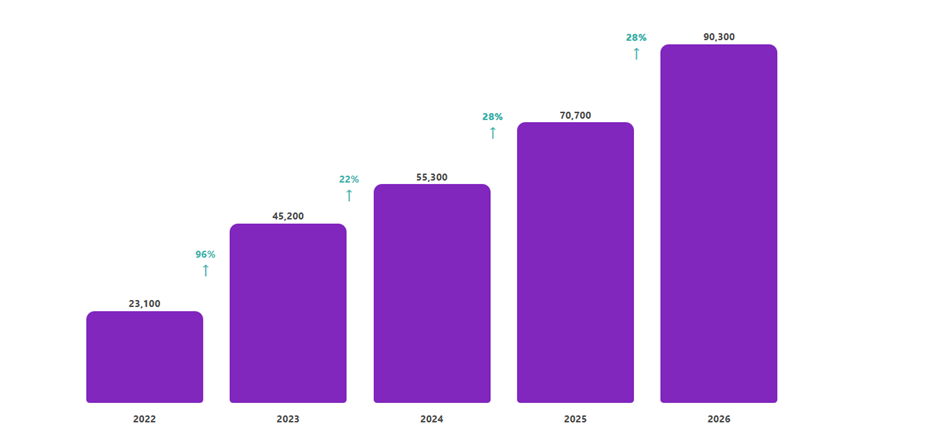
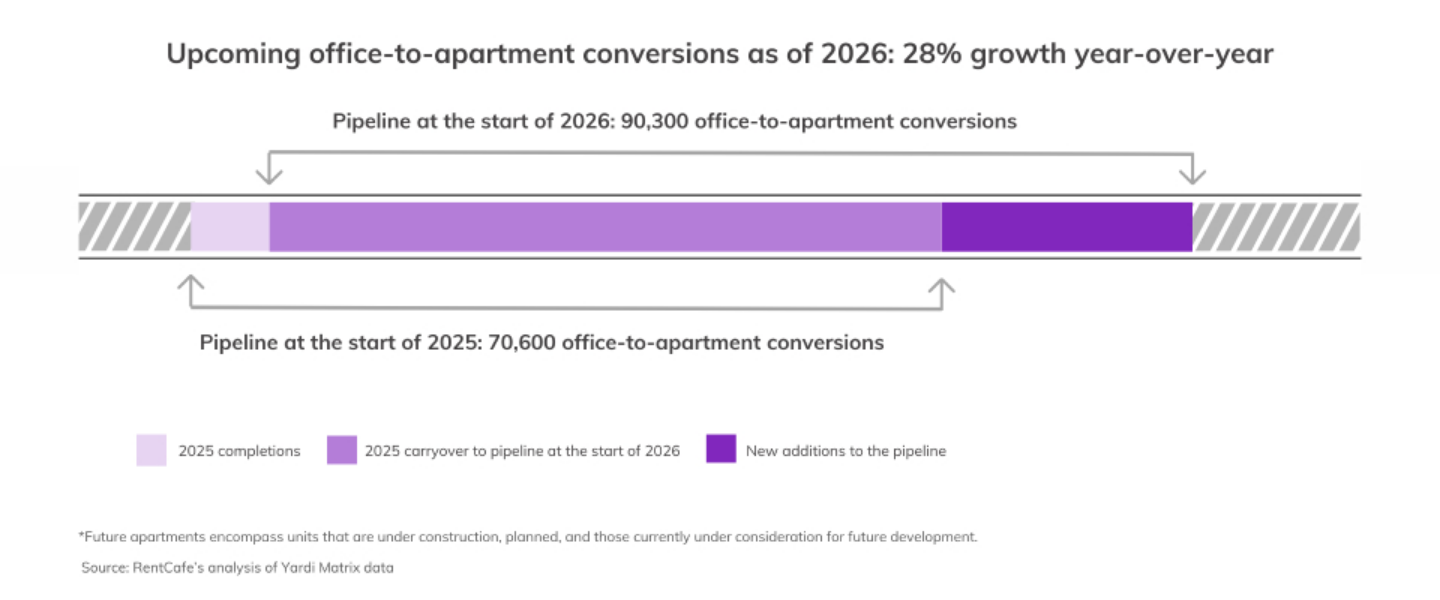
A record 90,000 apartments are now in the U.S. pipeline of office-to-apartment conversions, according to RentCafe’s latest analysis of Yardi data – a sign that each year shifts adaptive reuse even more from niche strategy to mainstream development tool. The surge comes as office vacancy persists under hybrid work and housing demand remains strong in supply-constrained cities.

“Office-to-residential conversions are no longer just a workaround for distressed buildings – they’re becoming a strategic tool for adding housing in supply-constrained markets,” said Doug Ressler, senior analyst and manager of business intelligence at Yardi Matrix.

A FAST-GROWING PIPELINE FUELED BY MARKET SHIFTS

The rise in conversions reflects two key trends coming together: higher office vacancy rates and an ongoing need for more housing. As companies reassess how much space they need, some office buildings – particularly older ones – are seeing lower demand. At the same time, renters continue to face limited housing options in many desirable urban locations.

This imbalance is creating opportunities for developers to reposition office assets into residential units. Compared to ground-up construction, conversions can offer a faster path to delivery in well-located areas where zoning and land availability might otherwise slow new development.

Still, not every building is a good candidate. “The feasibility of office conversions depends heavily on building design – factors like floor depth, window access and structural layout can make or break a project,” explained Peter Kolaczynski, director of data and research at Yardi.

Most conversion activity is concentrated in properties built between the 1960s and 1990s, which tend to have layouts better suited for residential use.

WHY OLDER OFFICE BUILDINGS ARE LEADING THE WAY

A defining feature of the current conversion wave is the age of the buildings involved. Most projects focus on offices that are already several decades old – not because they are outdated in every sense, but because their design makes them easier to adapt.

Older buildings typically have narrower floor plates, which allow more units to access natural light – a key requirement for residential use. They also often feature operable windows and structural layouts that simplify reconfiguration.

By contrast, newer office buildings tend to have deeper floor plans and large glass facades, which can complicate residential conversions. In many cases, these properties are better suited for continued office use or full redevelopment rather than conversion.

In practice, not every office building can be converted. Even as more projects move forward, only certain properties have the right layout and features to make the switch to residential use.

NEW YORK CITY LEADS, BUT ACTIVITY IS SPREADING NATIONWIDE

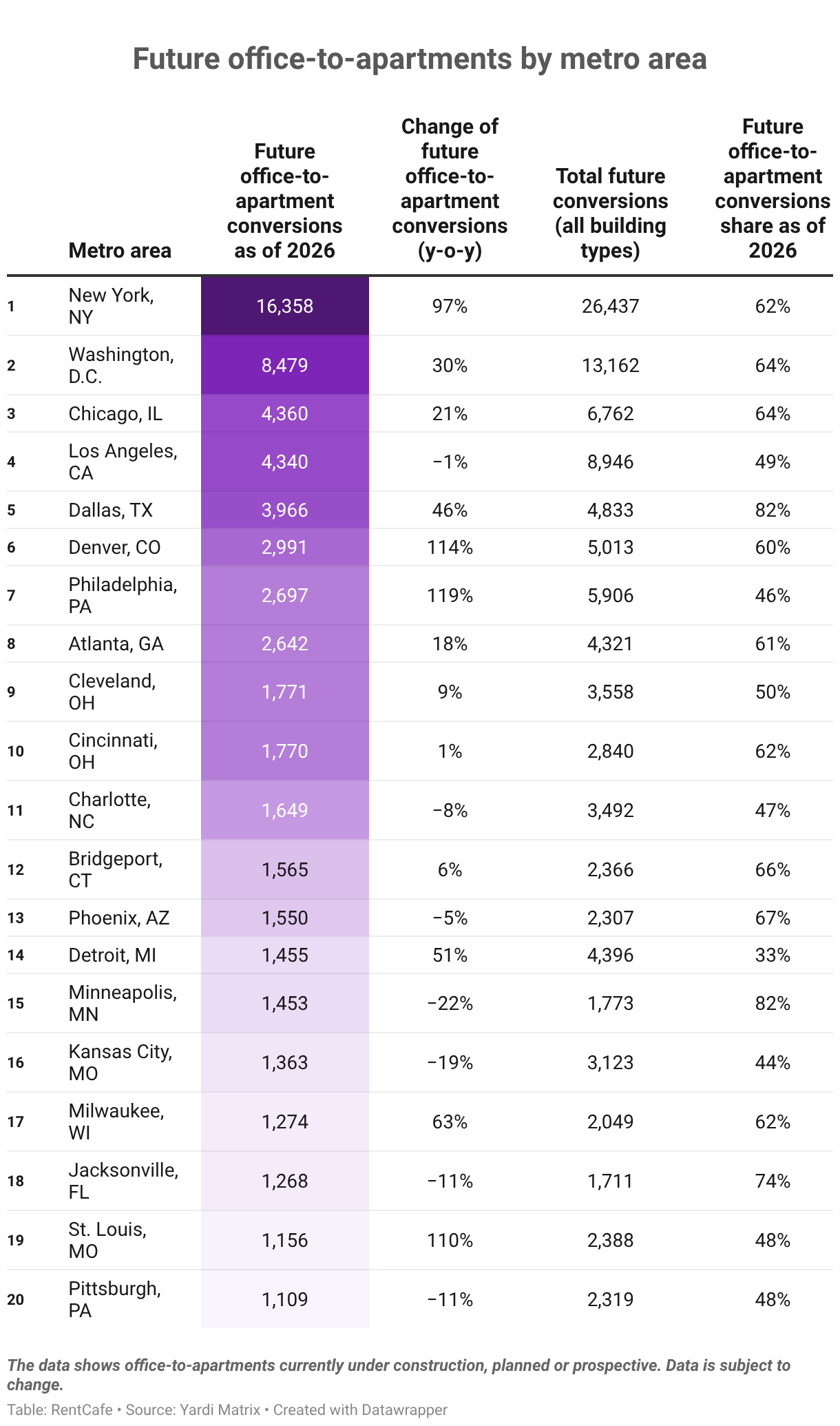
New York City leads the office-to-apartment conversion landscape, with the largest pipeline of units nationwide in 2026: over 16,000 units. A combination of older office stock, strong demand for rental housing, and supportive policy changes has helped position the city at the forefront of adaptive reuse.

But the trend is no longer limited to coastal gateways. Cities across the Midwest and South are increasingly embracing conversions to reinvigorate downtown areas and add housing without relying solely on new construction.

Chicago and Cleveland, for example, are making use of historic office buildings to bring residents back into their urban cores. Washington, D.C., is another key player, supported by local incentives aimed at encouraging office repositioning. Meanwhile, Los Angeles is seeing steady activity, particularly in its downtown area.

Future office-to-apartments by metro area (Table)

Smaller metros are also embracing the trend. In these markets, conversions can play a key role in revitalizing central business districts that have seen reduced foot traffic in recent years.

POLICY SUPPORT HELPS CLOSE THE GAP

Office conversions can be complex and costly, often requiring significant upgrades to meet residential building codes and tenant expectations. That’s where policy support comes into play.

Cities across the country are introducing zoning changes, tax incentives and streamlined approval processes to encourage adaptive reuse. New York City, for instance, has expanded eligibility for office-to-residential conversions, opening the door for more projects. Washington, D.C., has implemented financial incentives aimed at jumpstarting activity.

These measures are helping bridge the financial gap that can make conversions challenging, particularly in markets where construction costs remain high.

At the same time, public-private collaboration is becoming increasingly important. By aligning development goals with housing needs, cities can use conversions as a tool to address both office vacancies and housing shortages.

CHALLENGES PERSIST, BUT MOMENTUM IS BUILDING

Despite its growth, the conversion trend still faces limitations. Structural constraints, financing hurdles and high construction costs can all impact project feasibility. In some cases, developers may find that only a portion of a building can be converted, or that costs outweigh potential returns.

Even so, as office demand stabilizes at lower levels and housing needs remain pressing, conversions are likely to remain part of the development mix.

Beyond adding units, these projects also contribute to more balanced urban environments. They help bring residents into office-heavy districts and support local businesses by attracting increased foot traffic and creating more active neighborhoods.

A PRACTICAL PATH FOR ADDING HOUSING

Office-to-apartment conversions are not a silver bullet for the housing shortage, but they are becoming an increasingly practical solution in the right contexts. For developers, they offer a way to reposition underperforming assets. For cities, they provide a strategy to breathe new life into downtown areas. And for renters, they expand housing options in locations that might otherwise see little new supply.

For more insights, charts and a detailed methodology, read the full report on RentCafe.com.

This post was originally published here

Gina Baker Chambers, president of MCB Real Estate, joined NAIOP’s Inside CRE podcast to offer a behind-the-scenes look at how one of the East Coast’s most active development firms is scaling with discipline while maintaining community focus.

MCB has rapidly grown into a $3 billion platform, executing $1.3 billion in acquisitions in 2025 alone. But for Chambers, the appeal of joining the firm after 14 years at Artemis Real Estate Partners wasn’t just about size, it was about potential.

“I felt like MCB really had a lot of the ingredients to scale,” she said, pointing to the firm’s track record, transparency and team. It was “almost a startup challenge,” as she put it, “not from zero, but from a $3 billion base to $10 billion and beyond.”

MCB’s rapid expansion didn’t happen overnight. Chambers credits consistency and focus rather than opportunism.

“We really stay focused on the fundamentals – investing where we see real demand… and where we know we can execute,” she said. “It’s that consistency that we think makes the difference.”

Relationships are equally critical. “Relationships are the foundation of everything,” Chambers emphasized, from capital partners to local communities, adding: “You build trust by continuing to show up, by continuing to do what you said you were going to do, by pushing forward when things get difficult.”

MCB’s strategy centers on building where people actually live, not just where they work. This has led the firm to focus heavily on grocery-anchored retail and mixed-use developments integrated into neighborhoods.

While many investors remain cautious about retail, Chambers sees opportunity, especially after years of market correction.

“I think retail was so out of favor for so long that it was able to quietly work through some of its oversupply,” she said, describing today’s environment as healthier and more demand driven.

MCB prioritizes necessity-based retail over experiential concepts, favoring resilience across economic cycles. “If you over-index to experiential [retail]… those [household expenses] are typically discretionary,” she pointed out.

Two of MCB’s most ambitious projects highlight its long-term vision.

In Baltimore, the redevelopment of Harborplace aims to transform a struggling waterfront into a vibrant, mixed-use destination with residential towers, park space and a new architecturally striking “sail” building as a centerpiece. Community input has been central to the process.

“This was the most massive community outreach project… ensuring that this isn’t just being built for out-of-towners,” Chambers said.

Meanwhile, Viva White Oak near Washington, D.C., is a major master-planned community anchored by residential, retail and life sciences uses, a combination some have coined “MedTail,” a portmanteau of “medical office” and “retail.”

“If you put retail where the folks have to go to their [doctor] appointment, it’s a nice complementary use to co-locate,” Chambers said. “And so, I do think you’ll see a fair bit more of that across the country,” especially with the aging demographic in the U.S.

The project also recently secured a landmark tax increment financing (TIF) deal, unlocking infrastructure investment.

As the real estate landscape evolves, the path forward is clear for Chambers: stay disciplined, strengthen relationships, and keep building where people live.

Listen to the full episode of the Inside CRE podcast.

This post was created with the assistance of AI tools; all content was reviewed by the author.

This post was originally published here

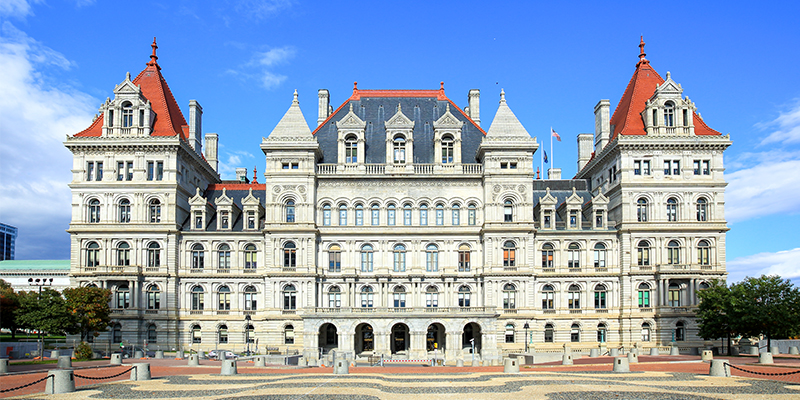
NAIOP members from the New York City Metro and Upstate New York chapters traveled to Albany in late March to engage with state lawmakers in support of our 2026 public policy priorities. Legislative action on these priorities will play an important role in advancing commercial real estate development that spurs economic growth, creates needed jobs and supports communities in providing additional housing, a centerpiece of discussions in meetings this year.

The New York chapters, comprised of hundreds of CRE developers, owners and related professionals, are strongly in support of Governor Kathy Hochul’s reforms to the State Environmental Quality Review Act (SEQRA) within her proposed 2026-2027 budget. Similar to CEQA reforms achieved in California last year, the governor’s SEQRA reforms, as part of her “Let Them Build” initiative, cuts unnecessary red tape and brings more certainty and predictability to the state’s environmental review process of housing projects.

Hochul proposes to expedite and exempt certain housing projects which do not have any significant environmental impact but which remain subject to local zoning and other state regulations and requirements, such as water usage. The expedited environmental review process is for housing projects on “previously disturbed areas” that have already been developed or improved. The governor’s SEQRA reforms will also apply to critical infrastructure projects with no impact on natural resources. The two chapters are hopeful that these commonsense SEQRA reforms will be expanded beyond housing to other property development types.

NAIOP’s New York chapters are also calling on the state Assembly to pass legislation establishing tax credit for the conversion of vacant office space to residential use. S. 9259 / A10192, which provide a 10% “office to residential conversion” tax credit to the costs of qualified office to residential projects outside of New York City, are very similar to NAIOP-supported Revitalizing Downtowns and Main Streets Act in Congress. New York City currently has its own successful conversion tax abatement program.

Qualified conversion projects include office buildings in upstate cities that are at least 50% vacant and converted to residential use in cities with populations under 1 million. The tax credit would also apply to historic rehabilitation projects with similar conversion objectives as well.

NAIOP members also expressed the need for state Assembly members to pursue energy policies designed to generate and transmit needed electricity to meet current and future demand. The state should also recognize and support steps already being taken by CRE to reduce emissions and reassess existing policies and mandates, such as the All-Electric Buildings Act, that hinder economic development and are unachievable within statutory timelines. Members also expressed support for maintaining an “all of the above” option for the source of energy for new and existing buildings.  

Other priorities, particularly for the Upstate New York chapter, include:

  • Revaluation of new wetlands regulations that expand wetlands and their adjacent areas from 3.5 million acres to 5.1 million acres
  • State support for opportunity zones that incentives the revitalization of economically distressed areas.
  • Repeal of the state’s Scaffold Law that holds the employer fully liable, with few exceptions, when a worker is injured from a fall, irrespective of if the worker is at fault.
  • Transparency in how prevailing wages rates are determined and applied on projects.

New York’s legislative Day at the Capitol provided an invaluable opportunity for state lawmakers and their staff to hear directly from the industry about the challenges and solutions facing the commercial development community. Member engagement in the legislative process, advocating for the interests of CRE in state capitals across the country, can affect policy outcomes.

This post was originally published here


A Matter of Perspective

Did you know that perspective was once “discovered”? It always existed, but for centuries, we didn’t know how to represent it. It wasn’t until the early Renaissance that artists like Filippo Brunelleschi unlocked the mathematical principles of perspective to accurately translate three-dimensional reality onto a flat surface.

In many ways, measuring embodied carbon mirrors that same journey. Translating the real-world complexity of buildings, their materials, sourcing, manufacturing, transportation, installation, use and eventual replacement into a model we can measure and analyze is one of the most complex challenges we face today. We rely on layers of abstraction: mathematics, coding, algorithms and databases to simulate multiple iterations and scenarios. And just like perspective, this modeling process is still evolving.

Means and Methods

When my interest in embodied carbon first started to grow, I noticed that most reports emphasized reductions, much like energy savings in energy models. That approach resonated with clients and the commercial real estate industry. But the question quickly became: reductions compared to what?

What is the universal benchmark? Is there an average per square foot? Should it vary by building type? And where were interior finishes in these studies? The truth was: there was no consensus. Defining system boundaries, scopes and baselines was messy and inconsistent. Believe me, we’ve lived through that confusion.

LEED v4 offered a starting point by requiring comparisons to a functionally equivalent baseline of the same size and scope. The Carbon Leadership Forum’s 2019 baseline guidance reinforced this need, while also spotlighting the overlooked impact of interiors. Though structural materials dominate new construction, tenant improvement projects, because of frequent renovations, can rival that impact over time, yet remain largely unsupported by standardized modeling practices.

Faced with these gaps, our team at BEYOND developed a methodology specifically designed for interiors. Like most things that involve calculations, it started with spreadsheets –  massive ones. We manually collected data from Environmental Product Declarations (EPDs), material take-offs and product specifications to piece together a working model.

At its core, our method revolves around these key principles:

  • Real project quantities. Using early design drawings to establish quantities ensures our baseline reflects actual project conditions.
  • Transparent baselines. We model the baseline to match the same size and scope as the proposed project.
  • Reliable carbon factors. We pull embodied carbon values from sources like industry-wide Environmental Product Declarations (EPDs), Carbon Leadership Forum baselines, One Click LCA databases and verified third-party studies.
  • Dynamic updates. As the design evolves, we continually refine the model from early design through bid documentation and all the way through post-value engineering reviews and construction.

This process helps us identify early opportunities where the biggest reductions can be made. For example, during one project, we discovered that 60% of the project’s embodied carbon stemmed from the carpet selection alone, driving us to prioritize low-carbon carpet options.

Lessons Learned: How Projects Made Them Real

Each project we’ve worked on has been an opportunity to refine our approach and better understand what truly drives embodied carbon reductions. The most important lessons we’ve learned come directly from experience:

For example, on the Lord Abbett project, our team was involved from the schematic design stage, working closely with the designers to specify materials and finishing below industry average values. This early alignment helped avoid last-minute compromises and contributed to the project avoiding over 1500 tons of CO₂e. Early collaboration makes all the difference.

“Less is more,” for many things in life, including embodied carbon. Steel and concrete are the usual suspects, but glass, aluminum and gypsum-based products often carry high embodied carbon values too. Identifying and minimizing their use when possible can make a major impact. On projects like Audible and Aspen, post-mortem assessments showed that glass components alone contributed significantly to overall carbon impacts, leading us to reconsider where and how these materials are used.

At Grant Thornton, an eight-story renovation project in Reading, London, reusing elements like glass partitions, carpet, ceiling finishes and access flooring became a core strategy. While these decisions were primarily carbon- driven, they ultimately deliver big budget savings along with a 75% reduction in embodied carbon, a powerful reminder that reuse, when thoughtfully implemented, is a quiet dynamo.

Generic assumptions only go so far. We now require product-specific EPDs for major material categories, especially flooring, ceiling systems and partitions. This pushes manufacturers to improve transparency and allows us to select materials with demonstrably lower global warming potential. We continue to work directly with manufacturers to better understand their products’ emissions. However, having an EPD, versus claiming your product is 90% recycled and powered by photovoltaics, makes a huge difference in credibility.

Transportation-related impacts aren’t always the biggest piece of the puzzle, but locally sourcing materials can still reduce emissions, and support local economies. For Clifford Chance’s NYC headquarters, the design team selected terrazzo with high recycled content of glass, and marble sourced within a 100-mile radius. These choices not only aligned with LEED, WELL, and overall sustainability goals but also contributed to the project’s 28% reduction in embodied carbon.

Plant-based Materials. Biobased products like wood, flax and plant-derived ceiling tiles often come with lower embodied carbon, and store carbon during their lifecycle. In the Skyfall project, combining repurposed access flooring with a palette of light, biobased finishes helped achieve a 78% reduction from baseline. If you’re an embodied carbon nerd, you might be suspicious of counting biogenic carbon storage as a sink that offsets anthropogenic emissions. And yes, there’s a lot of debate around it. We’ll discuss that another day. One thing I feel confident about is that equilibrium is key. If we only build with biobased materials, we’ll create imbalance, just as we have by relying too heavily on petrochemical-based products. Let’s be bold and explore more balanced, alternative solutions. This goes especially for manufacturers.

These five lessons have shaped our methodology and delivered tangible carbon reductions across a wide range of interior projects. We also recognize that as industry baselines improve over time, achieving large percentage reductions becomes harder, even though the design effort often increases. But this is a positive challenge that reflects real progress.

The Road Ahead

Our journey in modeling embodied carbon and using it as a tool to reduce global warming goes beyond specific strategies. It reflects a broader shift underway in our industry. More clients are setting carbon goals early. Designers are integrating embodied carbon into their decision-making, not as an afterthought but as a design driver. Manufacturers are stepping up with more transparent data and better products.

We can’t claim that we’ve perfected the method. Our approach continues to evolve with each project, each challenge and each conversation. But what we do see is progress. It is measurable, impactful and growing. Every baseline we define, every product we scrutinize and every kilogram of CO₂e we avoid brings us closer to a built environment that doesn’t just serve people, but also respects planetary boundaries.

The path to low-carbon design isn’t linear, just like the discovery of perspective. But it is becoming clearer with each project. And if these results are any indication, we’re heading in the right direction.

Read Part 1 of this series: The Fundamentals of Carbon.

Read Part 2 of this series: The Carbon Behind the Curtain.

This post was originally published here


Gen Z housing trends

Digitally fluent, socially connected and budget-conscious, Generation Z is entering the residential market with growing momentum. Over just five years, young renter households skyrocketed from 700,000 to 4.4 million, a sixfold expansion redrawing the map of demand from Birmingham, Alabama, to San Jose, California.

Although the vast majority of twentysomethings continue to rent rather than own, the pace at which young buyers are acquiring property is accelerating even faster – despite representing fewer than 1 million households overall. In fact, only 17% of Gen Zers own a home so far.

A RentCafe analysis of 97 U.S. metropolitan areas – each with at least 15,000 Gen Z households – reveals where the youngest generation of renters and buyers is choosing to live and which markets are recording the sharpest gains.

SUN BELT METROS SURGE AHEAD IN YOUNG RENTER GROWTH WHILE COASTAL HUBS HOLD FIRM

Today’s young renters are looking for cities with employment prospects, healthy wage gains and plenty of outdoor and entertainment options for a balanced lifestyle. But opportunity no longer resides exclusively in expensive coastal corridors. Emerging youth hubs across the South are absorbing much of the demand.

Birmingham, Alabama, exemplifies this shift. Five years ago, the metro barely registered on any Gen Z radar; today it leads the nation in young renter growth with a thirteenfold increase – from 1,683 households in 2018 to 23,859 in 2023. A lower cost of living (9% below the national average), expanding business activity, and diverse entertainment options draw young renters to Alabama’s largest metro.

Huntsville, Alabama, reinforces Alabama’s popularity among Gen Zers, ranking 11th after an eightfold increase.

Raleigh, North Carolina, ranks second with a twelvefold jump (3,079 to 39,887). The metro area’s appeal rests on its emergence as a tech hub and a 299% income gain in five years. Here, nine of 10 Gen Zers rent.

Buffalo, New York, climbed to third via affordability and remote-work appeal. Nashville, Tennessee, is fourth on the list after a ninefold surge that led to more than 65,000 Gen Z renter households in the metro area. Denver, in fifth place, posted a comparable ninefold gain driven by outdoor access and activities, and a strong job market.

Jackson, Mississippi, and Lafayette, Louisiana, round out the Southern contenders as affordable alternatives to coastal metros.

MAJOR METRO AREAS REMAIN POWERFUL DRAWS FOR GEN Z RENTERS

Large gateway cities continue to attract significant Gen Z renter volume. Washington, D.C., ranks seventh with nine times more young renter households in 2023 than in 2018 – reaching 115,473. The capital’s government, policy, technology and consulting sectors, combined with a tripling of typical young-professional income, sustain its pull.

San Jose, California, holds the eighth growth spot while claiming the highest renter share – nearly 95%. Miami follows at ninth and Boston at 10th, each posting eightfold increases.

New York ranks 12th and commands the largest absolute count at close to 280,000 Gen Z renter households after an eightfold expansion. New York City’s appeal is fueled by unmatched opportunities, experiences and networking, but also the quadrupling of Gen Z’s average income. Minneapolis and Philadelphia each recorded sevenfold gains; across all three metros, eight of every 10 Gen Zers rent.

CALIFORNIA AND TEXAS MARKETS REGISTER THE DENSEST YOUNG RENTER POPULATIONS

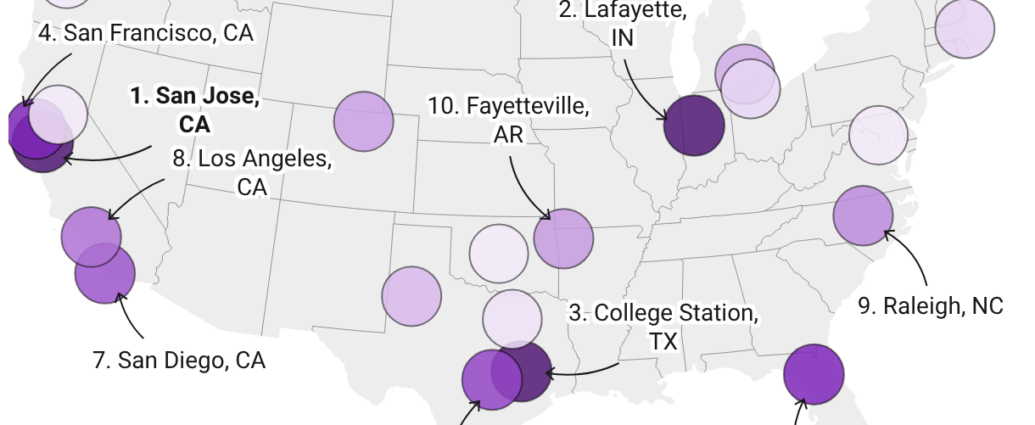
San Jose tops the concentration rankings with 95% of Gen Zers in the renter category. Four additional California metros feature in the top 20: San Francisco at 92%, Los Angeles at roughly 91%, San Diego at 91%, and Sacramento, California, at about 88%. Despite paychecks tripling in five years, elevated home prices keep ownership out of reach, reinforcing renter density.

Texas contributes four metros as well. College Station, Texas, places third at 93%, driven by Texas A&M University’s enrollment expansion. Austin, Texas, ranks sixth at approximately 92%. College-town Lafayette, Indiana, is the runner-up at 94%, while Raleigh and Ann Arbor, Michigan, each show nine of 10 Gen Z households renting.

AFFORDABLE HEARTLAND AND MID-SIZED MARKETS CAPTURE FIRST-TIME GEN Z BUYERS

Lower mortgage rates between 2020 and 2022 triggered the first substantial wave of Gen Z home purchases, concentrated in smaller and mid-sized metros across the South and Midwest where affordable prices coincide with strong income gains.

Tucson, Arizona, leads by a wide margin: Owner-occupied Gen Z households surged 170-fold, from 35 in 2018 to roughly 6,000 in 2023 – aided by the University of Arizona’s presence and a market far less expensive than Phoenix. Jacksonville, Florida and Dayton, Ohio, follow with approximately 60-fold jumps; both offer below-average living costs and solid wage growth.

Omaha, Nebraska, recorded a 44-fold increase to exceed 9,000 households, buoyed by housing costs roughly 20% under the national benchmark. Lafayette, Louisiana, ranks fifth with more than 3,400 homeowners in 2023 versus 78 in 2018 – 22% of all young-adult households. Louisville, Kentucky; Lincoln, Nebraska; San Antonio, Texas; Des Moines, Iowa; Lansing, Michigan; and Buffalo, New York – the highest-ranking Northeastern metro – also posted rapid gains.

WHICH MARKETS HOLD THE GREATEST CONCENTRATION OF GEN Z HOMEOWNERS?

Among the 97 metros studied, 10 have more than one-quarter of Gen Zers owning a home. Ogden, Utah, leads at approximately 41%, aided by proximity to Salt Lake City and local homeownership assistance programs. Detroit follows with one-third of young adults owning homes after household counts surpassed 29,500. Birmingham, Alabama, and Jackson, Mississippi, each register 30%, propelled by incomes that more than tripled. Greenville, South Carolina, ranks next at about 28%.

At the opposite extreme, San Jose, California, has the smallest Gen Z homeowner share at just 5% – underscoring how affordability constraints and a preference for flexibility keep nearly all young residents in the rental market.

For more insights, charts, and a detailed methodology, read the full report on RentCafe.com.

This post was originally published here


Last week, the Senate passed the 21st Century Road to Housing Act by a large bipartisan margin of 89-10, sending a major piece of housing legislation to the House of Representatives for its approval. The Senate combined its bill with a version passed by the House earlier, expanding and revising certain provisions, and excluding others. Both bills aim to increase the supply of affordable housing. Specifically, the Senate’s bill would increase the supply of affordable housing by, among other things, streamlining regulatory reviews for housing projects, promoting housing development in opportunity zones, increasing Federal Housing Administration loan limits and supporting manufactured housing.

While NAIOP and it national housing association allies supported legislation designed to increase housing supply and help address the current housing affordability crisis in many of our communities, the Senate bill contains a very problematic provision that would have the opposite effect. The Senate included language, demanded by President Donald Trump, designed to restrict the purchase of single-family homes by large institutional investors that own 350 homes or more. But in doing so, it would also undermine a nascent build-to-rent (“BTR”) industry that is increasing the supply of rental housing available to families – an outcome we do not believe was intended.

Preventing large institutional investment companies from purchasing existing single-family homes for rental – essentially taking them off the market for families seeking homeownership – has become a potent populist issue and one that Trump has embraced, issuing an executive order earlier this year titled Stopping Wall Street from Competing with Main Street Homebuyers.” This was one issue on which Trump and Massachusetts Senator Elizabeth Warren agreed.

However, Section 901 of the Senate legislation establishing the institutional investor ban also includes language that would require BTR developers, who are building units meant specifically to create rental communities, to sell these units within seven years to individual buyers. This seven-year disposition requirement would effectively eliminate the production of BTR housing at a time when public policy should be increasing housing supply and expanding rental choices for families.

Recently, BTR housing has emerged as a major source of new rental housing production for families who prefer these types of units to apartments. Many times the underlying zoning for these developments is multifamily, and the rental homes are all located on a single tax parcel and were never intended for individual sale. These communities often come with amenities and are fully staffed with onsite maintenance, the costs of which a future homeowners association would be unable to assume. The appeal and benefit of these communities is that residents are not forced to shoulder many of the maintenance responsibilities or costs of homeownership.

Notably, Trump’s executive order directing federal agencies to stop assisting large institutional investors from purchasing existing single-family homes provides a specific exemption for BTR communities, stating that guidance from federal agencies issued as a result of the order “shall include appropriate, narrowly tailored exceptions for build-to-rent properties that are planned, permitted, financed, and constructed as rental communities, and such other appropriate, narrowly tailored exceptions as the applicable agency may determine appropriate . . . ”

During the Senate floor debate of the housing bill, some Democrats also acknowledged that the seven-year disposition language would need to be revised. Senator Brian Schatz (D-HI), for example, warned that the bill could undermine housing production, saying that ”while there are a lot of good things in this bill that are kind of on the pro-housing supply side, what we are about to do is essentially ban a specific kind of housing.”

Procedurally, the House could vote on the Senate-passed legislation without any changes, or it could demand changes, which would require that both chambers pass a compromise, identical bill. NAIOP and national housing industry advocates have raised serious concerns with members of the House and Senate over the BTR language, and several House Republicans have called for revisions, as well as other changes to the Senate legislation before the bill is allowed to be voted on in the House. Representative French Hill (R-AR), chairman of the House Financial Services Committee with jurisdiction over housing legislation, is also calling for changes.

While the sponsors of the Senate’s legislation were hoping that Trump would put pressure on House Republicans to force a vote, he has not in fact done so. For now, it seems the House and Senate will have to work out their differences on BTR and other issues before the major housing legislation can be sent to the president’s desk for his signature.

This post was originally published here


In the latest episode of the Inside CRE podcast, NAIOP President and CEO Marc Selvitelli sat down with Carleton Riser, president of Transwestern, for a wide-ranging conversation on development strategy, market timing and how smart capital is positioning for the next upcycle. With more than 30 years in the business, Riser has seen multiple downturns, and the lessons he’s carried forward are shaping how he approaches today’s unique environment.

Another Cycle, Another Lesson

The dot-com bust underscored the fact that “credit actually matters,” Riser said, after markets cratered on the back of “phantom absorption” (where commercial real estate space appears occupied on paper but goes unused). The Global Financial Crisis taught him that “having flexibility in your capitalization matters because when the tide goes out and there’s no liquidity in the market, you need to make sure you’ve got some sort of staying power.”

More recently, the COVID-19 pandemic fueled a surge in multifamily and industrial development, where “the markets got out over their skis, inflation came in, and then an interest rate spike [occurred]. From a development standpoint, we’ve been in a three-year downturn because of that,” he said.

Thankfully, “we have a very diversified business, both geographically and by product type, which I think has served us well through these different fluctuations in the market,” Riser said.

Making Smarter Bets in Today’s Market

With capital markets disruptive and liquidity still constrained, Riser says Transwestern evaluates new projects in two different ways: the cost of upfront pursuit capital and the potential capital markets environment 9-18 months down the road when institutional partners would likely join the deal.

That means only the strongest opportunities make the cut. “The better deals are the first deals to get done as we emerge from this trough,” Riser said. Transwestern is prioritizing projects in submarkets with strong fundamentals, backed by smart underwriting and realistic assumptions around occupancy and rents.

Mixed-use Success Means Flexibility

Mixed-use development is complex but rewarding, Riser said, and requires discipline from day one. Don’t assume a mixed-use project can fix a weaker location: every individual use must stand on its own. Flexibility is key; plans must be able to adapt as market conditions evolve without requiring a complete redesign. Capital stacks should allow each component of the project to attract the right investors.

Avoid what Riser’s team has described as “broken teeth” – a missing piece of the “mix” in a mixed-use project – “which can send your plan sideways… and can be fatal to the first phase.” The complementary nature of the different product types working together is absolutely critical.

Capital is Scarce and Selective

Capital scarcity, particularly for multifamily development, is shaping strategy, Riser said. Investors with dozens of opportunities may pursue only a handful, so differentiation is essential.

On the other hand, mixed-use has become appealing to many partners as both a defensive and offensive play. “We know that if executed properly, a mixed-use project, especially in a Sunbelt market, will drive superior occupancy levels and superior rental rates if that retail offering and that placemaking aspect of the environment is compelling for those ventures as a differentiator versus their alternatives,” Riser said.

Transwestern is staying away from preferred equity and mezzanine debt structures, preferring a more conservative capital stack. “The more leverage, the more pressure you’ve got on your capital stack, the less staying power you have in the event of a market sea change,” he explained.

Fortunately, construction lending has improved, and Riser sees solid absorption trends across the Sunbelt. “In some of these markets, we think there’s a rationale to build today. In some of them, it’s more towards the end of 2026. In some of those, it’s more towards 2027. But we’ve seen a lot of robust absorption in those markets.”

Positioning for the Next Upcycle

Asked what developers should be doing now, Riser didn’t hesitate: control land. But do so carefully. Buying too early or without a clear picture of where capital markets are headed can be risky.

“None of us has a perfect crystal ball, but we are spending considerably more time these days trying to forecast out to early 2027, early 2028, and trying to get comfortable with that when we are putting capital at risk today,” he said.

Success in development is less about predicting the future and more about preparing for a wide range of possibilities.

Listen to the full episode of the Inside CRE podcast.

This post was originally published here


As February drew to a close, NAIOP members from Utah and Minnesota traveled to their respective state capitols to meet with lawmakers and advance the legislative interests of commercial real estate. The meetings with lawmakers provided important opportunities for NAIOP and the industry to build relationships and educate lawmakers on the important role of commercial real estate development in providing economic opportunities, creating jobs and strengthening the quality of life within communities. These relationships ensure that the interests of CRE are taken into consideration during policy debates.

Following breakfast under the capitol dome, NAIOP Utah members met with several lawmakers, including Rep. Mike Schultz, speaker of the state House of Representatives. Schultz highlighted the strength of state policies in attracting and retaining private business, along with infrastructure investments that support economic growth and the movement of goods and services between communities. U.S. News and World Report recently ranked Utah as the overall No. 1 state for the fourth consecutive year. Their No. 1 ranking is based on the economy, education, fiscal stability, crime and corrections, health care, and infrastructure. Schultz concluded by expressing concern over outside political pressure and court decisions that limit the legislature’s authority to govern under the state constitution. He made reference to the legislature authority to draw political boundaries.

Utah members also heard from state Senator Calvin Musselman, a real estate sales professional, who is sponsoring SB 245, Impact Fee Amendments. Impact fees, also known as linkage fees or proffers, depending on the state, are one-time fees paid by developers to help cover the costs of infrastructure and other public services associated with development projects. Members voiced support for the legislation that would require local governments to apply the fee within the service area that is impacted by the new development, not geographically unconnected areas of the municipality.

In Minnesota, over 60 CRE industry representatives, including NAIOP members, participated in the 2026 Day at the State Capitol in St. Paul. Numerous lawmakers from both parties provided their perspectives on the legislative outlook and challenges heading into the fall election. Following their remarks, attendees had the opportunity to ask questions and educate policymakers on the industry’s priorities for this year. NAIOP Minnesota’s 2026 priorities include taxes, energy and sustainability; vibrancy (i.e., removal of regulatory barriers to commerce); and workforce development.

The current challenges in Minnesota’s legislative process also involve the political structure of the two chambers and the declining influence of a governor not seeking reelection. The state House of Representatives is currently tied – 67 Democratic-Farmer-Labor (DFL) to 67 Republicans – following several special elections and the assassination of former Speaker Melissa Hortman. Committees are presently co-chaired by a member from each party, who alternate presiding over hearings.

On the other side of the capitol, DFL holds a narrow one seat advantage over Republicans at 34 to 33. Several special elections occurred last year because of resignations, criminal convictions, and the unexpected passing of Senator Bruce Anderson. With no clear advantage, the political rhetoric from both parties in St. Paul is focused on government fraud, waste and inefficiencies.

Lane Thor with Ryan Tax Firm also testified on behalf of CRE in support of HF 2959 during a House Judiciary meeting that same morning. This important NAIOP-supported legislation is intended to protect the privacy of data and lease agreements from public release if property tax assessments are appealed and go to court. The NAIOP chapter and coalition intend to continue their advocacy in support of the bill through individual meetings and other legislative opportunities until the legislature’s adjournment sine die on May 18.

These legislative advocacy days within state capitols play a critical role for lawmakers to directly hear from constituents on the priorities of NAIOP and the CRE industry within their respective states. These educational meetings continue to provide a platform for members to build relationships and engage policymakers that may influence policy outcomes. NAIOP chapters across the country will be holding their own “Days at the Capitol” throughout the remainder of 2026.  

This post was originally published here


From advanced manufacturing to hyperscale data centers, many modern industrial developments are requiring unprecedented levels of energy – and the demand is growing exponentially. A panel of experts at I.CON West this week moderated by Angela Gomez-Jones, RPA, CPM, partner, Endeavor Agency, discussed the challenges in locating and securing power, as well as strategies to overcome grid constraints, improve energy efficiency and use artificial intelligence to model and plan power needs.

Joining Gomez-Jones were Amanda Criscione, vice president, development, Link Logistics Real Estate; Mike Englhard, chief development officer, TeraWatt Infrastructure; John Gaglio, president, Newport Utility Consulting; and Matthew Goelzer, AIA, LEED AP, principal, MG2.

The number of U.S. data centers has more than doubled between 2018 and 2021. Fueled by investments in AI, that number has already doubled again, began Gomez-Jones, sharing a statistic from the Lincoln Institute of Land Policy.

Goelzer doesn’t see demand slowing anytime soon, even as available land and power constraints begin to throttle development: “AI demand is going to continue to drive it … We’re anticipating in the next five years you’re going to see more bumps in efficiency that’ll allow us to go back and retrofit existing centers to be able to drive more power through,” said Goelzer.

Gomez-Jones asked Gaglio to compare the energy demands of data centers to a typical residential site or office building. “Data centers compared to everything else – it’s absolutely astronomical the amount of power [required]. I like to compare it to an aircraft carrier relative to a small sailboat.”

However, many buildings are initially built with transformers much larger than what is required for the actual demand load of the tenant. “I think what you’re going to start to see are utilities utilizing AI to study the demand load of every building and then we might start to see things like transformers being downsized to free up capacity in the grid,” said Gaglio.

“We’re also starting to see utilities charge you if you’re not using the power,” said Goelzer. If a developer requests a certain amount of power and only uses a fraction of it, a utility may bill the developer back for the infrastructure they built to support the power usage originally projected.

“Even with electric vehicle charging [facilities], we’re having to put up bonds or deposits for three years of our utility bill that we say we are going to use,” Goelzer added. He’s seen these range anywhere from $200,000 to $1 million.

“We’ve done a sweep of our existing assets to get an understanding of what we have today and what we need to do to build for the future,” said Criscione. “We’re very cognizant of power and the race to get it, but we’re also making sure that we’re educating ourselves to know that we are providing ample amount of power but allowing for flexibility so that we’re not in a situation where we’re saying we need more than we do.”

Gaglio agreed with Link Logistics’ approach, and emphasized the importance of early, accurate planning. Developers who bring utilities precise load data and not inflated worst-case estimates secure power far more quickly.

As power needs surge, utilities are struggling to keep up. Power grids designed decades ago are not designed for the loads needed today.

Englhard shared that representatives from Southern California Edison said, “‘For the last 50 years, we have had a half-percent increase in demand every year… Four years ago, that went from half a percent a year to 4% a year.’” The steep increase in demand caught the utility flat-footed, but they’re working to catch up; there are a lot of advancements happening to the grid in California and elsewhere, he said.

Meanwhile, grid congestion has forced some developers to go offsite to find available capacity, with major users stretching up to nine miles away to connect to power – an extremely costly solution. “The cost of that comes at about $2.5 million/mile to run those ducts without pulling any wire – just to get the pathway there,” Englhard added.

On the plus side, Goelzer said he’s found that when he talks to city leaders, they often understand what developers are up against in terms of securing power supply.

 “As long as we’re able to demonstrate that we’re ready to go when power is ready to be there, we find that most cities are willing to meet us in that spot.” He stressed the importance of having real conversations, understanding the city’s priorities, and building relationships.

If you do that, “you can still move projects forward, because I think as a community, we all understand what we’re up against.”


JLL logo

This post is brought to you by JLL, the social media and conference blog sponsor of NAIOP’s I.CON West 2026. Learn more about JLL at www.us.jll.com or www.jll.ca.

This post was originally published here


Artificial intelligence is reshaping how deals are sourced, analyzed, negotiated and managed across the industrial sector. At NAIOP’s I.CON West this week in Los Angeles, a panel of experts with diverse roles and perspectives discussed efficiency gains, risk considerations and the competitive implications for firms that adopt (or hesitate).

Denice Tokunaga, partner, Seyfarth Shaw LLP, moderated the discussion, which included Jay Carle, partner, Seyfarth Shaw LLP; Chris Karacic, due diligence director, LBA Realty; Will Pearce, CEO and co-founder, Orbital; and Maria Poyer; head of acquisitions, Verrus.

Poyer shared how AI-driven platforms have transformed early site selection. What previously required weeks of analyst time now can be completed in a single day, often by just one person. “So really what that means is the speed of knowing site constraints is much faster. And in the development cycle, that’s everything,” she said. That acceleration has real implications for how many opportunities a team can evaluate, and how quickly they can pursue the most viable ones.

Tasks that once consumed hours or days – pulling jurisdictional data, comparing rent rolls, summarizing long leases – can now be accomplished in a fraction of the time. Poyer acknowledged that there’s a lot of discussion in the market about AI eliminating certain jobs, “but really it’s just transferring the type of analysis that needs to be done by junior folks and senior folks, rather than focusing their time on some of the minutia.”

Karacic shared another use case: “If you run into an issue with a seller that you need to creatively think around, you can prompt AI to give you some methods to solve the issue.”

As the CEO of an AI-enabled real estate technology company, Pearce presented an optimistic view: that AI represents the most significant technical paradigm shift in our lifetimes. In his view, nearly every step of a transaction that involves reasoning, pattern recognition or analysis will be accelerated and eventually executed by AI.

He highlighted the rapid pace of improvement: The latest AI models are doubling in capability once every seven months, so the professionals using them need to continuously recalibrate their expectations.

Optimism will get you far, but pragmatism has its value, too. Carle emphasized that while technology evolves quickly, law and regulation do not – and corporate governance must bridge that gap. Firms must know exactly what data they’re inputting into AI systems, where it’s going, and how it will be handled. Confidential lease terms and investor data, for instance, should never be uploaded into publicly available AI tools.

Companies need clear policies, audit trails and human oversight. It’s critical to have a reasonable validation process for AI outputs and build it into your governance, and clearly define what requires human review. Financial models and major underwriting decisions still need “a human in the loop,” as Carle put it.

With this tech acceleration in hyperdrive, what’s next?

“I would say robotics, and the interaction of AI and robotics, to support real estate construction,” said Pearce, and other panelists nodded in agreement.

Karacic shared a more near-term prediction. “Right now, a lot of the way that we use AI is through prompting… we ask the AI to abstract a lease. Then we ask the AI to look at a credit profile for a tenant. Then we ask it to run an environmental history.” Users have to prompt the AI several times at various steps. Karacic expects that as agentic AI tools – which act mostly autonomously with limited human supervision to accomplish pre-determined goals – continue to be more integrated into the due diligence process, the AI will do a lot of that by itself.

“And it should be able to compare different deliverables against each other,” he added. “So, for example, it’ll be able to look at an environmental history report, assess the risk, and then go look at the financial underwriting and say, ‘Well, do we need to tweak the underwriting based on the environmental risks that I just learned about?’”

Pearce brought up the flywheel effect: As AI capabilities grow, the speed of building AI products increases, which further strengthens AI itself – a cycle that drives the exponential growth AI researchers often discuss.

“I think things are going to get pretty scary pretty quickly,” said Pearce, clarifying: “Scary like good scary, like there’s going to be a world of opportunity with AI to disrupt real human work.”


JLL logo

This post is brought to you by JLL, the social media and conference blog sponsor of NAIOP’s I.CON West 2026. Learn more about JLL at www.us.jll.com or www.jll.ca.

This post was originally published here


Asian industrial capital

Global capital flows into U.S. industrial real estate are evolving, but one trend remains consistent: Asian investors continue to view the United States as one of the most attractive markets for long-term investment.

That was the central message from a panel at NAIOP’s I.CON West this week in Los Angeles moderated by Garry Weiss, SIOR, vice president – national director business development and strategic initiatives, ARCO/Murray. The panel featured Gunnar Branson, CEO of AFIRE; Richard Prokup, CEO, U.S. logistics, Mapletree Investments; and Cecilia Xu, managing principal, GT Global Advisory.

The speakers explored the motivations behind Asian investment in U.S. industrial real estate, the risks shaping decision-making, and what developers and capital partners should understand as global capital continues to evolve.

According to Prokup, the current cycle is characterized by a large amount of capital waiting to be deployed after several years of caution. “Everybody was on the sidelines for the last few years,” Prokup said. “There was uncertainty about demand, and uncertainty about the economy and rising interest rates. But these organizations still have billions of dollars they need to place every year.”

Now that market conditions are stabilizing and industrial fundamentals remain strong, capital is beginning to move.

The scale of the U.S. market also makes it difficult for global investors to ignore. “If you want to place capital at scale, the United States is really the only place where you can do that,” Prokup said. “The industrial market here is massive compared with most other regions.” Branson agreed, noting that the U.S. represents roughly half of the world’s investable institutional real estate.

“In most countries, you’re lucky to have one global city,” Branson said. “In the United States, you have about a dozen. That scale is incredibly attractive to global investors.”

GEOPOLITICAL UNCERTAINTY IS NOT SLOWING INVESTMENT

While headlines often focus on political tensions, tariffs and shifting global alliances, panelists said those factors are not deterring investment as much as some might expect.

Instead, geopolitical uncertainty often reinforces the appeal of the U.S. market.

“There’s what people say emotionally about politics, and then there’s what they actually do with their capital,” Branson said. “Those two things are often very different.” According to Branson, investors may voice concerns about political volatility, but they continue to view the U.S. as a relatively safe environment for long-term real estate investment.

Xu added that global trade tensions can even strengthen the case for U.S. industrial development. “If companies are worried about tariffs or supply chain disruptions, one way to reduce that risk is to move operations into the United States,” she said. “That means more demand for logistics and manufacturing space.”

Prokup said that Singapore-based global real estate developer, investor and manager Mapletree has already seen that shift in tenant demand. “About half of the major leases we signed last year involved companies bringing manufacturing or distribution back onshore.”

DEVELOPMENT OPPORTUNITIES ARE EMERGING

Prokup also pointed to a significant opportunity that emerged during the past year as construction pipelines declined across many markets. As new development slowed, Mapletree began building a new pipeline of projects.

“The pipeline under construction kept shrinking,” Prokup said. “At the same time, demand was still there. We started asking where the new buildings would come from in 2026 and 2027.”

In response, the firm moved aggressively into development.

“We’ve built about a half-billion-dollar development pipeline over the last year,” Prokup said. “We saw a window where there simply weren’t many competitors pursuing new projects.”

However, he noted that development activity is beginning to pick up again as other investors recognize the same opportunity.

PARTNERSHIP REMAINS KEY TO ATTRACTING GLOBAL CAPITAL

For developers and operators looking to work with Asian capital, panelists emphasized the importance of building long-term relationships rather than focusing on individual transactions.

Xu explained that relationship-building is particularly important for many Asian investors. “The first deal is always the hardest,” Xu said. “There is a long process of building trust and completing due diligence. But once that relationship is established, you often gain a very loyal capital partner.”

Those relationships frequently lead to multiple investments across different market cycles. “It’s not just about one deal,” Xu said. “It’s about working together over time.”

Branson also cautioned that “Asian capital” should not be viewed as a single group. “Asia is half the world,” he said. “There are many different countries, cultures and investment strategies involved.”

Understanding those differences can help developers build stronger partnerships and attract long-term capital.

A CHANGING GLOBAL INVESTMENT LANDSCAPE

Looking ahead, panelists expect the mix of international investors in U.S. real estate to continue evolving.

Branson noted that capital activity from countries such as Australia and Japan is increasing in the U.S. market. “They have enormous pension systems and limited opportunities to deploy capital domestically,” Branson said. “That’s pushing them to look abroad.”

Over time, Xu expects Asian investors to become even more integrated into the U.S. real estate landscape. “In five years, Asian capital will feel much less ‘foreign,’” she said. “Many of these investors have already been active in the U.S. for decades.”

As global capital continues to flow toward stable, large-scale markets, panelists agreed that U.S. industrial real estate is likely to remain a primary destination. “The fundamentals are still very strong,” Prokup said. “And when investors look around the world, the U.S. continues to stand out.”


JLL logo

This post is brought to you by JLL, the social media and conference blog sponsor of NAIOP’s I.CON West 2026. Learn more about JLL at www.us.jll.com or www.jll.ca.

This post was originally published here