
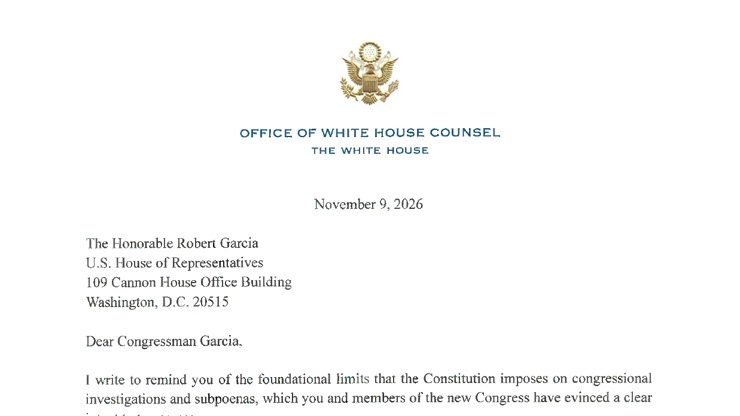
Opening of White House Counsel William O. Scharf's November 9, 2026 letter to Rep. Robert Garcia. Image: Office of White House Counsel, U.S. government work; cropped and resized.

The opening of White House Counsel William O. Scharf’s letter to Rep. Robert Garcia, dated November 9, 2026. Garcia responded November 11. Image: Office of White House Counsel, U.S. government work (cropped and resized).

White House Counsel William O. Scharf warned congressional Democrats that threatened investigations and subpoenas could cross legal boundaries, drawing a rejection from Rep. Robert Garcia, who said Congress does not need the White House’s permission to conduct oversight.

The dispute centers on a letter dated November 9. Garcia responded November 11. It is not a new November 12 executive order, criminal charge or court ruling.

In the signed letter to Garcia, Scharf argued that congressional investigations must serve a legitimate legislative purpose. He accused Democratic legislators of planning to use subpoenas to harass administration officials and deter them from public service.

Counsel raises the possibility of further investigation

Scharf wrote that threats directed at executive-branch officials to deter public service, or the use of process merely to abuse or instill fear, “may cross the line into blatant criminality.”

He also argued that issuing unlawful subpoenas with the intent of depriving citizens of constitutional rights and privileges “may warrant further investigation.”

Those statements are the White House counsel’s legal claims and warnings, not findings that Garcia or another lawmaker committed a crime. The letter does not announce an indictment, prosecution or judicial decision.

Scharf cited court decisions addressing the limits of congressional investigations and said the administration expected lawmakers to stay within constitutional boundaries. He said the administration would not be intimidated by unlawful process.

Garcia invokes Congress’s Article I authority

Garcia, the ranking Democrat on the House Committee on Oversight and Government Reform, rejected the warning in a November 11 statement.

“Congress’ authority comes from Article I of the Constitution, not from the permission of the White House,” Garcia said. He argued that Congress has wide latitude to investigate and conduct oversight as part of its legislative power.

Garcia called Congress a co-equal branch of government and said lawmakers would not be deterred by “baseless threats” from the Justice Department or the president’s lawyers.

The exchange presents competing arguments over the scope and limits of congressional oversight. Neither the letter nor Garcia’s response establishes that a specific subpoena has been held unlawful or that a prosecution has been announced.

JBizNews Desk | Washington

© JBizNews.com. All rights reserved. Unauthorized reproduction or redistribution is strictly prohibited.


Update: Eisenkot has asked the attorney general to intervene over security briefings.

Gadi Eisenkot urged Benjamin Netanyahu on Wednesday to hold off on military moves that could wait until a new Israeli government is sworn in, while the Prime Minister’s Office said its decisions were based solely on security needs and coordinated with the defense establishment.

Eisenkot, the Yashar! party leader tasked with forming the next government, made the appeal in a letter to Netanyahu, who remains caretaker prime minister, according to reports on the letter. The exchange concerns how security decisions should be handled during the government transition.

In the letter, Eisenkot called for restraint on steps that did not respond to a direct and immediate threat requiring urgent action. He warned that using security forces in the absence of such a threat could damage public trust in state institutions and Israeli democracy.

He also referred to reports that he said raised concerns about considerations unrelated to national security entering decision-making. Those were Eisenkot’s allegations, not an established finding about a particular operation.

Eisenkot said decisions that could wait should be left until a government with the Knesset’s confidence takes office. He also warned against putting senior security officials in what he described as a constitutional conflict over their responsibilities.

Prime Minister’s Office says decisions are security-based

In its response, the Prime Minister’s Office said all government decisions under Netanyahu had been taken for security reasons alone and in full coordination with the defense establishment.

The office described public discussion of sensitive security issues in Eisenkot’s letter as irresponsible and accused him of trying to politicize national security. It said the government’s decisions had delivered major achievements for Israel and renewed Netanyahu’s call for Eisenkot to join the current government.

Eisenkot subsequently questioned why, he said, a request for an operational briefing through official channels had been refused and why a meeting of the Knesset’s Foreign Affairs and Defense Committee was being delayed. According to reports, he said he would not allow a gap in parliamentary oversight. Those assertions remain attributed to him.

The reports describe a dispute over restraint, oversight and the government’s handling of security decisions. They do not establish that a particular military operation was ordered for political reasons.

JBizNews Desk | Jerusalem

© JBizNews.com. All rights reserved. Unauthorized reproduction or redistribution is strictly prohibited.
NEW YORK – Gov. Kathy Hochul signed six veterans bills on Wednesday, November 11, covering property tax eligibility, disability-related home improvements, vehicle paperwork and access to public college recreation facilities, according to an announcement from the governor’s office.

One measure allows local governments to waive or reduce fees for home improvements needed to accommodate a veteran’s service-connected disability. Another allows eligible veterans with a 100% disability rating from the U.S. Department of Veterans Affairs to use that rating to qualify for license plates bearing the Universal Symbol of Access.

For active-duty service members, a separate law allows early vehicle registration renewal when a registration is due to expire during deployment or other official military duties.

Two bills address property taxes. One clarifies the Persian Gulf conflict period used to determine eligibility for veterans’ property tax benefits. The other broadens the military records that combat-zone veterans can use to qualify for additional exemptions, including discharge records, military awards and records of hazardous duty pay.

The sixth measure provides for free or discounted memberships for veterans with disabilities at SUNY and CUNY campus gyms and swimming pools that are open to the general public.

The state Department of Veterans’ Services also announced $150,000 in grants to six nonprofits, with each receiving $25,000 for therapeutic outdoor recreation programs for veterans. Hochul directed 17 state landmarks to be illuminated green Wednesday evening as part of Operation Green Light.

JBizNews Desk | New York

© JBizNews.com. All rights reserved. Unauthorized reproduction or redistribution is strictly prohibited.
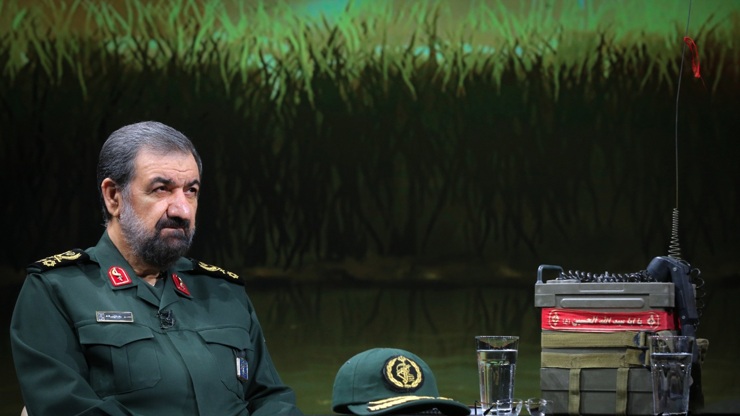
Mohsen Rezaei seated in uniform in a March 2020 archive photograph.

Mohsen Rezaei, March 2020 file: Khamenei.ir / Wikimedia Commons (CC BY 4.0, cropped)

Iran’s top security official Mohsen Rezaei has threatened to expand Iran’s response to any renewed U.S. attack to American military bases farther from the Middle East, including some in Europe.

In an interview reported Wednesday by Al Mayadeen, Rezaei, secretary of Iran’s Supreme National Security Council, said Iran would not limit itself to nearby bases if Washington attacked again. He warned countries hosting American forces against allowing their territory to be used for strikes on Iran.

“If the Americans make a mistake and attack us, we will not content ourselves with targeting nearby bases,” Rezaei said, according to Al Mayadeen’s account of its interview. He added that Iran would also target “distant American bases.”

His remarks were a conditional threat, not an announcement that Iran had launched an attack on a base in Europe. The interview report did not establish Iran’s ability to carry out the threatened strikes or identify specific European installations.

Rezaei also denied that negotiations with the United States were taking place and said Tehran was waiting for a clear American response to seven Iranian conditions. He tied reopening the Strait of Hormuz to Washington meeting those demands, describing an end to fighting on all fronts, particularly in Lebanon, as the first condition.

JBizNews Desk | Tehran

© JBizNews.com. All rights reserved. Unauthorized reproduction or redistribution is strictly prohibited.

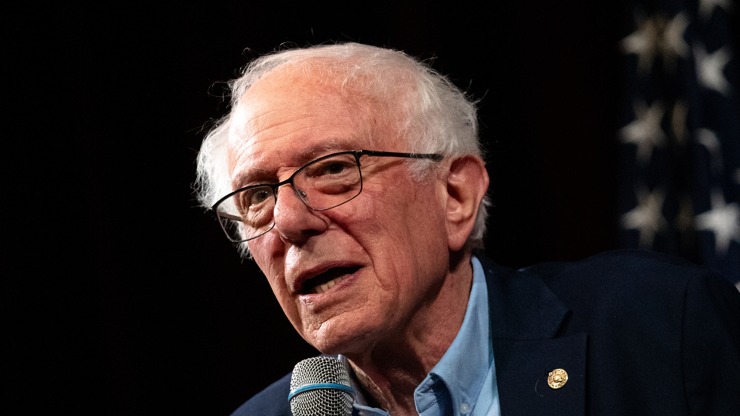
Senator Bernie Sanders speaks at Stanford University on February 20, 2026. File photograph, not Tuesday's news conference.

Sanders, Feb. 2026 file: Anders Eidesvik / Wikimedia (CC BY-SA 4.0, cropped)

Sen. Bernie Sanders said Tuesday he will not support Chuck Schumer for another term as Senate Democratic leader, adding a prominent voice to calls for a change at the top of the caucus.

The Vermont independent, who caucuses with Democrats, praised Schumer’s work ethic but said the party needs different leadership. His remarks came at a news conference alongside Michigan Sen. Elissa Slotkin, who has also called for a new generation of leaders.

Neither Sanders nor Slotkin endorsed an alternative candidate. Slotkin said she was not actively seeking the job herself.

Maryland Sen. Chris Van Hollen said Tuesday he was listening to colleagues about a possible run, but he had not announced a challenge. No leadership election had taken place.

Democrats are expected to choose their leaders next month, following midterm gains that put them on course to control the Senate. Schumer is seeking another two-year term and would need a majority of the caucus to keep the job.

Schumer defended his leadership Tuesday, saying Democrats were united around lowering costs and other priorities. Some colleagues have backed him, citing the party’s election gains.

The disagreement remains a debate within the caucus, not a completed leadership change. A declared challenger would still need to build enough support to defeat Schumer.

JBizNews Desk | Washington

© JBizNews.com. All rights reserved. Unauthorized reproduction or redistribution is strictly prohibited.

Senator Kevin Cramer, official Senate portrait, 2019 file photo

Sen. Kevin Cramer. Rebecca Hammel / U.S. Senate Photographic Studio, public domain. 2019 file photo; cropped.

Sen. Kevin Cramer called on Nvidia Chief Executive Jensen Huang to resign Tuesday, arguing that the potential for extortion poses a risk because of the sensitivity of the company’s advanced chips.

“The potential for extortion is so tremendous that something as sensitive as Nvidia chips, I just think he’s got to go,” the North Dakota Republican said late Tuesday, according to reports.

Cramer, a member of the Senate Banking Committee, made the demand amid an independent Nvidia board review of allegations that Huang was the target of a foreign intelligence effort. His comments are a call for Huang’s departure, not an announcement that Huang has resigned.

Nvidia has said its board has no reason to believe U.S. national security or company secrets were compromised, and that Huang has committed to cooperating with the internal review, according to reports. Huang has acknowledged being unfaithful to his wife. Allegations concerning the woman involved have not been established as findings against Huang.

Cramer’s committee has jurisdiction over legislation that could restrict sales of Nvidia’s advanced chips to China. Nvidia, based in Santa Clara, California, is a leading supplier of chips used to train and run artificial intelligence systems, placing its technology at the center of U.S.-China export-control debates.

The senator said the board’s internal investigation was “fine, but not nearly enough,” according to reports. Nvidia did not immediately respond to a request for comment cited in the report on his remarks.

The demand adds pressure on Huang while the board’s independent investigation continues.

JBizNews Desk | Washington

© JBizNews.com. All rights reserved. Unauthorized reproduction or redistribution is strictly prohibited.

Scott Bessent in Geneva, May 2025, official Treasury file photo

Scott Bessent in Geneva, May 2025. U.S. Treasury / public domain. File photo; cropped.

Treasury Secretary Scott Bessent urged a clear-eyed approach to U.S.-China cooperation on advanced artificial intelligence Tuesday evening in New York, warning that the two countries’ interests will not always align ahead of next week’s planned Trump-Xi talks.

In prepared remarks for the National Committee on U.S.-China Relations gala in New York, Bessent said the dialogue on superintelligence is designed to guard against shared risks and prevent misunderstandings between the two countries’ systems.

He said the countries expect to exchange best practices for evaluating and testing advanced models before release and keeping human judgment in command of the technology. He also said they are establishing a direct channel so either country can promptly alert the other to serious incidents involving its superintelligence models.

“We should harbor no illusions about the differences between the United States and China,” Bessent said in the prepared text. “Our interests will not always coincide.”

The remarks revisit the AI-risk notification mechanism described in September. They are not a new announcement of that mechanism. The remarks pair cooperation on AI risks with continued competition. They describe work toward a dialogue and an alert channel, not a completed joint testing standard or a guarantee that the two governments will agree on AI policy.

Bessent also said the U.S. objective in its economic relationship with China is “to de-risk, not to decouple.” Treasury’s event notice scheduled his remarks for 8:15 p.m. Tuesday, November 10. The prepared speech is dated November 11 on Treasury’s website.

JBizNews Desk | New York

© JBizNews.com. All rights reserved. Unauthorized reproduction or redistribution is strictly prohibited.

Treasury Secretary Scott Bessent speaking at May 28, 2026 White House press briefing, archive image

Treasury Secretary Scott Bessent at a White House press briefing, May 28, 2026. Official White House photo by Abe McNatt; public domain, cropped. File photo, not the reported relocation.

Treasury Secretary Scott Bessent has been relocated from his Washington home to a military base after Iranian threats against his life, a senior administration official confirmed Wednesday. The move was first reported Tuesday evening.

The official said the threats against Bessent had gone “more than an advanced stage” and declined to say exactly when the secretary was moved. The base was not identified.

The relocation places the official leading Washington’s economic pressure campaign against Tehran under heightened protection.

The Treasury Department confirmed his departure in a statement Tuesday. A spokesperson said Bessent refuses to “be deterred by the Iranian regime’s threats” and remains committed to the administration’s campaign to squeeze Iran’s economy.

U.S. officials concluded in recent weeks that Iranian plotting against current and former American officials had advanced. Intelligence about threats to Bessent helped inform that assessment.

Authorities have not said they stopped a specific plot or that an attack was attempted.

Bessent has led the pressure campaign since August, using tougher sanctions and restrictions on trade routes to isolate Iran financially, a role that officials say has made him a particular target of Iranian threats.

JBizNews Desk | Washington

© JBizNews.com. All rights reserved. Unauthorized reproduction or redistribution is strictly prohibited.

Model of the proposed arch in the Oval Office, October 7, 2025, White House file photo

A model of the proposed arch in the Oval Office, October 7, 2025. Official White House Photo by Daniel Torok; public domain. Cropped. File photo of a model, not a completed arch.

Nine members of the Kennedy family asked a federal court Tuesday to let them join the legal fight to block President Donald Trump’s proposed 250-foot arch, arguing that the structure would damage the setting of their relatives’ gravesites and the John F. Kennedy Eternal Flame at Arlington National Cemetery.

The filing adds the family’s claimed personal harm to the dispute over whether the administration can build the monument without new authorization from Congress. It is a request to intervene, not a ruling admitting the relatives to the case or granting them an injunction.

The November 10 motion, filed in U.S. District Court in Washington, asks to join two consolidated cases challenging the planned Independence Arch at Memorial Circle, between the Lincoln Memorial and Arlington National Cemetery.

The relatives say the arch would obstruct views of the Kennedy gravesites and Eternal Flame from Arlington Memorial Bridge, disrupting sightlines they describe as central to the memorials’ design. They also allege it would cast shadows over the graves and alter the family’s visits.

In their proposed complaint, the relatives say they often visit early in the morning, before the cemetery opens, for privacy. They argue that shadows would be most pronounced at precisely that time. Those are the family’s allegations, not findings by the court.

The nine relatives are Rory Kennedy, Maxwell Taylor Kennedy, Christopher G. Kennedy, Kerry Kennedy, Courtney Kennedy, Kathleen Kennedy Townsend, Joseph P. Kennedy II, Joseph P. Kennedy III and Edward M. Kennedy Jr. They are children and a grandchild of Robert F. Kennedy and Ethel Kennedy, and a son of Edward M. Kennedy.

The proposed complaint challenges the construction authorization under the Administrative Procedure Act, the Commemorative Works Act and a federal law requiring express congressional authority for structures on federal public grounds in Washington. It also alleges that officials acted beyond their legal powers.

The relatives ask the court to set aside the authorization and issue preliminary and permanent injunctions barring approval or construction without congressional authorization and compliance with required procedures. Their claims of illegality remain to be decided.

The motion says the National Capital Planning Commission approved the arch’s site and building plans November 5. The two underlying lawsuits were consolidated October 31.

Existing plaintiffs take no position on the family’s intervention request, according to the motion. The defendants had been notified but had provided no substantive response as of the filing. The relatives are represented by Democracy Defenders Fund.

JBizNews Desk | Washington

© JBizNews.com. All rights reserved. Unauthorized reproduction or redistribution is strictly prohibited.

Donald Trump at the Lincoln Memorial Reflecting Pool on November 2, 2026. Archive White House photograph by Joyce Boghosian, not the BBC court case.

Photo: White House / Joyce Boghosian, public domain. Archive: Donald Trump at the Lincoln Memorial Reflecting Pool, Nov. 2, 2026, not the court case. Cropped and resized.

President Donald Trump’s defamation claim against the BBC survived a dismissal bid Tuesday, keeping the dispute over an edited January 6 speech segment moving forward in federal court.

U.S. District Judge Jeffrey T. Kuntz denied the BBC’s motion to dismiss Count I, the defamation claim, but dismissed Count II, brought under Florida’s Deceptive and Unfair Trade Practices Act. The BBC must answer the surviving claim by December 1.

The 40-page order is a pleading-stage ruling, not a finding that the BBC is liable. It does not award Trump damages or a $10 billion payout. Whether he can prove his allegations and establish damages remains for summary judgment or trial.

Judge focuses on the edited speech segment

The case concerns a 12-second segment in the October 28, 2024 documentary “Trump: A Second Chance.” The segment joined remarks from Trump’s January 6, 2021 speech that were delivered nearly 55 minutes apart, making them appear to be a continuous statement.

“Here, the news entity created the story,” Kuntz wrote. “BBC admitted as much by confirming it had edited a video to make it appear as though President Trump made a statement he never made.”

The order cited the BBC chairman’s apology, which said the editing gave the mistaken impression that Trump had made a direct call for violent action. The BBC sought dismissal on jurisdictional grounds and argued that the complaint failed to state a defamation claim.

Kuntz concluded that Trump had plausibly alleged actual malice, the legal standard involving knowledge of falsity or reckless disregard for the truth. But the judge expressly separated a plausible allegation from proof.

“Of course, all of this does not prove BBC acted with actual malice. But it does make it plausible,” he wrote.

A partial ruling, not a final verdict

The judge dismissed the Florida deceptive-trade-practices claim because a documentary does not become commercial speech simply because its publisher has commercial purposes.

The court also found a basis for specific personal jurisdiction in Florida, allowing this dispute to proceed there. That does not mean the BBC is based in Florida or subject to general jurisdiction in the state.

Trump called the decision a “Huge Victory” in a Truth Social post Tuesday evening, quoting the judge’s criticism of the edit. That was Trump’s characterization of a ruling that preserved his defamation claim while rejecting his separate statutory claim.

The order was entered November 10 in Trump v. British Broadcasting Corp., case 1:25-cv-25894, in the Southern District of Florida.

JBizNews Desk | Florida

© JBizNews.com. All rights reserved. Unauthorized reproduction or redistribution is strictly prohibited.

West side of the U.S. Capitol, September 5, 2013 archive. Martin Falbisoner, CC BY-SA 3.0. Cropped and resized to 16:9. Not the November 2026 House vote.

Photo: Martin Falbisoner / Wikimedia Commons / CC BY-SA 3.0. Sept. 5, 2013 archive photo. Cropped and resized; adapted image under the same license.

The House voted 211-204 Tuesday evening to send the resolution seeking to impeach Defense Secretary Pete Hegseth to the Judiciary Committee, stalling the push for an immediate impeachment vote. Lawmakers voted on where to send the proposal, not on whether to approve the accusations against him.

The immediate result for Hegseth: the House did not impeach him in this vote. The proposal goes to a committee, where it can be examined, acted on later or remain without a final House impeachment vote. Tuesday’s referral did not require the committee to approve the charges.

The House Clerk’s official floor record says Rep. Darrell Issa moved to refer H.Res.1655 to Judiciary. At 6:02:42 p.m. Eastern, the Clerk recorded that motion as agreed to by yeas and nays under Roll Call 317.

President Donald Trump praised the outcome in a post on his official Truth Social account, calling the impeachment attempt a failure and describing the result as an “EXONERATION” of Hegseth. That was Trump’s characterization: the House voted to refer the resolution, not to clear Hegseth of its allegations.

Yes to what? Sending it to committee, not impeaching Hegseth

A vote only answers the question that is actually put before lawmakers. In this case, that question was whether to send the impeachment resolution to the Judiciary Committee.

A “yes” on that motion meant “send this proposal to committee.” It did not mean “I vote to impeach Pete Hegseth.” Approval of a referral and approval of impeachment are two different decisions.

The Clerk’s official Roll Call 317 result records 211 votes for referral and 204 against, with 18 members not voting. Of those voting yes, 210 were Republicans and one was an independent. All 203 Democrats who voted opposed referral, joined by Massie, the only Republican to vote no.

Massie’s no vote was a vote against sending his proposal to committee. It was not a vote against his own impeachment effort. Likewise, the 211 yes votes approved referral, not impeachment.

What was the risk for Hegseth today?

The issue was whether Massie’s effort would put Hegseth before an immediate House decision on impeachment. Rep. Thomas Massie brought his resolution to the floor as a privileged matter, a procedure that can force the House to deal with a proposal without waiting for the usual committee process.

But dealing with the proposal does not necessarily mean voting to approve its accusations. As the Congressional Research Service explains, the House can vote to send a privileged impeachment resolution to Judiciary instead of voting directly on impeachment. That is the route the House took Tuesday.

The plain consequence: there was no vote adopting articles of impeachment in this action. Hegseth avoided an immediate House decision on whether to impeach him, but the referral did not dismiss the resolution or decide that its accusations were false.

How impeachment works, step by step

First, someone proposes charges. A House member files a resolution, which is a formal proposal asking the House to act. An impeachment resolution asks the House to accuse a federal official of misconduct serious enough to warrant removal. The individual charges are called “articles of impeachment.” Filing them does not itself impeach anyone.

Usually, a committee examines the case. The Judiciary Committee can investigate, hear witnesses and decide whether to recommend articles to the full House. A resolution sent there can also remain in committee without reaching a final impeachment vote. Referral is not an order to find the official guilty, and it does not guarantee another vote.

The full House must then approve impeachment. As the Senate’s explanation of the process states, articles of impeachment are approved by a simple majority vote in the House. That is the step that formally impeaches an official. It is an accusation, not removal from office.

Only after impeachment does the Senate hold a trial. The Senate considers the charges and votes on whether to convict. Conviction requires two-thirds of senators present and results in removal from office. A House committee referral does not start that trial.

What the Clerk recorded Tuesday

At 4:17 p.m., Massie offered the resolution as a question of the privileges of the House. The chair determined that it qualified. At 5:33 p.m., the House considered H.Res.1655 as a privileged matter.

The resolution’s title is “Impeaching Peter Brian Hegseth, Secretary of Defense, for high crimes and misdemeanors.” That title states what its sponsor proposed, not something the House had already decided.

Issa moved to refer it to Judiciary at 5:34 p.m. The log then recorded debate on that motion and, later, the result: “On motion to refer Agreed to by the Yeas and Nays: (Roll no. 317).” A motion to reconsider was subsequently laid on the table without objection.

JBizNews previously reported on Massie’s resolution and the expected House action. The decision now recorded is narrower and clear: the House sent the proposal to Judiciary, rather than voting to adopt its impeachment articles.

JBizNews Desk | Washington

© JBizNews.com. All rights reserved. Unauthorized reproduction or redistribution is strictly prohibited.
Gage Skidmore / CC BY-SA 2.0. Archive photo, January 18, 2020, Des Moines, Iowa. Native landscape, no crop/fill.

Gage Skidmore / CC BY-SA 2.0

Sen. Elizabeth Warren said Sunday she was ready to work on a 10% cap on credit-card interest rates and housing legislation, while promising corporate investigations alongside bills aimed at lowering costs for families.

“President Trump himself said that he wants to reduce interest rates on credit cards to 10%. I got the bill, I’m ready to go,” the Massachusetts Democrat said in an interview that aired on Face the Nation, according to the full interview transcript. On housing, she added: “We’re ready. We have the bills ready to go.” Those comments did not announce an agreement with the White House or an enacted credit-card cap.

Asked whether her focus would be legislation or investigations, Warren said Democrats had to do both. “But I do want to be clear: if you’ve been making your profits by cheating American families and scamming your investors, you better get ready for some investigations, serious ones.” She did not identify particular subpoena targets, saying investigators needed to go through the steps.

Warren also backed tighter restrictions on chip exports to China and said lowering family costs and addressing corruption would guide her work. Her comments described legislative and oversight priorities, not newly issued subpoenas or findings of wrongdoing against a named company.

Watch the official 8-minute, 7-second interview.

JBizNews Desk | Washington

© JBizNews.com. All rights reserved. Unauthorized reproduction or redistribution is strictly prohibited.

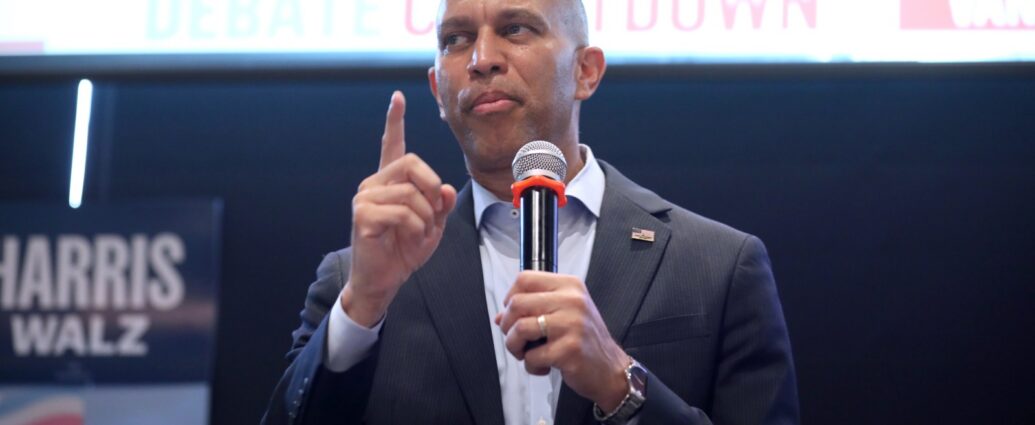
Gage Skidmore / CC BY-SA 2.0. Archive photograph, October 1, 2024, Phoenix debate watch party. Native landscape, no crop.

Gage Skidmore / CC BY-SA 2.0

House Democratic Leader Hakeem Jeffries said Sunday he would support a resolution to impeach Defense Secretary Pete Hegseth and expected strong Democratic backing, with a party discussion planned for Tuesday morning.

“I’m a hard Yes on the Hegseth resolution,” Jeffries told Jonathan Karl on ABC’s This Week, according to the full transcript published by his office. Karl had asked about a resolution Republican Rep. Thomas Massie told him he intended to introduce. The exchange did not establish that a resolution had been filed or approved.

Asked whether all Democrats would join him, Jeffries said: “We’ll certainly have that conversation on Tuesday morning when we reconvene for the first time in Washington, D.C., but I believe there will be incredibly strong support for that resolution.” He accused Hegseth of abusing his power and undermining national security through the Iran war. Those were Jeffries’ allegations, not findings established by the interview.

Jeffries also outlined priorities for the new Congress’s first 100 days: stopping Trump’s tariffs, reversing Medicaid and SNAP cuts, extending Affordable Care Act tax credits, and pursuing credit-card and healthcare-cost relief. He said he strongly supported banning members of Congress from trading stock. These were proposed priorities, not enacted measures or agreements with the White House.

Watch the full interview shared by Jeffries’ office.

JBizNews Desk | Washington

© JBizNews.com. All rights reserved. Unauthorized reproduction or redistribution is strictly prohibited.
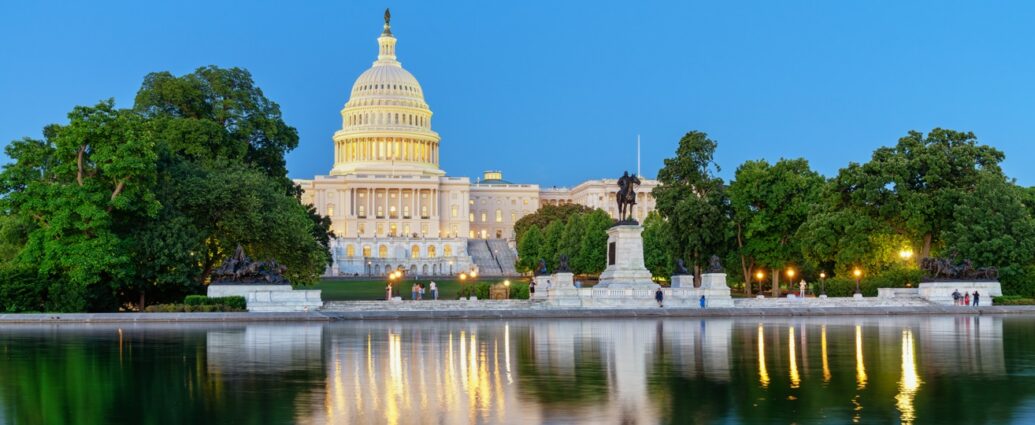
Daniel Torok / The White House / Public domain. Archive October 21, 2026 Marine One boarding on the South Lawn. Resized only.

Daniel Torok / The White House / Public domain

President Donald Trump said the Iran war and higher gasoline prices hurt Republicans in the midterm elections and signaled possible changes to his team, while defending Defense Secretary Pete Hegseth and declining to commit to endorsing a successor for 2028.

In his interview with Ross Douthat, recorded Friday at the White House and aired Sunday, Trump also discussed a possible immigration deal with Democrats, AI safety, Israel, Ukraine and questions about his family’s business interests. The full CBS transcript provides additional exchanges beyond the aired interview transcript.

Watch the extended interview

Watch the official 51-minute, 47-second extended interview on CBS.

War, gasoline prices and the Republican defeat

Trump offered a political explanation centered on the war, fuel costs and attitudes toward Israel. “They didn’t like the war. They didn’t like the fact that gasoline went up,” he said. In the full transcript, he added: “So you have that. You have the war itself. You have the gas prices. And I think those are the primary reasons.” These were his assessments of voters’ motives, not independently established causes of the result.

Asked about Vice President JD Vance’s argument that the war explained the loss, Trump said: “I don’t disagree with it, other than–” He went on to say the missing question was whether the decision to attack Iran should be made again. His own answer was: “My answer is an emphatic yes because you can’t let Iran have a nuclear weapon.” He said Vance had consulted him before writing the post, without claiming that Vance had expressed the same view about making the decision again.

Trump also conceded a possible failure in presenting his economic record: “I think it was bad messaging, maybe by me,” he said. He continued to defend the economy rather than accepting that his policies had failed.

Possible personnel changes, but support for Hegseth

Asked whether he expected to fire anyone after the defeat, Trump answered: “I do. Yeah.” He then said: “I love my Cabinet. I think they’re good. But I’ll do– be doin’ maybe a few changes.” He did not identify the people he had in mind in that answer.

When Douthat asked whether he had confidence in Hegseth, Trump replied: “I do.” He defended the administration’s military campaigns and Hegseth’s role. The exchange signaled potential personnel changes, not an announcement that Hegseth or another named Cabinet member had been dismissed.

Vance, Rubio and the 2028 succession

Trump did not promise an endorsement in the next Republican presidential contest. Asked whether he would endorse someone, he said: “Probably. Not necessarily–” When Douthat asked who might be considered besides the vice president, Trump responded: “Well, I think Marco’s great.”

Asked whether Secretary of State Marco Rubio was staying in his job, Trump said: “I think so. I mean, he certainly loves it and he’s doing great.” He referred to other people and senators without naming them, adding: “So I may or may not get involved. I don’t know.” Those comments did not constitute an endorsement of either Rubio or Vance.

Immigration negotiations and Israel

Trump said: “I’d love to do something on immigration.” He described deportations as politically mixed, defending border enforcement and the removal of criminals while acknowledging the impact of removing people who had jobs. Asked whether his policy had been too tough, he answered: “I think it might be too tough, yeah.”

He discussed the possibility of a deal for some longtime workers, including people who had been in the country for 10 or 15 years. “I think so, yeah. People have already called me,” he said when asked whether Democrats would be interested. The discussion did not establish agreed eligibility rules, legislation or a change in enforcement policy.

On Israel, Trump said there was “a great dislike, incredibly, for Israel” as part of his explanation of the election. He nevertheless defended the strikes on Iran and argued that they protected Israel. Asked whether he planned to escalate the Iran war after the midterms, he said: “Well, I’m not looking to. I don’t think there’s any reason to.” His claims about Iran’s military defeat, nuclear capabilities and the prospects for a deal remained the president’s assertions, not independently verified findings in this report.

AI guardrails and an unnamed company

Trump said he was willing to discuss AI safety with Democrats but argued that restrictions should not put the United States behind China. “I don’t mind guardrails. But I don’t wanna put us in a deep second position,” he said. His assertion that China had no guardrails drew a challenge from Douthat about the Chinese state’s control.

The extended transcript also included Trump’s account of an intervention involving an unnamed major AI company. He claimed someone had been reported for doing something bad with AI and had changed course after a warning about jail. He would not identify the person or company. The interview did not establish a prosecution, a formal enforcement action or a new safety rule.

Ukraine, business interests and his legacy

Trump said he believed a deal to end the Russia-Ukraine war was close, while declining to say whether he trusted Vladimir Putin or Volodymyr Zelenskyy more. Asked about a free and independent Ukraine, he said the country would end up with “a little bit different shape Ukraine.” That was his forecast, not an announced territorial agreement.

Douthat also pressed Trump about potential conflicts involving World Liberty Financial and his family’s business interests. Trump acknowledged co-ownership when asked and said: “Because I know nothing about it.” He described his sons as running the company. Those responses did not settle the questions Douthat raised about foreign investment and influence.

On pardons, Trump said he expected to issue many when leaving office, but said he did not expect to pardon himself. Asked how he wanted his presidency remembered, he answered: “That I made America great again.” The interview also covered UFOs, mortality and forgiveness, with the complete exchanges available in the video and full transcript above.

JBizNews Desk | Washington

© JBizNews.com. All rights reserved. Unauthorized reproduction or redistribution is strictly prohibited.
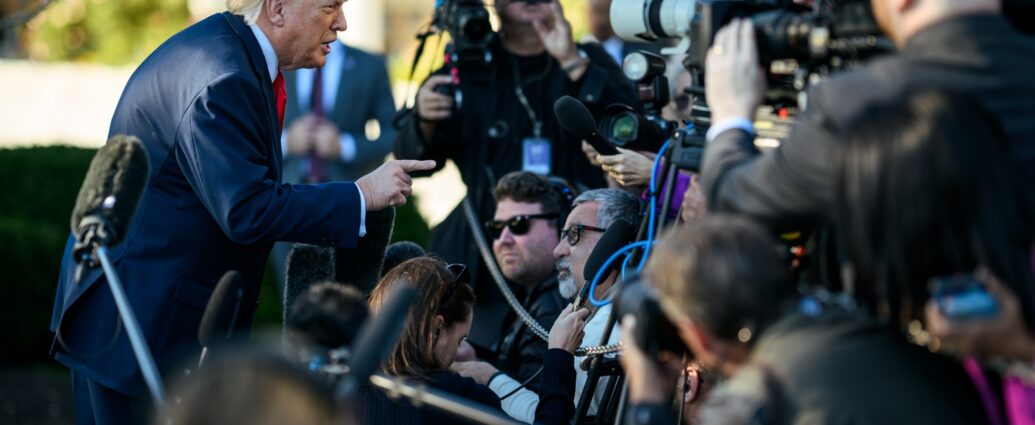
Tony Webster / Wikimedia Commons / CC BY 2.0. Archive U.S. Capitol and Grant Memorial from the reflecting pool, May 31, 2024. Resized only. License: https://creativecommons.org/licenses/by/2.0/

Tony Webster / Wikimedia Commons / CC BY 2.0

Latino voters backed Democratic candidates for the U.S. House by 67% to 31% in the midterm elections, according to a national voter survey that also found defections among Hispanics who had supported President Donald Trump two years earlier.

The 2026 Midterm Election Voter Poll, released November 4 by UnidosUS and the Latino Community Foundation, found that 17% of Latino respondents who reported voting for Trump in 2024 supported Democratic House candidates in 2026. By contrast, 3% of those who reported backing Kamala Harris in 2024 supported Republican House candidates.

The findings offered a picture of an electorate under financial pressure. Cost of living and inflation topped the list of issues respondents wanted Congress and the president to address: 58% placed that issue among their top three, according to the published survey crosstabs. Jobs and the economy followed at 34%, while health care costs drew 30%. Immigration reform and ICE were among the top three priorities for 27%.

Immigration policy also drew broad support for changes. In its release accompanying the poll, UnidosUS said 76% supported a package of ICE reforms involving identifiable uniforms, body cameras, a prohibition on masks and restrictions on the use of force. Ninety percent supported a proposed immigration system combining an earned path to citizenship for long-term residents, accountable enforcement, legal immigration channels and border security.

The poll also captured new participants in the electorate: 17% of Latino respondents said 2026 was their first November general election. That finding described the surveyed voters; it was not an official national turnout count.

The Hispanic sample included 3,014 respondents, with a reported margin of error of plus or minus 1.8 percentage points. The methodology described a broader multiracial survey of 10,141 voters conducted from October 19 through November 3 using live telephone interviews, text invitations, email and online panels. Respondents had voted early or said they were certain to vote on Election Day. The findings were survey estimates, not certified election returns.

JBizNews Desk | Politics

© JBizNews.com. All rights reserved. Unauthorized reproduction or redistribution is strictly prohibited.
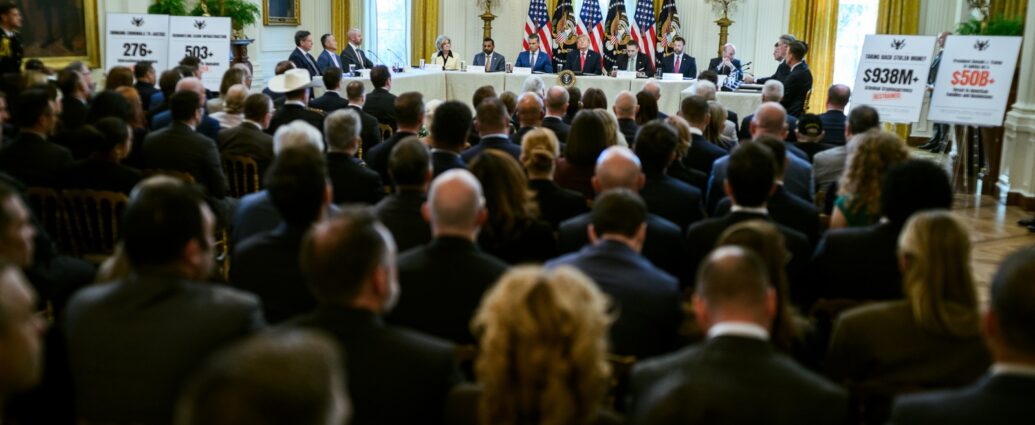
Daniel Torok / White House / Public domain. ArchiveOctober21,2026 SouthLawn departure press exchange. Resized only.

Daniel Torok / The White House / Public domain

President Donald Trump said dislike of Israel, the Iran war and higher gasoline prices contributed to Republican losses in the midterm elections, offering his own explanation for the result in an interview that aired Sunday.

“They didn’t like the war. They didn’t like the fact that gasoline went up,” Trump told Ross Douthat. He then added: “There’s a great dislike, incredibly, for Israel.” The remarks appear in the transcript of the interview, recorded Friday at the White House and aired Sunday at 7 p.m. Eastern.

Trump also said he had not been on the ballot and argued that his support had not transferred to some Republican candidates. “I think in some cases, they didn’t like the candidates,” he said.

Asked about Vice President JD Vance’s argument that the war explained the defeat, Trump replied: “I don’t disagree.” He said Vance had consulted him before writing the post, but defended the decision to attack Iran, saying he would make it again to prevent Iran from having a nuclear weapon.

The president’s comments were his political assessment of the election, not independent evidence establishing why individual voters cast their ballots. He did not announce a new policy toward Israel in the exchange.

The full transcript added detail to Trump’s election explanation. “So you have that. You have the war itself. You have the gas prices. And I think those are the primary reasons,” he said. Separately, discussing why voters did not share his positive assessment of the economy, he said: “I think it was bad messaging, maybe by me.” His response to Vance’s analysis also included a qualification: he wanted the vice president to address whether he would make the decision to attack Iran again, rather than treating the electoral cost as the only consideration.

JBizNews Desk | Washington

© JBizNews.com. All rights reserved. Unauthorized reproduction or redistribution is strictly prohibited.
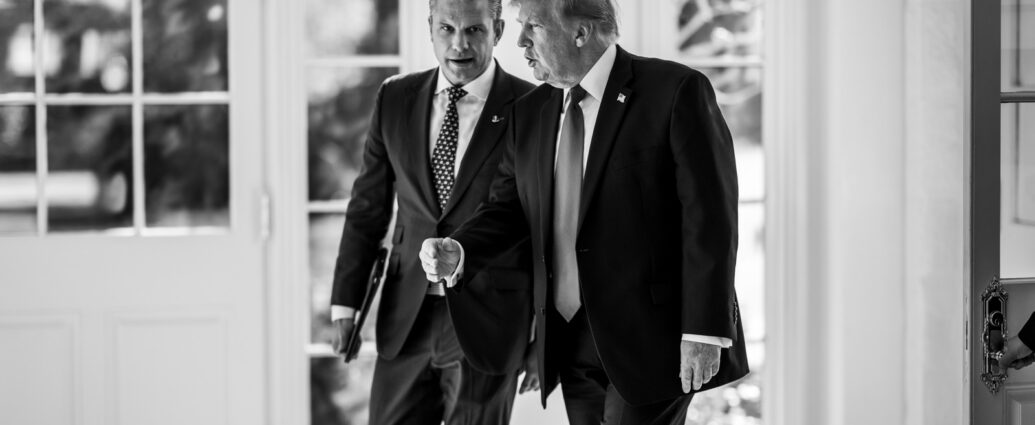
Daniel Torok / The White House / Public domain. Archive October 21, 2026.

Daniel Torok / The White House / Public domain

President Donald Trump said his deportation policy might be “too tough” and expressed interest in reaching an immigration deal with Democrats, pointing to workers who have spent years in the United States as people whose situations could be addressed.

“I think it might be too tough, yeah,” Trump told Ross Douthat when pressed on whether his deportation policy had gone too far. The remarks appear in the full interview transcript. The interview was recorded Friday at the White House and aired Sunday at 7 p.m. Eastern.

Asked what he would like to work on with a Democratic majority, Trump said: “I’d love to do something on immigration.” He said his immigration approach had both helped and hurt him politically, distinguishing his defense of border enforcement and removing criminals from the effect of deporting people with jobs.

Trump described the difficulty of removing longtime hotel workers and said there were competing views about how broadly deportations should apply. He acknowledged that people who wanted everyone removed worked in his administration, while describing another position that would remove violent criminals but “let the people that are here, and in some cases here for 10 and 15 years, work a deal for them.”

Asked whether Democrats would be interested in that kind of agreement, Trump answered: “I think so, yeah. People have already called me.” He did not identify the callers in that answer or set out an agreed proposal.

The comments signaled an interest in negotiations rather than an enacted change. Trump offered no legislative text, detailed eligibility rules or implementation timetable, and the interview did not establish a change to deportation policy or a completed agreement with Democrats.

The full transcript contained a further acknowledgement of the political cost: “I think ultimately–” Trump began, before adding: “–that hurt me.” Douthat pressed him specifically about some form of legal status for workers, but Trump answered with the example of longtime hotel staff rather than defining a legal mechanism.

Douthat also raised James Talarico’s stated interest in working on immigration. Trump responded that others, including people from South Carolina and numerous election winners, had said similar things. That exchange did not establish which individuals had personally called Trump or that they had agreed to a common plan.

JBizNews Desk | Washington

© JBizNews.com. All rights reserved. Unauthorized reproduction or redistribution is strictly prohibited.
Daniel Torok / The White House / Public domain. Archive October 21, 2026.

Daniel Torok / The White House / Public domain

President Donald Trump said he was not looking to escalate the war with Iran after the midterm elections, while claiming the two countries had been close to a deal before the vote and would still reach an agreement.

Asked whether he would escalate now that the midterms were over, Trump replied: “Well, I’m not looking to. I don’t think there’s any reason to.” The exchange appears in the full transcript of his interview with Ross Douthat, recorded Friday at the White House and aired Sunday at 7 p.m. Eastern.

Trump said Iran had wanted an agreement before the election and that “we were close to makin’ a deal.” He argued that the election result had given Tehran renewed hope, but added: “We’ll make a deal anyway.” Those were the president’s descriptions of the negotiations, not an announcement of a signed agreement.

The president also defended his decision to attack Iran. Asked in the course of the discussion whether he would make the decision again, he said: “My answer is an emphatic yes because you can’t let Iran have a nuclear weapon.”

In another part of the interview transcript, Trump claimed countries protected by the United States would reimburse the costs of the war. “Those countries that we’ve protected are going to pay us back any and all costs that we’ve had for the war,” he said. His remarks did not establish reimbursement agreements or payments.

The comments combined a stated preference against escalation with a defense of the military campaign and confidence in a future deal. They did not establish a ceasefire, a new military order or a verified assessment of Iran’s nuclear material and capabilities.

The extended transcript also included an exchange about Iran’s nuclear material and Pickaxe Mountain. Trump said the material was buried and described U.S. monitoring of sites. When asked whether material remained at Pickaxe Mountain, he said: “Well, we don’t know that.” He said action there was not needed at that moment while leaving open the possibility of a future strike. Those remarks did not verify the location or condition of Iran’s nuclear material, and his stated preference against escalation did not rule out all future military action.

Trump linked his defense of the Iran campaign to Israel’s security, claiming that without the U.S. strikes Israel would not exist. That was his assessment of the threat and the operation’s consequences. It was not independent confirmation of a nuclear timetable or a finding about what would otherwise have happened.

JBizNews Desk | Washington

© JBizNews.com. All rights reserved. Unauthorized reproduction or redistribution is strictly prohibited.
Beethoven / Wikimedia Commons, CC BY-SA 4.0. Archive Capitol exterior March 26, 2018, resized. Not Sunday announcement.

Beethoven / Wikimedia Commons / CC BY-SA 4.0 / Archive U.S. Capitol exterior, March 2018, resized; not Sunday’s announcement

President Donald Trump urged senators Sunday evening to support the American Affordability and Jobs Act, saying the permitting legislation would speed energy projects and require data centers to build and pay for their own electricity.

“I am urging all Senators to vote for The American Affordability and Jobs Act (S. 5653)!” Trump wrote in a 7:05 p.m. Eastern post on Truth Social. He called the measure a win for U.S. energy independence and urged supporters to contact their senators.

The president said the bill would put his energy agenda into law and allow pipelines, mines and power plants to be built faster. He argued that the changes would lower energy costs for families and create high-paying jobs. Those are the benefits Trump claimed for the legislation, rather than results already delivered by it.

Trump also tied the bill to his position on the electricity demands of data centers. “This Legislation also codifies my RATEPAYER PROTECTION PLEDGE, ensuring Data Centers build and pay for their own Electricity, and help invest in their local communities,” he wrote.

The post framed data-center construction as an issue of international competition, with Trump arguing that China would welcome facilities the United States did not want. He pressed senators to vote yes but did not announce that the measure had passed.

The appeal puts permitting and responsibility for data-center electricity costs together in Trump’s push for Senate action. His post was an endorsement of the legislation, not an announcement that new permitting rules or ratepayer protections were already in force.

JBizNews Desk | Washington

© JBizNews.com. All rights reserved. Unauthorized reproduction or redistribution is strictly prohibited.

DJTechYT / Wikimedia Commons, CC BY-SA 4.0. Archive White House exterior, June 2024; not the departure announcement. Resized.

DJTechYT / Wikimedia Commons / CC BY-SA 4.0 / Archive White House exterior, June 2024; not the departure announcement

White House Deputy Chief of Staff Richard Walters is leaving the Trump administration ahead of Stephen Miller’s move into the chief of staff role Monday, according to statements Walters and Miller issued Sunday.

Walters said in a statement that he would continue supporting the administration from outside the White House. Miller separately confirmed the departure, praising Walters’ work.

“Serving President Trump has been the honor of a lifetime and I will always be thankful to Susie Wiles for the opportunity,” Walters said in his statement. “Stephen is building an incredible and capable team to implement the President’s agenda and I look forward to being part of it from the outside.”

The departure comes as Miller prepares to replace Susie Wiles as chief of staff on Monday, November 9. Walters was a longtime political ally of Wiles, with a relationship extending back more than a decade.

The statements did not identify an effective departure date.

Miller called Walters an “invaluable member of the White House” in his statement and said he would continue to help the administration from outside. Neither statement described Walters’ next position.

Walters joined the White House in May. A veteran Republican operative, he previously served as chief of staff at the Republican National Committee and as executive director of Trump’s 2025 inaugural committee.

JBizNews Desk | Washington

© JBizNews.com. All rights reserved. Unauthorized reproduction or redistribution is strictly prohibited.

Jack E. Boucher / HABS, public domain federal photograph. Archive DOJ entrance detail; converted from16-bit TIFF and resized.

Jack E. Boucher / Historic American Buildings Survey / Public domain / Archive Justice Department entrance detail, resized

Attorney General Todd Blanche said Sunday that the Justice Department would represent executive-branch officials called before Congress, defending that role as Democrats prepared to exercise congressional oversight.

“In every Administration, the Department of Justice represents members of the executive who are brought in front of Congress,” Blanche said in remarks highlighted by a November 8 White House release summarizing his Sunday television appearances.

Blanche argued that his position was consistent with the work of previous attorneys general. The release presented the administration’s defense of its officials as it faces the prospect of investigations and demands for testimony.

He also criticized Democrats’ rhetoric about cabinet officials, private companies and donors. Blanche said proposed efforts to investigate companies that had invested in the country went beyond legitimate oversight. Those were his accusations and his assessment of Democrats’ intentions, rather than findings by a court.

The attorney general said threats directed at donors and students interested in working for conservative institutions were troubling. The White House release did not provide a new court order resolving those allegations.

For companies and individuals drawn into congressional inquiries, Blanche’s comments signal the administration’s intended approach to defending its officials. They do not establish immunity from subpoenas, resolve a dispute over congressional authority or announce a judicial ruling.

JBizNews Desk | Washington

© JBizNews.com. All rights reserved. Unauthorized reproduction or redistribution is strictly prohibited.

Hypergio, CC BY-SA4.0. Archive ICC headquarters April2016, resized. License https://creativecommons.org/licenses/by-sa/4.0/

Hypergio / Wikimedia Commons / CC BY-SA 4.0 / Archive ICC headquarters, 2016, resized

Secretary of State Marco Rubio warned Sunday that Washington could take further action against the International Criminal Court, pressing allies to persuade the court to reject jurisdiction over Americans.

“If they want to avoid the actions we are going to take against the ICC, they should convince the ICC once and for all” to ensure American service members and leaders were not subjected to its jurisdiction, Rubio said during remarks to reporters, ahead of the G7 foreign ministers meeting in Paris.

Rubio said the United States would not accept the court asserting jurisdiction over American service members or leaders. He described that position as a dispute involving citizens of countries that had not joined the court’s treaty, and argued that the court should make changes to address U.S. objections.

He urged allies who wanted to avoid U.S. action against the ICC to persuade the court to make those changes. “They still have a chance,” he said, while warning that Washington would do what it considered necessary if its concerns were not addressed.

Rubio’s characterization of the court’s jurisdiction was the administration’s position. His remarks did not announce a court ruling resolving that legal dispute.

The secretary did not identify new sanctions targets, provide a sanctions list or set an effective date for action in the remarks. His warning left the form and timing of any further U.S. measures unspecified.

Rubio separately criticized the progress of talks with Iran during Sunday’s exchange with reporters, while saying the administration would explore a diplomatic opening if one emerged.

JBizNews Desk | Washington

© JBizNews.com. All rights reserved. Unauthorized reproduction or redistribution is strictly prohibited.
U.S. Embassy & Consulates in Italy, public domain. Archive G7 group photograph, November 2025; not Sunday remarks. Resized.

U.S. Embassy & Consulates in Italy / Public domain / Archive 2025 G7 group photograph; not Sunday’s remarks

Secretary of State Marco Rubio said Sunday that talks with Iran had not been very productive, criticizing Tehran’s demands while saying Washington would still explore a diplomatic opening if one emerged.

“Right now it hasn’t been very productive because the Iranian demands are simply not just unacceptable, but in some cases outrageous and ridiculous and really not realistic,” Rubio told reporters ahead of the G7 foreign ministers meeting in Paris.

Rubio said he would not describe the negotiations as being on the verge of a breakthrough. He said President Donald Trump preferred a diplomatic solution and that the administration would explore an opportunity to reach one, while acknowledging that diplomacy was not always possible.

The comments stopped short of announcing that talks had ended or setting a deadline for an agreement.

Asked about potential military action, Rubio defended the United States’ right to respond to threats against its forces and shipping in the region. “The U.S. acts defensively. If there is a threat to our forces in the region, we will act against those,” Rubio said in remarks posted by the State Department. His remarks were a statement of the administration’s position, rather than an announcement of a new attack.

Rubio also defended the war against Iran as necessary even if it was unpopular. He said presidents were elected to make difficult decisions and argued that Trump had acted against a threat that previous presidents had not addressed.

His criticism came as Iranian Foreign Minister Abbas Araghchi reaffirmed Tehran’s conditional two-day proposal concerning the Strait of Hormuz. Araghchi said the offer depended on Washington meeting Iran’s requirements, including an end to war on all fronts. Neither statement announced an agreement or a change in access to the waterway.

The State Department’s travel announcement said Rubio would visit Paris November 8-10 for the G7 meeting and engagements with his counterparts.

JBizNews Desk | Washington

© JBizNews.com. All rights reserved. Unauthorized reproduction or redistribution is strictly prohibited.
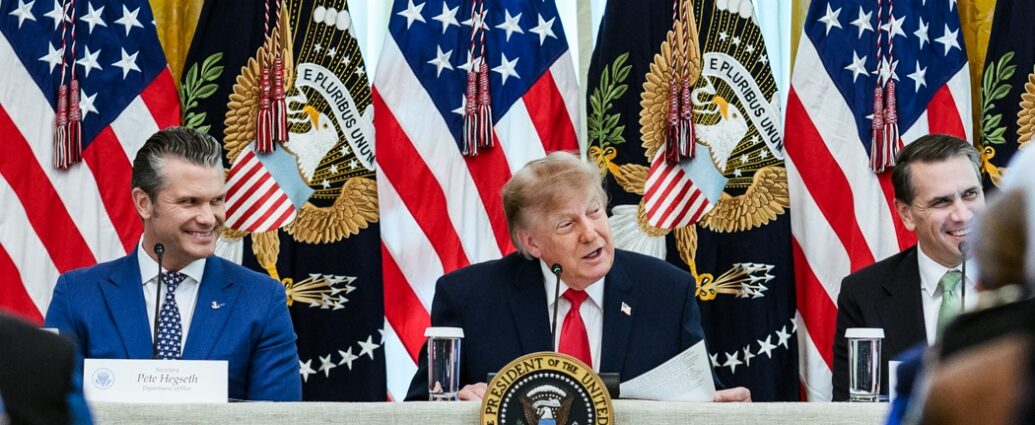
Trump at an October2026 White House roundtable, archive photograph

The White House / Public domain

President Donald Trump said Sunday that renewed U.S. attacks on Iran were “highly unlikely” if negotiations made progress, while warning that American forces remained ready to strike. His comments put talks over Iran’s nuclear program and reopening the Strait of Hormuz at the center of the next decision on military action.

The president paired his preference for an agreement with a warning that bridges and power plants remained potential targets, leaving diplomacy and the threat of force running alongside each other.

“It depends on whether or not they sign a very strong agreement,” Trump said in a Sunday telephone interview. “The answer is highly unlikely it’s going to be necessary.”

Trump repeatedly said he did not expect another round of attacks to be needed, but did not rule them out. “I would if necessary, but we hit them really hard,” he said.

Military pressure remains on the table

Trump said three U.S. aircraft carriers were in the region, including one that had recently arrived. “They’re fully locked and loaded,” he said, describing the forces as ready if he ordered action.

He also said the United States had identified 38 bridges it could destroy in an hour and had power plants among its potential targets. The president said he would prefer not to destroy infrastructure because rebuilding it would take years.

“I don’t like ripping down bridges. And the hardest thing to build is a bridge. It takes years, and I’m a good builder,” he said.

Trump also asserted that previous strikes had destroyed Iran’s air defenses and sharply reduced its missile and drone production capabilities. Those were the president’s assessments of Iran’s military position.

Hormuz keeps the talks tied to commerce

The negotiations concern both Tehran’s nuclear program and reopening the Strait of Hormuz, bringing the security of tanker traffic into the same discussion as the threat of new strikes. The interview’s account described tankers passing through the strait coming under Iranian attack during the prolonged standoff.

For companies moving oil through the waterway, the issue is whether ships can pass safely. For businesses and households watching energy costs, the talks connect the prospect of a military agreement with the conditions facing ships carrying oil.

Trump’s position Sunday was that a sufficiently strong agreement could avert renewed attacks, while the forces and targets he described would keep military pressure in place. “Most likely it will not be necessary,” he said. “They want to make a deal so badly.”

Archive photograph: Trump at an October 21, 2026 roundtable, not Sunday’s telephone interview.

JBizNews Desk | Washington

© JBizNews.com. All rights reserved. Unauthorized reproduction or redistribution is strictly prohibited.

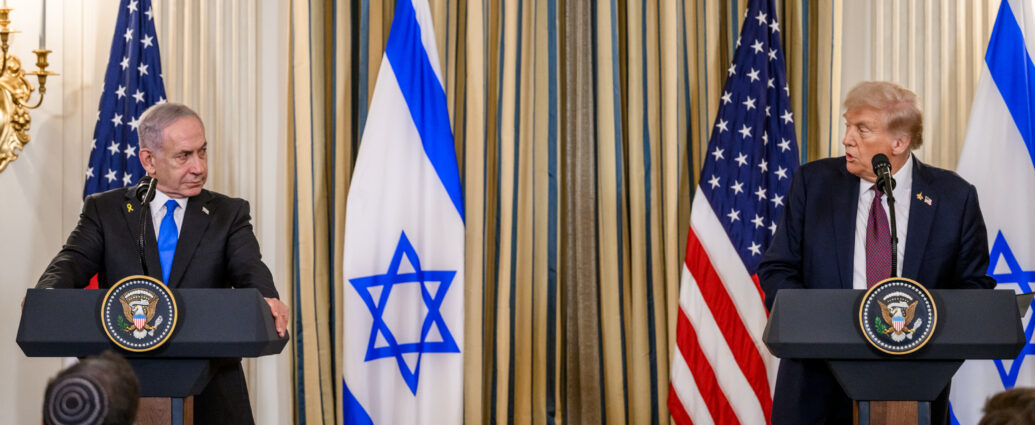
Trump and Netanyahu at a September2025 joint press conference, archive photograph

Official White House Photo / Joyce Boghosian / Public domain

President Donald Trump asked Israeli Prime Minister Benjamin Netanyahu to take steps to implement his Gaza peace plan during a Thursday phone call, according to an Axios report citing two sources with knowledge of the discussion. The reported push would put disarmament, civilian governance and reconstruction back on the agenda after Israel’s election.

The account describes Washington pressing for movement regardless of who forms Israel’s next government, with cooperation from Israel and Hamas still central to carrying out the plan.

Axios reported Sunday that Netanyahu initiated the call and that Secretary of State Marco Rubio, Jared Kushner and U.S. envoy Steve Witkoff also participated. One source described it as constructive and said the conversation also covered Iran. Axios said the White House and the Israeli prime minister’s office had not immediately responded to its requests for comment.

Disarmament before reconstruction

The reported discussion concerns a roadmap calling for Hamas to disarm, Gaza to be demilitarized and governing responsibilities to pass to a Palestinian technocratic administration. Axios said implementation had been held up for months around Israel’s October 27 election.

A U.S. official quoted in the report said the process would be gradual and reconstruction would begin only after progress in disarming Hamas had been verified. The report described a six-month, $2.45 billion initial recovery proposal covering 66 projects.

That condition ties the economic work to the security decisions: the reported proposal would not move from planning into reconstruction simply because the leaders spoke. Cooperation and verified disarmament would determine when recovery work could begin.

A framework for government and rebuilding

In its January 16 statement on the peace framework, the White House described restoring core public services, rebuilding civil institutions and supporting Gaza’s transition from conflict to development. It assigned the Board of Peace oversight and international resource-mobilization responsibilities, and described an International Stabilization Force tasked with security, demilitarization and enabling safe delivery of aid and reconstruction materials.

Axios reported that former British Prime Minister Tony Blair, a member of the Board of Peace, visited Israel Friday and met Netanyahu and Gadi Eisenkot, who has been tasked with trying to form a new government. A source said Blair urged Israeli political leaders to give the plan a chance.

“We want to move forward collaboratively and we need full cooperation and partnership from the Israeli government,” the U.S. official told Axios.

The central question in the reported push is whether renewed political pressure can produce the security cooperation needed for civilian government and reconstruction to take hold. The call described by the sources is a step toward that work, not an announced implementation agreement.

Archive photograph: Trump and Netanyahu at a September 29, 2025 press conference, not this week’s call.

JBizNews Desk | Washington

© JBizNews.com. All rights reserved. Unauthorized reproduction or redistribution is strictly prohibited.

Jean-Luc Melenchon in a May2026 archive photograph

jlm2017.fr / Wikimedia Commons / CC BY 4.0

Jean-Luc Mélenchon has pledged direct action against Israel’s policies and said French ships would escort pro-Palestinian civilian flotillas “if necessary” if he wins France’s 2027 presidential election. The La France Insoumise leader set out the position around his Saturday program rally at Le Bourget, near Paris.

In his own November 7 statement, Mélenchon wrote: “We will act directly to come to the aid of the Palestinians, both against the genocide in Gaza and against the gradual annexation of the West Bank.” The wording is translated from French and reflects his characterization of Israel’s actions.

“French ships will, if necessary, escort flotillas of citizens mobilized to assert their rights,” he added. His statement also rejected what he called the gradual annexation of the West Bank, southern Lebanon and the Golan Heights, and promised action in support of Christian communities in Palestine and Lebanon.

The party’s rally announcement identified the November 7 gathering as the presentation of L’Avenir en commun, its presidential government program. The naval-escort pledge is a proposed course for a future presidency, rather than an order from the French government.

If elected, Mélenchon’s stated pledge of direct action against Israel’s policies and French ship escorts for flotillas would put France-Israel relations at risk of confrontation. He would also command France’s nuclear arsenal as president.

A presidency with nuclear authority

The election carries security stakes beyond any one naval mission. France is a nuclear-armed state, and its president holds the ultimate decision over use of its nuclear deterrent. In a March 2026 speech, the French presidency stated that this decision belongs to the president alone.

A Mélenchon victory would place that presidential responsibility in his hands. His flotilla statement concerns French ships and support for Palestinians; it does not announce a nuclear deployment or a nuclear threat against Israel.

The business ties at stake

France and Israel also have a substantial commercial relationship. A French Foreign Ministry economic fact sheet puts their 2025 goods trade, excluding military equipment, at about 3.3 billion euros. It lists cosmetics, vehicles and pharmaceuticals among France’s leading exports to Israel, and agricultural products and medical instruments among its leading purchases from Israel.

That connects the diplomatic relationship to businesses and the goods people buy. Mélenchon’s verified statement sets out a foreign-policy pledge, not a new tariff, trade restriction or change to passenger flights. Any practical effect on those activities would depend on later government decisions.

JBizNews Desk | Paris

© JBizNews.com. All rights reserved. Unauthorized reproduction or redistribution is strictly prohibited.

Reggie Jackson pitches at the 2012 Home Run Derby, with a State Farm representative at right. Archive photo.

Archive: State Farm / CC BY 2.0

Baseball Hall of Famer Reggie Jackson urged Philadelphia-area leaders to speak out against antisemitism, drawing on his own experience of racist exclusion in the 1960s to call for solidarity with Jewish communities in his native Pennsylvania.

In a Saturday post, Jackson said seeing antisemitism near his hometown of Wyncote brought back memories of segregation in the South. He described signs refusing service to Black people and separate bathrooms and drinking fountains.

“I remember what that hatred looked and felt like. We cannot accept it in any form, directed at any people,” he wrote.

Jackson’s appeal was directed at public officials and community leaders. He said he wished he could stand alongside people protesting hate, and asked for clear, consistent condemnation of antisemitism.

“When hateful language is excused or repeated, it can make hostility seem acceptable and deepen fear and division,” he wrote. “Leaders should speak plainly and consistently: antisemitism and hate have no place in our communities.”

He ended with a blunt call: “What the hell? We have to speak up.”

Jackson pointed to Anti-Defamation League data recording 465 antisemitic incidents in Pennsylvania in 2024, an 18% increase from 2023. The organization’s 2024 audit lists harassment, vandalism and assaults among the incidents it tracks. The figures describe the organization’s incident count, not a count of criminal convictions.

His message emphasized the effect of hostility on people’s daily lives, including fear about personal safety and the pressure to take extra security measures. He linked that concern to his memories of being excluded because he was Black, arguing that hatred should be rejected regardless of whom it targets.

Jackson spoke publicly about those experiences during the 2024 tribute to the Negro Leagues at Rickwood Field in Birmingham, Alabama. He recalled being turned away from restaurants and hotels while playing for the Birmingham A’s in the 1960s, and credited teammates and friends with helping him through the threats and discrimination.

“I wouldn’t wish it on anybody,” he said during that appearance, as described in a 2024 account.

Jackson went on to a major-league career that included 563 home runs and three home runs in Game 6 of the 1977 World Series for the New York Yankees. The Hall profile records his induction in 1993. His latest statement used that personal history to urge leaders to reject antisemitism and support people facing hate today.

JBizNews Desk | Philadelphia, Pennsylvania

© JBizNews.com. All rights reserved. Unauthorized reproduction or redistribution is strictly prohibited.

Calley Means at AmericaFest in Phoenix, December 20, 2024. Archive photo with headroom.

Archive: Gage Skidmore / CC BY-SA 2.0 (cropped)

Sunday interview: Means said he wanted Wiles removed

In his interview with Margaret Brennan, a portion of which aired Sunday on Face the Nation, Means directly addressed his purpose in making the allegations public. Asked whether he had intended to get Susie Wiles removed, he answered: “Yes.” Asked whether his allegations had been a factor in her departure, he said: “I have no idea.” His stated intention did not establish that his intervention caused the personnel change.

Means again alleged that a group around Wiles had catered to special interests rather than carrying out the health agenda Trump had campaigned on. He named Richard Walters, Walker Barrett and James Blair in describing that group, and separately criticized outside pollster Tony Fabrizio’s influence over policy. Later in the interview, he also referred to Katie Wiles and Chris LaCivita in his allegations about lobbying and access. These were Means’ accusations and descriptions, not independently established findings of misconduct.

Brennan pressed him on the basis for those claims, distinguishing his theory from verified facts. The interview did not itself prove that money changed hands for a particular policy decision. Means’ account of who knew about or approved individual actions should not be read as a finding about those individuals.

Asked whether Health and Human Services Secretary Robert F. Kennedy Jr. had known in advance that he would go public, Means answered: “No.” That was Means’ account of Kennedy’s prior knowledge, not a statement from Kennedy.

Means also called for cooperation with Democrats on health policy. He said he believed Kennedy and Stephen Miller would be open to meetings and specific progress on drug pricing, labels for ultra-processed food, and greater disclosure and review processes at the Food and Drug Administration. The discussion included Bernie Sanders, Elizabeth Warren and Abdul El-Sayed as potential Democratic partners. Means was describing possible cooperation, not announcing a deal, a meeting schedule or legislation agreed with those lawmakers.

Watch the official 41-minute, 16-second full interview with Calley Means.

Former Trump administration health adviser Calley Means says White House officials allowed industry lobbying and midterm-election calculations to block parts of the Make America Healthy Again agenda, offering an insider’s account of the policy fights that preceded his resignation.

Means made the allegations in a Friday podcast interview with Joe Rogan. The episode aired Nov. 6, more than two weeks after Means left the administration on Oct. 22.

Means, a former senior adviser to Health and Human Services Secretary Robert F. Kennedy Jr. who also worked in the White House, said Kennedy’s Democratic background and decision to work with Republican President Donald Trump offered a major opportunity to bring the parties together. He said he joined believing their alliance could overcome resistance to health-policy changes.

The policies at stake

Means’ food-policy examples included school meals, an ultra-processed-food definition and former FDA commissioner David Kessler’s proposed inquiry into sugar and refined carbohydrates. He alleged that industry objections and the desire to preserve election money stalled proposals even after extensive internal work. He also credited public pressure and direct presidential intervention with advancing some initiatives, including food-dye changes and state restrictions on soda purchases with SNAP benefits.

Who he says controlled policy and access

Means traced those delays to the White House policy process, describing Wiles’ office as a central gatekeeper for Cabinet policy. He said no policy decision moved forward without her office’s approval and that Cabinet secretaries spent meetings discussing how to win her favor. He described this small circle as among the most powerful people in the country because they controlled which proposals advanced, not merely the scheduling of meetings. The people he identified around Wiles were:

  • James Blair: Means described the former political-operations official as a key policy gatekeeper who remained involved after moving to midterm work.
  • Walker Barrett: Means named him as a powerful deputy and the official who presented the glyphosate order as final.
  • Richard Walters: Means described the fundraiser and former consultant as an influential deputy who took on responsibilities while Wiles received cancer treatment.
  • Tony Fabrizio: Means said Trump’s outside pollster could determine whether proposals were considered politically acceptable.
  • Chris LaCivita: Means pointed to the campaign adviser and outside consultant as another influential figure.

He also pointed to Wiles’ former firm, Ballard Partners, as an example of the connections he believed shaped access.

Means specifically alleged that Fabrizio was being paid by Pepsi while advising that some MAHA proposals were not worth the political cost. He framed that combination as a conflict between corporate clients and the policy changes voters had supported. Fabrizio is an outside pollster and adviser, not a deputy White House chief of staff.

His firm’s public biography, checked Nov. 7, lists PepsiCo, Pfizer, Juul and Altria among companies he “has worked for.”

Means said companies hiring Wiles’ daughter through Continental Strategies were discussed internally as higher-priority matters. He also cited Checkmate and Ballard as firms whose business grew with their connections to the administration.

Midterm money versus the health coalition

He said election strategy shaped that process: the political team emphasized redistricting, targeted campaigning, affordability, tax cuts and no tax on tips rather than the health changes that he believed had helped build Trump’s coalition with Kennedy. He recalled Fabrizio dismissing MAHA as a relatively unimportant part of the election strategy and judging some proposals not worth the political cost.

Means alleged that Wiles told him industry money was needed for the midterms. His criticism was both ethical and political: he said carrying out popular campaign promises would have motivated voters more effectively than postponing those promises to preserve industry support. He rejected the argument that officials could wait until after the election to act, asking why the incentives would suddenly change then.

He blamed that approach for the party’s midterm losses. Rogan challenged his emphasis on staff, pointing to Trump’s own decisions, including the Iran war and cryptocurrency controversies. Means acknowledged that the president bore ultimate responsibility, while arguing that staff controlled many decisions below his attention.

Glyphosate: scrutiny, legal recourse and a national-security order

One detailed case study was glyphosate. Means described a fight simply to mention glyphosate in the administration’s health report. He alleged that industry and agricultural-state lawmakers pushed against further inquiry and that officials faced pressure not to study the pesticide. His argument was not that all use could end immediately: he said farmers needed alternatives and that lawsuits could create incentives to develop them.

He said Barrett presented him with a final executive order invoking national security and told him Kennedy should not reopen the discussion. The February order, signed Feb. 18, invokes the Defense Production Act to protect supplies of elemental phosphorus and glyphosate-based herbicides. Its stated rationale links phosphorus to defense manufacturing and glyphosate to agricultural productivity and food security. Means disputed that rationale and the process behind it.

Separately, he criticized the administration’s legal support for pesticide manufacturers in Supreme Court litigation. He alleged that Heidi Overton and lawyer Sarah Harris helped advance a position favoring liability protection without Kennedy’s involvement. Means said Trump later reacted negatively when the issue was raised with him.

Psychedelics and presidential intervention

By contrast, he described psychedelic research as an initiative that advanced after presidential intervention. He said it initially faced resistance from Wiles and Overton, whom he described as treating the therapies like ordinary street drugs. He said Rogan’s call to Trump helped break that impasse and drew complaints inside the White House that an outsider had bypassed the policy process.

He defended that contact as a legitimate way for a public constituency to reach the president. By the time he left, Means said, the initiative was moving more positively than many others, with work toward faster research and review of potential therapies, including ibogaine. He said he remained in contact with officials trying to keep that work moving.

Flavored vapes and concentrated kratom products

On vaping, he described pressure in the other direction, toward fewer restrictions. He alleged that Blair and other political officials made a more permissive pathway for fruit-flavored vapes a high-priority health issue, arguing that it mattered to young male voters. He said then-FDA commissioner Marty Makary faced repeated pressure over approvals while the health agenda received less attention.

He said Makary resisted relaxing standards and that Overton later pushed a policy change that drew legal opposition.

Means also criticized the handling of concentrated 7-hydroxymitragynine, or 7-OH, products associated with the kratom market. He alleged that lobbying pressure led officials to allow a concentration threshold 20 times higher than an earlier proposal. He distinguished the concentrated compound from trace amounts in the leaf and argued that easier access could worsen opioid addiction.

Review procedures he questioned

He extended that criticism to vaccine-review procedures, alleging that corporate pressure affected review of a Moderna mRNA flu vaccine and said an additional Pfizer COVID-vaccine study requirement was dropped after Makary left.

The system Means says operates across both parties

Means broadened his criticism beyond the Trump White House, arguing that the disputes were examples of a system that survives changes in party control. He said it had operated for roughly 30 years and called it a “structural problem,” rather than something unique to Trump or the Democrats. He argued that Congress had not meaningfully constrained special interests and said replacing individual officials would not, by itself, change the incentives.

He described a cycle in which companies hire people close to the officials who control policy, former staffers sell their access and knowledge after leaving government, and political leaders treat industry support as essential to winning the next election. In his account, that gives officials reasons to accommodate potential future employers and gives outside advisers conflicting incentives when their clients have business before the government.

Means said lobbying business was already shifting toward former staffers of Democratic leaders Chuck Schumer and Hakeem Jeffries as power shifted. “It’s not one party,” he said.

There is a separately documented hospital-industry address by Schumer: in an April speech published by Senate Democrats on April 20, 2026, Schumer told the American Hospital Association that hospitals would have resources and “a seat at the table” under Democratic control. He said he consulted the association and the health-care industry before changes and called for strengthening the Affordable Care Act, Medicare and Medicaid.

To illustrate the revolving door, Means recounted attending a dinner with Eli Lilly CEO Dave Ricks and another White House staffer who, he said, later became a lobbyist. He also questioned the move of National Security Council official Courtney Knupp to the United Soybean Board after work he associated with the glyphosate order. He presented those examples as evidence of career incentives that extend beyond any single administration.

Why he left and spoke publicly

Means said the stalled proposals, and what he regarded as misleading assurances about them, led him to leave the administration.

Means said speaking openly was now the most useful way he could advance the agenda. He remained optimistic about the movement, described his departure as an early stage rather than an endpoint and said telling the truth about the process could itself create pressure for change.

Means framed his decision to speak publicly as an effort to press for the health-policy commitments that drew him into the administration, rather than abandon the MAHA agenda.

The White House response

The White House defended its record. In a reported response, spokeswoman Allison Schuster said the administration had secured health-policy victories, citing dietary-guideline changes, action on artificial ingredients and investment in regenerative farming. She said Trump and Kennedy continued working to deliver further gains.

His call to action

His proposed answer went beyond replacing individual staff members. Means called on Americans across party lines to demand changes to the rules of government rather than keep switching parties within the same system. He urged Trump to change the people controlling policy and work with willing Democrats as well as Republicans on institutional reform. He said there were officials inside the administration who still wanted to carry out the original health commitments and argued that Trump could change course during the remaining two years.

His longer-term proposals focused on changing the rules:

Money in politics: A short, bipartisan constitutional amendment applying comparable restrictions to corporate and union money.

Outside influence: Scrutiny of super PACs, foreign-government payments to influential advisers and lawmakers’ fundraising demands.

Senate elections: Reconsidering direct election of senators in favor of the earlier system of selection by state legislatures.

He argued that these institutional changes should come before another round of policy promises.

He proposed making reform a central presidential campaign promise and using public pressure to force Congress to act. He also raised the Constitution’s state-convention route as an alternative path to amendments. Means’ broader point was that new policy promises would keep running into the same obstacles unless the underlying incentives changed.

JBizNews Desk | Washington

© JBizNews.com. All rights reserved. Unauthorized reproduction or redistribution is strictly prohibited.

Ron DeSantis waving at an event in Tampa on July18,2021, archival photograph

Gage Skidmore / CC BY-SA 2.0

Florida Gov. Ron DeSantis said Saturday that the military campaign against Iran lacks a clearly defined objective and sufficient public support, warning that efforts to bring down the Iranian regime could leave the United States in a prolonged conflict.

Speaking at the Notre Dame Center for Citizenship and Constitutional Government, DeSantis said the operation went beyond targeting Iran’s nuclear infrastructure and sought to overthrow the country’s leadership without a realistic plan for what would follow, according to a report on his remarks. “That’s not something that we’re going to be able to impose. That would require massive amounts of boots on the ground, massive amounts of treasure, that the American people are not interested in providing,” he said.

DeSantis distinguished the campaign from the June 2025 strikes on Iranian nuclear facilities, which he said he continues to support, and criticized what he called inconsistent explanations from senior administration officials about the war’s purpose. He also questioned whether Iran’s leadership has any incentive to negotiate after the killing of the country’s supreme leader and senior clerics. “My fear is that it’s going to kind of drag on and continue to be a sore spot,” he said.

DeSantis said the conflict “just kind of happened” without “much of a real debate,” and that many expected it to end quickly. “People thought it was going to end after a week or two, and then it didn’t, and then you had this issue with oil, oil supplies, and all these other things that have caused individual Americans to have pain at the pump,” he said, adding that higher energy prices permeate the economy as a whole, according to the report on his remarks.

He said the war had become “a big, big drag” on the Republican Party, telling voters’ concerns directly: “We have some of our voters who’ve checked out because they’re like, ‘I didn’t want any more Middle East wars and now we’re doing it.'” He contrasted the conflict with what he called the quick operation in Venezuela, saying an open-ended conflict now has “a direct impact on people’s finances because they’re going to the gas pump.”

His remarks come as Republicans debate the party’s direction after sweeping midterm losses and amid speculation about DeSantis’s own political future, which he has dismissed.

JBizNews Desk | South Bend, Indiana

© JBizNews.com. All rights reserved. Unauthorized reproduction or redistribution is strictly prohibited.
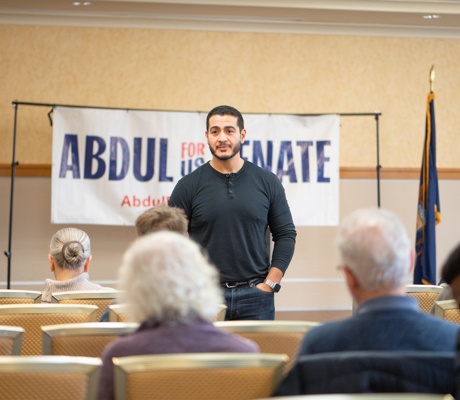
The US Capitol building seen from the Library of Congress

Photo: Packer1028 / Wikimedia Commons / CC0

Crypto companies are preparing for a harder fight in Washington as incoming Democratic majorities seek stronger investor protections and closer scrutiny of President Donald Trump’s ties to the industry. The shift threatens the terms of legislation the industry wanted, while leaving the existing stablecoin law and ongoing regulatory work in place.

The Clarity Act, the industry’s long-sought bill to settle which agencies police crypto markets, failed to advance in a September procedural vote even under Republican control. The new Congress that takes over committees in January could demand ethics restrictions, stronger consumer protections and a larger role for the Securities and Exchange Commission – demands that have not been enacted, a report said.

Sen. Elizabeth Warren of Massachusetts, the Banking Committee’s top Democrat, is expected to lead the panel, and Rep. Maxine Waters of California is set for greater influence on House Financial Services. Sherrod Brown could gain a senior Senate Agriculture Committee role overseeing the Commodity Futures Trading Commission, according to analysis firm Capstone, though no committee appointments have been confirmed. Warren has said she wants a bipartisan crypto bill but opposed the Clarity Act as “written by the crypto industry,” telling the Senate in September it would “turbocharge Donald Trump’s unprecedented corruption.” Trump denies any business conflicts.

Industry voices are adjusting. The Hyperliquid Policy Center’s Adam Minehardt described a “defensive posture” for the industry, New York University’s Austin Campbell pointed to risks from the industry’s alignment with Trump, Healthy Markets’ Tyler Gellasch said Democrats gain oversight tools short of legislation, and the Crypto Council for Innovation’s Ji Kim said bipartisan cooperation is still possible, according to the report. The stablecoin law signed earlier remains in place and SEC and CFTC rulemaking can continue.

“For crypto, the Democratic sweep may well be the final nail in the Clarity Act’s coffin,” Mati Greenspan, founder of Quantum Economics, told CoinDesk earlier this week, and TD Cowen analysts said a Democratic Congress kills the bill for two years. More than 70 House Democrats previously backed the legislation, which some industry leaders say leaves room for a tougher bipartisan bill with stronger consumer protections and conflict-of-interest rules.

JBizNews Desk | Washington, D.C.

© JBizNews.com. All rights reserved. Unauthorized reproduction or redistribution is strictly prohibited.
Conlan Houston / CC BY-SA 4.0

Michigan’s senator-elect Abdul El-Sayed called his state “the capital of Arab America” during remarks at the CONNECT Arab America Empowerment Summit in Chantilly, Virginia, on Friday, Nov. 6, days after his Senate election victory.

“My name is Abdulrahman Mohamed El-Sayed, and I’m honored to be the next United States Senator from the great state of Michigan,” he told the audience. Drawing a contrast with the Washington area, he added: “Obviously Washington is the capital of the United States of America, but Michigan is the capital of Arab America.” The remarks appear in a video recording of the appearance.

The event took place at the Westfields Marriott Washington Dulles, outside Washington, D.C. The Arab America Foundation’s event announcement scheduled El-Sayed for the Friday evening program and said his appearance would focus on Arab American leadership, public service, identity and empowerment.

The summit program included discussions on civic participation, education, entrepreneurship, media and Arab American heritage. Organizers said before the event that they expected more than 300 participants from across the country; that was an advance estimate, not a final attendance count.

El-Sayed, a Democrat and the son of Egyptian immigrants, defeated Republican Mike Rogers in Michigan’s Senate race and will become the first Muslim to serve in the U.S. Senate, according to a race report. His remarks at CONNECT placed Arab American identity at the center of a post-election appearance before a community audience.

The foundation’s speaker announcement describes El-Sayed as an Egyptian American physician, epidemiologist and former public-health official. He previously led the Detroit Health Department and Wayne County’s Department of Health, Human and Veterans Services.

His campaign’s stated priorities include reducing the influence of money in politics, improving household finances and passing Medicare for All.

JBizNews Desk | Washington, D.C.

© JBizNews.com. All rights reserved. Unauthorized reproduction or redistribution is strictly prohibited.
Stephen Miller speaking at CPAC in February 2025

Gage Skidmore / CC BY-SA 2.0

Stephen Miller pledged “absolute loyalty” to President Trump on Friday evening in his first public remarks since being named White House chief of staff, calling the promotion “the honor of my life” during an event at Trump’s Mar-a-Lago resort in Palm Beach, Florida.

“We need to stand with the man who has stood with us with every fiber of his being,” Miller said in a video Trump posted to Truth Social. “I pledge you, Mr. President, my absolute loyalty, my unwavering commitment and my total devotion to your success and the success of this country.”

Trump announced Friday morning that Susie Wiles had stepped down as chief of staff and that Miller, the architect of the administration’s hardline immigration policies, would replace her. The choice drew quick backlash from Democrats and some Republicans after the party’s sweeping midterm losses. Senate Minority Leader Chuck Schumer of New York wrote that Trump “learned nothing from his historic defeat” and called Miller “the architect of the most barbaric, inhumane policies of this administration.” Sen. Thom Tillis of North Carolina urged the president to “rethink” the elevation, calling it a “colossal mistake,” a report said.

Cabinet secretaries broadly praised the switch. Defense Secretary Pete Hegseth shared a photo of himself with Miller captioned, “Stand. Fight. Defend the Republic.” Miller also praised the administration’s defense agenda Friday night, saying, “If it wasn’t for President Trump, the United States of America would not exist right now. This man saved America.”

JBizNews Desk | Palm Beach, Florida

© JBizNews.com. All rights reserved. Unauthorized reproduction or redistribution is strictly prohibited.

President Donald Trump outdoors, October 13, 2026 archival White House photograph

White House / Molly Riley

President Donald Trump on Saturday ordered the Justice Department to investigate Democratic officials he called “extortionists” and said they should face prison, accusing them of threatening Republicans and GOP donors with impeachment and prosecution after the party’s losses in Tuesday’s midterm elections.

“The Democrats are going around threatening a lot of people, including the Attorney General of the United States, and others, with Impeachment and many other forms of punishment, even though they admit they have no reason to do so,” Trump wrote on Truth Social Saturday. “This is extortion at the highest level, and they should be held accountable for this.” He added: “The imprisonment should be against these EXTORTIONISTS, and Republicans should get smart, fast!”

“By copy of this statement, I am ordering the Department of Justice to look into this criminal act, immediately!” he wrote.

The post named Sen. Elissa Slotkin of Michigan, whom Trump accused of threatening young Republicans. It came after Democrats made sweeping gains in Tuesday’s election and as several Democratic lawmakers stepped up talk of investigations and impeachment: Rep. Robert Garcia of California, the House Oversight Committee’s top Democrat and its incoming chairman, warned people to “lawyer up” after the election, and Reps. Hank Johnson of Georgia and Deborah Ross of North Carolina floated impeaching Attorney General Todd Blanche, according to reports.

Rep. Thomas Massie of Kentucky, who lost his May primary to a Trump-backed challenger, has announced plans to force a vote on impeaching Defense Secretary Pete Hegseth. Rep. Jamie Raskin of Maryland and Illinois Gov. JB Pritzker have each called for an investigation of the Department of Government Efficiency, the cost-cutting office previously run by Elon Musk, who spent more than $400 million backing Republicans in the midterms, a report said.

Trump’s post came a day after he named Stephen Miller, his top policy aide, as White House chief of staff.

JBizNews Desk | Washington, D.C.

© JBizNews.com. All rights reserved. Unauthorized reproduction or redistribution is strictly prohibited.

Theodore Roosevelt Executive and Legislative Building in Mineola, New York, photographed in 2018

Tdorante10 / CC BY-SA 4.0

Muslim and Pakistani-American community members in Nassau County say a fake Instagram account is targeting County Executive Bruce Blakeman’s administration and Muslim members of his team with an online smear campaign, according to an article circulating in the community.

The account, operating under the name “Muslim Audits,” uses a profile image of an unidentified woman wearing a hijab and presents itself as a grassroots representative of local Muslim interests. Community members quoted in the article, by local writer Farooq Mirza, say it is a ghost handle run by anonymous actors to spread disinformation and divide neighbors along ethnic and religious lines. That claim has not been independently verified.

The account has posted attacks on Blakeman and on figures in his administration and advisory circle, including Chaudhry Akram, an advisor to the county executive; Shahryar (Sheryar) Ali, an attorney; Own Naqvi, director of community affairs; businessman Mohsin Shah; and community activists Dr. Ijaz Ahmed and Asim Malik, according to the article. One graphic it posted urged residents not to vote for Ali, accusing local leaders of complicity in foreign conflicts. The Halal Guide, a community organization owned by Raza Dastgir, was also targeted, the article said.

Community members rejected the account’s claims, pointing to what they described as Blakeman’s supportive relationship with Muslim residents, including mosque visits, county venue space for religious and cultural events, and appointments such as Naqvi, Akram and Ali to community-affairs roles. Community members have asked local law enforcement to look into the account, according to the article.

Blakeman, a Republican, is the Nassau County executive and lost the governor’s race to Kathy Hochul on November 3. In September, Muslim residents pressed North Hempstead town officials to condemn a Blakeman social media post mocking Governor Kathy Hochul for wearing a hijab during a mosque visit, local media reported.

JBizNews Desk | Mineola, New York

© JBizNews.com. All rights reserved. Unauthorized reproduction or redistribution is strictly prohibited.

Carol M. Highsmith / Library of Congress

Right-wing activist Laura Loomer has been paid by private clients to make political posts on social media without publicly disclosing the payments, the Washington Post reported Saturday, citing a former campaign aide to President Donald Trump and three other people familiar with the arrangements.

The allegations were made by Alex Bruesewitz, an adviser to Trump’s 2024 campaign, and three other people who spoke on condition of anonymity, the newspaper said. Two of the three said they had paid Loomer directly to post political messages, and two of the people said she charges $3,000 to $5,000 per post, sometimes more. The newspaper said it reviewed bank transaction emails and a wire transfer statement showing four payments totaling more than $60,000 to Loomer and a Florida company registered in her name since May 2025; the documents do not specify what the payments were for.

Bruesewitz told the newspaper he paid Loomer for tweets last year through his political consulting firm for posts on policy issues, declining to name the clients, while saying such deals need clearer disclosure. Loomer denied being paid for posts. “My business is public affairs and opposition research,” she told the newspaper. “I certainly don’t charge $5,000 for a tweet.” She said Bruesewitz’s firm paid her for a one-page research document and then asked her to distribute the information, and she accused him of “lashing out” over her political beliefs.

JBizNews Desk | Washington, D.C.

© JBizNews.com. All rights reserved. Unauthorized reproduction or redistribution is strictly prohibited.

Rep. Abraham Hamadeh in his official congressional portrait

House Creative Services (public domain)

Republican Rep. Abe Hamadeh won a second term in Congress on Friday, defeating Democrat Bernadette Greene-Placentia in Arizona’s 8th Congressional District, in a race called Friday with Hamadeh leading 51.3% to 48.7%.

The win stood out on a difficult night for his party. Democrats captured control of both the House and the Senate in Tuesday’s midterm elections and flipped two other Arizona congressional seats, while Hamadeh held a West Valley district he had carried by 13 percentage points in 2024. He is no stranger to close races: as the Trump-endorsed Republican nominee for Arizona attorney general in 2022, he lost to Democrat Kris Mayes by 280 votes after a recount. Greene-Placentia, a small-business owner and long-haul truck driver, was making her first run for elected office.

Raised in Arizona’s 8th district and the son of Middle East immigrants, according to his bio, Hamadeh served as an Army Reserve captain and intelligence officer and later as a Maricopa County prosecutor. His mother is Druze, he wrote in an op-ed, describing how a law-school trip to Israel and a visit to a Druze village there shaped his support for the Jewish state. In Congress he sits on the House Armed Services and Veterans’ Affairs committees, has backed Israel and an expansion of the Abraham Accords, and in July 2025 called for an end to “barbaric violence” against the Druze community in Syria, urging the Syrian government to protect all its citizens, in a statement.

That heritage has drawn the attention of Jewish community leaders. The Orthodox Jewish Chamber of Commerce signed an MOU with the Druze community of Ein Qiniyye in August 2025, with founder Duvi Honig signing it in person alongside the delegation. The Chamber described it as a partnership of solidarity and cooperation dedicated to the memory of 12 Druze children killed in the Golan Heights. The children were killed in a rocket attack on a soccer field in Majdal Shams in July 2024, which Israel and the United States attributed to Hezbollah.

“We congratulate Congressman Hamadeh on his victory,” said Duvi Honig, Founder / CEO of the Orthodox Jewish Chamber of Commerce. “The Chamber supports him, and we look forward to working together with him.”

JBizNews Desk | Phoenix, Arizona

© JBizNews.com. All rights reserved. Unauthorized reproduction or redistribution is strictly prohibited.

Allan Criss / APCSS

President Donald Trump made clear Friday that Defense Secretary Pete Hegseth has his confidence, saying in an interview that aired Sunday evening that he stands behind his Pentagon chief even as he weighs a few changes elsewhere on his team.

Asked directly whether he has confidence in Hegseth, Trump said: “I do.”

“I love my Cabinet. I think they’re good,” he said in the interview. “But I’ll … be doing maybe a few changes.”

Trump recorded the interview Friday, and CBS released a preview on Saturday. The full interview aired Sunday at 7 p.m. ET on CBS and Paramount+. Hours after it was recorded, Trump announced that Stephen Miller would replace Susie Wiles as White House chief of staff, a change at the White House rather than at the Pentagon.

It was the second time this week the president backed Hegseth publicly. On Wednesday, asked whether he was considering replacing him, Trump said, “No, I think he’s doing a very good job.” He added that Hegseth, a former Army National Guard major, would be “very popular” if he ever sought the Tennessee Senate seat Marsha Blackburn is giving up to become governor, while saying, “I haven’t heard that at all.” The Associated Press reported Thursday that Hegseth is not under consideration for the appointment, citing one person familiar with private discussions.

The president’s full remarks aired Sunday at 7 p.m. ET on CBS and Paramount+. The full interview transcript includes his comments on Hegseth’s work at the Pentagon and potential changes to his team.

JBizNews Desk | Washington

© JBizNews.com. All rights reserved. Unauthorized reproduction or redistribution is strictly prohibited.

AI illustration of a generic office desk with a telephone, closed laptop and document folder.

The United States is offering up to $20 million, and possible relocation, to anyone who gives information about Iran’s nuclear program. U.S. Central Command announced the offer Friday evening.

The money comes from the State Department’s Rewards for Justice program. Its reward page says the tips can cover Iran’s nuclear facilities, equipment and the people tied to them, including scientists, as well as the movement of any of those. Central Command shared the offer in its post at 7:01 p.m. Eastern on Friday, Nov. 6.

What the program says about Iran’s uranium

The reward page says the International Atomic Energy Agency reported in 2025 that Iran is enriching uranium to 60 percent purity. It calls that a short technical step from the 90 percent needed for a nuclear weapon. The page says Iran is the only country without nuclear weapons that makes uranium at that level.

Who can send a tip

Anyone can send information to the program through its tip-reporting options. The page says possible relocation is available to people who come forward.

JBizNews Desk | Washington, D.C.

© JBizNews.com. All rights reserved. Unauthorized reproduction or redistribution is strictly prohibited.

President Donald Trump said Friday the U.S. is “doing very well with Iran” and is talking to Iran, a day after he said he would rather not destroy the rest of the country but may have to.

Trump told reporters during a gaggle Friday: “We are doing very well with Iran. We’re talking to Iran.” He added: “We have the Hormuz Strait opening, doing more business than they’ve ever done with oil. And we’re doing very well. And we are talking to them.”

What Trump said Thursday

Trump spoke Thursday at a White House signing event, in a video the White House posted. “I would rather not destroy the rest of the country if possible, but maybe I’ll have to,” he said. “You’ll know soon enough.”

He described it as a choice not yet made: “And now we’ll make a decision. Do we want to go further…”

On the talks with Iran, Trump said: “They’re not doing anything without our approval… Iran will never have a nuclear weapon.”

Where the talks stand

Qatar’s foreign ministry said Nov. 3 that Qatar is facilitating an exchange of proposals between Washington and Tehran. Its spokesman, Majed Al Ansari, said a Qatari delegation held a meeting of about three hours in Tehran on Monday, and that mediators are exchanging proposals in real time.

Al Ansari said both sides are reviewing the ideas, and that “it is not possible at this moment to speak of any specific breakthrough.”

JBizNews Desk | Washington, D.C.

© JBizNews.com. All rights reserved. Unauthorized reproduction or redistribution is strictly prohibited.

Satellite images taken in November show digging and new buildings at two major Iranian missile sites and apparent repairs at at least 12 other military sites, analysts say.

The analysts, at the British intelligence company MAIAR, reviewed the images for a new report. They also pointed to new construction and excavation outside tunnel entrances near the city of Qom, close to the Fordo underground uranium enrichment complex, which the U.S. and Israel have bombed several times.

What the images show

MAIAR analysts said digging and new buildings are visible at the Garmdareh military base in Karaj, near Tehran, and at the Shahroud base in the north.

Sam Lair, a research analyst at the Foreign Policy Research Institute, said the Karaj images appear to show “a new portal for an underground facility.” Analysts at Janes said a new facility appears to be under construction at Karaj, with tunnel entrances and structures that could mean an expansion of nearby damaged or destroyed missile bases, or could be for storage or other purposes.

At the other sites, the images appear to show repairs. New roofs have been built on destroyed buildings at the Kermanshah missile base in western Iran. At the Parchin military complex, east of Tehran, damaged buildings and debris have been cleared, and an underground bunker at the Taleghan 2 facility appears to have been repaired and reinforced with concrete.

What analysts say it means

Jim Lamson, a former CIA analyst who focused on Iran, said the digging near Shahroud could be related to missile production, and that the Islamic Revolutionary Guards Corps is probably trying to move production underground. A MAIAR analyst said Iran has “a pattern of moving infrastructure underground to protect them from further strikes.”

Mark Cancian, a military analyst at the Center for Strategic and International Studies, said activity on military assets would show Tehran is bracing for further attacks. “The purpose is to better defend itself against future attacks,” he said. “It also indicates a priority on rebuilding military capability rather than rehabilitating the economy.”

Sean O’Connor, a Janes analyst, said the construction is unlikely to be an effort to deceive foreign intelligence agencies because that would be costly and might achieve little.

A Pentagon spokesperson has said the U.S. “destroyed up to 90% of Iran’s drone, ballistic missile, and naval industrial base.” Iran says it still has large stockpiles of missiles, and state TV this week broadcast footage it said showed dozens of missiles at the entrance to an underground facility in southern Iran.

Background: Pickaxe Mountain, September 2026

In an analysis published Sept. 9, the Center for Strategic and International Studies said its satellite imagery could neither refute nor substantiate an Israeli intelligence claim that Iran moved uranium centrifuges into Pickaxe Mountain, a large underground tunnel complex about 2 kilometers south of Natanz. It said the facility’s depth is difficult to assess: some open-source estimates put it at 80 to 100 meters, but those rely on measuring piles of excavated dirt, which does not show a tunnel’s internal design.

JBizNews Desk | Tehran

© JBizNews.com. All rights reserved. Unauthorized reproduction or redistribution is strictly prohibited.

Archive: Gage Skidmore (CC BY-SA 2.0)

Former New York City Mayor Rudy Giuliani said Thursday that Vice President JD Vance has presidential potential but also “certain dangers” in his personality.

Giuliani spoke on his own YouTube livestream, addressing Vance directly. “I see presidential potential with you,” he said. “I also see certain dangers in your personality, which make you a dangerous possibility as president.” He added: “To be president, you have to have the flexibility of mind, not to have slogans dominate your thinking.”

Giuliani was responding to Vance’s lengthy online post on Wednesday, which said: “The reason we lost is the war.” Giuliani said: “That’s the feeling I got from you yesterday when you said that the election was determined by the war.” He said the election “wasn’t mainly, mostly determined by the war. The war was a sub part,” and that the economy was the deciding factor.

What voters said before the election

A Gallup survey released before the midterms found that about 47% of voters said the war would be an “extremely” important issue in their vote. In the same survey, half said the economy was extremely important.

JBizNews Desk | Washington, D.C.

© JBizNews.com. All rights reserved. Unauthorized reproduction or redistribution is strictly prohibited.

Archive: panumas nikhomkhai/Pexels (Pexels License). Cropped and resized. General archive, not a photo of the data center discussed.

Communities that voted to restrict data centers can keep those limits, White House economic adviser Kevin Hassett said Friday, while arguing planned AI construction elsewhere in the country can continue.

Data centers are the large buildings full of computers that run AI. How fast they get built can affect AI companies, local electricity bills and jobs in the towns where they are planned.

What Hassett said

Hassett, the director of the National Economic Council, said: “We respect the localities that decide that’s what they want to do. But America is a big place, and right now, the data centers scheduled over the next couple of years aren’t affected by these ballot initiatives.”

He added that there is “plenty of room in the U.S. for data center growth to continue, as it was projected ahead of the election.” He also said local communities should decide whether to welcome development.

Related coverage

Also Friday, President Trump said he is “100% in favor of Super Intelligence”. Separately, OpenAI’s finance chief said the company will keep building despite the election backlash.

JBizNews Desk | Washington
© JBizNews.com. All rights reserved. Unauthorized reproduction or redistribution is strictly prohibited.

Photo: Tom Fisk / Pexels

President Trump announced Friday that Stephen Miller will become White House chief of staff on Monday, Nov. 9, replacing Susie Wiles. Wiles will move to Trump’s political operation.

The chief of staff runs the president’s day-to-day schedule and decides who gets to see him and which issues reach his desk, so the change affects how the White House is run. Miller currently serves as deputy chief of staff. Wiles’s last day is Friday, Nov. 6, and Miller starts Monday, Nov. 9.

What the announcement said

Trump wrote in a Truth Social post: “I am pleased to announce that Mr. Stephen Miller, the current Deputy Chief of Staff of the Trump Administration, and one of my most trusted advisors, will become the Chief of Staff starting Monday, November 9, 2026.”

On Wiles, the post said: “Susie Wiles, who has done an outstanding job, will be moving over to the Trump Political Operation. I want to thank her for her service as Chief of Staff – She has done a great job!”

Wiles’s statement

Wiles also issued a statement soon after the announcement, in a post on X: “Today is my last day as White House Chief of Staff.” She added: “Serving President Trump in the White House has been the honor of a lifetime.” She also said: “While my role may be changing, my commitment to the President and the mission never will.”

JBizNews Desk | Washington
© JBizNews.com. All rights reserved. Unauthorized reproduction or redistribution is strictly prohibited.

Photo: Hakeem Jeffries’s official congressional portrait / United States Congress, Wikimedia Commons / public domain

By: JBizNews Desk 🌎

House Democratic leader Hakeem Jeffries formally launched his bid for speaker of the House on Wednesday in a letter to colleagues, a report said. Jeffries is widely expected to win the gavel after Democrats’ landslide midterm victory, which would make him the first Black speaker in U.S. history.

“I write to humbly request your support in connection with my candidacy to serve as the next Speaker of the House of Representatives,” Jeffries wrote. “We must now deliver the dramatic change the American people are demanding in the majority.” He said he wants Democrats to act decisively in three areas: affordability, accountability and American values.

Jeffries, first elected to Congress in 2012, has led House Democrats since Nancy Pelosi stepped down in 2022. While some incoming progressive and red-district Democrats have declined to commit to backing him, he is not expected to face serious opposition, and the size of the new majority helps insulate him, the same report said.

The rest of the team is taking shape. Katherine Clark formally launched her bid Thursday, Nov. 5, for majority leader, and Pete Aguilar is running for whip. Ted Lieu is in line to become caucus chair, and Joe Neguse is running for assistant speaker. None of them has been elected yet: House Democrats hold their leadership elections on Nov. 18, Clark’s office said.

In a letter to colleagues, Clark made affordability her main pitch and pledged to end the war in Iran, rescind the president’s tariffs, reverse Republican cuts to health care and food assistance, and oversee the administration. Those are promises, not actions.

JBizNews Desk | Washington

© JBizNews.com. All rights reserved. Unauthorized reproduction or redistribution is strictly prohibited.

Gadi Eisenkot meets U.S. General Joseph Dunford in Tel Aviv, May 2017. Archive photo.

Archive: Dominique Pineiro/U.S. Navy/DVIDS

Gadi Eisenkot said Friday that negotiations to form a national emergency government in Israel had made significant progress, outlining his plan for a minority government built on the four Change bloc parties with outside support from Arab and ultra-Orthodox parties.

“I intend to fulfill the mandate the people have given me, and the mandate the president is expected to entrust to me, with a profound sense of responsibility,” the Yashar party leader and former military chief said in a statement posted on X. President Isaac Herzog said Thursday he will announce on Sunday which lawmaker he tasks with forming the next government; no mandate has been assigned yet.

Eisenkot said his team had held dozens of hours of talks with opposition parties, making what he called “significant progress and breakthroughs.” He proposed swearing in a government “as quickly as possible, based on the four Zionist parties of change and reform,” with any party or Knesset member willing to accept his four principles joining “either immediately or gradually”: recognizing Israel as a Jewish and democratic state; upholding the values of its Declaration of Independence; requiring military, national or civilian service for all; and recognizing Hamas as a terrorist organization while committing to dismantling its military and governing capabilities.

The outside backing of Arab and ultra-Orthodox parties is Eisenkot’s proposal; such support has not been secured. Israel’s Oct. 27 election left no bloc with the 61 seats needed for a Knesset majority.

Joint List leader Ahmad Tibi said in a Friday interview that Eisenkot’s four principles do not apply to the Joint List, because it would stay outside the coalition. “Some of his supporters will be inside the coalition, and we will be outside the coalition as a safety net,” Tibi said. He said he does not expect the ultra-Orthodox and religious parties to join Eisenkot, so Eisenkot will need the Joint List and Ra’am, a combined 19 Knesset members. “We do not want Netanyahu to remain prime minister,” Tibi said.

“Israel is facing a real, tangible and dangerous emergency,” he wrote, arguing that the current government “threatens the very foundations of Israeli democracy” while military fronts remain open – his characterization of the stakes as Prime Minister Benjamin Netanyahu remains in office.

He also warned that anyone who tries to “undermine or sabotage the formation of a government for personal rather than substantive reasons” would be remembered by history as having “failed to act to save Israel in a time of emergency,” adding, “They will not be forgiven” – remarks widely seen as directed at Yisrael Beytenu chairman Avigdor Liberman, who this week reversed his position and voiced support for a government that includes ultra-Orthodox parties, even if it requires compromises on military conscription.

Eisenkot said another election would only prolong political uncertainty and leave Netanyahu in office as caretaker prime minister.

JBizNews Desk | Jerusalem

© JBizNews.com. All rights reserved. Unauthorized reproduction or redistribution is strictly prohibited.

Mississippi State Capitol in Jackson. Archive photo.

Update: Colom has been declared the winner.

Archive: Michael Barera/Wikimedia Commons, CC BY-SA 3.0

Mississippi’s U.S. Senate race remained uncalled Friday morning, with Democrat Scott Colom leading Republican Sen. Cindy Hyde-Smith by 1,813 votes as of Thursday evening, with about 96% of ballots counted, the Associated Press tally shows.

Colom’s lead has grown from just over 1,100 votes earlier in the count as counties process absentee and affidavit, or provisional, ballots.

Thousands of ballots remain to be counted. Mississippi’s Republican Party chairman, Mike Hurst, said up to 20,000 ballots were still uncounted, local reports say. Counties have until Nov. 13 to certify their results.

Hyde-Smith’s campaign and state Republicans have asked election officials to separate and preserve all provisional ballots, setting the stage for a possible legal fight over the count, local reports say.

Colom, a district attorney in northeast Mississippi, was nominated to the federal bench by President Joe Biden, but Hyde-Smith blocked the nomination. He announced his run against her in 2025.

Mississippi has not elected a Democrat to the U.S. Senate since 1982. The Associated Press has not called the race.

JBizNews Desk | Jackson, Miss.

© JBizNews.com. All rights reserved. Unauthorized reproduction or redistribution is strictly prohibited.
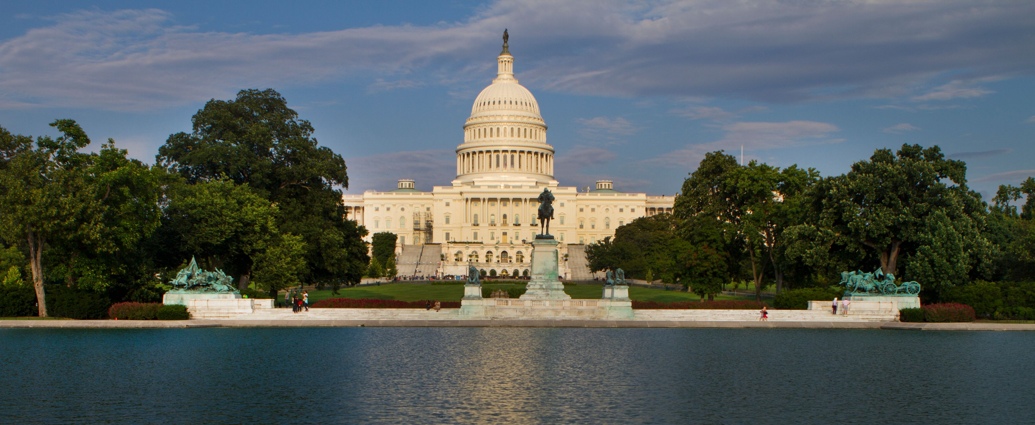
Federal courthouse in Miami. Archive photo.

Archive: Miami92/Wikimedia Commons, public domain

Two senior Justice Department officials left Friday: Miami’s top federal prosecutor and the head of the department’s national security division, which handles terrorism, espionage and leak cases.

The top federal prosecutor in South Florida resigned Friday, Attorney General Todd Blanche announced on X.

“United States Attorney for the Southern District of Florida Jason Reding Quiñones submitted his resignation from the Department of Justice,” Blanche wrote. “We are grateful for Jason’s leadership in combatting violent crime, drug trafficking, sex trafficking, and transnational crime, including the indictment of Raúl Castro. Jason has served the Department multiple times over his distinguished career, and we thank him for his service to this country.”

No reason for the resignation was given.

John Eisenberg, the assistant attorney general in charge of the National Security Division, also resigned Friday, according to two people familiar with the matter, and other sources said the same. Neither the department nor Eisenberg had commented when this was published. No reason or effective date has been given.

The division handles terrorism, leak and espionage prosecutions and was part of the case against former national security adviser John Bolton. The departures come a day after Harmeet Dhillon announced she was leaving as head of the department’s Civil Rights Division.

JBizNews Desk | Washington

© JBizNews.com. All rights reserved. Unauthorized reproduction or redistribution is strictly prohibited.

US Capitol and Reflecting Pool. Archive photo.

Archive: Ramaz Bluashvili/Pexels

Democrats are preparing a wave of bills aimed at artificial intelligence and data-center development for when they take control of Congress in January, shifting from promoting AI growth to regulating it, Reuters reported.

The plans are proposals, not law. Among them: shielding consumers from higher electricity bills tied to power-hungry data centers, requiring independent testing of advanced AI models against safety standards, and clarifying that companies can be held liable when their AI systems cause harm.

Senator Chuck Schumer of New York, who is expected to become majority leader, said protecting consumers from energy costs linked to the data-center buildout would be a priority next year. Representative Lori Trahan of Massachusetts plans legislation requiring independent experts to evaluate leading AI models, her office said, along with a measure clarifying company responsibility when AI acts in harmful ways. Representative Zoe Lofgren of California said Democrats would pursue “responsible regulations for AI while also fostering innovation.”

The shift follows Tuesday’s midterm elections, in which voters backed candidates and measures skeptical of rapid data-center expansion and the strain it puts on local power grids. Technology shares sold off Thursday in part on concern that a new Congress will slow AI development.

Any bill would still need President Trump’s signature or a two-thirds majority in both chambers to override a veto. Analysts say Democrats could also attach AI measures to must-pass legislation. Most U.S. voters think the administration and Congress are not taking AI risks seriously enough, a Reuters poll found in October.

JBizNews Desk | Washington

© JBizNews.com. All rights reserved. Unauthorized reproduction or redistribution is strictly prohibited.

Archive: Mojtaba Nozarnejad/Fars Media, CC BY 4.0 (cropped)

Iranian media reported that the Islamic Revolutionary Guard Corps claimed to have shot down a U.S. drone over Qeshm Island in the Strait of Hormuz, a claim that had not been confirmed by the United States, Iran International reported.

The claim, carried by Iranian outlets and relayed by Reuters, described the aircraft as a U.S. military drone downed over or near Qeshm Island. The IRGC said its Aerospace Force used electronic warfare systems to force the drone to land, according to the report. U.S. officials had not confirmed any loss of an aircraft.

Qeshm, Iran’s largest island, sits at the mouth of the Persian Gulf alongside the Strait of Hormuz, the waterway that carries roughly a fifth of global oil consumption, according to the U.S. Energy Information Administration. The IRGC has announced drone shootdowns in the area before, including the 2019 downing of a U.S. Navy surveillance drone that brought the two countries close to open conflict.

Any confirmed downing of a U.S. aircraft would mark a significant escalation at a time of heightened tension in the Gulf.

JBizNews Desk | Washington

© JBizNews.com. All rights reserved. Unauthorized reproduction or redistribution is strictly prohibited.

Archive: Rafid Sahrear/Pexels

A tanker transiting the Strait of Hormuz reported an explosion at its waterline 16 nautical miles east of Khasab, Oman, the United Kingdom Maritime Trade Operations center said Friday.

In a warning to shipping, UKMTO said the tanker’s master reported the blast on the vessel’s port side at 10 p.m. UTC Thursday while outbound through the strait. The crew is safe and accounted for, and the tanker remains under its own power and is continuing its voyage.

UKMTO did not say what caused the explosion, and authorities are investigating. The center advised vessels to transit with caution and report any suspicious activity.

The Strait of Hormuz, between Iran and Oman, carries roughly a fifth of global oil consumption, according to the U.S. Energy Information Administration, and security incidents there are closely watched by shipping and energy markets.

JBizNews Desk | London

© JBizNews.com. All rights reserved. Unauthorized reproduction or redistribution is strictly prohibited.