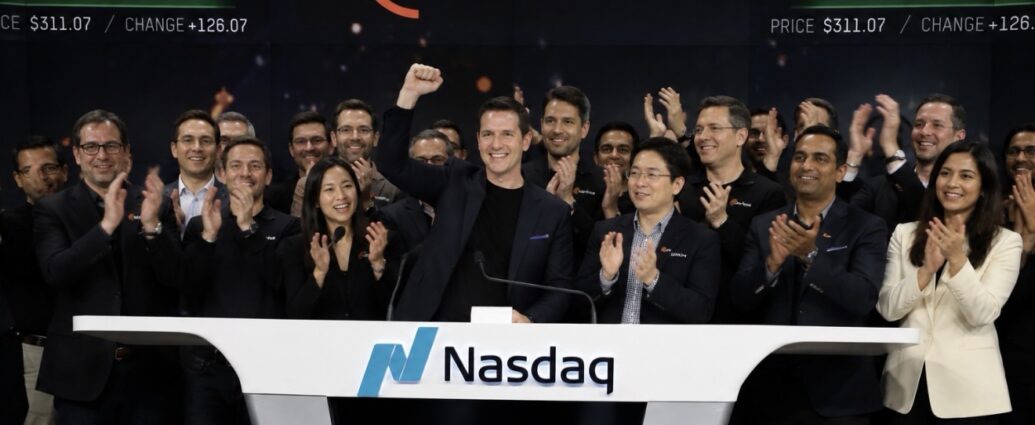
Cerebras Systems Inc. exploded onto Wall Street Thursday in the largest U.S. technology IPO since Uber’s 2019 debut, with shares of the artificial-intelligence chipmaker surging 68% on their first trading day and instantly turning co-founder and Chief Executive Andrew Feldman into a multibillionaire.
The Silicon Valley AI hardware and cloud-computing company priced its IPO Wednesday night at $185 per share — well above the originally expected $150-to-$160 range — before opening Thursday morning at $350, climbing as high as $386, and ultimately closing at $311.07.
At the closing price, Cerebras commanded a market valuation of roughly $95 billion, instantly becoming one of the most valuable pure-play AI infrastructure companies in public markets outside of NVIDIA.
The offering raised approximately $5.55 billion, with underwriting banks including Morgan Stanley, Citigroup, Barclays, and UBS holding an option to sell an additional 4.5 million shares that could lift total proceeds above $6.3 billion.
The deal marks the largest American technology IPO since Uber Technologies went public in 2019 and the first major pure-play AI chip listing to hit public markets during the current artificial-intelligence boom.
For Wall Street, the offering also signals a dramatic reopening of the technology IPO market after years of sluggish activity following the Federal Reserve’s aggressive rate-hiking cycle beginning in 2022.
Andrew Feldman Becomes Billionaire
The IPO instantly transformed Cerebras co-founder Andrew Feldman into one of Silicon Valley’s newest billionaires.
According to SEC filings, Feldman owns approximately 10.3 million shares, or roughly 5.5% of the company, giving him a paper fortune worth approximately $3.2 billion at Thursday’s close.
Feldman did not sell shares in the offering.
Cerebras co-founder and Chief Technology Officer Sean Lie also crossed billionaire status, with his holdings valued near $1.7 billion.
Speaking Thursday on CNBC’s Squawk Box, Feldman said Cerebras had reached a scale and maturity level that justified entering public markets as demand for AI infrastructure accelerates globally.
“This market opportunity is enormous,” Feldman said. “We believe we are still in the very early innings.”
Feldman previously founded microserver company SeaMicro Inc., which was acquired by Advanced Micro Devices in 2012 for roughly $334 million.
Massive AI Contracts Drive Growth
The financial performance behind the IPO has improved dramatically over the past year.
Cerebras reported revenue growth of 76% last year to approximately $510 million and swung to net income of $88 million from a loss exceeding $480 million the prior year.
Much of the turnaround stemmed from major AI-computing contracts signed over the past 18 months.
The company’s most significant deal came in January, when Cerebras secured a multi-year agreement with OpenAI reportedly worth more than $20 billion for 750 megawatts of AI compute capacity.
Cerebras also maintains partnerships with Amazon Web Services and G42, the Abu Dhabi-based artificial-intelligence company backed by Microsoft.
G42 previously accounted for nearly 80% of Cerebras’ chip sales, creating concentration concerns that nearly derailed the IPO process.
National Security Review Nearly Halted IPO
Cerebras originally filed for its public offering in September 2024 but delayed the process after the Committee on Foreign Investment in the United States opened a national-security review tied to the company’s relationship with G42.
The review was ultimately closed without action, allowing the IPO to proceed.
In the interim, Cerebras completed a private fundraising round in February 2026 valuing the company at approximately $23.1 billion.
AMD participated in that financing round.
Bloomberg also reported earlier this month that both Arm Holdings and SoftBank Group explored acquiring Cerebras before the IPO, though the company declined to comment publicly on the reports.
Early Investors Score Massive Gains
The IPO generated enormous paper gains for Cerebras’ early investors.
Venture capital firm Benchmark, which co-led the company’s Series A financing, now holds shares worth approximately $5.5 billion.
Foundation Capital owns stock valued near $4.8 billion, while Fidelity Investments controls holdings worth roughly $3.8 billion.
Eclipse Ventures emerged with a stake valued at approximately $2.5 billion.
Among individual investors, OpenAI Chief Executive Sam Altman holds shares worth roughly $27.8 million, while OpenAI President Greg Brockman owns shares valued near $24.2 million.
Intel Chief Executive Lip-Bu Tan was also among the company’s early backers.
A Direct Challenge to NVIDIA
Cerebras has positioned itself as one of the most serious challengers to NVIDIA in AI computing infrastructure.
The company claims its flagship Wafer Scale Engine 3 chip delivers superior performance and lower operating costs for AI inference workloads — the computing process used to run AI models in real time after training.
Inference has rapidly become one of the fastest-growing segments of the AI market as businesses deploy large-language models into commercial products and enterprise systems.
The debut comes amid an extraordinary rally across the broader AI infrastructure sector.
NVIDIA reached fresh all-time highs Thursday, while shares of AMD, Intel, and Micron Technology have surged in recent weeks as investors continue pouring money into AI-related companies.
IPO Market Reawakens
Wall Street increasingly sees the Cerebras offering as the beginning — not the peak — of a new technology IPO cycle centered around artificial intelligence.
Several massive offerings are already expected to follow.
SpaceX, which absorbed Elon Musk’s AI startup xAI earlier this year, is reportedly preparing a new share sale that could value the company near $75 billion.
Meanwhile, OpenAI and Anthropic — both privately valued near or above $1 trillion in secondary markets — are widely expected to explore public offerings in the coming year.
After four years of frozen IPO markets and cautious investor sentiment, Cerebras may have delivered the clearest sign yet that Wall Street’s appetite for high-growth technology offerings has fully returned.
— JBizNews Desk
© JBizNews.com. All rights reserved. This article is original reporting by JBizNews Desk. Unauthorized reproduction or redistribution is strictly prohibited.