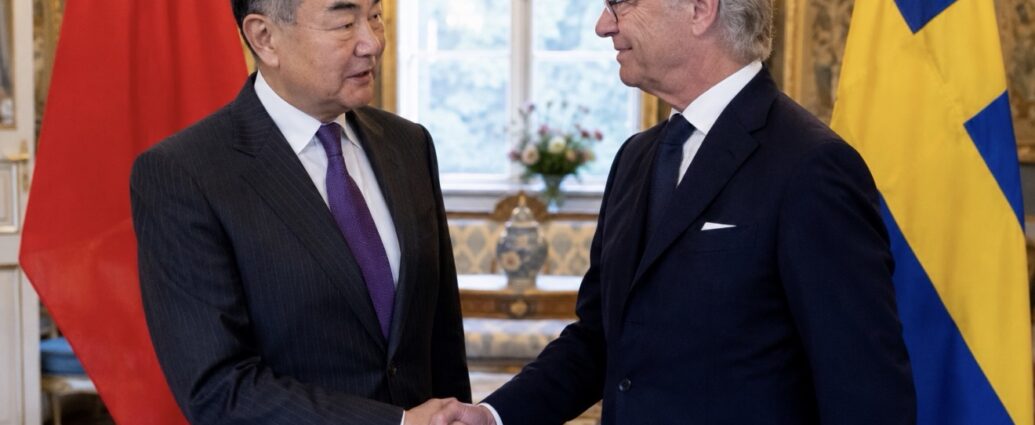
Chinese Foreign Minister Wang Yi told one of Europe’s most prominent business families that China is open for their investment, using a meeting in Stockholm to pitch deeper economic cooperation at a time when President Donald Trump’s tariff disputes have strained relations with several U.S. allies.
According to a statement from China’s Ministry of Foreign Affairs, Wang met Jacob Wallenberg, chairman of Swedish investment company Investor AB, on Saturday and welcomed Swedish and broader European businesses to expand cooperation with China for what he described as mutual benefit.
“Investing in China means investing in the future,” Wang said, noting that the Wallenberg family was among the first European business groups to invest in China following the country’s economic opening during the 1970s and 1980s.
The timing is significant.
Wang’s visit to Sweden is part of a week-long tour of Denmark, Sweden, Finland, and Norway—countries that were among those targeted earlier this year by the Trump administration’s tariff threats.
In January, President Trump threatened a 10% tariff on imports from Denmark and seven other European nations, including Sweden, Norway, and Finland, as part of his campaign to acquire Greenland, warning the tariffs could rise to 25%.
The eight governments responded with a joint statement saying the threats “undermine transatlantic relations and risk a dangerous downward spiral.”
Into that environment stepped China’s top diplomat, presenting Beijing as a cooperative economic partner rather than a competitor.
The messaging has been consistent.
Earlier in Copenhagen, Wang said China and Europe are “partners, not rivals,” arguing that cooperation—not confrontation—should define the relationship. Chinese state media has increasingly portrayed what it calls “transatlantic turmoil”—including U.S. tariffs and disputes over Greenland—as an opportunity for China to attract greater European investment and business.
The implication for European executives is difficult to miss: while Washington threatens additional trade barriers, Beijing is offering expanded access to one of the world’s largest consumer markets.
Whether U.S. tariff policy ultimately pushes European business toward China remains less clear.
The Trump administration’s tariff program has become one of the broadest in decades. After the U.S. Supreme Court struck down the administration’s emergency-powers tariffs in February—forcing refunds estimated at $166 billion collected from more than 330,000 businesses—the administration replaced them with a universal 10% tariff under different statutory authority through late July, while President Trump has suggested raising that rate to 15%.
Separate tariffs on steel, aluminum, copper, and automobiles remain as high as 50%. The average effective U.S. tariff rate reached approximately 11.8% in April, among the highest levels in more than a century.
Those policies have already reshaped global trade flows.
U.S. imports from China declined sharply during the first half of last year as tariffs took effect. In response, China has accelerated efforts to expand exports into other markets, particularly Europe. For many European companies, the business calculation is evolving: if exporting to the United States becomes more expensive and unpredictable, China’s market and manufacturing ecosystem may appear relatively more attractive.
That is the audience Wang Yi was targeting in Stockholm.
The picture, however, remains more complicated than Beijing suggests.
Europe has spent several years pursuing a strategy of “de-risking” its relationship with China by tightening foreign-investment screening, imposing tariffs on Chinese electric vehicles, and raising concerns about Chinese industrial overcapacity. European governments generally welcome investment while remaining cautious about increasing dependence on China, particularly in strategically sensitive industries.
The European Union and China only recently established a new trade and investment consultation mechanism, reflecting an effort to manage tensions rather than fundamentally realign their relationship.
Despite current tariff disputes, the transatlantic economy remains by far the world’s largest commercial partnership. Trade between the European Union and the United States totaled approximately €1.68 trillion during 2024, a level of economic integration that cannot easily be replaced.
The broader challenge for Washington may therefore be less about companies relocating to China than about geopolitical influence.
A tariff strategy intended in part to counter China’s economic rise also risks creating diplomatic openings that Beijing can exploit. When Wang Yi tells European executives that China offers stability and predictability, he is reinforcing an argument made more persuasive by ongoing trade disputes between the United States and its closest allies.
For businesses, the lesson centers on leverage.
Tariffs can reduce trade deficits and strengthen negotiating positions, but imposing trade barriers on allies also increases their incentive to diversify economic relationships elsewhere. China is betting that if Washington continues treating close partners as trade adversaries, more European investment and commercial activity will gradually shift eastward.
Whether that strategy succeeds will depend less on Beijing’s diplomatic outreach than on how the United States manages its economic relationships with the allies China is now actively courting.
JBizNews Desk | Stockholm
© JBizNews.com All Rights Reserved. Reproduction or distribution without written permission is prohibited.