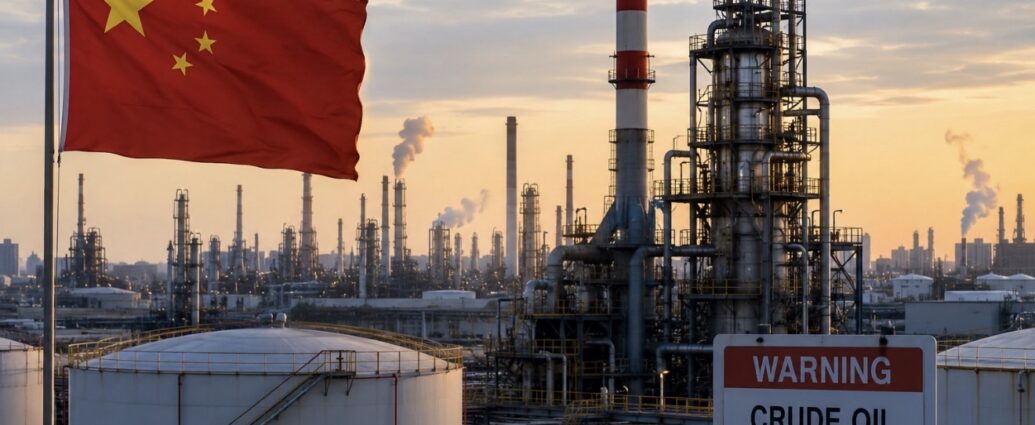
China imported 29.27 million tons of crude oil in June — about 7.12 million barrels a day — the lowest monthly total since October 2016, according to data released Tuesday by the General Administration of Customs of China. Imports fell 41.3% from a year earlier and dropped another 12% from May, when purchases had already collapsed to an eight-year low.
The country that buys more oil than any other has simply stopped buying at anything close to its normal pace. And its refineries have followed.
The utilization rate at China’s crude distillation units — the basic measure of how hard refineries are working — fell to 57.72% in June, down 3.28 percentage points from May and down 13.09 percentage points from a year earlier, according to Chinese consultancy Oilchem. That is close to the weakest reading in a decade. Refiners are running roughly half-empty because the crude they would normally process is too expensive, and because Beijing has restricted how much gasoline and diesel they are allowed to ship overseas.
The reason traces back to the Strait of Hormuz. Since the war with Iran began on February 28, the waterway that normally carries about one-fifth of the world’s oil has been throttled repeatedly. Ship-tracking firm Vortexa put China’s seaborne crude arrivals at roughly 6 million barrels a day in June, with volumes from the Middle East at their lowest in ten years. Iranian crude — the discounted feedstock that keeps China’s small independent refiners, known as teapots, in business — fell 40% from May to under 800,000 barrels a day as Washington’s blockade of Iranian ports tightened.
Living off the stockpile
China could afford to walk away from the market because it spent years preparing for exactly this. Analysts at Kpler and Energy Aspects estimate the country holds between 1.2 billion and 1.3 billion barrels in commercial and strategic reserves, built up during the cheap-oil years before the war. Instead of paying wartime prices, refiners have been draining tanks at roughly 1 million barrels a day.
Sumit Ritolia, lead analyst for refining supply and modeling at Kpler, has said the true split between commercial and strategic barrels is impossible to verify given how little Beijing discloses. Jianan Sun, a London-based analyst at Energy Aspects, said state refiners will return to international markets once reserves are meaningfully drawn down — but that government authorization, tied to Beijing’s read on Hormuz, will come first.
There is also a permanent piece to this. Emma Li, lead China market analyst at Vortexa, estimates that the country’s rapid switch to electric vehicles has knocked about 1 million barrels a day off fuel demand this quarter alone. Gasoline consumption is down 2.4% year over year and diesel down 4.4%, according to industry data. GL Consulting expects Chinese refining activity to fall about 5% for all of 2026.
Why it matters outside China
China’s absence from the crude market is the main reason oil has not gone to $150. Roughly 4 million barrels a day of buying disappeared, which offset a large share of the barrels lost to the war. That kept prices tolerable for American truckers, airlines and drivers through the spring.
That cushion is thinning. Rory Johnston, founder of research firm Commodity Context, said the stock buffer that absorbed the shock has largely been spent, leaving the market far more exposed to another disruption.
Prices are already moving. Brent crude settled Tuesday at $84.73, up 1.7%, after trading as high as $87 during the session. U.S. West Texas Intermediate closed at $79.34, up 1.5%. U.S. Central Command reimposed a naval blockade on Iran’s ports and coastline effective 4 p.m. Eastern, and President Donald Trump dropped his proposed 20% transit fee on cargo crossing Hormuz. Brent has climbed more than 10% since Friday.
For businesses, the squeeze runs through fuel. Chinese refined-product exports averaged about 417,000 barrels a day in May, according to Kpler — nearly half the roughly 750,000 barrels a day shipped before the war. Asian importers that relied on Chinese diesel and jet fuel are competing for cargoes elsewhere, which pushes product prices up globally, including in the United States. OPEC has already cut its 2026 demand growth forecast to 800,000 barrels a day.
The question every refiner, airline and freight operator is now watching: what happens when China turns the taps back on. Once state refiners restart buying at scale, roughly 4 million barrels a day of demand returns to a market that no longer has a spare cushion. The relief the world has enjoyed from China’s silence may end abruptly — and the bill will land at the pump.
JBizNews Desk | New York © JBizNews.com All Rights Reserved. Reproduction or distribution without written permission is prohibited.