
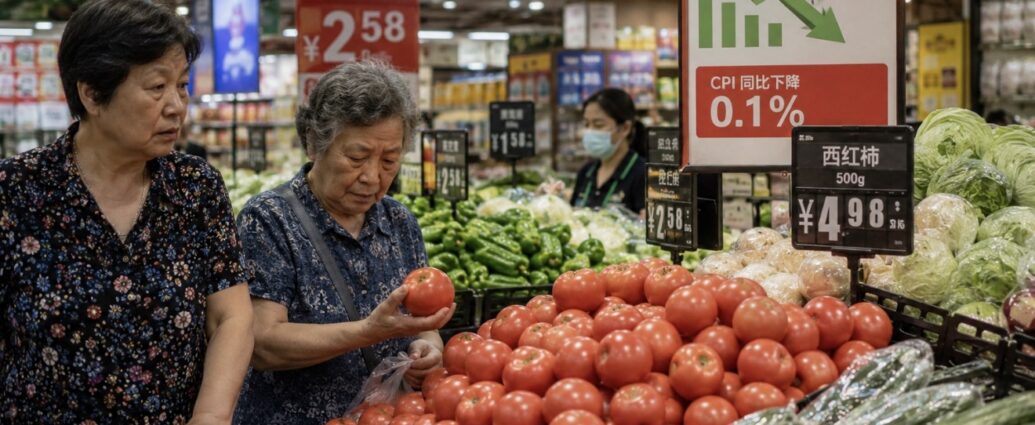
China’s consumer prices barely rose last month, and the reason is straightforward: gasoline got cheaper. Data released Sunday by China’s National Bureau of Statistics showed the consumer price index up 0.5% from a year earlier in July, a six-month low, and down 0.1% from June. The spike in energy costs that the U.S.-Israel war with Iran pushed through the global system this spring is now working its way back out.
The mechanism is worth spelling out because it explains nearly the whole number. An NBS statistician, Dong Lijuan, said the annual CPI rate narrowed by half a percentage point from June mainly because gasoline price increases slowed sharply. Gasoline was up just 1% from a year earlier, a growth rate that collapsed by 16 percentage points in a single month, cutting roughly 0.45 percentage points off headline inflation and dragging overall energy price growth down to 0.6%. Measured against June, domestic gasoline fell 10.7% — a decline that widened by 5.8 points from the prior month and by itself pulled the CPI down about 0.35 percentage points.
Factory costs told the same story. The producer price index, which tracks what manufacturers charge at the factory gate, rose 3.5% year on year, down from 4.1% in June and short of the roughly 3.98% economists surveyed by Wind had expected. Month on month, producer prices fell 0.7%, a steeper drop than June’s 0.3% decline. That marks a three-month low, and it came in below a Reuters poll forecast of 3.8% as well.
How the war got into Chinese prices
Fighting in the Middle East disrupted shipping through the Strait of Hormuz beginning in early March, and with roughly a fifth of the world’s petroleum moving through that waterway, crude prices surged and carried energy costs up worldwide. China, the largest crude importer on earth, felt it fast: the producer price index climbed to 3.9% year on year in May, close to a four-year high.
Those price shocks did something Beijing had been struggling to do on its own — they ended China’s long deflationary run. A peace deal signed around June 17 reopened the strait and began pulling the war premium out of commodity markets almost immediately. Oil fell, and the upward pressure on Chinese prices went with it. The annual CPI reading moved from 1.2% in May to 1.0% in June to 0.5% in July.
What’s left when the oil premium is gone
Strip out the energy story and the picture underneath is soft. Core CPI, which excludes food and energy, rose 0.9% from a year earlier, while food prices fell 1.5%. Food prices were flat against June, running 0.6 percentage points below the normal seasonal pattern. Industrial consumer goods outside of energy rose 1.5%, slowing from the prior month.
The producer price gains that remain are concentrated in a narrow slice of the economy. Dong said the stronger increases showed up in oil and gas extraction, non-ferrous metal mining, coal mining, electrical machinery and electronic equipment manufacturing. Reuters noted the same split: strength in mining and raw materials, while food and everyday goods got cheaper. Prices in smart household devices rose 3.4% and in skincare cosmetics manufacturing 0.7%.
Other pressures were local and temporary. Dong pointed to high temperatures, heavy rainfall and typhoons slowing construction activity and pushing prices down in some sectors.
The two-speed problem
Softer-than-expected readings on both indexes reinforce the picture of an economy running at two speeds — strong exports and factory output on one side, weak household demand on the other. Chinese leaders have committed to supporting growth by speeding up fiscal spending on infrastructure projects already in the budget, running through the end of the year. Household demand remains soft, tied to the property market slump and worries about job security, which points to limited upward pressure on prices in the near term. Fiscal stimulus typically takes about a quarter to feed through.
That timing gap matters for anyone selling into China. If infrastructure spending does ramp up, commodity-linked firms feel it first, because roads, power grids and property work start with steel, cement and fuel — which can keep a floor under upstream prices even with consumer demand weak. The same dynamic squeezes the other end: manufacturers and consumer brands face higher materials bills with little ability to raise prices while CPI stays flat.
Oil price trends remain uncertain, and forecasters expect an uneven inflation path through the rest of the year. The war premium has come out of Chinese prices. What it was masking has not gone anywhere.
JBizNews Desk | Beijing
© JBizNews.com All Rights Reserved. Reproduction or distribution without written permission is prohibited.




