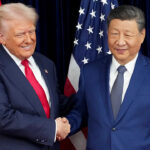
Global investors are increasingly positioning for what could become the most consequential geopolitical meeting of 2026: a high-stakes summit between President Donald Trump and Chinese President Xi Jinping in Beijing that markets hope will preserve — and potentially deepen — the fragile trade détente stabilizing relations between the world’s two largest economies.
The summit, scheduled to begin May 14, marks the first official state visit to China by a sitting U.S. president since Trump’s 2017 visit during his first administration. Originally planned for March, the meeting was postponed after the outbreak of the Iran conflict and the subsequent U.S.-Israeli military operations that reshaped global diplomatic priorities.
Now, with oil markets volatile, rare earth supply chains under pressure, and global investors searching for signs of stability between Washington and Beijing, the summit has taken on outsized economic significance.
Markets are already reacting.
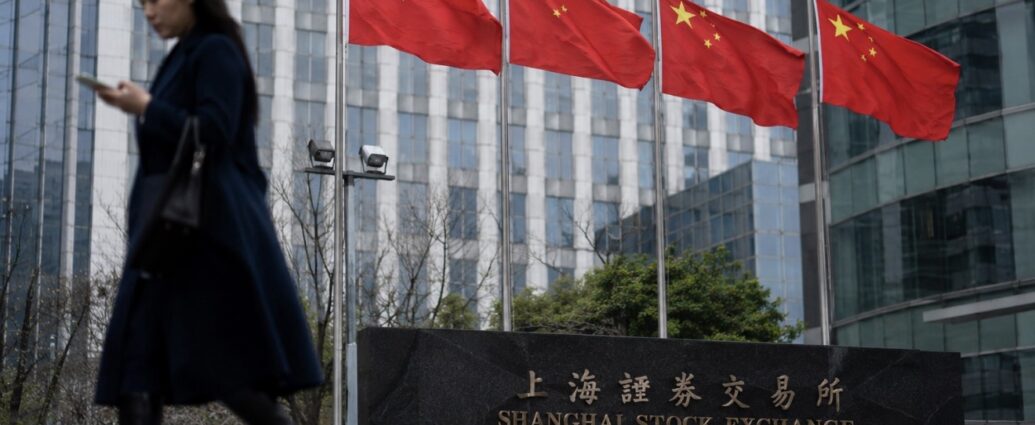
China’s CSI 300 Index rose 1.64% Monday, closing at 4,951.84, while Hong Kong’s Hang Seng Index has gained more than 4% year-to-date as investors cautiously rebuild exposure to Chinese assets after years of geopolitical uncertainty, regulatory crackdowns and slowing growth.
The rally reflects a straightforward calculation on Wall Street and across Asia: if Trump and Xi can prevent another escalation in tariffs, technology restrictions or rare earth export controls, Chinese equities could still have substantial room to recover.
“If the summit can bring a little bit more certainty to the U.S.-China relationship and drive that risk premium down, that’s ultimately going to be very positive for Chinese equities,” said Christopher Hamilton, Head of Client Solutions for Asia Pacific ex-Japan at Invesco Ltd.
Despite the improving sentiment, expectations for a sweeping trade agreement remain modest.
Most analysts expect the summit to focus narrowly on maintaining stability rather than pursuing a dramatic reset in relations. Key agenda items are expected to include tariffs, rare earth mineral exports, U.S. technology restrictions, Chinese purchases of American goods, and broader supply chain security.
Economists at Goldman Sachs, led by Andrew Tilton, said the discussions will likely center on “trade and export controls — including tariffs, Chinese purchases of U.S. goods such as soybeans, energy, and airplanes, and stable rare earth flows.”
Rare earths remain the most strategically sensitive issue.
China controls more than 70% of global rare earth supply, giving Beijing enormous leverage over industries ranging from semiconductors and electric vehicles to missile systems and consumer electronics.
That leverage became especially visible during the 2025 trade confrontation, when China threatened to restrict exports of rare earth minerals and industrial magnets in response to Trump administration tariffs that at one point exceeded 140% on certain Chinese goods.
The resulting standoff forced both governments into a fragile trade truce reached in October 2025.
Under that arrangement, Washington eased some tariffs while Beijing resumed soybean purchases and partially relaxed rare earth export restrictions. The détente helped stabilize supply chains and triggered a recovery in Chinese industrial and commodity-related equities.
Since then, shares of major Chinese rare earth producers including China Northern Rare Earth Group High-Tech Co. and Xiamen Tungsten Co. have more than doubled.
Investors are now betting the Beijing summit will preserve that stability.
The geopolitical backdrop, however, remains highly fragile.
The Iran conflict is expected to dominate portions of the discussions, particularly after China recently hosted Iran’s foreign minister for talks tied to ceasefire and energy negotiations.
Treasury Secretary Scott Bessent has already confirmed Iran will be discussed during the summit, raising the possibility that broader geopolitical tensions could overshadow economic negotiations.
Taiwan, artificial intelligence export controls and semiconductor restrictions also remain major unresolved flashpoints.
While the Trump administration has eased certain tariff measures over the past several months, Washington continues maintaining restrictions on advanced AI chips and sensitive technology exports to China — controls Beijing views as direct attempts to constrain its technological rise.
At the same time, the White House reportedly declined Beijing’s invitation to organize separate high-profile meetings between senior Chinese leaders and American CEOs, amid concerns that such engagements could politically expose U.S. companies as appearing too closely aligned with China.
Still, investors increasingly believe the relationship has entered a more stable phase compared with the confrontational posture that dominated much of the past several years.
Thomas Fang, Head of China Global Markets at UBS Group, said many institutional investors no longer see China and the United States as mutually exclusive investment choices.
“Instead of choosing between investing in the U.S. or China, more investors believe they need exposure to both,” Fang said. “The question has become one of allocation.”
Currency markets are reinforcing that optimism.
The Chinese yuan has strengthened as the U.S. dollar weakened in recent months, historically a supportive signal for Chinese equities. HSBC now forecasts the yuan strengthening to 6.95 per dollar by year-end, while Morgan Stanley projects further appreciation toward 6.80 by 2027.
Valuations also remain comparatively attractive.
Chinese equities currently trade near 11.8 times forward earnings, roughly half the valuation multiple of the S&P 500, which trades closer to 22 times forward earnings. Analysts say that leaves significant room for valuation expansion if geopolitical risks continue easing.
For Beijing, the summit’s importance extends well beyond markets.
Images of Trump and Xi together are expected to send a broader message throughout China’s political and business system that engagement with American companies is becoming more acceptable again after years of heightened tensions.
“Since U.S. military actions earlier this year, Chinese officials have been more hesitant to engage with the American business community,” said Michael Hart, President of the American Chamber of Commerce in China.
The most likely outcome, analysts say, is neither a breakthrough agreement nor a renewed confrontation.
Instead, markets are betting on something simpler — an extension of the current détente, continued rare earth stability, no new tariff escalation, and avoidance of major provocations around Taiwan or technology restrictions.
For investors, multinational companies, manufacturers dependent on Chinese supply chains, and consumers still feeling the inflationary effects of U.S.-China trade tensions, that alone may be enough to keep the rally alive.
JBizNews Desk
© JBizNews.com. All rights reserved. This article is original reporting by JBizNews Desk. Unauthorized reproduction or redistribution is strictly prohibited.