Technology & Geopolitics | Saturday, April 25, 2026 | JBizNews Desk
China is tightening its grip on foreign capital in strategic sectors, directing leading technology companies—including some of its most prominent artificial intelligence firms—to reject U.S.-linked investments unless explicit government approval is secured, according to officials familiar with the policy and regulatory notices issued in recent weeks.
The directive, led by the National Development and Reform Commission (NDRC) alongside other central agencies, applies to major firms such as ByteDance Ltd., parent company of TikTok, as well as rising AI players including Moonshot AI and StepFun. Under the new framework, companies must obtain prior clearance before accepting funding or executing secondary share sales involving American investors, a move designed to protect technologies deemed critical to national security and economic competitiveness.
Officials in Beijing have framed the policy as a safeguard against the transfer of sensitive intellectual property and talent to geopolitical rivals. The restrictions effectively place China’s most valuable technology firms under tighter state supervision, particularly in sectors tied to artificial intelligence, advanced computing, and data infrastructure.
The shift follows growing concern inside China’s leadership over the outflow of high-value innovation. The catalyst, according to multiple analysts, was Meta Platforms Inc.’s acquisition of Manus, a Singapore-based AI startup founded by Chinese entrepreneurs, in a deal valued at approximately $2 billion that closed in late 2025. The transaction triggered alarm among Chinese regulators, who viewed it as a loss of advanced AI capabilities to a U.S. technology giant.
Chinese authorities subsequently launched a multi-agency review into the structure of the deal, focusing on whether Manus had effectively bypassed domestic controls by relocating operations abroad—a strategy often described as “Singapore-washing.” The investigation exposed gaps in China’s ability to monitor overseas entities founded by Chinese nationals, prompting calls for tighter regulatory oversight.
The new policy represents a clear escalation—and mirrors steps taken by Washington in recent years. The United States has imposed sweeping restrictions on Chinese access to advanced technologies through export controls, entity list designations, and investment bans targeting sectors such as semiconductors, artificial intelligence, and quantum computing. Companies including Huawei Technologies Co. and ZTE Corp. have been central targets of those measures.
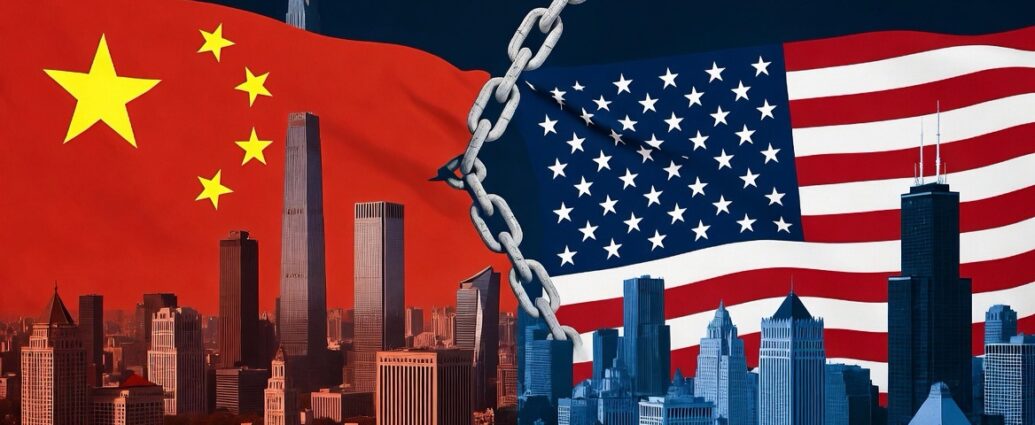
By requiring government approval for U.S. capital inflows, Beijing is effectively adopting a reciprocal stance. Analysts describe the move as part of a broader tit-for-tat dynamic, as the world’s two largest economies increasingly decouple in critical technology domains.
For decades, American capital played a pivotal role in building China’s technology ecosystem. U.S. venture capital firms, pension funds, and institutional investors were early backers of companies such as Alibaba Group Holding Ltd., Tencent Holdings Ltd., and ByteDance. That era of relatively open cross-border investment is now rapidly giving way to a more fragmented and controlled global system.
The implications for China’s AI sector are significant. Companies like Moonshot AI, known for its Kimi chatbot, and StepFun, which has attracted strong investor interest, now face additional hurdles in raising international capital. Industry participants say the added regulatory layer could increase financing costs, slow expansion timelines, and push firms toward domestic or state-backed funding sources.
ByteDance, already under scrutiny in multiple jurisdictions, may also face constraints on liquidity events for early investors and employees due to tighter controls on secondary share sales. The broader impact could include a reorientation of capital flows, with companies increasingly turning to non-U.S. investors such as Middle Eastern sovereign wealth funds or European institutions—though those channels may also come under heightened review.
Analysts at several global investment firms warn that overly restrictive policies could have unintended consequences. Artificial intelligence development, they note, often depends on open collaboration, cross-border talent mobility, and access to diverse capital sources. Limiting those inputs risks slowing innovation in a sector Beijing has identified as a national priority.
The policy also aligns with China’s broader “dual circulation” strategy, which emphasizes domestic self-reliance while maintaining selective engagement with global markets. In practice, however, the balance is becoming harder to sustain as geopolitical tensions intensify.
For international investors, the changes introduce a new layer of complexity. U.S.-based funds already navigating domestic restrictions on China exposure now face additional barriers from Beijing itself, narrowing access to some of the country’s most promising technology startups.
Looking ahead, the move underscores a structural shift in the global technology landscape. As Washington and Beijing continue to prioritize national security over economic integration, companies operating at the intersection of both systems will be forced to adapt—balancing rapid innovation with increasingly strict regulatory oversight on both sides.
The result is a more fragmented, competitive, and politically sensitive global tech ecosystem—one in which capital, talent, and ideas are no longer as freely exchanged as they once were.
JBizNews Desk