By JBizNews Desk
Monday, May 4, 2026
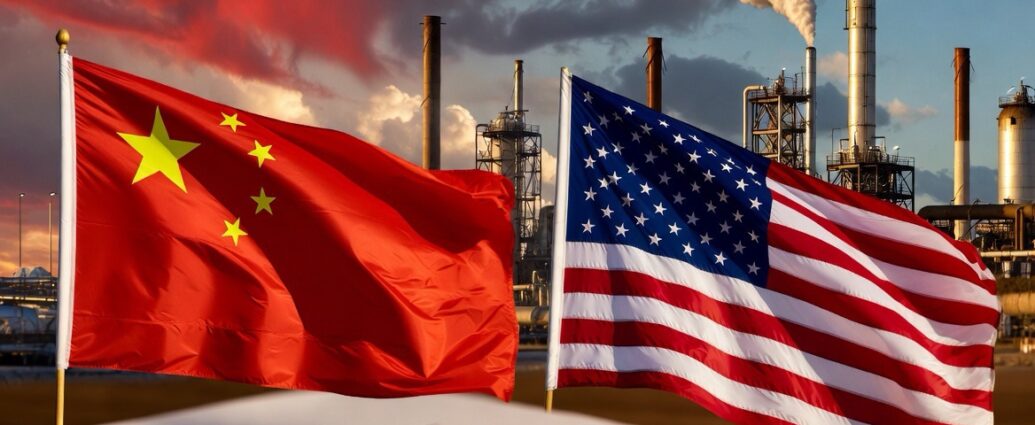
China has taken an extraordinary step that could mark a turning point in how the world’s two largest economies wage economic war on each other. For the first time, Beijing has formally ordered Chinese companies to defy U.S. sanctions — a move that puts China’s entire banking sector and business community on a collision course with Washington and signals a new phase in the geopolitical fallout from the Iran war.
China ordered companies in the country not to comply with U.S. sanctions on five domestic refiners linked to the Iranian oil trade, deploying a blocking measure introduced in 2021 that was aimed at protecting its firms from foreign laws it deemed unjustified. The refiners — including Hengli Petrochemical (Dalian) Refinery Co., which was sanctioned last month, and several other privately-owned processors — had been facing asset freezes and transaction bans.
China has ordered companies to defy U.S. sanctions for the first time, a step that threatens to put its banking sector into the crosshairs of competition between the world’s largest economies. The decision, announced Saturday, risks becoming a watershed moment. While China has often railed against unilateral sanctions, it has in the past quietly allowed companies to comply with them to avoid blowback on its own economy and preserve access to the U.S. financial system.
What Beijing Actually Did
China’s Ministry of Commerce issued a formal injunction stating that the U.S. measures “shall not be recognized, implemented, or complied with.” The ministry said the U.S. measures unlawfully restrict normal trade with third countries and breach international norms. “The Chinese government has consistently opposed unilateral sanctions that lack authorization from the United Nations and a basis in international law,” the department said.
The legal mechanism Beijing used carries teeth beyond a simple policy statement. The injunction allows the refineries to seek compensation in Chinese courts from any entity that complies with the U.S. sanctions — including domestic actors such as banks, investors and downstream customers that have ceased dealings, as well as foreign firms with a presence in China. Analysts at Eurasia Group said the move signals Beijing is taking a more assertive approach to countering sanctions, adding that by activating its blocking measures for the first time since adopting the rule in 2021, China is demonstrating a lower threshold for deploying its legal and regulatory toolkit.
Why Hengli Matters
The decision to defend Hengli specifically marks an escalation in the scale of U.S.-China friction over Iranian oil. China has long been the single largest buyer of Tehran’s oil shipments, many of them arriving indirectly through private refiners and then processed into gasoline, diesel and other products. Chinese customs data do not reflect that trade, with the last official shipment recorded several years ago. Before Hengli, Washington’s efforts to cut off Tehran’s oil revenue had targeted smaller Chinese companies and facilities. Hengli, by contrast, is representative of the most modern of China’s private refiners, with a sprawling oil-processing and chemicals complex in the northeastern province of Liaoning.
The Banking Risk
The most consequential risk from Beijing’s move is not to the refiners themselves — it is to China’s banking system. The refineries primarily work with Chinese banks that have not yet been directly sanctioned, analysts at Eurasia Group led by Dominic Chiu wrote in a note. “If the U.S. extends secondary sanctions to those institutions, or major state-owned entities, Beijing would likely respond with more forceful countermeasures,” the analysts said.
That escalation path — from refiner sanctions to bank sanctions to full-scale financial warfare — is exactly what has kept Chinese companies compliant with U.S. restrictions in the past. By crossing that line now, Beijing is betting that the economic and geopolitical stakes of the Iran war justify a direct confrontation with Washington’s sanctions architecture for the first time in history.
The Diplomatic Timing
The decision lands at a delicate moment. The sanctions and Beijing’s response come just weeks before an expected and long-awaited meeting between President Donald Trump and Chinese President Xi Jinping. While the blocking measure is not likely to derail the summit, Washington’s reaction to it will indicate whether the matter escalates further, according to Eurasia Group analysts.
For American businesses with operations in China, for global banks with exposure to Chinese financial institutions, and for any company caught between the world’s two largest economies, Monday’s announcement is a warning: the rules of economic engagement between Washington and Beijing just changed — and nobody yet knows where the new lines are drawn.
— JBizNews Desk
© JBizNews.com. All rights reserved. This article is original reporting by JBizNews Desk. Unauthorized reproduction or redistribution is strictly prohibited.