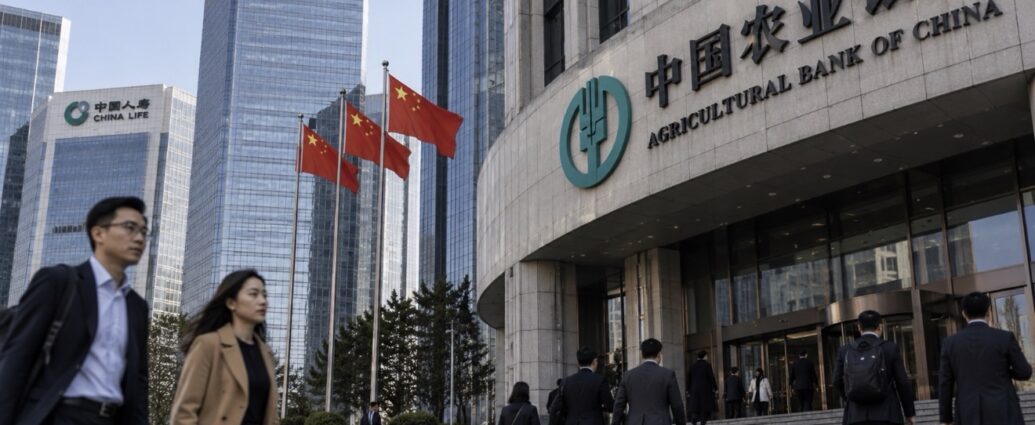
Beijing is injecting tens of billions of dollars into some of China’s biggest financial institutions, strengthening their balance sheets as the government pushes banks to keep lending and support economic growth.
China is moving roughly $54 billion into major state-owned banks and insurance companies, one of Beijing’s most significant recent efforts to reinforce the financial system and give lenders more room to support the economy.
The capital push announced Sunday centers on three state financial institutions receiving a combined 290 billion yuan, or about $43 billion, while another group of major state-controlled insurers will receive additional capital.
Agricultural Bank of China plans to raise up to 160 billion yuan, approximately $24 billion, through a private placement of shares.
Industrial and Commercial Bank of China, the country’s largest commercial lender by assets, plans to raise another 100 billion yuan, or roughly $15 billion.
The Export-Import Bank of China is set to receive a further 30 billion yuan.
The money is intended to strengthen what regulators call core Tier 1 capital — essentially the highest-quality financial cushion banks maintain to absorb losses and continue lending during periods of economic stress.
China is also putting billions of dollars into its insurance sector.
China Life Insurance is set to receive 35 billion yuan, while China Taiping Insurance will receive 7 billion yuan. Other state-backed insurers are also receiving additional capital through separate transactions.
The broader message from Beijing is clear: China wants its largest financial institutions strong enough to continue providing credit even as parts of the economy remain under pressure.
Loan demand has been uneven, property-sector problems continue to weigh on activity, and Chinese banks have faced pressure on profitability as interest rates remain low.
At the same time, Beijing is asking banks to finance strategic industries, infrastructure, manufacturing and other areas the government views as important to long-term economic growth.
That creates a balancing act.
Banks are expected to lend more aggressively while also protecting themselves against bad loans and maintaining sufficient capital.
The new government money gives them additional room to do both.
China has already been using special government bonds to reinforce its banking system. Earlier government disclosures showed that 500 billion yuan in special treasury bonds had previously been issued to help several major banks replenish core capital.
The latest round extends that strategy to additional financial institutions.
What It Means for You
This is not simply a bank bailout.
It is Beijing using government money to make sure its financial system has enough firepower to keep lending.
That matters globally because Chinese banks finance enormous portions of manufacturing, infrastructure, exports and industrial investment.
More bank capital can translate into more credit for factories, technology projects and Chinese companies competing in global markets.
It also shows that Beijing remains concerned enough about economic conditions to strengthen financial institutions before problems become larger.
For investors and businesses, the most important question is what happens next.
If the additional capital produces stronger lending and investment, it could support Chinese growth and global demand for commodities and industrial goods.
If banks remain reluctant to lend — or companies remain reluctant to borrow — then even tens of billions of dollars in new capital may have limited impact.
Either way, China has just made another major government-backed move to keep its financial system capable of supporting the world’s second-largest economy.
JBizNews Desk | New York
© JBizNews.com All Rights Reserved. Reproduction or distribution without written permission is prohibited.