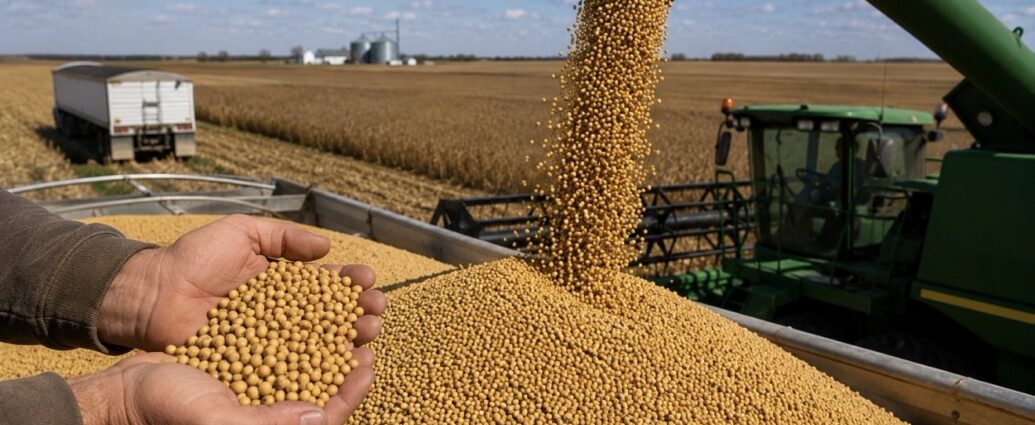
China is preparing to commit to purchasing 25 million metric tons of U.S. soybeans annually for three years, according to people familiar with negotiations cited by Bloomberg and CNBC, giving President Donald Trump and Chinese President Xi Jinping one of the clearest commercial deliverables from this week’s Beijing summit and handing the American farm economy its strongest potential export breakthrough in years.
The agriculture package is expected to include expanded Chinese purchases of U.S. soybeans, beef, poultry, non-soybean crops, coal, oil and natural gas, with Cargill Chief Executive Brian Sikes traveling as part of the U.S. delegation to help finalize the commodity commitments.
For Midwestern farmers, the soybean number is the centerpiece.
Before the 2018-2019 trade war, U.S. soybean exports to China averaged roughly 28 million to 32 million metric tons annually. Chinese retaliatory tariffs later collapsed the trade, pushing buyers toward Brazil, Argentina and Paraguay and reducing America’s share of Chinese soybean imports to less than 20% by 2024, down from roughly 40% a decade earlier.
A three-year baseline commitment of 25 million metric tons annually, if fully implemented, would restore a meaningful portion of that lost demand.
The immediate corporate beneficiaries would include the dominant global grain traders — Cargill, Archer-Daniels-Midland, Bunge Global and Louis Dreyfus — along with farmer-owned cooperative CHS Inc., which handles major soybean export flows through Pacific Northwest and Gulf Coast terminals.
The ripple effects would extend deep into the agricultural supply chain, lifting volumes for country elevators, river terminals, rail operators including BNSF Railway and Union Pacific, barge companies and port operators tied to U.S. soybean exports.
For farmers, the timing is critical.
Soybean futures on the Chicago Board of Trade have traded largely between $9.50 and $11.50 per bushel through 2025, well below the $14-plus peak reached in 2022.
Farm-budget analyses from Iowa State University suggest many Corn Belt growers face breakeven costs near $10.50 per bushel once land rent, fertilizer, equipment and financing expenses are included.
That means a meaningful portion of soybean operations has been operating near or below breakeven for two consecutive crop cycles.
A credible Chinese purchase floor would likely provide immediate support to prices and improve planning visibility heading into the next planting season.
The broader commodity basket is also politically significant.
Expanded Chinese beef purchases would arrive as the Trump administration separately weighs measures to ease U.S. grocery prices, where beef costs have remained elevated because of tight cattle supplies.
Larger Chinese purchases would benefit meat processors including Tyson Foods, JBS USA, Cargill Protein and National Beef Packing, while poultry commitments could support Tyson and Pilgrim’s Pride, both of which have faced margin pressure in Asian export markets.
Coal and energy commitments would provide additional wins for U.S. producers.
Potential coal purchases could benefit Peabody Energy, Arch Resources and Consol Energy, while any liquefied natural gas commitments would support exporters including Cheniere Energy and Venture Global as new export capacity comes online.
Oil commitments are likely to matter more politically than commercially, since China already sources crude globally based on price and availability. Still, the optics of Beijing agreeing to increase U.S. energy purchases would give both governments a visible trade-balancing headline.
Skepticism remains high.
Chinese purchase commitments have historically been easier to announce than to execute. The Phase One trade agreement signed in January 2020 pledged roughly $200 billion in additional Chinese purchases of U.S. goods and services, but those targets were never fully met.
Agricultural traders note that Chinese soybean buying decisions are ultimately driven by crusher margins, Brazilian harvest timing, currency movements, freight costs and domestic demand — factors no political agreement can fully override.
The political incentives, however, are unusually aligned.
The late-2025 Busan APEC truce paused the most damaging pieces of the tariff escalation between Washington and Beijing, but that framework expires later this year. Both governments are now searching for measurable commercial wins that can justify an extension.
For Trump, the soybean commitment would provide a direct economic message to the Midwest ahead of the 2026 midterm cycle. For Xi, stable access to U.S. agricultural and energy supplies helps reduce trade friction while China manages its own economic slowdown and energy-security pressures.
For Sikes and the agriculture-trading complex, the immediate question is what written commitments emerge from the Beijing meetings.
For farmers, the bigger question is whether Chinese buyers actually take delivery once the cameras leave.
JBizNews Desk
© JBizNews.com. All rights reserved. This article is original reporting by JBizNews Desk. Unauthorized reproduction or redistribution is strictly prohibited