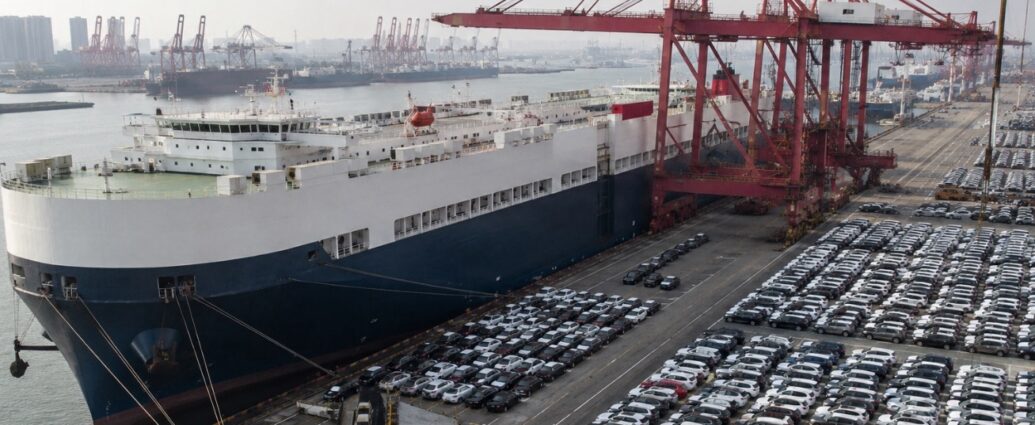
China is now building and selling so many cars abroad that the world has run out of boats to move them. The ships that carry vehicles across oceans are a specialized type — floating parking garages with ramps, known in the trade as car carriers — and there are only so many of them afloat. Chinese factories are turning out export vehicles faster than that fleet can haul them, so the ships are booked years ahead, the cost of hiring one has jumped 65% this year, and carmakers are resorting to stuffing cars into ordinary steel shipping containers to get them overseas.
The numbers explain the squeeze. In 2019, China shipped just under 600,000 cars and vans to foreign buyers. This year, research group Mobility Global expects the figure to reach as high as 10 million — roughly 16 times as many vehicles in seven years. The global car-carrier fleet, meanwhile, has grown by about 40%. Cars up sixteenfold, ships up four-tenths: that gap is the entire bottleneck.
Prices moved the way prices always move when demand overwhelms supply. Hiring a large car carrier on an annual contract averaged $42,500 a day at the end of last year, according to shipbroker Clarksons. By June it averaged $70,000 a day — about two-thirds more in half a year. Lasse Kristoffersen, chief executive of Norwegian carrier operator Wallenius Wilhelmsen, said the enlarged fleet still cannot keep up with what Chinese exporters want to move. Andreas Enger, chief executive of Höegh Autoliners, said ocean freight rates for automobiles now run at double their pre-pandemic level, and pointed out that China went from a minor exporter to the world’s biggest in about five years.
The workaround is already at sea. Rather than wait for a berth on a dedicated car carrier, exporters are loading vehicles into the same 40-foot containers used for furniture and televisions, and sending them on regular container ships. Kristoffersen estimates up to four million vehicles a year now leave China this way or by similar improvised means — close to four out of every ten cars China exports. The practice has grown large enough that container giants including A.P. Moller-Maersk and Mediterranean Shipping Co. are selling shipping services straight to automakers, a customer they once left to the specialists.
Chinese manufacturers are also solving the problem by buying their way into the shipping business. BYD launched its first dedicated car carrier in 2024 and now runs a fleet of eight. Shipyards, most of them Chinese, are working through order books that stretch out for years, which is why relief on charter rates is unlikely to arrive quickly. A ship ordered today does not carry a car until the end of the decade.
Behind the export push sits a problem at home. Chinese car sales inside China fell more than 20% in the first half of 2026 against the same stretch last year, according to International Energy Agency figures. More than 100 domestic brands are fighting over a shrinking home market, and the factories keep running. Tu Le, managing director of Sino Auto Insights, described exports as a pressure release valve for a market with far more brands than it can support. Cars that cannot be sold in Shanghai get sold in São Paulo instead.
Europe is where the displacement shows up most clearly. In the first half of this year, SAIC Motor’s registrations across the European Union rose 19% and BYD’s more than doubled, according to the European Automobile Manufacturers’ Association. Over the same period, Stellantis gained 6%, Volkswagen 2.6%, and Renault slipped 4.2%. Chinese brands are also taking share in the United Kingdom, Germany and Brazil.
American driveways are largely untouched, for now. Tariffs and federal restrictions on Chinese vehicle software, imposed on national security grounds, keep those cars off U.S. lots almost entirely. But American buyers still feel the shipping squeeze indirectly, because the same fleet that moves Chinese cars to Europe also moves German, Japanese and Korean cars to Baltimore, Brunswick and Long Beach. When the cost of an ocean crossing doubles, that expense reaches the sticker on an imported sedan in Newark the same way it reaches one in Rotterdam.
The fix, such as it is, comes in three parts and all three are already underway: more ships being built, more cars traveling in containers, and carmakers buying their own vessels rather than renting. None of it is fast. Until the new hulls arrive, the constraint on how many cars China sells to the world is not how many it can build. It is how many it can float.
JBizNews Desk | New York
© JBizNews.com All Rights Reserved. Reproduction or distribution without written permission is prohibited.