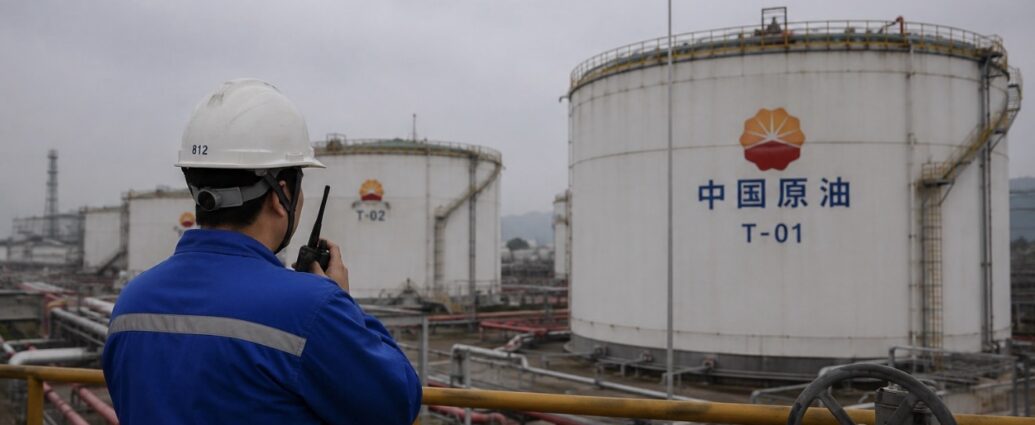
On Tuesday, July 14, China’s General Administration of Customs reported that the country’s crude-oil imports collapsed in June to their lowest level in nearly a decade, a striking retreat for the world’s largest oil buyer and a sign of how deeply the war in the Persian Gulf has scrambled global energy trade. Purchases fell 41% from a year earlier to 29.27 million tons, the least since October 2016, according to the customs data. The figure came in 12% below May, which had itself been the weakest month in eight years.
The plunge reflects a rare mix of forces hitting at once. The most immediate is the ongoing conflict between the United States and Iran, which has choked shipping through the Strait of Hormuz, the narrow waterway that normally carries about a fifth of the world’s seaborne oil. With Gulf barrels harder and costlier to obtain, Chinese refiners have leaned on other tools rather than chase expensive replacement cargoes.
Those tools have been on full display for months. According to shipping analysts at Kpler, China has drawn down oil held in its refineries and commercial tanks, trimmed how much crude its plants process, and cut exports of finished fuels, all to stretch existing supplies. At the same time, Beijing has kept adding barrels to its strategic petroleum reserve during the war, a bet that today’s disruption could last. The result is a country consuming from storage instead of buying fresh imports at war-inflated prices.
The geography of the shortfall tells the story. Data cited by the American Petroleum Institute showed that Chinese imports from Iraq and Kuwait fell essentially to zero in May, because both nations rely almost entirely on export routes that pass through the Strait of Hormuz. Saudi Arabia and the United Arab Emirates, which can move some oil through pipelines that bypass the chokepoint, managed to keep a portion of their crude flowing to Chinese ports. Even so, the overall decline was steep, with seaborne arrivals running far below the levels seen before the fighting began.
The backdrop is a market once again on edge. West Texas Intermediate traded near $78 a barrel this week after rallying 9.4% on Monday, while Brent closed above $83, according to market data compiled Tuesday. The jump followed a statement from President Donald Trump that the United States would reimpose a blockade on Iranian ships crossing the Strait of Hormuz and demand payment for other cargo moving through the waterway, a levy he pegged at 20% of a shipment’s value, or roughly $30 million for a fully loaded supertanker. U.S. forces launched a third night of strikes on Iran, raising the risk of a longer disruption.
For years, the oil market ran on a simple assumption: whatever shock hit global supply, China’s near-bottomless appetite would eventually soak up the excess and steady prices. June’s numbers show that assumption fracturing. Rather than scrambling for every available barrel, Beijing has let its imports fall sharply and ridden out the storm on inventories. That restraint has quietly helped cap oil prices, since the world’s biggest buyer is not competing aggressively for scarce cargoes.
There is a longer-running force underneath the war disruption, too. China’s rapid shift to electric vehicles is steadily eroding demand for gasoline, with new-car sales overwhelmingly electric. Analysts increasingly argue that even after the Gulf conflict eases and Iranian barrels return to the market, Chinese imports may never climb back to the peaks above 11.6 million barrels a day averaged in 2025. In other words, part of what looks like a temporary war shock may turn out to be a permanent change in how much oil the country needs.
For businesses far from the Gulf, the stakes are concrete. China’s buying decisions ripple through the price every refiner, airline, trucking firm, and factory pays for fuel. When the largest importer pulls back, it eases some of the upward pressure that war and the Strait of Hormuz would otherwise put on prices at the pump and on shipping invoices. OPEC, for its part, recently trimmed its 2026 forecast for global oil-demand growth to about 800,000 barrels a day, a nod to softer appetite from the very market that once seemed unstoppable.
The near-term picture remains hostage to the fighting. Early tracking data suggest July imports may tick up modestly from June as tanker traffic through the strait slowly normalizes, though volumes would still sit around 41% below year-ago levels. Until the conflict resolves, China looks content to buy less, lean on its reserves, and wait, a posture that is reshaping oil markets well beyond any single battlefield.
JBizNews Desk | Beijing
© JBizNews.com All Rights Reserved. Reproduction or distribution without written permission is prohibited.