JBizNews Desk
CHICAGO — June 1, 2026
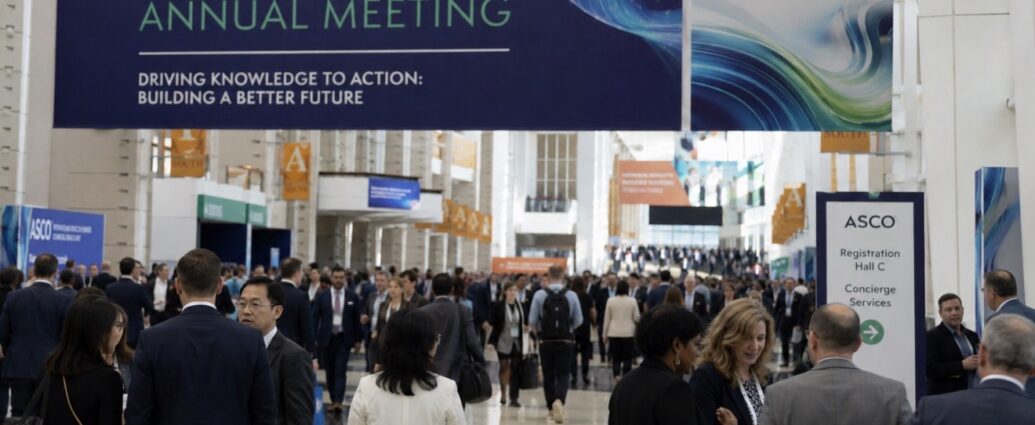
The American Society of Clinical Oncology said its 2026 Annual Meeting, running May 29 through June 2 at McCormick Place in Chicago, drew a record number of studies led by Chinese researchers. A total of 95 studies led by researchers from China, Hong Kong, Macao, and Taiwan were selected for oral and featured presentations, marking a new record and the third consecutive year of significant growth.
That figure is more than a conference statistic. It is one of the clearest signs yet that China has evolved from a low-cost manufacturing center into a major force in global drug innovation—and the world’s largest pharmaceutical companies are taking notice.
The headline moment in Chicago belongs to Akeso, the Chinese biotechnology company whose late-stage lung cancer study earned a coveted place in ASCO’s prestigious Plenary Session. It is only the second time in the conference’s six-decade history that a clinical study involving an original Chinese-developed drug has received that distinction.
The study focused on ivonescimab, a lung-cancer treatment that has already attracted significant international attention. Summit Therapeutics, the U.S.-based company that licensed rights to the drug outside China, is currently awaiting an FDA decision after the agency accepted its filing earlier this year. A regulatory decision is expected on November 14, 2026.
Another company drawing attention is Ascentage Pharma, which operates in both Maryland and Suzhou, China. The company presented six studies at the meeting, including three selected for rapid oral presentations and three poster presentations, highlighting experimental cancer therapies developed largely through clinical trials conducted in China.
The scientific achievements on display in Chicago are being matched by an extraordinary surge in dealmaking.
For decades, pharmaceutical innovation largely flowed from Western laboratories to the rest of the world. Today, that flow is increasingly moving in both directions.
According to Vision Lifesciences, Chinese biotechnology firms now account for nearly 30% of global drug development activity, with more than 1,200 novel drug candidates currently in clinical trials. Global pharmaceutical companies that once viewed China primarily as a manufacturing hub are increasingly looking there for the next generation of blockbuster medicines.
The financial figures illustrate the scale of the shift.
Data from PharmCube show that cross-border licensing agreements between companies in Greater China and multinational pharmaceutical firms reached a record $137.7 billion in 2025, nearly ten times the $13.9 billion recorded in 2021. The number of completed out-licensing transactions rose to 186 deals, compared with 65 deals just a few years earlier.
The momentum has continued into 2026.
Chinese regulatory officials reported that cross-border licensing agreements involving Chinese biotechnology companies reached approximately $60 billion during the first quarter alone, representing a substantial increase from the same period a year earlier.
The driving forces behind the trend are straightforward.
Major pharmaceutical companies face an approaching wave of patent expirations that threatens hundreds of billions of dollars in revenue. Industry analysts estimate that patent losses could erase as much as $200 billion in annual pharmaceutical sales between 2026 and 2030, forcing drugmakers to search aggressively for new products capable of replacing those revenues.
At the same time, many Chinese biotechnology firms have demonstrated an ability to develop promising therapies more quickly and at lower cost than many Western competitors.
As demand has increased, so have prices.
Industry data cited by analysts show average upfront payments in Western-Chinese licensing agreements have climbed dramatically in recent years. What was once viewed as a lower-cost source of pharmaceutical innovation is increasingly commanding premium valuations as competition for promising assets intensifies.
The list of global buyers underscores how seriously the industry is taking the trend.
Gilead Sciences, Eli Lilly, AstraZeneca, AbbVie, GSK, Sanofi, and UCB have all entered major licensing agreements involving Chinese biotechnology firms. One of the most significant transactions came earlier this year when AstraZeneca announced a deal with CSPC Pharmaceutical covering obesity treatments, a transaction that could ultimately be worth up to $18.5 billion if development and commercial milestones are achieved.
For patients, the implications could be positive. Increased competition and larger drug pipelines may accelerate the arrival of new cancer therapies, obesity treatments, and other medicines.
For the United States biotechnology sector, however, the implications are more complicated.
While American companies continue to dominate many areas of fundamental scientific research, executives increasingly acknowledge concerns that some of the most commercially valuable early-stage discoveries are emerging elsewhere. The result could be growing pressure on U.S. biotechnology hubs that have long served as centers for high-paying research and development jobs.
Washington has attempted to address some of these concerns through various policy proposals and heightened scrutiny of certain China-related biotechnology activities. Yet despite geopolitical tensions, licensing activity continues to accelerate.
The reason is simple: pharmaceutical companies facing looming patent cliffs cannot afford to ignore promising science, regardless of where it originates.
That reality was impossible to miss at McCormick Place this week.
The immediate story is a record-setting conference, breakthrough cancer research, and billions of dollars in pharmaceutical dealmaking. The larger story is a fundamental shift in the geography of drug innovation—and a growing debate over whether the United States can maintain its long-standing leadership position as China rapidly expands its role in developing the medicines of the future.
Chicago — JBizNews Desk
© JBizNews.com All Rights Reserved. Reproduction or distribution without written permission is prohibited.