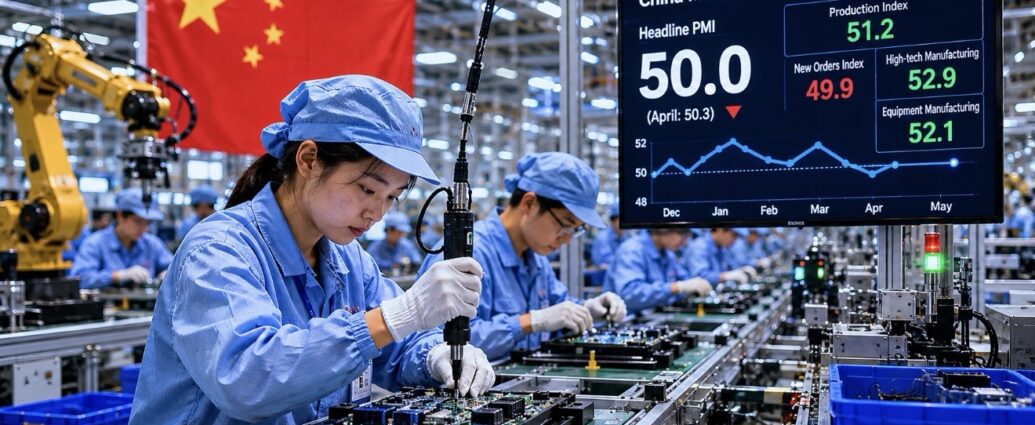
China’s manufacturing sector lost momentum in May, with factory activity flattening as weaker demand offset continued growth in production, according to data released Sunday by the National Bureau of Statistics (NBS) and the China Federation of Logistics and Purchasing.
The official manufacturing Purchasing Managers’ Index (PMI) registered 50.0 in May, down from 50.3 in April. The reading places the world’s second-largest economy directly on the dividing line between expansion and contraction, signaling that factory activity effectively stalled during the month.
While the headline number suggests stability, the details underneath tell a more complicated story.
Chinese factories continued producing goods at a healthy pace. The production sub-index remained in expansion territory at 51.2, indicating manufacturers are still operating and output remains relatively resilient.
Demand, however, is beginning to weaken.
The closely watched new orders sub-index slipped to 49.9, falling just below the 50-point threshold that separates growth from contraction. The reading suggests customers, both domestic and international, are becoming more cautious even as factories continue manufacturing products.
In practical terms, Chinese factories are still making goods, but incoming orders are no longer keeping pace.
Officials highlighted stronger performance in higher-value sectors that Beijing has prioritized as part of its long-term economic strategy.
According to Huo Lihui, chief statistician at the National Bureau of Statistics, China’s newer growth industries continued outperforming traditional manufacturing segments. The PMI for high-tech manufacturing rose to 52.9, while equipment manufacturing reached 52.1, both comfortably above the expansion threshold.
Those numbers reinforce Beijing’s push to move China up the global value chain and reduce dependence on lower-margin manufacturing industries.
The divergence illustrates the increasingly two-speed nature of China’s economy.
Advanced manufacturing sectors tied to electronics, automation, industrial equipment, and technology continue showing growth. More traditional industries tied to consumer goods, construction materials, and lower-cost exports remain under pressure.
Several factors are contributing to the softer demand environment.
China continues to wrestle with a prolonged property-sector slowdown that has weakened consumer confidence and business investment. Domestic spending has improved only gradually, leaving manufacturers more dependent on exports to maintain growth.
At the same time, global economic uncertainty remains elevated.
Higher energy costs linked to ongoing tensions in the Middle East have increased expenses for manufacturers worldwide. Rising costs for oil, petrochemicals, transportation, and raw materials continue squeezing margins, particularly among lower-value industrial producers.
China’s massive industrial base gives it advantages in absorbing some of these pressures, but it cannot fully escape rising global input costs.
There are also signs of cautious optimism on the trade front.
Recent discussions between President Donald Trump and Chinese President Xi Jinping have fueled hopes that U.S.-China economic relations could stabilize after years of trade tensions. While no major breakthroughs have been announced, markets are closely watching for signs that trade conditions could become more predictable for exporters.
For global consumers and businesses, China’s manufacturing data matters far beyond its borders.
China remains one of the world’s largest producers of consumer goods, industrial products, electronics, machinery, and components. Changes in Chinese factory activity often ripple through global supply chains, affecting everything from shipping volumes to retail prices.
Economists say the May PMI reading may also increase pressure on Chinese policymakers to provide additional support for the economy.
A reading of 50.0 does not indicate a recession or severe slowdown, but it does suggest growth remains fragile. If demand continues weakening in coming months, Beijing could face growing calls to introduce targeted stimulus measures aimed at supporting manufacturing, consumer spending, and business investment.
For now, the message from China’s factories is relatively simple: production remains steady, but demand is beginning to soften.
Whether that proves to be a temporary pause or the start of a broader slowdown will likely become clearer in the months ahead.
Beijing — JBizNews Desk
© JBizNews.com All Rights Reserved. Reproduction or distribution without written permission is prohibited.