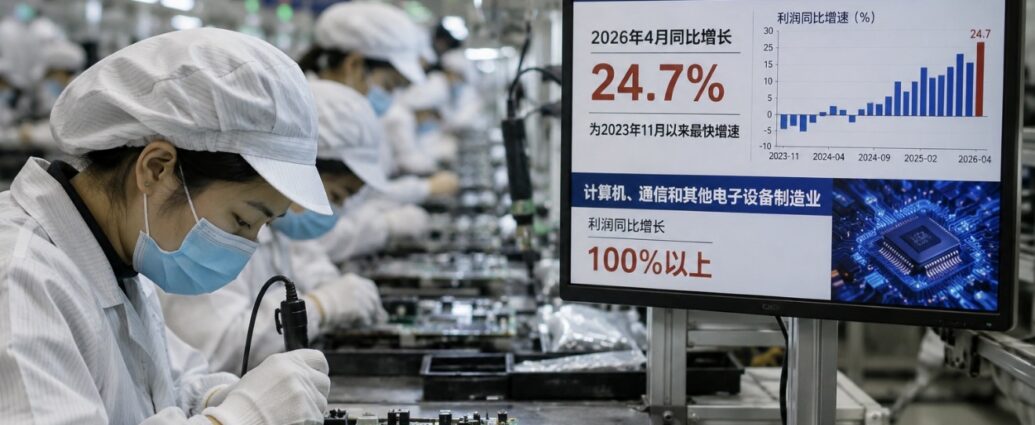
BEIJING — China’s factories posted their strongest monthly profit growth in more than two years in April, with earnings at the country’s largest industrial companies jumping 24.7% year-over-year, according to data released Wednesday, May 27, 2026 by China’s National Bureau of Statistics, underscoring how deeply the global artificial-intelligence boom is now reshaping manufacturing profits on both sides of the Pacific.
The gain marks the fastest pace of Chinese industrial profit growth since November 2023, accelerating sharply from a 15.8% increase in March and lifting year-to-date profit growth for the first four months of 2026 to 18.2%, up from 15.5% in the first quarter.
The numbers arrive as global equity markets — especially U.S. semiconductor stocks — continue surging on expectations of massive AI-driven spending on data centers, memory chips, networking equipment and computing infrastructure.
And increasingly, the same forces driving record valuations on Wall Street are also driving profits inside Chinese factories.
The strongest gains in China’s report came from the computing, communications and electronics manufacturing sector, now the country’s single largest industrial profit category. Earnings in that segment more than doubled from a year earlier as demand for AI-related hardware accelerated globally.
That matters directly to American investors.
On Tuesday, the S&P 500 closed at a fresh record high of 7,519.12, while the Nasdaq Composite finished at 26,656.18, also an all-time high, led overwhelmingly by semiconductor and AI infrastructure stocks.
Micron Technology surged roughly 19%, briefly crossing a $1 trillion market capitalization after UBS sharply raised its price target on the company. The VanEck Semiconductor ETF climbed more than 3% to a new 52-week high, while Advanced Micro Devices, On Semiconductor and Western Digital all posted major gains.
The link between the two markets is becoming increasingly obvious.
The global AI infrastructure buildout — from hyperscale data centers to inference clusters and advanced memory systems — is generating extraordinary demand across the entire semiconductor supply chain.
American chip designers are pricing that demand into equity valuations.
Chinese factories assembling servers, networking systems, electronics and hardware components are pricing it into margins and profit growth.
Both sets of numbers are effectively telling the same story at the same time.
The second major contributor to China’s April profit surge was energy.
Oil prices have climbed sharply amid the expanding Middle East conflict, with crude trading in roughly the $100 to $106 per barrel range during April. China’s oil and gas extraction industry swung from a 1.4% profit decline in the first quarter to an 8.1% gain through April as higher crude prices boosted margins for state-owned energy producers.
Government policy is also playing a role.
Chinese officials have spent years subsidizing strategic industrial sectors including semiconductors, advanced manufacturing and high-tech equipment through tax incentives, low-cost financing and direct state investment.
Earlier this year, Yu Weining, chief statistician at the National Bureau of Statistics, said profits in China’s equipment-manufacturing sector rose 21%, while high-tech manufacturing profits surged 47.4% during the first quarter alone.
But beneath the headline profit numbers, China’s broader economy remains uneven.
Industrial output growth slowed to 4.1% in April, while retail sales barely moved, rising just 0.2%. Fixed-asset investment — spending on factories, housing and infrastructure — contracted over the first four months of the year as China’s property slump continued weighing on domestic demand.
In other words, the factory-profit boom is real, but highly concentrated.
The strongest industries are tied directly to AI hardware, advanced electronics and energy — not to broad-based consumer recovery inside China.
There is also a pricing dynamic emerging underneath the data.
China’s Producer Price Index (PPI) rose 2.8% in April, the largest increase since July 2022, suggesting factories are finally regaining pricing power after more than two years of deflationary pressure and price wars across parts of Chinese industry.
Beijing has spent months trying to reduce aggressive domestic price competition that had crushed margins in sectors ranging from solar equipment to industrial machinery. April’s numbers suggest some of those efforts may now be feeding through into corporate profitability.
For Washington policymakers, however, the data also highlights a strategic complication.
The single strongest category inside China’s profit report — electronics and computing equipment — is the very sector the United States has spent years trying to constrain through semiconductor export controls and technology restrictions.
Since 2022, Washington has imposed multiple rounds of restrictions targeting advanced AI chips, semiconductor manufacturing equipment and high-end computing exports to China.
Yet Chinese manufacturers tied to AI infrastructure are still seeing profits surge.
That does not necessarily mean the export controls failed strategically, but it does suggest the global AI spending boom has become so large that Chinese firms continue benefiting even under significant restrictions.
Trade flows also remain surprisingly resilient.
China’s exports rose 14.1% year-over-year in April, while imports surged 25.3%, according to customs data released earlier this month.
Meanwhile, the fragile U.S.-China trade détente reached late last year continues holding for now. Earlier this month, Beijing confirmed an order for 200 Boeing aircraft, describing aviation as a “key area” for bilateral cooperation — a signal both governments appear eager to preserve at least limited economic stability despite broader geopolitical rivalry.
For Wall Street, the takeaway from Wednesday’s Beijing data is straightforward.
The AI capital-expenditure cycle is now large enough to push industrial profits, stock prices and corporate investment higher simultaneously across both the American and Chinese economies.
Chip designers, memory producers, foundries, server manufacturers and contract electronics firms are all feeding from the same underlying demand wave.
The Chinese numbers, in many ways, simply confirm what U.S. markets have already been pricing in for months.
The risks, however, remain equally clear.
China’s recovery remains narrow. American equity markets remain heavily concentrated in a small group of AI-linked technology companies. And the same Middle East conflict helping lift energy-sector profits also threatens broader economic stability if oil prices spike further or supply disruptions worsen.
This week, strategists at Goldman Sachs warned that today’s bull market still faces structural vulnerabilities tied to tech concentration, geopolitical tensions and volatility in bond markets.
For now, however, the message coming simultaneously from Beijing’s factory floors and the New York Stock Exchange is unmistakable:
AI hardware is generating real profits — and nearly everyone connected to the supply chain is benefiting at once.
Asia — JBizNews Desk
© JBizNews.com All Rights Reserved. Reproduction or distribution without written permission is prohibited.