By Julia Parker — JBizNews Desk
China is scaling up industrial and humanoid robots at a pace no other economy can match, but a recent court ruling, provincial reskilling mandates, and explicit central-government messaging are simultaneously pushing companies to avoid mass labor displacement. Factories pouring billions into automation are increasingly being told they cannot use new AI systems and robotics as blanket justification to cut the human workforce that powered China’s manufacturing rise.
The clearest signal emerged last month from the Hangzhou Intermediate People’s Court. In a ruling dated April 28, the court found that a technology company in eastern China unlawfully terminated a quality-assurance employee — identified in legal filings only as Zhou — after he refused a 40% pay cut and demotion tied to his role being replaced by a large-language-model system. The court rejected the company’s argument that AI deployment qualified as a “business downsizing” event and ordered compensation for the employee. Legal analysts described the case as the first major judicial indication that Chinese firms cannot cite automation alone as legal grounds for layoffs.
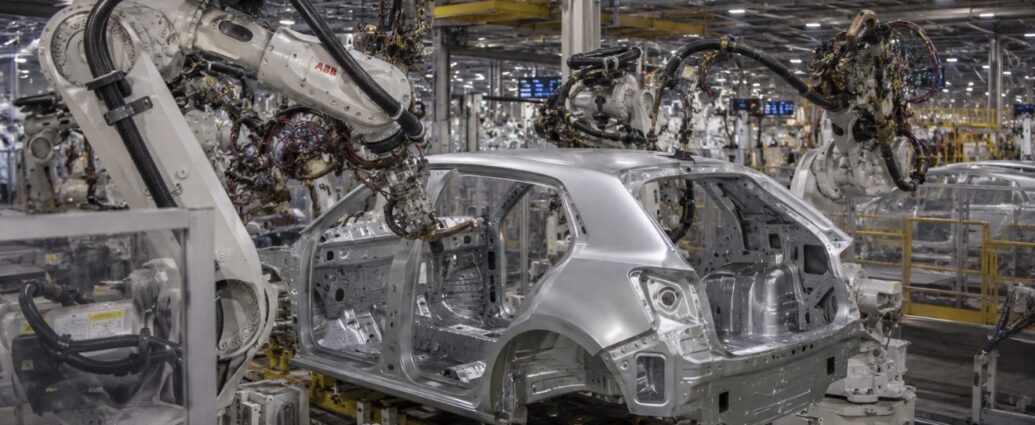
The ruling arrives against the backdrop of an industrial-robotics expansion of historic scale. According to the International Federation of Robotics, China accounted for 54% of all new industrial robot installations worldwide in 2024, deploying approximately 295,000 new units — more than the rest of the world combined. China’s robot density has climbed to roughly 392 to 400 robots per 10,000 manufacturing workers, nearly triple the global average of 141 and ahead of Germany, while rapidly approaching the levels seen in South Korea and Japan.
Takayuki Ito, president of the IFR, said China’s latest five-year framework is accelerating the shift away from traditional factory automation toward AI-integrated, high-end robotics systems intended to anchor the country’s next phase of industrial modernization. Beijing’s strategy increasingly treats robotics, AI, semiconductors, and advanced manufacturing as interconnected pillars of long-term economic and geopolitical competitiveness.
That policy infrastructure has expanded aggressively. China formally launched its 15th Five-Year Plan in 2026 with robotics positioned near the center of national industrial strategy, building on the earlier Made in China 2025 initiative and the newer AI+ development framework. According to Reuters, Beijing allocated more than $20 billion in subsidies, grants, tax incentives, and state-backed investment funding to the robotics sector during late 2024 and early 2025 alone. Analysts now estimate China’s industrial robotics market at roughly $47 billion, far larger than the comparable U.S. sector.
At the same time, authorities are constructing a parallel labor-protection system designed to soften the social impact of automation. Guangdong province — home to the massive manufacturing corridor surrounding Foshan and the Pearl River Delta — has launched a “Million Talents Plan” aimed at reskilling roughly 3 million industrial workers over three years, with AI operations, robotics maintenance, and advanced-manufacturing support roles prioritized heavily. Government spending on vocational and industrial AI training programs has surpassed $15 billion since 2020.
Technical institutions including Shunde Polytechnic University are now partnering directly with manufacturers such as Midea to align factory-floor certifications with real-time industrial demand. Beijing’s broader message is increasingly clear: automate aggressively, but avoid the kind of visible labor shock that could destabilize employment and domestic consumption.
The underlying tension, however, is becoming harder to disguise. According to Bloomberg, Chinese manufacturing employment has already fallen from roughly 115 million workers in 2013 to below 85 million in 2025, representing a decline of more than 30 million jobs even as Chinese exports reached record highs earlier this year.
Major manufacturers have already automated significant portions of their operations. Foxconn has removed tens of thousands of factory positions across its Shenzhen, Zhengzhou, and Kunshan facilities. Xiaomi’s Changping smartphone plant has been described as operating with virtually no human workers on portions of the production floor while producing roughly one device per second. EV and battery giants including BYD and CATL have rapidly expanded robotics integration throughout their manufacturing operations.
The humanoid robotics sector is accelerating even faster. China’s Ministry of Industry and Information Technology said more than 140 domestic humanoid robotics manufacturers were operating in 2025, with over 330 humanoid robot models already introduced. UBTECH has deployed its Walker S2 humanoid into production-line environments, while Unitree Robotics has drawn international attention with its G1 platform and its lower-cost $5,000 R1 system.
Automakers including BYD, Geely, and Xpeng have already begun integrating Unitree humanoids onto factory floors. Xpeng has reportedly explored humanoid robotics investments approaching 100 billion yuan — roughly $13.8 billion — a scale difficult to justify solely on the basis of worker augmentation rather than eventual labor replacement.
For global competitors, the numbers are increasingly difficult to ignore. U.S. robot density stands at roughly 295 robots per 10,000 manufacturing workers, still well below China’s level. None of the world’s 10 largest industrial robotics companies are headquartered in the United States, and most robots deployed in American factories continue to be imported from Japan or Germany. U.S. companies such as Boston Dynamics remain heavily focused on research, defense applications, and limited-scale commercial deployment rather than mass industrial manufacturing.
The broader challenge emerging from China is not simply technological scale, but policy coordination. Beijing is attempting to engineer a model built around maximum automation alongside minimum visible labor displacement — a balancing act with few clear historical parallels in modern industrial policy. Whether that model proves economically sustainable may help determine the competitive landscape for global manufacturing over the next decade.
JBizNews Desk
© JBizNews.com. All rights reserved. This article is original reporting by JBizNews Desk. Unauthorized reproduction or redistribution is strictly prohibited.