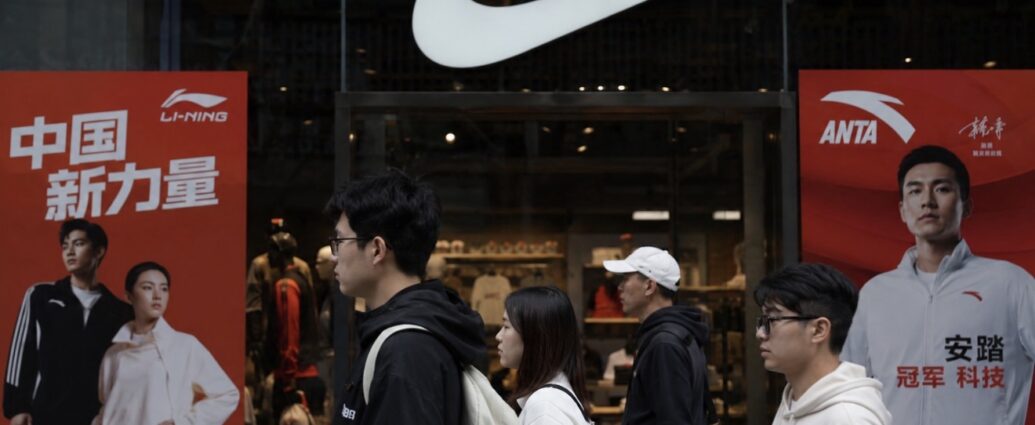
Nike Inc. is confronting the deepest crisis its China business has faced in decades, as Chinese consumers increasingly abandon the American sportswear giant in favor of fast-growing domestic competitors including Anta Sports and Li-Ning, forcing Nike into a sweeping strategic overhaul in what was once its most important international growth market.
According to Nike earnings filings and reporting reviewed by The Wall Street Journal, revenue in Greater China now sits roughly 28% below comparable levels from five years ago, while the company has recorded six consecutive quarters of year-over-year sales declines in the region.
The deterioration has transformed China from one of Nike’s most valuable growth engines into the weakest-performing major region in the company’s global portfolio.
In Nike’s latest reported quarter, Greater China revenue fell 17%, with footwear sales down 21%, extending a prolonged decline that has weighed heavily on consolidated results and contributed to significant stock weakness over the past year.
The region still accounts for roughly 15% of Nike’s total global revenue, making the slowdown impossible for investors and management to ignore.
Chief Executive Elliott Hill, who returned to Nike in October 2024 after previously spending more than three decades at the company, acknowledged during a recent earnings call that China represents “the longest road” in Nike’s broader turnaround effort.
“This market requires a complete reset,” Hill told investors.
From Phil Knight’s ‘Two Billion Feet’ Vision to Crisis
Nike’s China ambitions date back decades.
Co-founder Phil Knight famously described China as “one billion people, two billion feet,” a phrase that became central to Nike’s long-term international expansion strategy and helped turn China into one of the company’s most profitable regions by the early 2010s.
For years, Nike’s China playbook became a model studied by consumer brands across corporate America.
But the environment has changed dramatically.
According to Wall Street Journal reporting, internal execution problems compounded broader market shifts. Much of the operational breakdown reportedly occurred during the tenure of former China General Manager Angela Dong, who has since departed the company along with former Chief Commercial Officer Craig Williams.
Nike has since appointed longtime company veteran Cathy Sparks as Vice President and General Manager of Greater China to stabilize operations and oversee the turnaround effort.
Chinese Rivals Gain Ground
Nike’s decline has coincided with the explosive rise of domestic Chinese sportswear brands.
Anta Sports, headquartered in Fujian province, has aggressively expanded store networks throughout China’s interior cities while strengthening its presence in performance athletics and Olympic sponsorships — categories once dominated by Nike.
Meanwhile, Li-Ning, founded by the former Chinese Olympic gymnast of the same name, has successfully blended patriotic branding, localized marketing, and lower pricing to gain share in running and basketball apparel.
Both companies have benefited from faster mainland-based supply chains and significantly shorter design and production cycles than Nike’s more globally distributed manufacturing network.
A growing number of local athleisure and outdoor brands have also fragmented the market further.
Industry analysts increasingly view Chinese sportswear brands not as low-cost imitators but as legitimate global competitors capable of challenging Western brands on product quality, innovation, and consumer engagement.
Nike Misses China’s Digital Shift
Nike’s digital execution in China has also lagged competitors.
The company reportedly did not launch a flagship store on Douyin, the Chinese version of TikTok owned by ByteDance Ltd., until 2024 — roughly two years after Anta, Li-Ning, and other domestic brands had already built massive followings on the platform.
Douyin has become one of China’s dominant retail-discovery ecosystems for younger consumers, particularly in sportswear and lifestyle categories.
Nike’s delayed entry into the platform cost the company valuable market share and consumer relevance during a critical period of digital transformation in China’s retail sector.
The company also faced political and cultural backlash following a controversial 2024 Paris Olympics advertisement featuring an Asian female table-tennis player licking her paddle, which drew criticism from Chinese state media during a period of heightened nationalist sentiment.
The controversy contributed to growing pressure on then-Chief Executive John Donahoe, who later departed the company.
Geopolitics Add More Pressure
Broader geopolitical tensions have further complicated Nike’s position.
Ongoing tariff disputes under the Trump administration, rising U.S.-China political tensions, and lingering controversies involving Xinjiang cotton sourcing have created a more difficult operating environment for American consumer brands throughout China.
While competitors such as Adidas AG have managed to return to growth in China through more localized product strategies and faster execution, Nike continues struggling to regain momentum.
At the same time, premium athletic brands including Lululemon, Hoka, and On Holding are capturing market share globally, intensifying competitive pressures beyond China alone.
Nike Bets on ‘Back to Sport’ Turnaround
Hill’s turnaround strategy centers on what Nike internally calls a “back to sport” approach — refocusing the company on performance running, basketball, and athletic training after years emphasizing lifestyle apparel and fashion-oriented collaborations.
Nike said early signs from March showed stabilizing traffic trends at some Chinese stores, particularly in performance-running categories, where sales reportedly returned to double-digit growth.
Still, analysts at firms including Jefferies, Morgan Stanley, and Citigroup continue identifying China as the single largest risk factor facing Nike’s fiscal 2026 outlook.
For Wall Street and the broader retail industry, Nike’s struggles underscore a major shift underway in the Chinese consumer economy.
The China market that once fueled decades of relatively easy growth for American companies including Nike, Apple, Starbucks, and others has fundamentally evolved.
Chinese consumers are wealthier, more digitally sophisticated, more nationalistic, and increasingly loyal to domestic brands capable of competing globally.
Whether Nike can reclaim its lost market share — or whether China’s “two billion feet” have permanently moved elsewhere — may ultimately define Elliott Hill’s leadership and the company’s future growth trajectory.
— JBizNews Desk
© JBizNews.com. All rights reserved. This article is original reporting by JBizNews Desk. Unauthorized reproduction or redistribution is strictly prohibited.