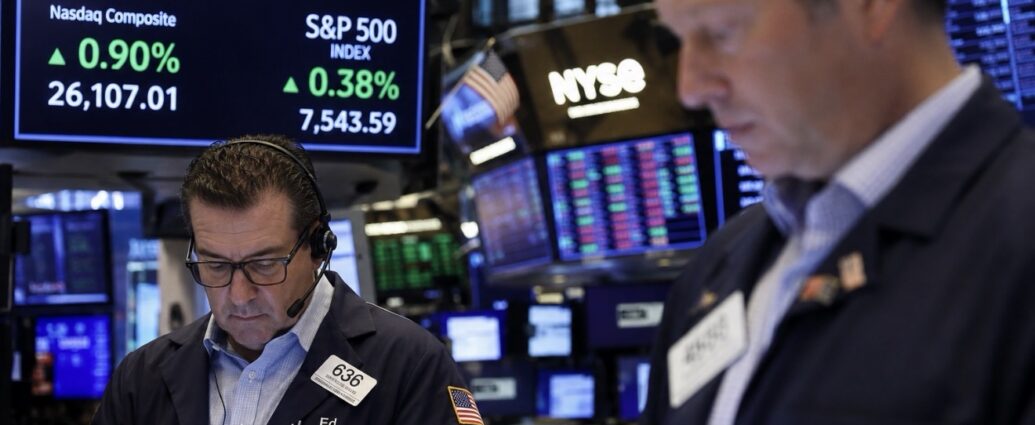
U.S. stocks opened firmly higher Tuesday, with semiconductors and a strong showing from General Motors driving a broad recovery, as investors positioned for a dense week of technology earnings and weighed easing oil prices against a fresh escalation in trade tensions with Canada.
Roughly an hour into the session, the Nasdaq Composite led the advance with a gain of about 0.9%, retaking ground after last week’s chip-sector selloff. The S&P 500 rose around 0.6%, and the Dow Jones Industrial Average added roughly 0.4%, clawing back Monday’s modest losses. The move followed an overnight rally across Asia, where South Korean and Taiwanese benchmarks each climbed more than 2.5% on strength from the region’s largest chipmakers, and Japan’s Nikkei jumped 2.2% as trading resumed from a holiday.
The rebound reflects a market betting that this week’s megacap technology results can justify the AI-driven rally that has powered equities for much of the year. Alphabet and Tesla both report after Wednesday’s close, in what many participants view as the first real test of whether the roughly $180 billion the largest firms have poured into AI infrastructure is beginning to generate proportional returns. Semiconductor shares, which bore the brunt of last week’s retreat, led the bounce ahead of those reports.
Market Movers
General Motors was the standout of the morning. The Detroit automaker reported adjusted earnings of $3.57 per share, well ahead of Wall Street’s expectations near $3.13 to $3.29, on revenue of $48.03 billion, up 1.9% from a year earlier. GM raised several of its 2026 forecasts, pointing to consistent vehicle pricing, lower warranty costs, and narrowing losses on electric vehicles as it winds down a multibillion-dollar EV pullback. Reported net income still fell about 31% year over year to $1.3 billion, weighed down by charges tied to that retreat — but the raised outlook and pricing discipline drove shares higher and lifted the Dow.
Charles Schwab climbed after posting earnings ahead of expectations, with the brokerage crediting a pickup in retail trading. That activity followed heightened market swings tied to recent geopolitical uncertainty — a reminder that volatility itself has become a revenue driver for firms positioned to capture trading flow.
Circle Internet Group jumped more than 8% despite a reported 5.1% decline in USDC stablecoin supply to $73.1 billion as of mid-July. The drop pressures the company’s reserve-income outlook, and at least one securities firm trimmed its rating, flagging possible shifts to the business model. The stock’s rise in the face of that caution underscores how much investor appetite remains for digital-asset exposure.
Nvidia added just under 1% at the open, tracking the broader semiconductor bounce and keeping the AI trade at the center of market attention. In consumer names, Jersey Mike’s is preparing an initial public offering that could generate more than $700 million, a signal of renewed demand for fast-casual dining and a test of appetite for consumer listings.
Commodities and Energy
Crude oil eased in early trading, retreating after Monday’s climb. The pullback came on reports that mediators are pushing for a 10-day ceasefire, tempering the risk premium that had built as the U.S. carried out its tenth consecutive night of strikes on Iran. The de-escalation hopes offered relief at the pump-price level and helped improve risk appetite across equities, even as the underlying conflict remains unresolved. Energy markets stayed sensitive to shipping conditions, with concerns over Red Sea traffic continuing to shadow the outlook for supply routes.
Trade Policy Enters the Frame
A new front opened over the weekend. President Trump signed proclamations imposing a 50% tariff on a wide range of Canadian goods under Section 338 of the Tariff Act of 1930, with the measures set to take effect August 19. The covered products range from wine and cement to furniture, dairy, and clothing, and apply regardless of whether goods qualify under the U.S.-Mexico-Canada Agreement, though energy, potash, critical minerals, and fish are exempt. Canadian Prime Minister Mark Carney called the action a violation of the continental trade pact. For import-dependent businesses across the tri-state region, the added cost uncertainty lands squarely on cross-border supply chains heading into the fall.
The combination leaves markets balancing genuine optimism on earnings against unresolved external risks. A firmer open is not a settled one, and the reports arriving over the next several sessions will do more to set direction than any single morning’s move. The practical takeaway for owners and investors: the recovery is real but conditional, resting on technology delivering the numbers already priced in — and on trade and energy risks staying contained.
JBizNews Desk | Wall Street
© JBizNews.com All Rights Reserved. Reproduction or distribution without written permission is prohibited.