The global chocolate industry is undergoing one of its most consequential structural resets in decades, as extreme volatility in cocoa prices forces the world’s largest confectionery companies to rethink sourcing, pricing, and product composition—all while consumers continue to face elevated prices at the register.
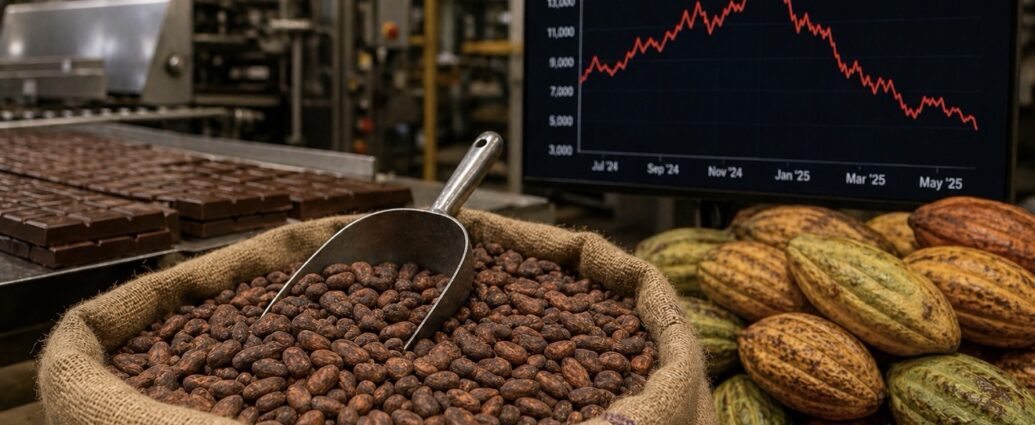
Cocoa futures, which surged to a record $12,931 per metric ton in late 2024, have since fallen more than 70%, stabilizing in the $5,000 to $6,000 range in early 2026. Despite the sharp decline, prices remain well above historical norms, leaving manufacturers navigating a fundamentally altered cost environment. The volatility—driven by poor harvests in West Africa, climate disruptions, disease, and years of underinvestment—has exposed deep structural vulnerabilities across the cocoa supply chain.
“The scale of the shock changed how companies think about cocoa entirely,” industry analysts note, pointing to a shift from short-term hedging strategies toward long-term supply resilience. Cocoa’s role extends far beyond chocolate bars, feeding into bakery products, snacks, dairy, and beverages—meaning pricing disruptions ripple across the broader food economy.
For The Hershey Company (NYSE: HSY), the response has centered on tightening hedging strategies while expanding sourcing flexibility. Chief Financial Officer Steve Voskuil told investors the company has strengthened its commodities governance framework, combining derivatives, market intelligence, and structured oversight to manage volatility. “We have very good visibility into our cost basket, including cocoa, albeit at significantly higher pricing levels than prior years,” Voskuil said, adding that hedging allows Hershey to cap downside risk while maintaining upside exposure if prices fall.
At the same time, Hershey has quietly adjusted certain product formulations. Some seasonal and specialty items have shifted away from traditional milk chocolate toward alternative coatings using sugar and vegetable oils, a move that has sparked consumer backlash. The company has defended its core products, particularly Reese’s Peanut Butter Cups, while acknowledging ongoing experimentation across its portfolio.
Despite the controversy, Hershey has outperformed peers. The company’s latest earnings beat expectations, sending shares higher and supporting a stronger outlook for 2026. Analysts note that Hershey has managed to maintain elevated retail prices even as input costs began to ease—effectively preserving margins in a way reminiscent of previous commodity cycles.
In contrast, Mondelēz International (NASDAQ: MDLZ) has faced a more constrained recovery. Although the company exceeded earnings estimates, its shares declined after management issued a cautious outlook. Analysts point to longer-duration cocoa hedges as a key factor limiting its ability to benefit from falling prices. Chief Executive Officer Dirk Van de Put emphasized that consumer demand for chocolate remains resilient but signaled that pricing pressure could persist. “For sure, cocoa prices will remain higher than they’ve been in the past, but they will come down eventually from the current high,” Van de Put said.
Across Europe, reformulation trends are accelerating. Nestlé S.A. (SWX: NESN) removed the legal designation of “chocolate” from certain products in the UK after reducing cocoa content below regulatory thresholds, relabeling them as “chocolate-flavored” coatings. Pladis Global, the maker of Penguin and Club bars, has taken similar steps. These changes have triggered backlash from consumers, with critics arguing that the industry has moved beyond shrinkflation into ingredient substitution.
“Chocolate manufacturers are looking for ways to decrease the impact of supply challenges, quality fluctuations, and volatile cocoa pricing,” said Billy Roberts, Food & Beverage Economist at CoBank. “But such moves have not been without controversy, whether from taste changes or negative public perception.”
Retail data underscores the disconnect between commodity prices and consumer experience. Despite the sharp drop in cocoa futures, chocolate prices in U.S. stores continued to rise into early 2026. Datasembly reported a 14.4% year-over-year increase in shelf prices during the opening weeks of the year, reflecting the lag effect of higher-cost inventories and sustained pricing strategies by manufacturers.
The most significant structural shift may be unfolding at the supply chain level. Barry Callebaut AG (SWX: BARN), the world’s largest chocolate producer, is reportedly exploring options to separate its cocoa trading and processing business from its chocolate manufacturing division. Potential scenarios include a spin-off, joint venture, or sale, according to people familiar with the matter. The move would mark a major departure from the integrated model that has long defined the industry. Shares in Barry Callebaut surged following reports of the potential restructuring.
The concentration of the cocoa market adds urgency to these discussions. Just three companies—Barry Callebaut, Cargill Inc., and Olam Group Ltd. (SGX: VC2)—control an estimated 60% to 70% of global cocoa grinding capacity, giving them outsized influence over supply dynamics. Their scale-driven model, built on predictable sourcing and cost efficiency, has been strained by the unprecedented volatility of recent years.
In response to growing pressure at the farm level, major industry players are also turning toward collective action. In February, companies including Mars Inc., Mondelēz, Nestlé, Hershey, and Lindt & Sprüngli AG (SWX: LISN) launched TogetherCocoa, a joint initiative aimed at improving farmer incomes and stabilizing production in Côte d’Ivoire and Ghana—the world’s two largest cocoa producers. “We are working closely with governments and supply chain partners to address long-term sustainability challenges,” said Todd Scott, Senior Communications Manager at Hershey.
The initiative reflects a broader acknowledgment that the root causes of cocoa volatility—aging tree stock, climate stress, farmer poverty, and lack of reinvestment—cannot be solved through financial hedging or product reformulation alone. With more than 90% of global cocoa produced by smallholder farmers, many of whom face declining yields and economic pressures, the long-term outlook for supply remains uncertain.
For consumers, the implications are clear. Even after a dramatic collapse in commodity prices, retail chocolate costs are unlikely to fall significantly in the near term. Companies that absorbed higher costs through price increases have little incentive to reverse them quickly, particularly as structural risks in the supply chain persist.
The result is a new reality for the global chocolate market—one defined by higher baseline prices, evolving product formulations, and a supply system still under strain. Whether this reset ultimately stabilizes the industry or introduces a new era of volatility will depend on how effectively companies—and governments—address the deeper structural challenges now laid bare.
JBizNews Desk