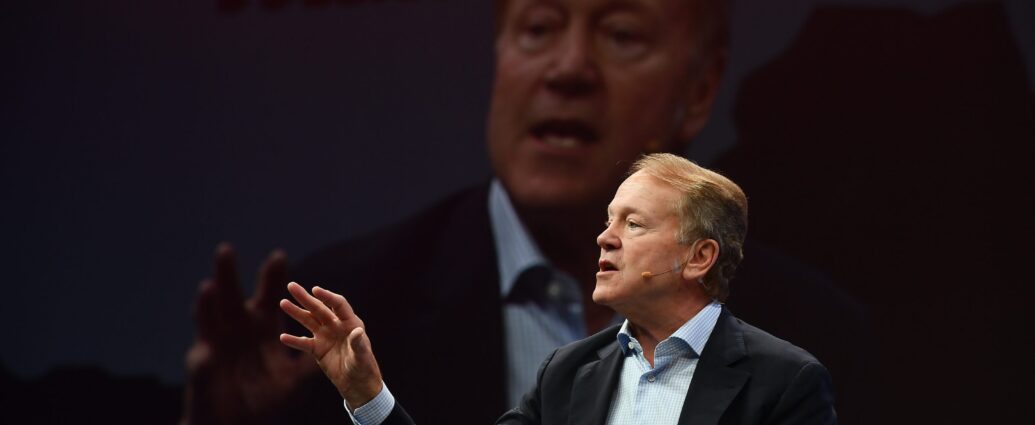
- In today’s CEO Daily: Diane Brady interviews John Chambers, who knows bubbles, about the AI boom.
- The big leadership story: Kalshi and the SCOTUS case that could determine the future of gambling.
- The markets: Down in Europe as tanker attacks threaten a fragile ceasefire.
- Plus: All the news and watercooler chat from Fortune.
Good morning. Are we in a stock market bubble? If you go by the so-called Buffett Indicator, as my colleague Shawn Tully reminded readers in this piece yesterday, the answer is yes. The ratio of total stock market capitalization to GDP now stands at 232%, exceeding 1999 levels and the 200% threshold where Buffett said investors were “playing with fire.”
But is today’s bubble comparable to what we saw during the dot-com boom from 1995 to 2000? For insight on that, I spoke yesterday with John Chambers, who was CEO of Cisco from 1995 to 2015. Under his watch, it became the most valuable company on earth, with a market cap of $576 billion in March 2000, dropping to a low of around $60 billion by October 2002. Today, it’s around $340 billion. For almost a decade, Chambers has bet big on AI through JC2 Ventures and continues to advise founders, government leaders, and CEOs on market trends. (I co-wrote a book with him and find his annual tech predictions prescient.) His take:
What’s similar: “The driving force was the internet, and growth was almost completely out of control. The limiting factor was supply chain: lead times stretched out and nobody wanted to cancel orders, which can disguise a lot of problems. The most valuable companies were the technology companies, and there was a 50% increase in (annual) productivity gains. I do see parallels there. AI will change the way we work, live, learn and play, just like the internet did, and it will drive productivity for the next decade and the decade after that. There will be bubbles, with dramatic winners and spectacular train wrecks.”
What’s different: “We’re in the very early innings of an endurance baseball game with 100 innings that’s moving at tremendous speed. We snuck up on IBM (which tried to control enterprise architecture as Cisco built an open network for different systems to work together). The Magnificent Seven are all investing big time in AI and investing fast. Nobody is sneaking up on anybody. Microsoft led early on, then Google, now Anthropic probably has the most momentum. Any company could go any way. These CEOs get that. The bell-shaped curve where 50% of companies are in the middle is flattening. Companies to the right will have tremendous valuations but a lot more companies are going to get destroyed than will move to the right.”
Net Net: “I think a portfolio approach makes sense. AI affects everything. If you try to bet on one or two companies, that’s a high-risk approach. I would bet on the U.S. and, more than ever, I’m also bullish on India. Europe is way behind. The Middle East was one area where I was optimistic, but events have slowed down opportunities there. China should have led in AI, but you cannot do it with a five-year plan or top-down control. You need personalities to drive innovation. AI is moving at five times the speed with three times the impact. For leaders, it’s going to make Andy Grove’s paranoia look conservative.”
Contact CEO Daily via Diane Brady at diane.brady@fortune.com
This story was originally featured on Fortune.com





This post was originally published here