
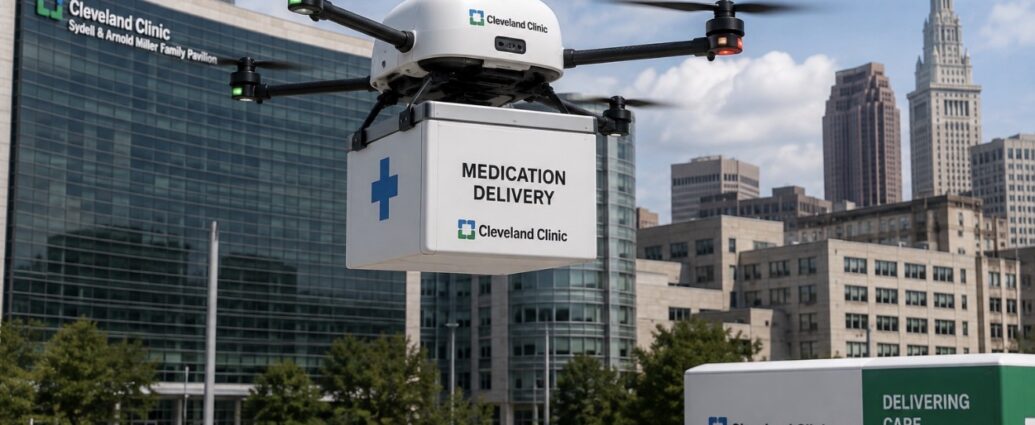
Cleveland Clinic is now sending prescriptions to patients by air. A pharmacy technician at its Beachwood campus loads a filled order into a secure drop box, an autonomous drone picks it up, flies to the patient’s address, hovers roughly 300 feet overhead and lowers the package to the ground on a tether. The drone never lands. The pod sets the medication down, winches back up, and the aircraft returns to its charging station.
The service went live Monday, Aug. 3, and has been running daily since. Cleveland Clinic says it is the first long-term deployment of a prescription drug drone delivery program by a U.S. health system, which is the distinction that matters commercially — hospitals have flown medical drone pilots for years, but this one is built to operate as a standing part of patient care rather than a demonstration.
The operator is Zipline, the drone logistics company that has been flying medical payloads since 2016. The company has delivered tens of millions of medical products worldwide and now serves more than 5,000 hospitals and healthcare facilities, and says each aircraft runs more than 500 safety checks every second in flight.
The launch is deliberately small. Deliveries are limited to patients within a five-mile radius of Cleveland Clinic’s Beachwood Administrative Campus, which serves as the drones’ home base. Eligible patients are those already enrolled in the health system’s pharmacy home delivery program; the pharmacy team notifies them through their patient portal when a medication qualifies. The option is voluntary and carries no extra charge.
What flies is limited too. Controlled substances are not being transported by drone at this stage, and refrigerated items are excluded, leaving shelf-stable prescriptions as the initial payload. Patients follow the aircraft through a tracking link sent in the MyChart portal.
The operating case is speed. Matt Soder, executive director for Cleveland Clinic specialty and community pharmacies, said a courier run traditionally takes several hours from notification to the patient’s door, where the drone route is measured in minutes. For a patient starting an antibiotic or waiting on a refill, that compresses a same-day errand into a wait shorter than the drive to the pharmacy would have been.
Volume showed up immediately. Bri Robinson, who manages the health system’s home delivery pharmacy, said on launch day that the pharmacy opened at 7 a.m. and had already sent five to ten orders to patient homes.
Lindsey Amerine, chief pharmacy officer at Cleveland Clinic, framed the program as an extension of the system’s existing delivery operation rather than a standalone experiment, saying it strengthens home delivery and extends the reach of its services beyond the walls of its facilities. Zipline’s president of U.S. healthcare, Hillary Brendzel, made the customer argument in plainer terms: one less errand to run, and more time back in people’s days.
For the healthcare business, the economics sit in the last mile. Pharmacy home delivery has been growing for years, but it is carried by courier fleets and parcel networks whose costs scale with drivers, vehicles, fuel and traffic. An autonomous aircraft that completes a short hop in minutes and returns to a charging station changes that cost curve, and it changes what a health system can promise a patient about timing. That is why the first long-term deployment matters more than any of the pilots that preceded it — a program designed to run indefinitely has to survive on its unit economics, not on grant funding or novelty.
The expansion path is already mapped. Cleveland Clinic plans to add locations and to use the drones for additional medications, lab samples, medically tailored meals and medical supplies. Lab samples are the item to watch: moving specimens between collection sites and central labs is one of the most routine, most vehicle-dependent logistics problems in medicine, and it is the kind of repetitive short-distance run that autonomous aircraft handle best.
Regulation remains the gate on how fast any of this scales. Routine flights beyond a pilot’s visual line of sight require federal approval, and Cleveland Clinic and Zipline say they cleared the regulatory and technical requirements before launching. Every new service area will need the same clearances, which is why a program of this kind starts inside a five-mile circle rather than across a metropolitan region.
For now, the practical picture is narrow and real: a few thousand households on Cleveland’s east side can have a prescription arrive in the yard in minutes, and the rest of American healthcare is watching whether the numbers hold up well enough to copy.
JBizNews Desk | Cleveland
© JBizNews.com All Rights Reserved. Reproduction or distribution without written permission is prohibited.




