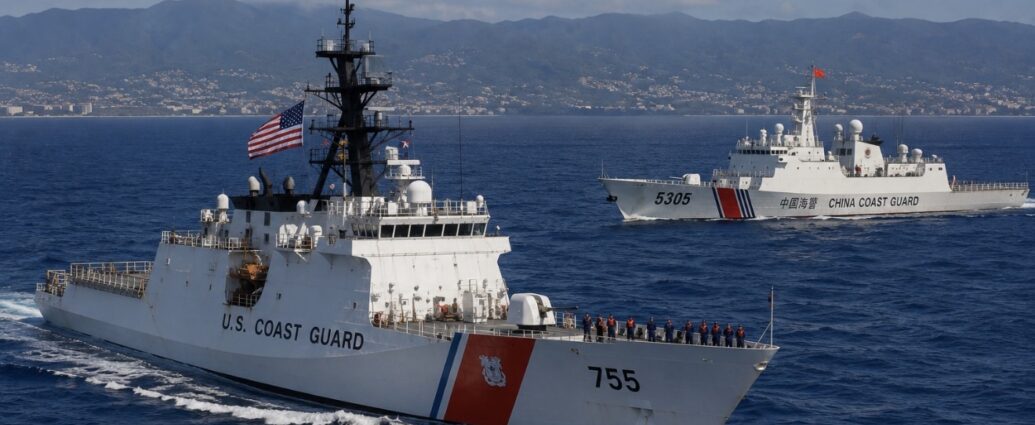
The U.S. Indo-Pacific Command’s Staff Judge Advocate office in Hawaii marked the tenth anniversary of the landmark South China Sea arbitration ruling on Tuesday, July 14, by issuing formal legal guidance reaffirming that China remains in violation of international law.
The legal statement revisited the 2016 Permanent Court of Arbitration decision in The Hague, which overwhelmingly rejected Beijing’s sweeping “nine-dash line” claim covering roughly 90% of the South China Sea and ruled in favor of the Philippines.
According to the Hawaii-based command, the decision remains legally binding under the United Nations Convention on the Law of the Sea (UNCLOS), which China ratified in 1996.
The renewed legal declaration comes as the U.S. Coast Guard quietly shifts assets from the Middle East into the Western Pacific, reflecting Washington’s growing concern over China’s increasingly aggressive maritime claims across one of the world’s busiest shipping lanes.
A Commercial Waterway Worth Trillions
The South China Sea carries enormous economic significance.
Roughly one-third of global seaborne trade passes through its waters each year.
Container ships, crude oil tankers and liquefied natural gas carriers serving Japan, South Korea, Taiwan, Southeast Asia and global supply chains all transit waters where China increasingly asserts authority through the world’s largest coast guard fleet.
For businesses, shipping companies and insurers, the legal dispute has evolved into a practical commercial risk.
Why the Coast Guard Is Taking the Lead
Unlike U.S. Navy warships, Coast Guard cutters operate as law enforcement vessels rather than military combatants.
That distinction has become increasingly important.
China has expanded the legal authority of its own coast guard through domestic legislation, including a 2021 law permitting the use of force in certain circumstances.
Beijing routinely dispatches coast guard vessels—not naval destroyers—into disputed waters surrounding the Philippines, Japan, and Taiwan, framing its operations as civilian law enforcement rather than military activity.
Washington has responded in kind.
In late May, the USCGC Midgett conducted the first-ever joint maritime operation involving a U.S. Coast Guard cutter alongside the Philippine Navy frigate BRP Antonio Luna and the Philippine Coast Guard vessel BRP Melchora Aquino.
The exercises focused on maritime law enforcement, vessel boarding operations and interdiction training approximately 35 to 40 nautical miles from Scarborough Shoal, an area controlled by China but claimed by the Philippines.
According to Japanese ship observers, USCGC Midgett was docked at Yokosuka, Japan, as recently as July 10.
Meanwhile, USCGC Kimball continues operating alongside the USS Theodore Roosevelt Carrier Strike Group during the multinational RIMPAC 2026 naval exercises, which continue through July 31.
China Expands Its Presence
Regional tensions escalated sharply during June.
For the first time, the China Coast Guard conducted law enforcement patrols east of Taiwan and began radioing commercial cargo vessels transiting nearby waters, requesting information about crews, cargo and destinations.
On July 4, Chinese authorities announced deployment of a replacement patrol fleet east of Taiwan, stating the vessels would strengthen enforcement activities inside what Beijing described as China’s jurisdictional waters.
Many regional security analysts see those actions as far more significant than simple radio communications.
Gregory Poling, director of the Asia Maritime Transparency Initiative at the Center for Strategic and International Studies, told AFP that China appears to be asserting law enforcement authority well beyond what international law permits under exclusive economic zone rules.
Su Tzu-yun, of Taiwan’s Institute for National Defense and Security Research, said radio verification of commercial shipping could serve as preparation for enforcing a future maritime quarantine or blockade around Taiwan.
Former U.S. Air Force officer Ray Powell, who closely tracks Chinese maritime operations, warned that interference with liquefied natural gas carriers would immediately threaten Taiwan’s energy security since the island imports nearly all of its fuel supplies.
Insurance companies often begin pricing geopolitical risk long before any military confrontation actually occurs.
The Fleet Challenge
The Coast Guard’s expanding Pacific mission comes as it faces longstanding fleet shortages.
Congress recently approved more than $25 billion in Coast Guard funding through the One Big Beautiful Bill Act.
The legislation includes:
- $4.3 billion for nine Offshore Patrol Cutters
- $1 billion for Fast Response Cutters
- $4.3 billion for Polar Security Cutters
The legislation also elevates Indo-Pacific operations under the Coast Guard’s Force Design 2028 modernization strategy.
The challenge remains execution.
Delivery of the first Heritage-class Offshore Patrol Cutter, USCGC Argus, has slipped repeatedly and is now expected no earlier than December 2026, more than five years behind schedule.
As of January 2026, none of the Offshore Patrol Cutters had entered operational service.
At the same time, Rear Adm. Barata testified before the House Homeland Security Committee that an estimated 600 to 800 sanctioned “dark fleet” vessels continue transporting oil among Iran, Russia, China, and Venezuela—missions that also rely heavily on Coast Guard resources.
Why Businesses Should Care
For American exporters, manufacturers and logistics companies, the implications extend well beyond military strategy.
If Chinese authorities increasingly stop, question or delay commercial vessels transiting international waters, shipping costs, insurance premiums and transit times could all increase.
Longer shipping routes and greater geopolitical uncertainty would ripple throughout global supply chains.
Thirteen governments—including Australia, Canada, Germany, Japan, and the United Kingdom—have jointly called on all parties to comply with the 2016 arbitration ruling.
China has rejected those appeals.
Foreign Ministry spokeswoman Mao Ning again declared the arbitration award “illegal, null and void” and stated China would never recognize any claims based upon it.
A decade of legal rulings has not altered Beijing’s position.
Washington is increasingly signaling that ships—not statements—may now become the primary instrument for defending freedom of navigation.
JBizNews Desk | New York
© JBizNews.com All Rights Reserved. Reproduction or distribution without written permission is prohibited.