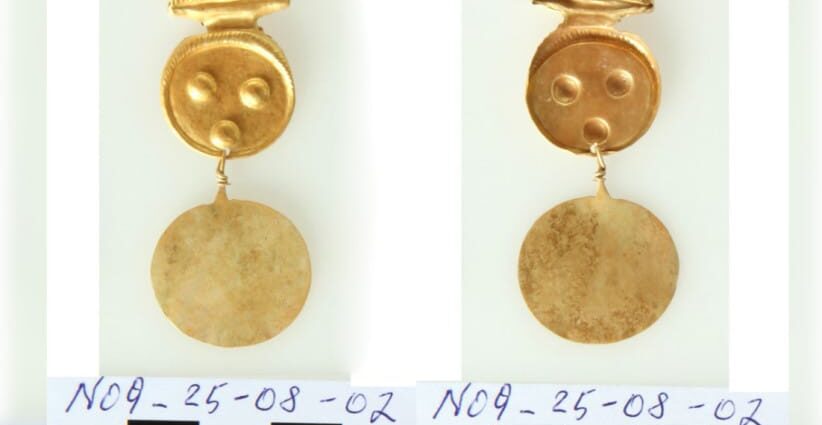
A collection of gold beads and amulets dating to the first half of the second millennium BCE were found during 2025 excavations at the archaeological site of Kolona on the Greek island of Aegina.
The discovery, announced last week by the Greek Culture Ministry, was found inside the ruins of a large stone structure, near the remains of a wall that protected the “inner suburb” of the Middle Bronze Age settlement.
Included in the collection were eight gold bilateral disc-shaped amulets, one gold non-bilateral disc-shaped amulet, seven golden biconical beads, one cylindrical gold bead, eight decorative sheets of gold leaf, and seven spherical carnelian beads.
All 32 of the items were found in excellent condition and believed to have belonged to a gold necklace or pendent.
In addition, a needle and twelve copper fragments, likely from small knives, were found at the site.
According to archaeologists, the jewelry may have served as grave offerings, possibly from a Middle Bronze Age burial. However, there has been no evidence of a surviving tomb to support this theory.
Pieces bear similarity to famed ‘Aegina Treasure’
The jewelry, and the amulets in particular, bear similarities to pieces from the “Aegina Treasure,” a Minoan gold hoard believed by some to have been found in a tomb on the island in 1891, while others think it to have been taken from the Chryssolakkos necropolis at Malia, Crete.
In 1892, the British Museum purchased the majority of the hoard from British artifact dealers. Further pieces were later bought by the museum in 1914.
The Aegina Treasure has been dated to the Greek Bronze Age between 1850 and 1550 BCE.
It includes two pairs of earrings, three diadems, a chest pendent, bracelet, and gold cup, four rings, ornamented plaques and plain strips. As well, there are five hoops and numerous beads and pendants made out of gold, lapis lazuli, amethyst, quartz, cornelian and green jasper.
The Kolona excavations were conducted by the University of Salzburg through the Austrian Archaeological Institute in Athens, under the direction of Professor Alexander Sokolicek and the supervision of the Ephorate of Antiquities of Piraeus and the Islands.