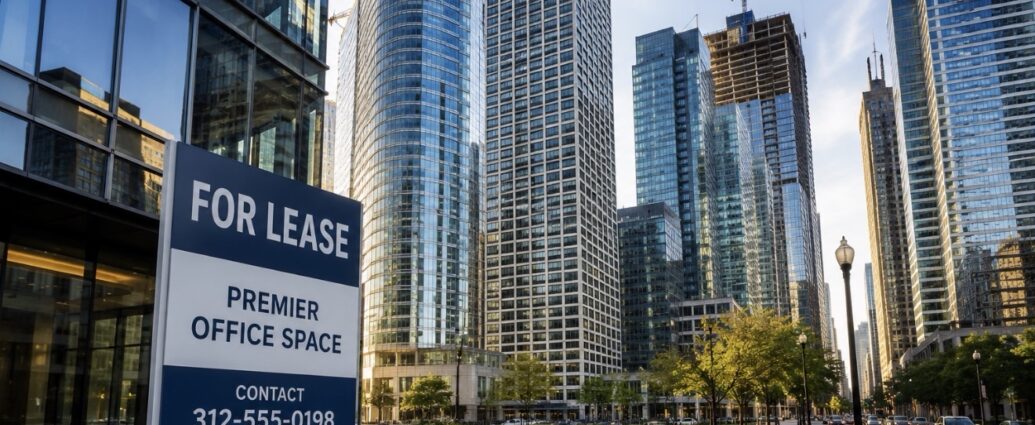
The 10-year U.S. Treasury yield climbed to its highest level in a year Monday, hardening the financing math that has reshaped American commercial real estate for the past 36 months and setting the stage for what brokers, lenders, and workout specialists describe as the most consequential six months of this cycle. With Federal Reserve rate-cut expectations sliding, roughly $148 billion in office-backed debt scheduled to mature this year, and Blackstone Inc. preparing its first publicly listed data-center REIT for launch, the question hanging over the market is no longer whether higher rates broke commercial real estate. It is which parts of the market were broken, which were simply reshaped, and which emerged stronger. The data through May suggests rates did not kill the entire CRE market. They sorted it.
Office: The Distress Is Real and Concentrated
The clearest evidence of damage remains in the office sector. Office CMBS delinquency hit an all-time high of 12.34% in January before easing modestly to 11.4% in February, according to Trepp, up sharply from roughly 1.6% in mid-2022. Morningstar analysts have identified maturity defaults rather than missed monthly payments as the primary driver, meaning many buildings are still generating cash flow but can no longer refinance under current rate structures and lender requirements. Approximately $148 billion in office-backed CRE debt is scheduled to mature in 2026, with five-year loans originated during the ultra-low-rate environment of 2021 now facing the most acute pressure.
The distress is heavily concentrated in older, lower-amenity Class B and C office towers. Trophy assets continue to attract refinancing capital. Tishman Speyer closed a $2.85 billion refinancing last year on The Spiral at Hudson Yards, while the office CMBS payoff rate climbed to 70.1% in 2025, up 11.3 percentage points from 2024. But large legacy towers such as Worldwide Plaza and One New York Plaza have slipped into delinquency, individually large enough to distort national data. Michael Cohen, a CMBS workout specialist at Brighton Capital Advisors, argues the market has now moved beyond simple asset devaluation and entered a transfer-of-ownership phase where foreclosures, discounted recapitalizations, and rescue-equity transactions will define the next 18 months.
Industrial: Cooled, Not Broken
Industrial real estate spent much of the past decade as institutional capital’s favorite trade, and the hangover from that boom is now working through the system. Industrial vacancy reached 7.3% in the second quarter of 2025 as new supply outpaced demand for a third consecutive year. Cushman & Wakefield expects vacancy to peak around mid-2026 before gradually tightening again. The market’s “flight to quality” has accelerated: modern, automation-ready logistics facilities near major population centers continue leasing relatively well, while older speculative warehouse developments in secondary metros face rising vacancy and slower absorption.
Even with softer fundamentals, industrial remains one of the healthiest major property sectors. Industrial CMBS delinquency stands at just 0.62%, the lowest of any major CRE category. Long-term structural tailwinds remain firmly intact, including e-commerce penetration hovering near 16% of total retail sales, reshoring efforts tied to U.S. manufacturing policy, and continued outsourcing growth among third-party logistics operators.
Multifamily: Stable Despite the Sun Belt Hangover
Multifamily housing has weathered the rate shock better than many investors initially feared. The sector absorbed roughly 1.1 million units during the historic 2024–2025 construction wave, while national vacancy currently sits near a manageable 5.2%, according to Inland Investments research. Rent growth briefly turned negative during peak deliveries, but new construction starts have now fallen sharply, and deliveries are expected to steadily decline through 2027.
The pressure remains concentrated in Sun Belt markets including Phoenix, Austin, Dallas, and Atlanta, where developers built aggressively during the migration boom and pricing power has weakened materially. Multifamily CMBS delinquency, at 6.94%, remains elevated but relatively stable. Analysts continue to point to America’s housing affordability crisis as a powerful long-term support mechanism for rental demand, particularly as elevated mortgage rates keep homeownership increasingly out of reach for younger households.
Retail and Lodging: Quietly Recovering
Retail real estate — once viewed as structurally impaired during the e-commerce panic of the late 2010s — has quietly stabilized into one of the steadier institutional sectors. Grocery-anchored centers, discount chains, off-price retailers, and service-oriented tenants continue driving leasing demand. Retail CMBS delinquency has eased from recent highs and now sits around 7.04%.
Hotels are recovering faster than many analysts expected. Lodging CMBS delinquency fell more than 100 basis points in early 2026 to 5.56%, the lowest level since March 2024, supported by strong leisure demand and a recovering corporate-group travel market. The upcoming 2026 FIFA World Cup is expected to further strengthen hotel fundamentals, with analysts projecting roughly $900 million in incremental U.S. lodging revenue as host cities prepare for surges in international tourism.
Data Centers: The Story Changing Commercial Real Estate
The single biggest structural shift in commercial real estate is the rise of data centers from a niche infrastructure play into a core institutional asset class. Global data-center investment reached roughly $580 billion in 2025 and is projected to rise to approximately $650 billion this year, according to estimates from Colliers and Reuters. U.S. data-center vacancy now sits near 1.3%, with Northern Virginia — the country’s largest market — operating below 1%. Market rents have more than doubled over the past four years.
JLL projects roughly 100 gigawatts of additional data-center capacity will come online globally between 2026 and 2030, potentially creating more than $1.2 trillion in new real estate value. Some industry forecasts now estimate the broader sector buildout could approach $3 trillion by the end of the decade.
Institutional capital is flooding into the space. Blackstone filed in April for the IPO of Blackstone Digital Infrastructure Trust, expected to trade under the ticker BXDC and initially target roughly $2 billion in acquisitions of stabilized hyperscaler-leased facilities. Meanwhile, Amazon, Microsoft, Alphabet, Meta Platforms, and Apple collectively invested roughly $350 billion into data-center infrastructure during 2025 and are expected to deploy another $511 billion this year alone. Data centers returned approximately 11.2% over the past year, outperforming every traditional CRE category.
Wall Street’s focus now turns to Nvidia Corp., which reports earnings Wednesday in what many investors increasingly view as a quarterly referendum on the broader AI infrastructure boom driving the sector.
Not everyone is convinced the current pace is sustainable. Patrick Wilson, portfolio manager at CenterSquare Investment Management, has warned that by 2027 investors will likely demand a clearer monetization path for many of the AI workloads driving today’s unprecedented infrastructure spending. Rich Hill, global head of real estate research at Principal Asset Management, similarly cautions that while long-term demand appears durable, not every investor entering the sector will ultimately succeed.
The Opportunity Set
For investors with patience and liquidity, the current market may represent the cleanest set of dislocations since the Global Financial Crisis. Distressed office assets in major gateway cities are trading at discounts ranging from 40% to 70% below 2019 valuations, opening potential conversion opportunities into residential or mixed-use developments as cities increasingly introduce incentive programs to encourage redevelopment.
Sun Belt multifamily markets weakened by oversupply may begin presenting attractive entry points over the next 12 to 18 months as construction pipelines collapse. Industrial assets in prime infill markets remain structurally constrained despite temporary softness. And data centers — despite growing valuation concerns — continue delivering leasing economics unmatched elsewhere in commercial real estate.
What higher rates ultimately destroyed was not commercial real estate itself, but the cheap-money model that dominated the industry for more than a decade: highly leveraged acquisitions, perpetual refinancing cycles, and assumptions that cap-rate compression alone could drive returns indefinitely. The market emerging from 2026 will likely be smaller, more selective, and significantly more disciplined. But in many corners of the industry, particularly those tied to digital infrastructure and logistics, American commercial real estate has rarely looked more dynamic.
JBizNews Desk
© JBizNews.com. All rights reserved. This article is original reporting by JBizNews Desk. Unauthorized reproduction or redistribution is strictly prohibited.