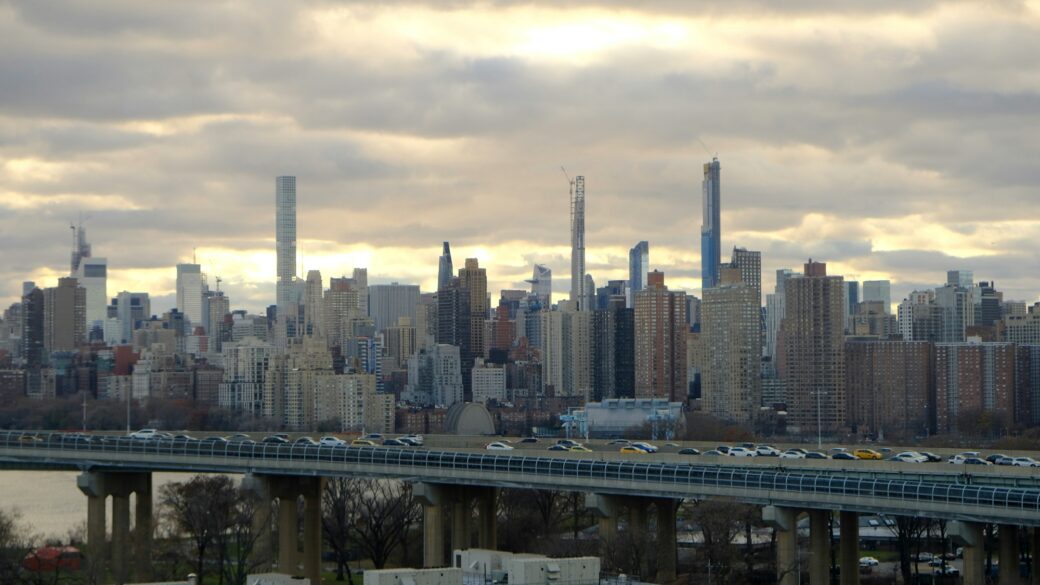
While congestion pricing has delivered on its initial promise of curbing traffic in Manhattan’s busiest areas, the program’s expected benefits for air quality and pollution have so far fallen short, according to a new report. Released Friday by the New York City Health Department, the report found that air quality in Manhattan’s central business district, where drivers are charged $9 to enter below 60th Street during certain times, remained stable or improved only marginally after the toll program took effect in January 2025. Meanwhile, on major highways outside the toll zone, where opponents had feared changing traffic patterns would lead to increased air pollution, pollution levels remained stable.
Data shows that the program, which survived several attempts by the federal government under President Donald Trump to eliminate it, has delivered on its promise to reduce traffic. In 2025, more than 27 million fewer vehicles entered the toll zone, contributing to lower noise levels and fewer pedestrian crashes, as 6sqft previously reported.
The program had generated $550 million in revenue as of January, providing much-needed funds for the Metropolitan Transportation Authority to finance critical transit improvements, including the second phase of the Second Avenue Subway, signal upgrades, new railcars and buses, and accessibility improvements.
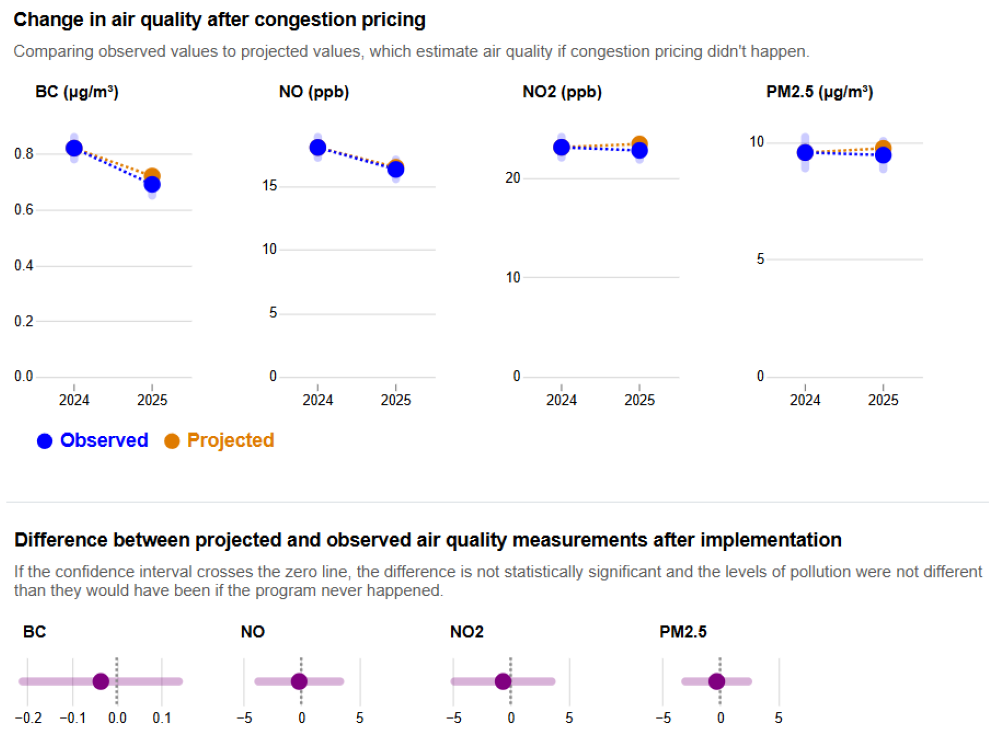
However, according to the Health Department’s report, its impact on air quality has been minimal. The department’s most comprehensive evaluation of the toll program’s impact on air quality to date found that measured pollution levels across the 12 zones within the CBD were not significantly different from what they would have been without the program.
“Cleaner air means healthier communities, and New Yorkers deserve to know how major policies affect the air they breathe,” NYC Health Commissioner Dr. Alister F. Martin said.
“This report gives us the clearest picture to date of how air quality has changed during the first year of congestion pricing, and we now know that air quality across NYC was not any different because of congestion pricing,” he added.
These findings are consistent with the Final Environmental Assessment for the toll program, released in April 2023, which did not predict significant changes in air quality resulting from congestion pricing.
The analysis focused on four traffic-related air pollutants: fine particulate matter (PM2.5), nitrogen dioxide (NO2), nitric oxide (NO), and black carbon (BC). While all four pollutants are emitted by vehicles and can negatively affect health, NO2 is considered the best measure of traffic-related air pollution.
Although traffic has decreased as a result of the tolls, the report found that traffic accounts for just roughly 14 percent of PM2.5 emissions and 20 percent of NO and NO2 emissions. As a result, the 10 percent reduction in traffic has not translated into a substantial decrease in overall air pollution levels.
In the major highway zones outside the CBD where officials had raised concerns about potential increases in air pollution, including the Major Deegan, Cross Bronx, Brooklyn-Queens, and Staten Island Expressways, air quality levels remained relatively stable, according to the report.
Outside the five boroughs, average pollutant levels from July to September 2025 were similar to those measured at the same sites during the same period from 2022 to 2024.
Overall, changes in pollution levels from 2024 to 2025, both before and after congestion pricing took effect, continued a gradual decline that the Health Department has tracked across the city over the past 18 years.
“Before we turned the cameras on, there was concern about the potential for increased pollution caused by drivers looking to avoid the toll,” MTA Chair and CEO Janno Lieber said in a statement. “As this study confirms, that didn’t happen, and congestion pricing is already funding additional investments to further improve air quality.”
However, the report’s findings are at odds with a study released in May by Columbia University researchers, which found that air quality had worsened in parts of the South Bronx near highways since congestion pricing began in early 2025.
The researchers analyzed two years of data from 19 air quality sensors across the Bronx. Four sensors located near expressways recorded “significant increases” in fine particulate matter, while two others, including one in a community garden, recorded decreases in pollution, according to Gothamist.
It also contrasts with another report from Cornell University, which found that air pollution levels had “plummeted” across the region since the program began.
Released last December, the report found that congestion pricing correlated with a 22 percent drop in small airborne particles within the CBD. The report also found slight reductions in air pollution in the suburbs and outer boroughs, including the Bronx.
Despite conflicting reports on the program’s impact on air quality, congestion pricing has helped fund projects aimed at reducing pollution.
In April, Gov. Kathy Hochul announced that revenue from congestion pricing would fund the replacement of 20 diesel-powered transport refrigeration units at Hunts Point Market in the Bronx with cleaner diesel and hybrid units. The upgrades are projected to reduce annual particulate matter emissions by 99.7 percent and nitrogen oxide emissions by 66 percent.
Replacing a single diesel-powered TRU with a newer model eliminates the equivalent particulate matter emissions of 330 truck trips per day on the Cross Bronx Expressway, as 6sqft previously reported.
RELATED:
- Congestion pricing funds major air quality upgrades at Bronx’s Hunts Point Market
- Congestion pricing lives on after federal judge rules Trump’s effort to end program unlawful
- One year of congestion pricing in NYC, 27 million fewer vehicles, $550M in revenue
The post Congestion pricing has had little impact on NYC air quality, city report finds first appeared on 6sqft.