By JBizNews Desk
May 10, 2026
A bipartisan effort to pour billions of dollars into rebuilding America’s aging national parks is rapidly gaining momentum in Washington, as lawmakers, major retailers, and outdoor recreation companies rally behind competing proposals that could reshape how the federal government funds public lands for decades to come.
At the center of the debate is a simple but politically volatile question: who should pay for it?
The push comes as the National Park Service faces mounting infrastructure deterioration, workforce reductions, and the expiration of one of the most consequential conservation funding laws in modern U.S. history — the Great American Outdoors Act, signed by President Trump in 2020.
Supporters of renewing and expanding the program argue the economic case is compelling.
According to National Park Service data, the original Great American Outdoors Act generated more than 72,500 jobs and contributed roughly $8 billion to the U.S. economy through approximately $5.7 billion in infrastructure investments tied to roads, bridges, campgrounds, trails, water systems, and visitor facilities across the national park system.
Now lawmakers are racing to build a successor program ahead of the United States’ approaching 250th anniversary celebrations in July 2026 — an event expected to drive record tourism to America’s public lands and historic sites.
Two competing funding visions are emerging on Capitol Hill.
On the House side, Rep. Bruce Westerman (R-Ark.), chairman of the House Natural Resources Committee, is advancing a proposal known as the “Next 250 Fund.”
The plan would establish dedicated long-term funding streams for park restoration and infrastructure repair, potentially including tolls on select federally managed roadways and parkways.
Among the roads under discussion are heavily traveled corridors such as the George Washington Memorial Parkway in the Washington, D.C. region.
Westerman has also floated higher entrance fees for international visitors as another possible revenue source.
Supporters argue the approach creates a sustainable stream of infrastructure funding without requiring large new appropriations from Congress.
But the toll proposal is already triggering political resistance.
Rep. Jared Huffman (D-Calif.), the top Democrat on the House Natural Resources Committee, has publicly called the tolling idea a “nonstarter” and a “poison pill.”
Huffman argues national park infrastructure should remain a core federal responsibility funded broadly through government revenues rather than shifting costs directly onto commuters and visitors through new user fees.
Critics fear federal tolling could establish a precedent eventually extending beyond parks into broader federal transportation infrastructure.
The Senate is pursuing a markedly different approach.
The America the Beautiful Act, introduced by Sen. Steve Daines (R-Mont.) and Sen. Angus King (I-Maine), would replenish the National Parks and Public Land Legacy Restoration Fund using royalties already collected from federal oil and gas development.
The legislation — listed as S.1547 on Congress.gov — has already attracted 52 co-sponsors, an unusually large bipartisan coalition for natural-resources legislation.
Rather than introducing new tolls or entrance fees, the Senate bill would dedicate approximately $2 billion annually through 2033 toward deferred maintenance projects across national parks and public lands.
The structure mirrors the original Great American Outdoors Act funding model, which similarly relied on energy-development royalties.
Despite disagreements over funding mechanics, the broader business community is pushing aggressively for some version of the legislation to pass.
The outdoor recreation economy has become a major force within the broader American consumer sector.
According to the Outdoor Recreation Roundtable, the industry contributes more than $1.2 trillion annually to the U.S. economy and supports approximately 5 million jobs.
Major retailers and consumer brands including REI, Patagonia, Walmart, Target, Lululemon, and Abercrombie & Fitch are lobbying lawmakers in support of the park restoration push, viewing strong national park visitation as directly tied to demand for outdoor apparel, travel spending, footwear, equipment, and recreation services.
That commercial interest has become increasingly important as retailers confront slowing discretionary consumer spending tied to elevated inflation, rising fuel prices, and weakening household confidence.
Well-maintained parks capable of supporting another tourism surge heading into the country’s 250th anniversary are increasingly viewed as an economic stimulus opportunity for rural communities and outdoor-focused industries alike.
The infrastructure needs themselves are substantial.
The National Park Service was already managing a deferred maintenance backlog exceeding $23 billion before staffing reductions intensified pressure further.
According to the National Parks Conservation Association, approximately 24% of the agency’s permanent full-time workforce has been removed since early 2025 as part of broader federal government downsizing initiatives tied to the Department of Government Efficiency.
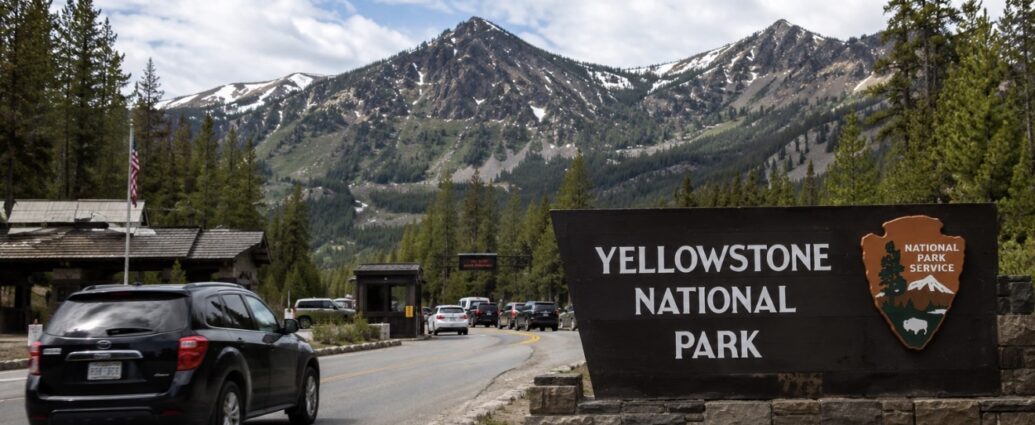
Roads, bridges, wastewater systems, campgrounds, visitor centers, and trails throughout the park system continue aging beyond intended design capacity even as visitation remains near record levels at parks including Yellowstone, Yosemite, and the Grand Canyon.
The economic impact extends well beyond the parks themselves.
National Park Service data shows visitors spent approximately $29 billion in surrounding gateway communities during 2024 alone, supporting hotels, restaurants, retailers, gas stations, tour operators, and local service economies throughout hundreds of small towns across the country.
The urgency surrounding the debate has accelerated further because of the Trump administration’s proposed fiscal year 2027 budget.
The administration’s proposal calls for approximately a 34% reduction in overall National Park Service funding and a 72% cut to construction funding, according to Interior Department budget documents — potentially the steepest proposed reduction in the agency’s history.
That looming funding pressure is forcing lawmakers toward negotiations even as disagreements over tolling and visitor fees remain unresolved.
The House’s “Next 250 Fund” and the Senate’s America the Beautiful Act will ultimately need to be reconciled into a single legislative framework if Congress hopes to move a final package before America’s semiquincentennial celebrations begin next summer.
For now, one thing appears increasingly clear on both sides of the aisle: after years of deferred repairs and swelling visitor demand, the economic and political cost of allowing America’s national parks to continue deteriorating is becoming harder for Washington to ignore.
— JBizNews Desk
© JBizNews.com. All rights reserved. This article is original reporting by JBizNews Desk. Unauthorized reproduction or redistribution is strictly prohibited.