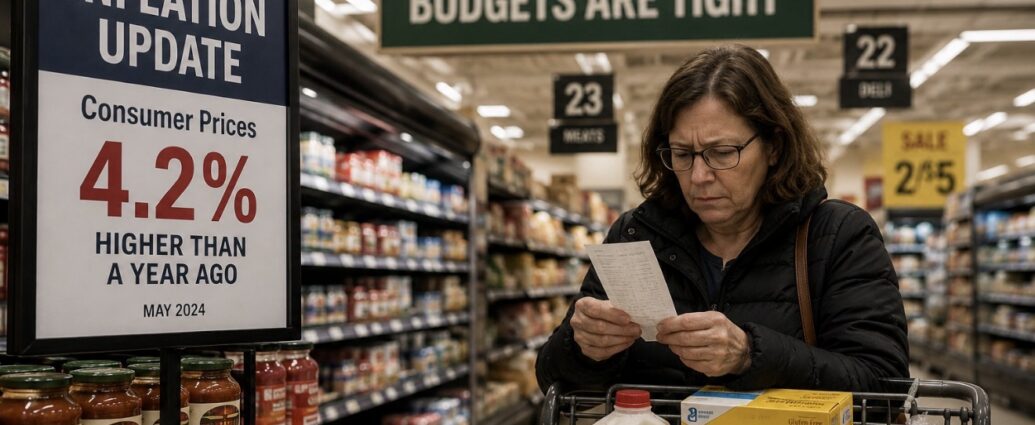
American households felt a little less gloomy in early June, recording their first meaningful improvement in sentiment since January. The University of Michigan said Friday that its preliminary Consumer Sentiment Index rose to 48.9 from May’s record low of 44.8, a gain of roughly 9% as easing gasoline prices offered consumers some relief.
Joanne Hsu, director of the university’s Surveys of Consumers, said the improvement was broad-based but cautioned that “views of the economy are still relatively dour.”
The rebound ended a four-month decline and came in ahead of economists’ expectations. Both major components of the survey improved: consumers reported feeling somewhat better about current economic conditions and slightly more optimistic about the months ahead. The gains were seen across age groups, income levels, educational backgrounds and political affiliations, with lower-income households showing some of the strongest improvement.
Even with the increase, consumer sentiment remains historically weak.
At 48.9, the index is still roughly 13% below where it began the year and about 19% lower than a year ago. The survey’s long-term average stands at 83.8, meaning June’s reading remains more than 40% below normal levels. In fact, despite the rebound, it remains the second-lowest reading recorded in the survey’s seven-decade history.
The improvement highlights how closely consumer attitudes remain tied to energy prices.
Since February, geopolitical tensions involving the United States and Iran have rattled energy markets and pushed fuel costs higher. Disruptions affecting shipments through the Strait of Hormuz helped drive the national average gasoline price above $4.50 per gallon by May, putting additional pressure on household budgets already strained by inflation.
That is why even a modest decline in fuel prices can have an outsized impact on sentiment. For many consumers, gasoline prices are among the most visible indicators of economic health because they encounter them several times a week. When prices fall, confidence often improves quickly.
Inflation, however, remains a significant concern.
Consumers’ long-term inflation expectations held at 3.4%, remaining above levels generally considered comfortable by Federal Reserve policymakers. Persistent inflation expectations can complicate monetary policy decisions because they suggest consumers still expect prices to continue rising at an elevated pace.
That creates a challenge for the Federal Reserve as policymakers evaluate the path of interest rates. If inflation expectations remain elevated, the central bank may have less flexibility to lower borrowing costs, potentially delaying relief for consumers facing high mortgage, credit-card and auto-loan rates.
There is also an important timing factor in the survey results.
The interviews were conducted between May 19 and June 8, before the weekend announcement of a deal aimed at ending the conflict between the United States and Iran and before the subsequent decline in oil prices. If energy costs continue moving lower following the reopening of the Strait of Hormuz, sentiment could improve further when the final June reading is released later this month.
For businesses, consumer confidence remains one of the most closely watched indicators in the economy.
Consumer spending accounts for roughly 70% of U.S. economic activity, and shifts in confidence often influence purchasing behavior. When households feel pressure, discretionary spending is typically among the first areas affected, impacting restaurants, retailers, travel companies and other consumer-facing industries.
Several major retailers and restaurant chains have already reported signs of more cautious spending and have increasingly relied on promotions and value-oriented offerings to attract customers.
The months ahead may determine whether June’s rebound marks the beginning of a broader recovery in consumer confidence or merely a temporary improvement.
A continued decline in gasoline prices, combined with greater stability in global energy markets, could help confidence recover further and support stronger spending. On the other hand, renewed inflation pressures or another spike in fuel costs could quickly reverse the gains seen this month.
For now, the message from American consumers appears cautiously optimistic. Conditions feel somewhat better than they did a month ago, and the sharp deterioration seen earlier this year has eased. But households remain far from confident that the economic challenges of the past several months are fully behind them.
JBizNews Desk
© JBizNews.com All Rights Reserved. Reproduction or distribution without written permission is prohibited.