America’s southern border is becoming one of the federal government’s biggest construction and technology projects, creating billions of dollars in new business for defense contractors, surveillance companies, and infrastructure builders.
According to U.S. Customs and Border Protection (CBP), the agency is rapidly expanding what officials describe as a “smart wall” along the U.S.-Mexico border using money from a $46 billion border security fund approved by Congress last year.
The funding, included in the sweeping 2025 tax-and-spending law, has turned border security into one of the fastest-growing areas of federal contracting.
CBP Commissioner Rodney Scott said the agency is currently completing approximately six miles of new border barrier each week, while Homeland Security Secretary Markwayne Mullin said the first major phase of the new system is expected to be completed around this time next year.
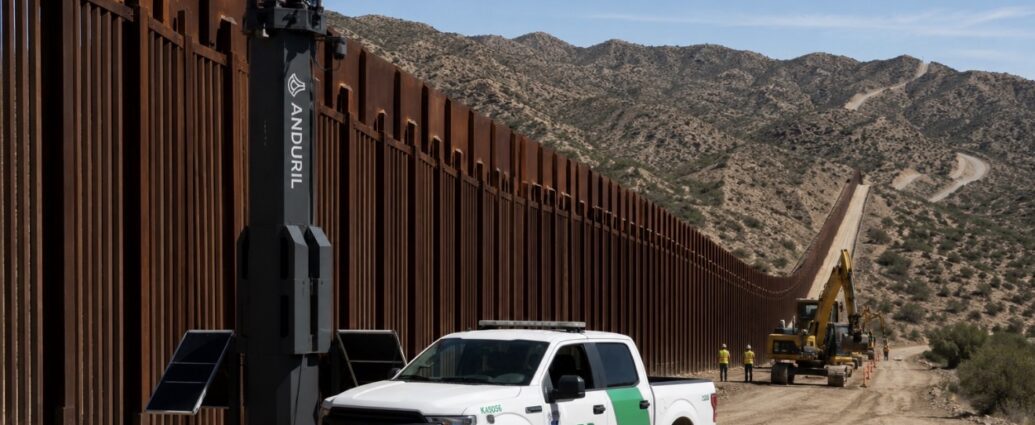
Unlike earlier border barriers, the new system combines 30-foot steel fencing with advanced surveillance technology, including artificial intelligence, radar, motion sensors, high-resolution cameras, and autonomous surveillance towers capable of monitoring vast stretches of the border without requiring agents on site.
As of mid-June, CBP reported completing another 74 miles of border barrier since President Donald Trump returned to office. During congressional testimony earlier this year, Commissioner Scott said the agency expects to complete approximately 250 miles of new barriers by the end of September.
For private industry, the project represents a multibillion-dollar opportunity.
Among the biggest beneficiaries is Anduril Industries, the defense technology company founded by Palmer Luckey.
Its AI-powered autonomous surveillance towers have become a centerpiece of the new border strategy. Equipped with cameras, sensors, and artificial intelligence capable of distinguishing between people, animals, and vehicles, the towers operate around the clock using solar power.
The 2025 legislation directs CBP to deploy autonomous surveillance towers throughout the border system, with another 95 towers already scheduled for installation.
Being designated as a formal government “program of record” provides Anduril with a long-term stream of federal business while strengthening its position across the defense industry.
Several other companies are also securing major contracts.
Elbit Systems of America, the U.S. subsidiary of the Israeli defense company, continues supplying surveillance equipment, while technology firm Sintela is installing underground fiber-optic sensing networks capable of detecting movement beneath the surface and feeding real-time information into artificial intelligence systems.
According to Sintela CEO Magnus McEwen-King, the company’s technology can follow terrain across forests, mountains, and riverbanks while providing continuous monitoring over large geographic areas.
The spending extends well beyond technology.
Building roughly six miles of fencing every week creates steady demand for steel, heavy construction equipment, engineering firms, skilled labor, transportation providers, and maintenance contractors. CBP is also expanding hiring efforts to support the growing border infrastructure.
In Texas, contractors are additionally installing large floating barriers in portions of the Rio Grande, creating another market for specialized marine barrier manufacturers.
The construction boom comes as illegal border crossings have fallen to their lowest levels in decades following broader immigration enforcement policies implemented by the Trump administration.
Supporters argue the decline provides an opportunity to permanently strengthen border security infrastructure, while critics question whether taxpayers are receiving sufficient value from such a large investment.
Josh Sewell, Director of Research and Policy at the nonpartisan watchdog Taxpayers for Common Sense, has called for stronger oversight before additional billions are committed, pointing to previous government border technology projects that ran significantly over budget.
Meanwhile, local advocacy groups continue expressing concerns about increased surveillance and environmental impacts in sensitive border regions, including parts of Big Bend National Park.
For businesses, however, the outlook remains clear.
With billions of dollars already appropriated and major contracts continuing to be awarded, the federal government’s smart wall initiative is becoming a long-term source of revenue for defense technology companies, construction firms, engineering contractors, surveillance manufacturers, and suppliers across multiple industries.
As work accelerates, the project is evolving into one of the largest infrastructure and technology investments currently underway anywhere in the United States.
JBizNews Desk | Washington
© JBizNews.com All Rights Reserved. Reproduction or distribution without written permission is prohibited.