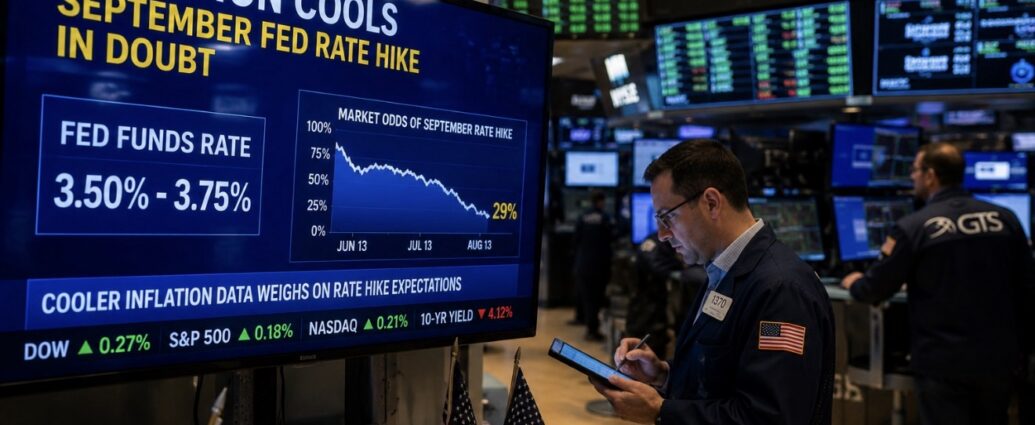
A second straight day of softer inflation data is reshaping the Federal Reserve’s September decision, with financial markets increasingly betting policymakers may leave interest rates unchanged rather than raise them again.
Consumer and wholesale inflation both came in milder than feared this week, easing concern that persistent price pressures would force the Fed to tighten monetary policy immediately.
The shift is significant because only days ago markets were treating another September rate increase as roughly a coin toss.
Those odds have fallen sharply.
The Federal Reserve’s benchmark rate currently stands at 3.50% to 3.75%, and policymakers remain divided over whether inflation is cooling quickly enough to justify waiting.
The debate is increasingly visible inside the Fed itself.
Some officials argue that inflation remains too far above the central bank’s 2% target and that another increase may still be necessary. Others see this week’s inflation reports, combined with signs of softer employment and consumer demand, as reasons to avoid tightening unnecessarily.
That disagreement puts Fed Chair Kevin Warsh in a difficult position.
Raise rates too aggressively and the central bank risks slowing an economy already showing pockets of weakness. Wait too long and inflation could regain momentum, particularly if higher oil prices from the Middle East conflict begin filtering through transportation, manufacturing and consumer prices.
Bond markets are already reflecting that split.
Short-term yields have eased as investors reduce expectations for an immediate Fed increase, while long-term borrowing costs remain unusually high.
That means businesses could eventually get some relief on shorter-term financing while mortgages, commercial real estate loans and long-duration corporate borrowing remain expensive.
The next major test comes at the Fed’s September meeting.
Until then, every significant inflation, employment and consumer-spending report will carry unusual weight because the central bank is no longer deciding whether inflation is a problem.
It is deciding whether the problem is serious enough to justify another rate increase despite mounting evidence that parts of the economy are beginning to cool.
For businesses, the difference could be substantial.
A September pause would not make borrowing cheap again.
But it would remove the immediate threat of another increase — and give companies something they have had very little of lately: time for financial conditions to stabilize.
JBizNews Desk | Washington
© JBizNews.com All Rights Reserved. Reproduction or distribution without written permission is prohibited.