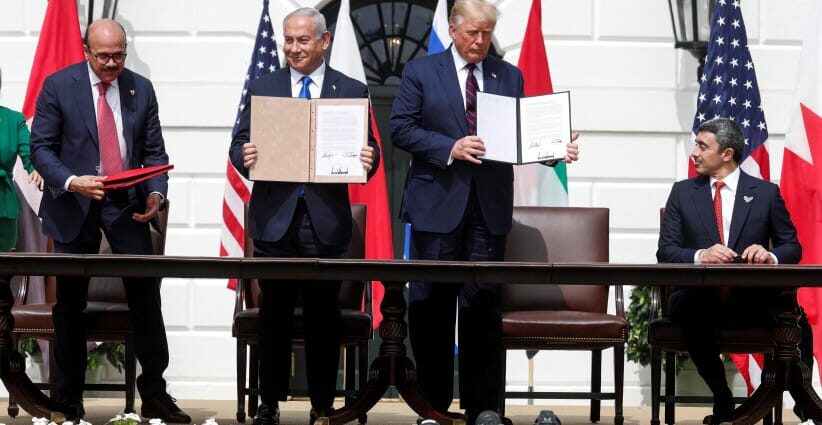
US President Donald Trump is increasing pressure on countries in the Middle East to join the Abraham Accords. “I’m not sure we should make the deal if they don’t… join the Abraham Accords,” Trump said during a cabinet meeting on May 27. He was discussing Saudi Arabia, Qatar, and other countries joining the Accords. He also said these countries “owe” the US. The push for these countries to join the Accords comes as reports continue to ride a roller coaster about a possible Iran deal. Although a deal seemed possible around May 23, by May 28, there were new clashes in the Gulf.
The pressure to join the Abraham Accords is a new message from Washington. The original Accords, sealed in September 2020, were a major achievement of the first Trump administration. They came about after years of quiet, growing ties among the UAE, Bahrain, and Israel. Saudi Arabia likely gave the green light. It was seen as a major test. When they were signed, there was an outpouring of warmth. There was talk about how this was real peace between Israel and the Arab states, not the cold peace between Israel and Egypt and Jordan.
The Accords were supposed to pave the way to many new initiatives, from green technology to financial tech, and also cooperation, as the UAE was expected to help “scale up” the “start-up nation.” People flocked to the Gulf from Israel. There was coexistence, and Jewish life was spotlighted. However, this sprint quickly petered out. The Gulf War was wary and wanted to move more slowly. They were also watching to see if Israel’s policies changed.
The Gulf doesn’t like pressure. Monarchies can take time, and they have the wealth, clout, and history to wait and see. For instance, the Abraham Accord partners pushed back in 2021 when they felt that Jerusalem was trying to use them in Israeli electoral politics. When Israel had elections in 2022 and elected a more right-wing government, the Gulf countries were concerned. No new Abraham Accords partners emerged in the Gulf. Talk of normalization with Saudi Arabia was put on the back burner. The Biden administration had not appeared eager to give the Trump administration credit for the Accords. Initiatives such as the I2U2 concept of Israel, the UAE, the US, and India appeared to fade in favor of IMEC, the India-Middle East Corridor. The Negev Forum faded from view, and an initiative called N7 emerged. Talk of regional integration and stability was badly harmed by the October 7 attack and the war that followed.
In the last year countries like Saudi Arabia have appeared even more critical of Israel. They don’t like the trajectory of aggression. For instance, Riyadh helped the new Syrian government get ties with Washington. Israel began bombing the new Syrian government when it came into power. Israel didn’t appear to give any chance for peaceful ties with Damascus. Instead, Israeli officials threatened Syria’s president. This did not go over well in Riyadh.
Riyadh and other states were patching things up with Ankara and Doha. The Qatar crisis of 2017 was long gone. Riyadh had even been working with China and Iran on better ties. As such, pro-Israel commentators began to talk about how Saudi Arabia, Egypt, and Turkey now represented a “Sunni” threat. Articles appeared suggesting that Turkey is the “new Iran.” Saudi could read Israeli media. This didn’t seem like the road to the expansion of the Abraham Accords that had been imagined in 2021-2022 in Riyadh.
Trump administration is increasing the pressure
Now the Trump administration is being more open in its pressure. It is also asking countries that already have peace with Israel to join the Accords. This includes Egypt, Jordan, and Turkey.
An article at Arab News on May 27 pushes back on Saudi Arabia joining the Accords. “The Arab position on normalizing ties with Israel has long rested on the 2002 Arab Peace Initiative, introduced by the late King Abdullah of Saudi Arabia and adopted unanimously. The Saudi position, in particular, has been clear and consistent for years: Normalization with Israel must be linked to a credible path to Palestinian statehood,” writes Osama Al-Sharif is a journalist and political commentator based in Amman. “In November 2025, Crown Prince Mohammed bin Salman said Riyadh ‘wants to be part of the Abraham Accords,’ but only with a ‘clear path’ to a two-state solution. Saudi officials have repeatedly tied any normalization to an independent Palestinian state with 1967 borders and East Jerusalem as its capital.
Saudi Arabia is an important state and a leader in the Islamic world. It will want to get something in return for any progress toward the Accords. Pressure may backfire. There is already a lot of talk in the Gulf that expresses concerns about the Israel-US relationship and the US decision to join Israeli strikes on Iran. The countries in the Gulf feel they were pushed onto the frontline of a war without being consulted. They may now feel that, as a result of that, they are being pressured again into joining the Abraham Accords. They may think that Israel is being rewarded by the US for pushing for war with Iran.
These countries don’t want to argue with the Trump administration. However, they can read online the trajectory that emerged toward the push for these countries to join the Accords. Some US politicians have pushed for this. The Gulf countries are wary of being dragged into domestic political fights. They have already seen the outcome of these fights, going back to the dispute over the Qatar crisis and the negative coverage that used to exist targeting Saudi Arabia’s Crown Prince. They know how toxic domestic battles have become in the US.
Saudi Arabia, Pakistan, Qatar, and Turkey expect that their close ties with the White House will remain removed from Israel issues. What that means is they believe that while the US and Israel ties have grown to unprecedented levels in recent years, in terms of the US-Israel alliance, they also expect that the US will listen to what other countries are saying.
The first Abraham Accords in 2020 came about because of quiet, emerging ties and trends, and a real sense that the countries wanted to move forward. The Trump administration helped provide the support to get the deal over the finish line. When the Trump administration has been effective in its doctrine, it is through this consensus and using American power to bring people together and move the ball forward.
What this means is that the administration is best at deal-making when everyone wins. It doesn’t usually get deals when sides feel pressure and threats and feel they are losing. The ceasefire deal in Gaza, for instance, was accomplished by bringing together Qatar, Turkey, Egypt, Saudi Arabia, and other countries. It wasn’t threats that got the deal. Or pressure.
The model for the Abraham Accords should be positive to achieve results. Countries feeling they are forced to make a deal with Israel or end up with more conflict with Iran will feel between a rock and a hard place. They may recalibrate their policies long term, and even if the US gets something short-term, the long term will not likely be positive.