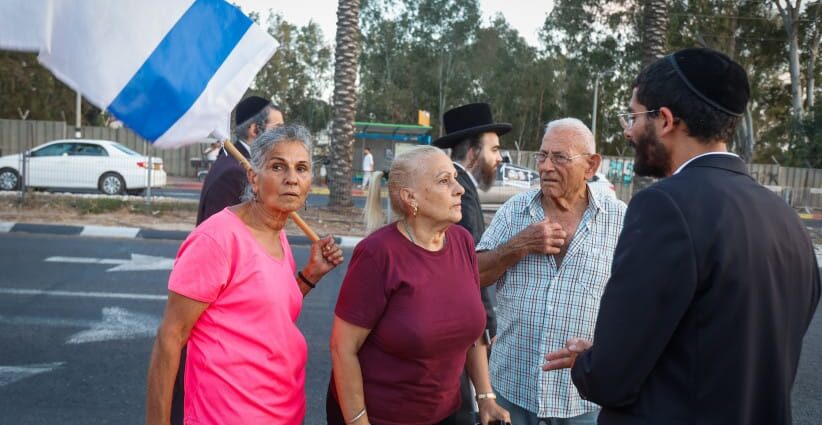
Following protests by haredi (ultra-Orthodox) demonstrators that disrupted traffic across the country this week and caused major congestion, a counter-protest took place on Friday.
Between 1 p.m. and 4 p.m., hundreds of protesters are expected to arrive in Bnei Brak for a demonstration against inequality in the burden of service. During the protest, they plan to disrupt traffic at the city’s entry points. Participants are expected to include reserve soldiers, active-duty soldiers, mothers of combat troops, and residents of Kfar Yona, Kfar Saba, and other cities.
According to organizers, the protest has been coordinated with police and will take place simultaneously at several locations. The main gathering point will be at the Coca-Cola Bridge, from where protesters will march on foot toward Bnei Brak. At the same time, drivers have been instructed to enter the address “Rabbi Kahaneman 120” into Waze and drive repeatedly at a slow pace until 4 p.m. The message accompanying the protest reads, “The convoy of draft dodgers will not disrupt the lives of citizens.”
At the same time, a convoy of vehicles departed from a parking lot near Prison 10 in Kfar Yona toward Bnei Brak. Residents of Kfar Yona, along with those from Kfar Saba and the surrounding area, joined the convoy, saying they had experienced traffic disruptions over the past week due to Haredi protests.
Among the protest leaders is the chairman of the “Free Seculars” movement, Ilai Harsgor Hendin, who said he believes the public has reached a breaking point.
“Haredi leaders have stretched the rope too far. From now on, they will understand the consequences of their actions. What applies to Bnei Brak applies to Kfar Yona and Tel Aviv. We will no longer accept institutionalized draft evasion while our soldiers are falling in Lebanon. We will not accept continued looting of public funds or discrimination between Haredim and the rest of the population. It is time for the residents of Bnei Brak to feel the anger of secular Israelis, and this is only the beginning.”
Bnei Brak residents prepare for Shabbat early due to protest
“Within less than an hour, hundreds of people are expected to arrive who are saying enough to draft evasion from the IDF while our soldiers are fighting,” Harsgor Hendin added.
“Enough wasting public money and a situation where those who work, serve, and pay taxes are also stuck for hours in traffic because of road blockages. It is time for the residents of Bnei Brak to feel what we feel. We are already hearing about residents in the city who have begun preparing early for Shabbat due to concerns about expected disruptions.”
Among the protest organizers are also 19 year old Yekutiel Epstein from Kibbutz Nachshonim, who serves in mandatory IDF service in the West Bank, and attorney Ayelet Hashachar Saidoff, head of the “Mothers on the Front” movement. “Just as the Haredim use timing to take away our freedom, we will respond in the same way at times that are difficult for them,” Epstein said.
“The goal is for them to understand what it feels like when your life is stopped because of road blockages.”
Saidoff said the protest was born out of growing frustration.
“We are mothers, reservists, and residents of Kfar Yona and Kfar Saba, telling them, enough. They think they are the masters of the land, and it is time for a response. If time and again they are allowed to disrupt everyone’s lives, we also have the right to protest. We want them to understand what it feels like when your way home is blocked.”
Additional protests to operate within Bnei Brak
According to organizers, in addition to the march and vehicle convoy, additional protest points will operate within Bnei Brak, with their exact locations not disclosed in advance.
“It is time to respond,” they said. “Our goal is not revenge, but to send a clear message: those who repeatedly disrupt the public’s life cannot expect no response.”
In the coming hours, it will become clear whether the counter protest remains within the defined limits or leads to broader traffic disruptions. For the organizers, the message is clear: if haredi protests have become part of the routine, those who serve in the IDF, go to reserve duty, and carry the burden are now also seeking to make their voices heard on the same roads.