
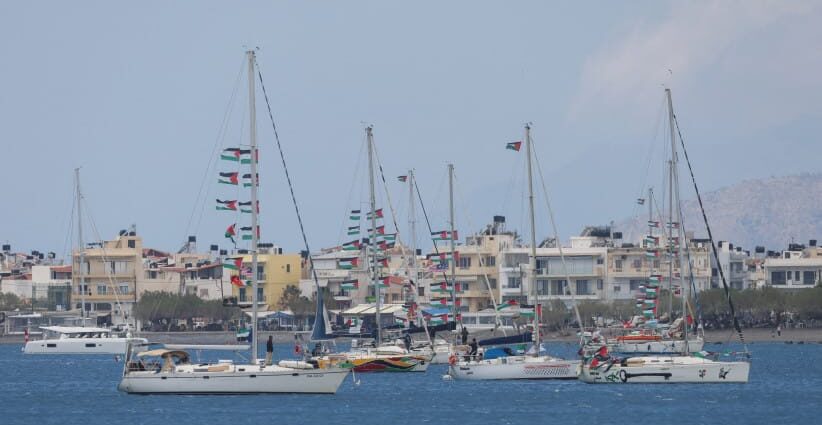
The Beersheba District Court on Wednesday rejected an appeal filed by two foreign activists taken into Israeli custody after Israel intercepted a Gaza-bound flotilla last week, leaving in place a lower court decision extending their detention until Sunday.
Brazilian activist Thiago Ávila and Palestinian-Spanish-Swedish national Saif Abu Keshek were among the activists aboard the Global Sumud Flotilla, which set sail in an attempt to break Israel’s naval blockade of Gaza and allegedly deliver humanitarian aid.
Israeli forces intercepted the flotilla near Crete, hundreds of nautical miles from Israel. Most of the activists were later released in Greece, while Abu Keshek and Ávila were brought to Israel for questioning.
The Ashkelon Magistrate’s Court had extended their detention until Sunday morning. On Wednesday, Beersheba District Court Judge Tal Lahayani Shoham upheld that decision, ruling that there was no error in the lower court’s finding that reasonable suspicion existed.
They are suspected of aiding the enemy during wartime. In earlier hearings, police also cited suspicions of contact with a foreign agent, contact with terrorist elements, and additional terrorism-related offenses.
The judge also rejected, at this stage, the defense’s argument that the allegations did not meet the legal threshold for aiding the enemy during wartime. She said a recent ruling cited by the defense, which analyzed the elements of that offense, was not applicable to the case before her because of the substantive difference between the acts alleged in the two cases.
Lahayani Shoham said she had reviewed the investigation file and materials marked by the Magistrate’s Court in hearings held on Sunday and Tuesday. She ruled that the material supported the lower court’s decision and added that the material in the file appeared to raise further security-related offenses.
The judge also rejected, at this stage, the defense’s argument that the allegations did not meet the legal threshold for aiding the enemy during wartime. She said a recent ruling cited by the defense, which analyzed the elements of that offense, was not applicable to the case before her because of the substantive difference between the acts alleged in the two cases.
“In this case,” the judge wrote, the acts attributed to the two were “clearer” and could amount to the offense attributed to them.
The court further ruled that the nature of the suspected offense establishes grounds for detention and that, based on the investigative plan detailed in classified material, there were still investigative actions to be carried out, some of which required the continued detention of the two activists.
Adalah attorneys Hadeel Abu Salih and Lubna Tuma argued that Israel had no authority to arrest and investigate the activists because they were detained outside Israeli territorial waters, in international waters near Greece, aboard a foreign-flagged vessel.
The court rejected that argument, citing the Magistrate’s Court’s reasoning that some offenses may be adjudicated in Israel even when they are not committed inside Israeli territory. Lahayani Shoham also cited case law stating that when an Israeli court has substantive jurisdiction over a defendant, the legality of the trial or detention is not affected by the manner in which the defendant was brought into Israeli territory.
The defense also argued that the two were being discriminated against compared with other activists who were released after the flotilla was intercepted. The court rejected that claim as well, saying the investigation material and the state’s arguments indicated that there was specific evidence and reasonable suspicion against the two and not against those who had been released.
The judge added that this distinction now also applied to Ávila – who, according to the defense, had previously been released despite taking part in other flotillas – due to the amount of evidence collected against him and when it was gathered.
Adalah said after the ruling that it continued to view the detention as unlawful and unreasonable, and maintained that the activists had been engaged in a transparent humanitarian mission to Gaza. The organization also said the two had been on hunger strike for nearly a week, and that Abu Keshek had escalated his strike and was refusing water.
The court did not rule on the hunger strike claim in the written decision, but addressed complaints regarding the activists’ detention conditions. Regarding Abu Keshek, the court said initial equipment that had been brought for him should be transferred to him as soon as possible. Regarding Ávila, the court noted the claim that personal items had been taken from him and that he was suffering from cold in his cell, saying that basic conditions must be provided and that there was no place to cause him unnecessary suffering.
The court also ordered that a claim regarding socks that had been brought for Ávila but not transferred to him be checked, and that if correct, the equipment should be handed over.
Danya Saperstein contributed to this report.




