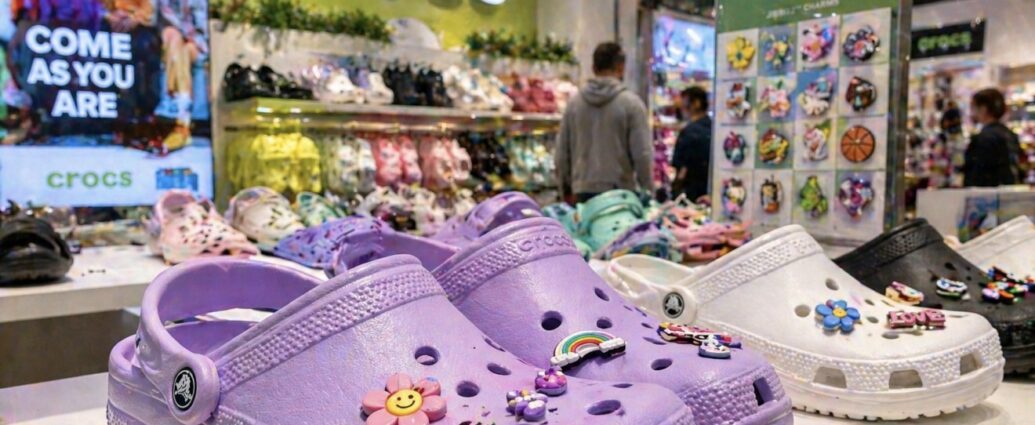
Crocs, Inc. has pulled off one of the most unexpected turnarounds in modern retail, transforming a once-mocked foam clog into a global cultural and financial force generating more than $4 billion in annual revenue and commanding attention across Wall Street and social media alike.
Long dismissed as unfashionable — and even labeled one of the “worst inventions” by critics in its early years — Crocs (NASDAQ: CROX) is now experiencing a powerful resurgence fueled by cultural relevance, disciplined execution, and aggressive expansion into digital commerce. “This is a brand that rewrote its own narrative,” said Andrew Rees, Chief Executive Officer of Crocs, noting that the company has “leaned into authenticity and consumer engagement in a way that resonates globally.”
The numbers underscore the transformation. Crocs reported full-year 2025 revenue exceeding $4 billion, while generating approximately $659 million in free cash flow. The company returned capital to shareholders by repurchasing roughly 6.5 million shares for $577 million and reduced debt by $128 million — a financial profile that signals strength rather than recovery. “Crocs is operating from a position of offense,” said Jim Duffy, analyst at Stifel, describing the company’s capital allocation as “a clear indicator of confidence in sustained demand.”
At the core of Crocs’ resurgence is a dramatic cultural repositioning. Once considered socially undesirable, the brand has successfully repositioned itself as a customizable, expressive, and highly visible lifestyle product. Strategic collaborations have played a central role. In 2025, Crocs launched partnerships with the National Football League, as well as entertainment franchises including Stranger Things and Twilight, both of which generated rapid sellouts and strong resale activity. “Limited drops and cultural tie-ins have created urgency and relevance,” said Simeon Siegel, retail analyst at BMO Capital Markets, adding that “Crocs has mastered the modern playbook of scarcity and storytelling.”
The company’s newest partnership with LEGO Group signals a longer-term strategy aimed at younger consumers and families, extending Crocs’ reach across generations. “We are building for the future consumer,” Rees said, emphasizing the importance of brand engagement early in life.
Nowhere is Crocs’ momentum more visible than on social platforms. The company and its sister brand HeyDude currently rank as the number one and number two footwear brands on TikTok Shop in the United States, reflecting a broader shift in how consumers discover and purchase products. “Social commerce is becoming a primary growth driver,” Rees said, pointing to continued expansion across international TikTok markets.
To deepen that engagement, Crocs has moved into original content. In early 2026, the company launched a short-form microdrama series titled Charmed to Meet You, which surpassed 10 million views within weeks and reached the Top 10 on ReelShort, a fast-growing mobile entertainment platform. “This is a brand behaving more like a media company,” said Doug Stephens, retail futurist and founder of Retail Prophet, noting that “Crocs understands attention is currency.”
International growth is accelerating alongside digital expansion. Crocs reported an 11% increase in international revenue in 2025, with China surging 30% and continued strength in Japan and Western Europe. The company now operates approximately 2,600 branded retail locations globally and plans to open an additional 200 to 250 stores and kiosks in 2026. “Global demand remains robust, particularly in Asia,” said Erinn Murphy, consumer analyst at Piper Sandler, highlighting Crocs’ ability to localize while maintaining brand consistency.
Product innovation and personalization remain central to the company’s strategy. Crocs’ signature Jibbitz charms — small, customizable accessories that attach to footwear — accounted for roughly 8% of total sales last year. The company has expanded the concept into adjacent categories, including bags and accessories. “Personalization drives repeat purchases and brand loyalty,” Rees said, describing Jibbitz as “a meaningful contributor to growth.”
Meanwhile, Crocs is quietly building a second growth engine in sandals. The category accounted for approximately 13% of product mix in 2025, approaching $450 million in annual revenue. The company is now launching its Saturday sandal line, designed to capture additional market share in a segment traditionally dominated by legacy competitors. “We see significant runway in sandals,” Rees said, pointing to strong momentum in North America and extended seasonal demand.
The broader industry backdrop is also supportive. The global footwear market is projected to reach approximately $550 billion in 2026, growing at an annual rate of more than 5%. Crocs is not merely participating in that growth — it is outperforming within the fastest-moving channels, particularly digital and social commerce. “Crocs is where the consumer is going, not where they’ve been,” said Simeon Siegel of BMO, emphasizing the brand’s relevance with younger demographics.
What began in 2002 as a niche boating shoe — conceived by founders Scott Seamans, Lyndon Hanson, and George Boedecker Jr. — has evolved into a symbol of modern consumer behavior, where comfort, individuality, and cultural alignment outweigh traditional notions of fashion. The company’s stock has reflected that shift, with investors increasingly viewing Crocs as a durable growth story rather than a cyclical fad.
From industry punchline to platform-driven powerhouse, Crocs has redefined what a comeback looks like in the digital age. The question now is no longer whether the brand can sustain relevance — but how far it can scale it.
JBizNews Desk