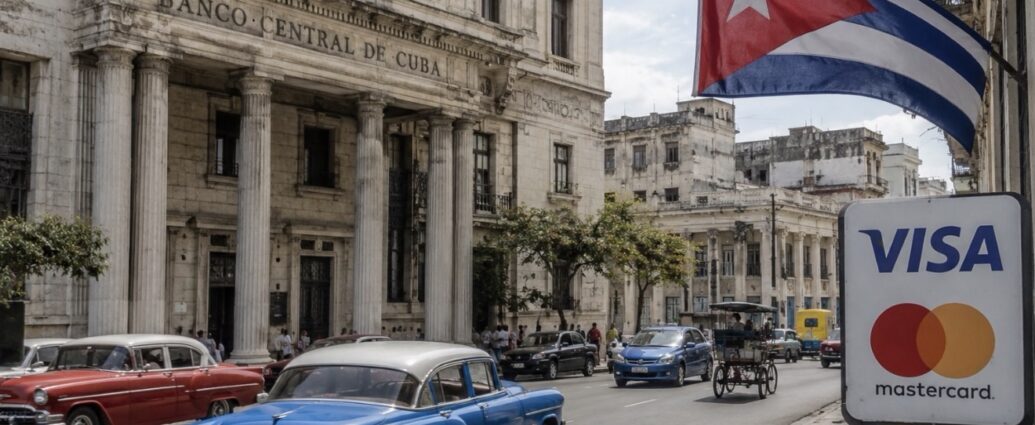
HAVANA — The Central Bank of Cuba said Wednesday that it would shut off Visa and Mastercard transactions across the island beginning June 6 after the foreign bank that processed those payments chose to exit rather than risk violating newly tightened U.S. sanctions.
For travelers, the impact is immediate: foreign visitors can no longer use internationally issued Visa or Mastercard credit and debit cards to pay for hotels, restaurants, transportation, or other services in Cuba. For the Cuban economy, the move severs one of the last remaining financial connections to the global payment system.
The Central Bank of Cuba said the cutoff means the country will no longer be able to receive funds from purchases made through internationally recognized card networks.
The trigger was President Donald Trump’s May 1 executive order, which significantly expanded restrictions on business dealings involving Cuba. The order gave foreign companies until June 5 to end relationships with GAESA, the military-run conglomerate that controls large portions of Cuba’s tourism, financial, retail, and transportation sectors, or face potential sanctions themselves.
For years, Cuba’s international card-processing system operated through Fincimex, a financial entity tied to GAESA, working in partnership with an overseas bank. Once that foreign banking partner withdrew to protect itself from possible sanctions exposure, the payment system effectively collapsed.
Washington argues that GAESA channels profits from tourism, remittances, and other industries to Cuba’s military and political leadership. The Cuban government disputes that characterization, maintaining that revenues generated by GAESA support national economic and social programs.
Since January, Secretary of State Marco Rubio has expanded sanctions pressure on Cuba, adding GAESA and its leadership to a list of more than 240 sanctions-related designations.
The payment shutdown is only the most visible sign of a broader corporate retreat from the island.
Several major international hotel operators have already begun reducing or ending their involvement in Cuba. Spain’s Meliá Hotels International, the largest foreign hotel operator in the country, has scaled back portions of its operations. Canada’s Blue Diamond Resorts is exiting entirely, returning approximately 15 hotels to Cuban state management. Iberostar has ended relationships with GAESA while maintaining certain properties through non-military state entities. Archipelago International, headquartered in Jakarta, has also departed.
The aviation sector has seen similar changes.
At least 11 international airlines, including Air Canada, WestJet, Air Transat, Air France, and Iberia, have suspended Cuba service this year, eliminating more than 1,700 scheduled flights. Several global shipping companies have also reduced or ended their Cuba-related activities amid the evolving sanctions environment.
Perhaps the most significant corporate casualty is Sherritt International, one of the last major foreign companies with substantial operations in Cuba.
The Toronto-based mining company announced on May 7 that it was suspending its direct role in a key Cuban joint venture and beginning the process of bringing Canadian employees home. Investors reacted sharply, sending Sherritt shares down approximately 30 percent following the announcement.
Sherritt’s relationship with Cuba dates back more than three decades.
Its flagship operation is the Moa Nickel venture, a 50-50 partnership with Cuba’s state-owned General Nickel Company. The project mines and processes nickel and cobalt, two metals critical to global battery manufacturing and electric vehicle production.
For Cuba, nickel remains one of the country’s most important sources of hard-currency earnings. For that reason, the operation sits at the center of the country’s export economy—and increasingly at the center of sanctions concerns.
The company’s response illustrates the difficult position facing foreign businesses still operating in Cuba.
Initially, Sherritt indicated it would seek a court order in Alberta to dissolve the joint venture. Days later, however, the company reversed course, citing discussions with advisers and government officials and suggesting a potential path remained to preserve value from the operation.
The financial stakes are significant.
Cuba reportedly owes Sherritt at least $344 million, while the company itself carries approximately $266.2 million in bonds paying 9.25 percent interest, with its next major payment due in October.
The consequences extend beyond any single company.
As Paolo Spadoni, a Cuba expert at Augusta University, noted, the United States has effectively targeted nearly every major source of hard currency flowing into the Cuban economy, including tourism, remittances, medical services, and nickel exports.
Those pressures are landing on an economy already facing severe challenges.
Large portions of the country have experienced extended power outages. Shortages of food, fuel, medicine, and water remain widespread. Tourism, once one of Cuba’s most reliable economic engines, has fallen dramatically.
Even Canada, historically Cuba’s largest source of foreign visitors, has advised citizens to avoid non-essential travel to the island, citing concerns about fuel availability and the reliability of basic services.
The broader business lesson reaches beyond Cuba.
Modern economies depend on networks—banks, airlines, payment systems, shipping companies, hotel operators, suppliers, and international investors. Those connections are often invisible until they disappear.
When enough of them break at once, economic activity becomes dramatically more difficult regardless of a country’s natural resources, workforce, or strategic location.
That is the challenge Cuba now faces.
The departure of payment processors, airlines, hotel operators, shipping firms, and major investors suggests many international businesses are concluding that the risks of operating in Cuba are rising faster than the potential rewards.
For now, those companies are heading for the exits.
And their actions suggest they believe Cuba’s economic isolation may deepen before it improves.
JBizNews Desk — Latin America
© JBizNews.com All Rights Reserved. Reproduction or distribution without written permission is prohibited.