By JBizNews Desk | Monday, May 4, 2026
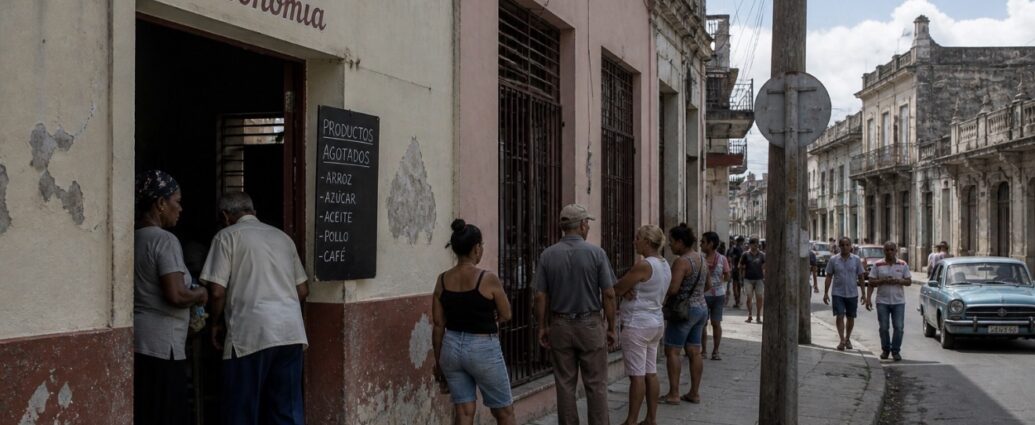
The little booklet that Cuba’s socialist government has relied on for more than six decades to feed its people is running out of both pages and purpose. Across Havana, state-run bodegas that once anchored daily life are now largely empty, and the ration system known as “la libreta” has been reduced to a handful of basics — split chickpeas, limited sugar, and little else. In its place, essential goods are increasingly priced in U.S. dollars, a currency out of reach for much of the population.
José Luis Amate López, a bodega clerk in central Havana, said demand has collapsed alongside supply. His store, which serves roughly 5,000 residents, has had virtually nothing to sell for weeks. “No Cuban can truly survive on the products from the ration book anymore,” he said.
The erosion of the ration system is now one of the clearest signs of a broader economic breakdown in a country of nearly 10 million people, where fuel shortages, power outages, and inflation have become part of daily life. Wages paid in Cuban pesos continue to lose purchasing power, leaving households increasingly dependent on external support.
The numbers underscore the strain. Ana Enamorado, 68, said her April ration amounted to little more than split chickpeas and two pounds of sugar. Her combined salary and pension total roughly 8,000 pesos — about $16 a month. Meanwhile, a carton of eggs can cost nearly half that amount, with basic staples like meat and cornmeal consuming what remains. “There’s hardly anything in the ration book,” she said. “We’re practically living off air.”
Even bread, once one of the most protected items in the system, has become a symbol of decline. Lázaro Cuesta, 56, said daily portions have been cut in half while prices have surged more than tenfold. “And the quality is worse,” he added, reflecting a broader frustration shared across long lines that form daily outside distribution points.
For those without access to remittances, the situation is particularly severe. Roughly 60% of Cubans receive financial support from relatives abroad, but Rosa Rodríguez, 54, is not among them. Earning the equivalent of about $8 a month, she said choices between basic goods have become unavoidable. “If you buy beans, then you can’t buy sugar,” she said, describing a system where survival increasingly depends on trade-offs rather than stability.
Economists point to structural failures at the core of the crisis. William LeoGrande, a professor at American University, said the government no longer has the financial capacity to sustain the ration system at scale. Supplies now arrive sporadically, he noted, while inflation continues to erode purchasing power following the government’s 2021 currency unification effort. “They simply don’t have the money to do it anymore,” he said.
The strain is visible inside the bodegas themselves. Shelves once stocked with yogurt, pasta, and soap now sit bare, with faded posters listing goods that have effectively disappeared. The gap between policy promises and daily reality has become a source of public cynicism — and increasingly, quiet frustration.
At the same time, the shift toward dollar-based pricing has widened inequality across the island. Access to food is no longer defined solely by citizenship, but by whether a household has access to foreign currency. Those with relatives abroad can still navigate the system; those without face growing scarcity.
Officials have discussed moving toward a model that subsidizes individuals rather than goods — a shift that could ease pressure on state finances — but implementation has lagged. For now, the ration book remains in place, though its role has fundamentally changed.
For many Cubans, “la libreta” is no longer a guarantee of survival. It is a reminder of a system that once was — and of the widening gap between state support and everyday reality.
— JBizNews Desk
© 2026 JBizNews.com. All rights reserved.
This content is original reporting by JBizNews Desk. Unauthorized use, reproduction, or distribution, in whole or in part, without prior written permission is strictly prohibited.