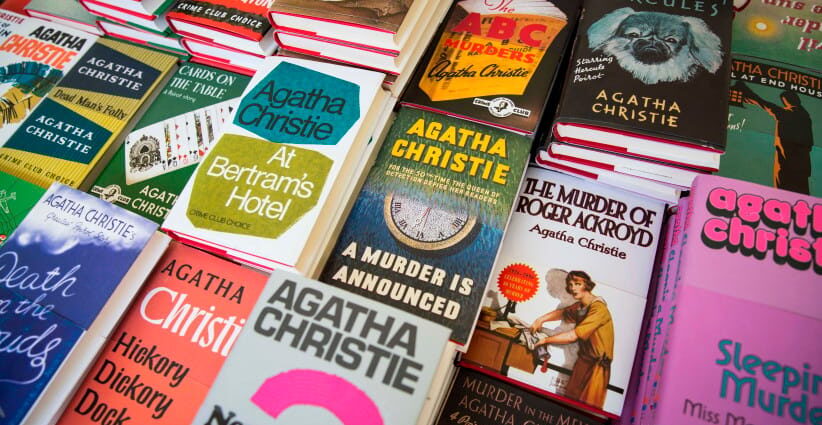
A new study published in the academic journal Nordisk Judaistik (“Scandinavian Jewish Studies”) examines the recurring presence of Jewish characters and antisemitic tropes across the detective fiction of Agatha Christie.
Written by Sofie Lene Bak, a historian at the University of Copenhagen, the study, titled ‘Whodunit?’ Antisemitism as a literary device in the detective works of Agatha Christie, investigates how antisemitism functioned as a deliberate literary device rather than merely reflecting harmless attitudes of the period.
The study is part of Bak’s research project, Code and Conspiracy: Antisemitism in Denmark After 1945, which examines how antisemitic ideas have continued in the period following the Holocaust.
How memory cultures are reproducing classical prejudices
Bak wrote that the study was also prompted by the sharp resurgence of antisemitic tropes following the Hamas terrorist attack on Israel on October 7, 2023, and the subsequent Israel-Hamas War.
The surge raised questions about how generations raised in memory cultures shaped by the Holocaust are reproducing classical prejudices. She noted that while research on post-1945 antisemitism has largely focused on political extremes, there remains a need to examine popular culture and entertainment where audiences may be particularly susceptible.
Examining Christie’s works, the study notes that out of 70 books, including 66 detective novels, Jewish characters appear in 23 works, with seven novels featuring sufficiently detailed portrayals for deep textual analysis.
Addressing the common defense that Christie’s work must be read purely within its historical context when antisemitic prejudices were socially acceptable, Bak analyzes three distinct interpretive levels to determine how anti-Jewish statements operate.
At the first level, prejudices were utilized according to genre conventions as red herrings to distract readers from the genuine clues leading to the solution of the murder and the identification of the true culprit.
At the second level, Christie placed xenophobic or prejudiced statements in the mouths of fictional characters to signal their narrow-mindedness, snobbery, or social position, though these remarks were rarely challenged within the narrative.
At the third level, where antisemitic statements appear without an omniscient narrator or specific character attribution, Bak points to embedded and potentially unconscious stereotypes belonging to the author herself, providing insight into the cultural-historical context.
Grappling with whether these portrayals gradually disappeared as awareness of National Socialism grew, Bak examines specific texts across a chronological span to test prevailing historiographical claims.
Antisemitic caricatures used in Christie’s early works
In Christie’s early works, such as The Mysterious Affair at Styles (1921) and Peril at End House (1932), Jewish characters such as Dr. Bauerstein and Jim Lazarus are marked by prominent physical descriptions and financial associations that cast them as outsiders and suspects.
Bak said that “Christie often uses Jewish characters as red herrings. Readers are meant to suspect them, only to discover in the end that someone else committed the crime. But that mechanism works only if readers already associate these characters with certain negative assumptions,” and they “are depicted as different or foreign. This creates a distance between them and the other characters, and this distance is essential to the role they play in the story.”
Drawing on social psychological research regarding warmth and competence, Bak argues that these figures embody ambivalent antisemitic stereotypes, perceived as cold, arrogant, and excessively concerned with money yet highly competent, which elicits both envy and suspicion.
While historiography has frequently sought to downplay these portrayals by arguing that such tropes receded as Christie became aware of the consequences of National Socialism, Bak’s analysis emphasizes continuity, effect, and the long afterlife of these depictions.
Jewish stereotypes became more ‘coded’ after World War II
Challenging the assumption of a post-war break, Bak points out that explicit Jewish characters largely vanished after World War II, yet Christie’s writing still contained problematic caricatures.
“It is true that she abandoned the most overt depictions. Instead, the stereotypes became more indirect and coded.” Bak said.
Examples include the dressmaker Madame Alfrege in The Hollow (1946), who is introduced by the narrative voice as a vitriolic little Jewess and depicted as malicious, vulgar, and loud, with a physical description highlighting a thick nose.
Another instance is the traumatized German cook and Holocaust survivor Mitzi in A Murder is Announced (1950), who, despite not being explicitly named as Jewish, is portrayed through coded markers of sallow skin and dark hair while being subjected to constant mockery, cruelty, and ridicule by her household.
Bak said, “No one in the novel likes Mitzi, and it is suggested that she suffers from paranoia and may even exaggerate the suffering she experienced in her homeland. As a result, the other characters portray her as unreliable, ungrateful, and fundamentally ridiculous. It is a brutal caricature. I believe Christie intended her as a comic character, but that does not make the portrayal any less problematic.”
Bak contends that post-1945 antisemitism became coded, indirect, and sarcastic rather than disappearing outright.
She points out that this coded language relied on subtle textual hints, such as foreign origins, German-accented exclamations, fear of the Gestapo, and physical markers previously associated with Jewish characters, where the object of scorn was never explicitly named as Jewish, requiring readers to decode the underlying tropes.
Building on this analysis, Bak further substantiates her findings by examining how these texts persisted across generations through international publishing practices. She argues that while this prejudice became more subtle in later writing, the bias itself endured because decades of reprints and translations preserved the original phrasing verbatim.
To support this claim, the study tracks the publication history of Danish translations, demonstrating that publishers maintained the original antisemitic descriptions and references across multiple reissues spanning decades.
By contrast, Bak highlights that modern film adaptations have consistently omitted or de-emphasized the Jewish backgrounds of characters entirely, proving that the explicit markers were never essential to the narrative plots.
Bak concludes the study by rejecting the notion that these elements can be excused as mere laziness or harmless attempts at comic relief, asserting that such tropes must be confronted directly rather than downplayed as reflections of a different era.
She notes that while an author’s precise psychological intentions remain difficult to reconstruct, the decisive factor is the tangible emotional impact on readers who absorb these embedded stereotypes without conscious challenge.
Read more of Sofie Lene Bak’s study here.