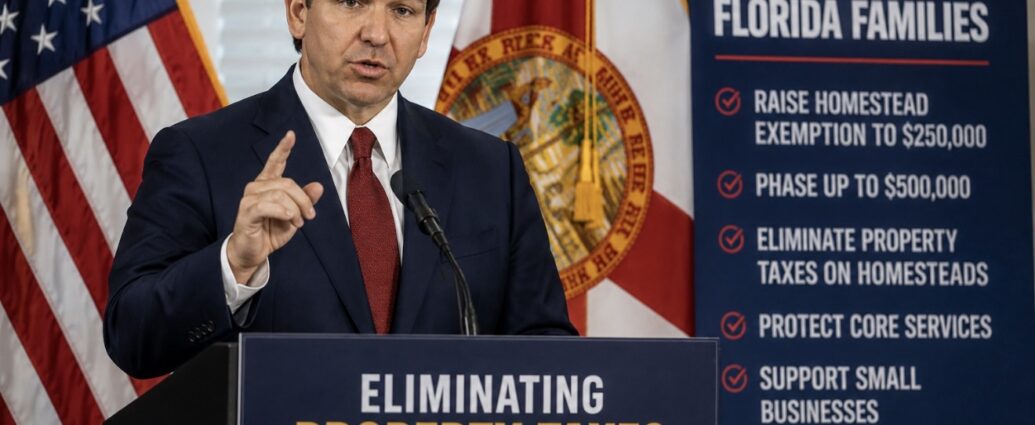
Florida Governor Ron DeSantis on Wednesday unveiled one of the most aggressive tax-cut proposals currently under discussion anywhere in the United States: a long-term plan to eliminate property taxes on primary residences entirely for most Florida homeowners.
The proposal, which DeSantis plans to advance through a summer special legislative session, would dramatically expand Florida’s homestead exemption and eventually phase out property taxes on owner-occupied homes altogether if approved by both the legislature and Florida voters.
If enacted, Florida would become the first major state in the country with both no state income tax and effectively no property tax on primary homes.
For ordinary Floridians, the immediate impact would be straightforward: many homeowners would stop receiving large annual property-tax bills entirely.
Under the first phase of the proposal, Florida’s homestead exemption would rise from the current $50,000 level to $250,000. According to DeSantis, that single change would eliminate property taxes entirely for roughly 60% of Florida homeowners whose homes qualify as homesteaded primary residences.
The second phase would increase the exemption to $500,000, which the administration says would fully eliminate property taxes for approximately 92% of Florida homesteaded properties.
“The primary purpose of that is to make your homestead property tax free,” DeSantis said during Wednesday’s announcement.
For many households, the savings could be substantial.
Depending on the county and home value, Florida homeowners currently pay anywhere from roughly $2,000 to more than $7,000 annually in property taxes. A middle-class family owning a $400,000 home could potentially save approximately $5,000 to $6,000 per year if the proposal fully eliminates their homestead tax bill.
Retirees on fixed incomes could also see major relief after years of rapidly rising home valuations across much of the state.
But the proposal also raises enormous questions about how Florida would replace tens of billions of dollars currently funding local government operations.
Property taxes generate an estimated $55 billion to $60 billion annually across Florida and fund a significant share of public-school systems, sheriff’s departments, fire and rescue services, road maintenance, libraries, parks, and county government operations.
According to state budget figures, property taxes account for roughly 18% of county-government revenue statewide.
DeSantis said the state would create a trust fund mechanism to help backfill essential local services and restrict remaining property-tax collections primarily toward core functions such as schools, police, and emergency services.
The governor also proposed reducing the annual cap on assessment increases for small businesses from 10% to 5%, easing pressure on commercial property owners as well.
One of the most politically significant parts of the proposal is a five-year residency waiting period for newcomers moving into Florida after the amendment takes effect.
Under the governor’s framework, new residents would continue paying property taxes under the existing structure for several years before becoming eligible for the expanded homestead exemption.
That provision is designed to address concerns that eliminating property taxes could accelerate migration into Florida, further drive up housing prices, and intensify affordability pressures for existing residents.
The proposal’s effect on renters remains less certain.
Rental properties, second homes, vacation homes, and commercial real estate would continue paying property taxes because they would not qualify as homesteaded primary residences. Landlords would likely continue passing those costs into rents, meaning renters may not experience direct tax relief.
The broader housing-market impact could also prove complicated. Eliminating property taxes for homeowners could encourage more renters to purchase homes, potentially tightening rental supply. At the same time, Florida’s continued population growth could encourage additional housing development and investment activity.
The political path forward is difficult even in Republican-controlled Florida.
Because the proposal requires a constitutional amendment, it must first pass both chambers of the Florida legislature with at least 60% support before reaching the statewide ballot. It would then require approval from at least 60% of Florida voters during the November election.
Earlier property-tax reform proposals have struggled to advance through the Florida Senate despite support from DeSantis and many House Republicans.
Opposition is already emerging from county governments, school districts, municipal officials, and public-sector unions concerned about how local services would remain funded if residential property-tax revenue declines sharply.
There are also broader financial implications.
Local governments routinely borrow money for infrastructure projects using future property-tax revenue as collateral. A major reduction in homestead property taxes could force rating agencies to reevaluate municipal credit quality across Florida, potentially increasing borrowing costs for roads, schools, water systems, and public infrastructure projects.
At the same time, supporters argue the proposal would strengthen Florida’s long-term competitive position by making it the most tax-advantaged large state in the country for homeowners.
Florida has already benefited heavily from migration trends over the past five years as residents and businesses relocate from higher-tax states such as New York, California, Illinois, and New Jersey.
Supporters believe eliminating property taxes on primary residences would accelerate that trend further while helping long-term residents remain in their homes despite rising valuations.
The proposal also carries national political significance.
If Florida successfully phases out homestead property taxes, pressure could quickly build in other no-income-tax states such as Texas, Tennessee, Nevada, South Dakota, and Wyoming to explore similar measures.
The broader debate ultimately centers on one of the oldest questions in American tax policy: how governments balance homeowner relief, economic growth, and public-service funding.
For now, DeSantis has formally pushed the issue to the center of Florida politics heading into the second half of 2026.
The legislature will decide whether the amendment reaches the ballot.
Florida voters would then decide whether one of the most dramatic state tax overhauls in modern American history actually becomes law.
Tallahassee — JBizNews Desk
© JBizNews.com All Rights Reserved. Reproduction or distribution without written permission is prohibited.