JBizNews Desk | Friday, May 8, 2026
Economists have spent months warning that American consumers would eventually crack under the combined pressure of rising gas prices, persistent inflation, elevated interest rates, and the economic fallout from the Iran war.
So far, that breaking point has not arrived.
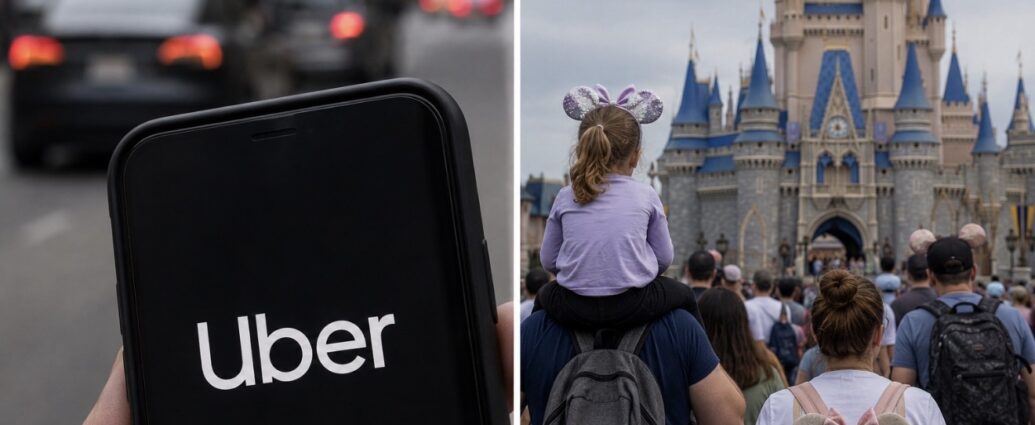
Two of America’s largest consumer-facing companies — Uber and Disney — just reported first-quarter earnings that suggest millions of Americans are still spending aggressively on travel, rides, entertainment, food delivery, and experiences despite a far more difficult economic backdrop.
The results are offering Wall Street a measure of reassurance that consumer demand remains surprisingly resilient — at least among higher-income households.
Uber: Consumers Keep Riding and Ordering
Uber’s first-quarter numbers came in stronger than analysts expected across several major categories.
The company reported:
- Gross bookings up 21% year over year
- Significant acceleration in both rideshare and delivery demand
- 3.6 billion trips completed during the quarter
- Non-GAAP earnings per share up 44%
- $3 billion returned to shareholders
The performance came despite one major challenge: fuel prices.
Uber drivers bear their own gasoline costs, meaning surging pump prices tied to the Iran conflict directly affect driver economics and operating conditions.
CEO Dara Khosrowshahi acknowledged the difficult backdrop during the company’s earnings call, describing a “complex macro environment marked by weather disruptions, geopolitical tensions, and gas price volatility.”
Still, demand held up.
“The consumers are spending, they’re spending locally, and we don’t see any signs of that weakening at this point,” Khosrowshahi told CNBC.
Disney’s Parks and Cruises Stay Strong
Disney delivered a similarly resilient picture.
The entertainment giant beat Wall Street expectations, driven largely by strength in:
- Theme parks
- Cruises
- Streaming operations
- Consumer experiences
Disney’s experiences division generated nearly $9.5 billion in quarterly revenue, up approximately 7% from a year earlier.
Global park attendance increased 2%, although domestic attendance slipped slightly.
The results suggest consumers continue prioritizing vacations, travel, and entertainment even as broader economic concerns intensify.
But Disney executives also signaled caution.
Chief Financial Officer Hugh Johnston warned that the company remains highly sensitive to further increases in fuel prices and consumer pressure.
“We’re mindful of the macro uncertainty consumers are facing,” Johnston said during the earnings call. “We’re not immune to the impacts.”
The Consumer Economy Is Splitting in Two
The resilience shown by Uber and Disney may be real — but economists increasingly warn it reflects only part of the American economy.
Both companies disproportionately serve middle- and upper-income consumers — precisely the households that Federal Reserve researchers say have been least affected by the recent energy shock.
According to New York Fed data:
- Higher-income households continue spending aggressively despite rising gas prices
- Lower-income households are already reducing driving, cutting discretionary purchases, and scaling back spending
Bank of America consumer spending data similarly shows that much of the recent spending growth is coming from wealthier Americans whose investment portfolios have benefited from a stock market that continues hovering near record highs.
Meanwhile, lower-income families are increasingly being squeezed by:
- Higher gasoline costs
- Elevated rents
- More expensive borrowing
- Rising grocery prices
- Persistent inflation
Inflation Risks Remain Elevated
Economists continue warning that the broader inflation picture may worsen before it improves.
The Consumer Price Index recently climbed to an annual inflation rate of 3.3%, the highest level since mid-2024, largely driven by rising energy costs.
Some analysts now expect the Federal Reserve’s preferred inflation gauge — the Personal Consumption Expenditures index — could approach 4% later this year, well above the Fed’s 2% target.
That creates growing uncertainty for businesses dependent on discretionary consumer spending.
As long as higher-income Americans continue traveling, dining out, booking vacations, and spending on entertainment, companies like Uber and Disney may continue posting strong results.
But if fuel prices continue climbing or the Iran conflict drags on longer than expected, that resilience could eventually weaken.
For Now, the Consumer Still Has Not Broken
For investors, the earnings reports offer an important signal:
The American consumer — particularly affluent consumers — remains remarkably durable despite economic headwinds.
But beneath the surface, the economy increasingly appears split into two very different realities.
One America is still booking vacations, ordering Uber Eats, and planning Disney trips.
The other is cutting back on driving simply to afford gasoline.
Uber and Disney’s earnings captured the first story.
The second story is unfolding more quietly — but it is already visible in the data.
© JBizNews.com. All rights reserved. This article is original reporting by JBizNews Desk. Unauthorized reproduction or redistribution is strictly prohibited.