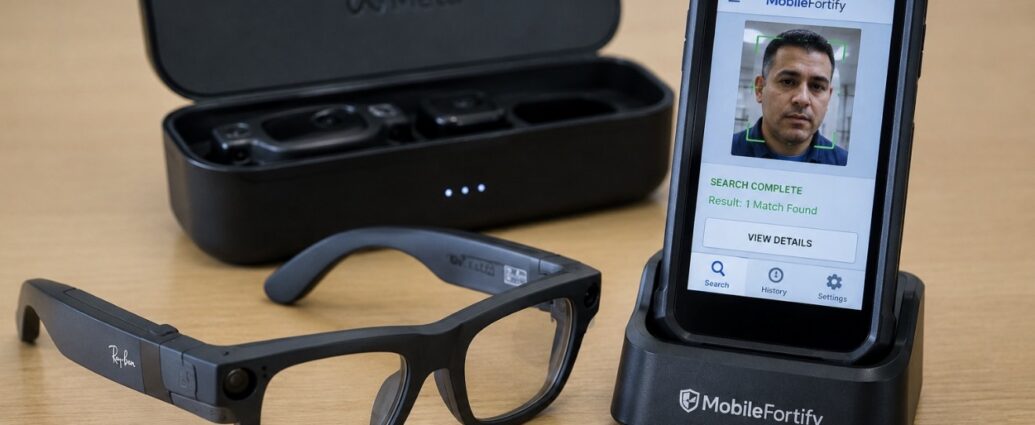
The U.S. Department of Homeland Security has asked Congress for $7.5 million to develop smart-glasses prototypes that would give Immigration and Customs Enforcement agents real-time facial recognition and biometric identification in the field, according to the department’s fiscal 2027 budget justification for the Science and Technology Directorate.
The line item, which received fresh attention Tuesday after Fortune detailed how the request maps onto existing field practice, places mobile biometric identification at the center of the next phase of federal immigration enforcement and signals a new procurement track for vendors in facial-recognition software, secure mobile hardware and federal-systems integration.
The budget justification states that the funds will “deliver innovative hardware, such as operational prototypes of smart glasses, to equip agents with real-time access to information and biometric identification capabilities in the field.”
The work appears under the directorate’s Border Security and Immigration Mission Center, within the Detention and Removal Operations program, and is paired with broader budget language committing DHS to “encounter, transport, detain, and remove individuals who are in the U.S. unlawfully.”
Documents reviewed by NewsNation describe a development timeline targeting operational testing in early 2027, with availability projected around September of that year.
The request lands in a market where the underlying technology is already in circulation.
ICE agents have been photographed wearing Meta’s Ray-Ban smart glasses during enforcement operations in at least six states since the start of President Donald Trump’s second term, according to Fortune’s reporting. Meta, which produces the consumer glasses jointly with EssilorLuxottica’s Ray-Ban brand, has separately signaled it intends to add a facial-recognition system to the devices — a plan first reported by The New York Times and a reversal of the company’s earlier decision to abandon similar work over privacy concerns.
The DHS request would, in effect, give ICE a federally engineered version of a product its agents are already buying off the shelf.
It would also extend a field biometric tool the agency has been running for nearly a year.
ICE and U.S. Customs and Border Protection currently use Mobile Fortify, a $23.9 million biometric application that photographs faces or captures contactless fingerprints and queries federal and state databases — including the DHS IDENT system, which holds more than 270 million biometric records, the State Department’s visa and passport photo files, the FBI’s National Crime Information Center, and state driver license records.
A January 2026 lawsuit brought by the State of Illinois and the City of Chicago against DHS and former Secretary Kristi Noem alleged the app had been used more than 100,000 times since its June 2025 launch and that it could be turned on anyone, not just enforcement targets.
The $7.5 million figure is small relative to the rest of the FY 2027 biometric stack DHS has put in front of Congress.
Transportation Security Administration budgeting includes roughly $41 million for Credential Authentication Technology-2 facial-comparison units, with a planned cumulative deployment of 2,929 units by FY 2029, alongside $20 million for biometric eGates.
The Science and Technology Directorate’s broader Biometrics and Identity portfolio totals about $16 million, and a separate ConfirmID program is funded at $154.8 million.
For federal-technology vendors, the smart-glasses line reads less as a final addressable market than as a research-stage entry point into a department-wide identity infrastructure.
The political environment is unsettled.
The budget request emerged from a months-long DHS funding standoff that left the agency partially shut down, triggered by the killings of two American citizens by federal agents in Minneapolis and by Democratic demands that ICE agents remove facial coverings during operations.
Senate Republicans ultimately routed ICE funding through budget reconciliation.
In February, Sens. Ed Markey, Ron Wyden and Jeff Merkley, joined by Rep. Pramila Jayapal, introduced the ICE Out of Our Faces Act, which would bar ICE and CBP from using facial recognition entirely and require deletion of existing biometric records. The bill has not moved out of committee.
Senate Homeland Security Committee ranking Democrat Gary Peters told Courthouse News he had not been briefed on the smart-glasses request, while North Carolina Republican Thom Tillis said he was not immediately concerned.
Civil-liberties pushback has focused on accuracy and scope.
A CBP pilot of similar glasses at Los Angeles International Airport last year reportedly logged a 13% false-positive rate for people of color, according to advocacy groups tracking the program.
Cody Venzke, an attorney with the ACLU’s speech, privacy and technology project, has argued that withholding the FY 2027 appropriation is the most direct lever Congress has and that future DHS funding should be conditioned on non-deployment.
DHS has responded that the directorate is “constantly assessing” ICE’s needs and that any technology used will operate “within the full scope of the law.”
For the broader government-technology market, the request crystallizes a procurement pattern: frontline experimentation with commercial gear, followed by formal R&D funding, with scale contingent on accuracy testing, privacy compliance and congressional appetite.
Whether the smart-glasses program advances from prototype to fielded system will turn on those three variables — and on whether lawmakers treat $7.5 million as a research footnote or as a vote on the future of mobile biometric surveillance.
JBizNews Desk
© JBizNews.com. All rights reserved. This article is original reporting by JBizNews Desk. Unauthorized reproduction or redistribution is strictly prohibited.