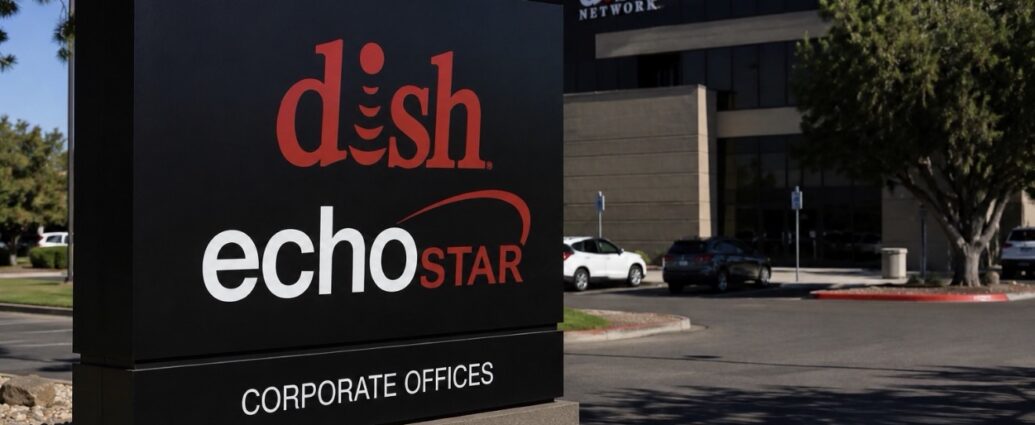
Satellite television provider Dish DBS filed for Chapter 11 bankruptcy protection on Tuesday, its parent company EchoStar Corporation announced, after a delayed $23 billion sale of wireless airwaves to AT&T left the company unable to pay off bonds that were coming due.
The filing was made in the U.S. Bankruptcy Court for the Southern District of Texas, in Houston. In a statement, EchoStar said the move was a prepackaged restructuring — a bankruptcy planned in advance with creditors — backed by holders of more than 88% of Dish DBS bonds. The company said the goal is to restructure its debt quickly and exit court protection before the end of the third quarter of 2026.
At the center of the trouble is a $2 billion block of 7.75% senior secured notes that matured on July 1. Dish DBS could not repay them because the money it was counting on — proceeds from selling wireless spectrum to AT&T — has not arrived. EchoStar agreed last year to sell nationwide 3.45 GHz and 600 MHz spectrum licenses to AT&T for about $23 billion, but the deal has been held up by what the company called unforeseen delays as it awaits regulatory approval.
Charlie Ergen, the chairman and chief executive who co-founded EchoStar and recently returned to lead it through the crisis, framed the filing as a step forward rather than a collapse. He said the company has been “at the forefront of telecommunications for over 45 years” and that the moves would position the business for a stronger future. He added that EchoStar is operating as usual throughout the process.
Importantly, the bankruptcy is limited to the Dish DBS and Dish Wireless corporate entities. EchoStar said its consumer brands — Dish TV, Sling TV, Boost Mobile, Gen Mobile and Hughes — are not part of the filing and will keep operating normally, with no changes to service, employees or vendor payments. Customers, in other words, should see nothing different.
The company that is filing has been under pressure for years. EchoStar, which merged with Dish in 2024, has been struggling to manage roughly $25 billion in debt. Its pay-TV business is shrinking fast: Dish now has about 5 million satellite subscribers and Sling TV about 2 million, down sharply from its peak. In the first three months of 2026 alone, the company lost roughly 177,000 net subscribers, and pay-TV revenue fell more than $260 million from a year earlier, to $2.26 billion.
The bankruptcy also marks a retreat from Dish’s expensive bet on wireless. The restructuring is expected to help wind down Dish Wireless’s facilities-based 5G network — the network the company built to become a fourth national wireless carrier alongside AT&T, Verizon and T-Mobile. That ambition, once encouraged by federal regulators to boost competition, has now given way to selling the underlying airwaves to a rival.
For AT&T, the stalled deal is a complication but also an opportunity. Acquiring EchoStar’s spectrum would give the carrier a large block of valuable airwaves to expand its network, and the delay appears tied to regulatory review rather than a collapse of the agreement. Once the sale closes, EchoStar says it will use the proceeds to repay most of its debt, which would clear the path out of bankruptcy.
The case is being handled by law firm White & Case, with Houston partner Charles Koster leading, while FTI Consulting serves as financial advisor. EchoStar shares, which trade on the Nasdaq under the ticker ECHO, rose 0.4% in after-hours trading following the news — a sign investors viewed the prepackaged filing as an orderly cleanup rather than a surprise.
The filing closes a difficult chapter for Ergen, who spent years trying to reinvent Dish from a fading satellite-TV operator into a wireless player. An earlier attempt to merge with rival DirecTV fell apart, leaving the spectrum sale to AT&T as the company’s main route to raising cash. With that deal delayed and a major bond payment due, bankruptcy became the tool to buy time. If the AT&T transaction finally closes, EchoStar could emerge in the third quarter with far less debt — and a business built around wireless airwaves and streaming rather than the satellite dishes that made it famous.
JBizNews Desk | Houston
© JBizNews.com. All Rights Reserved. Reproduction or distribution without written permission is prohibited.