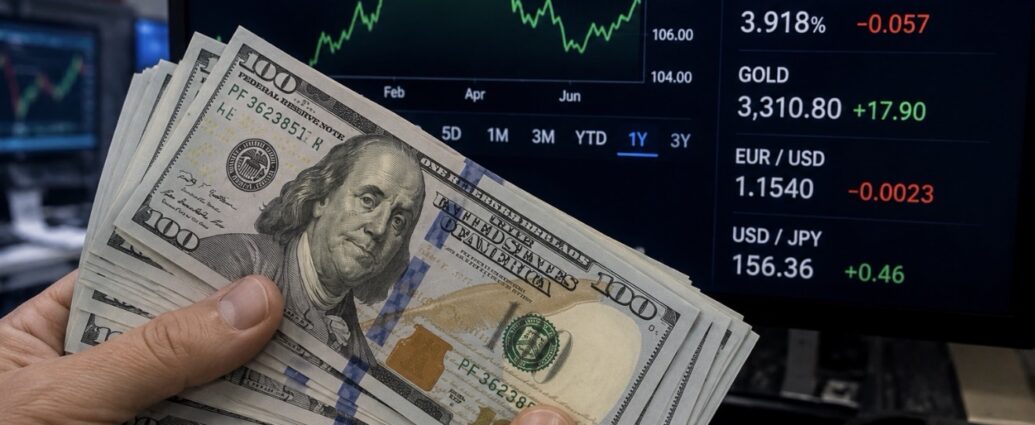
Traders head into the final stretch before the Federal Reserve’s July 29 meeting caught in a rare bind: the same forces lifting the U.S. dollar are punishing the bond market, a split that hardened this week after Fed Chair Kevin Warsh reaffirmed that prices remain too high and declined to signal any retreat from his higher-for-longer stance.
The U.S. Dollar Index finished Friday near 100.9, within reach of the 101.8 peak it touched in late June, its strongest level in 13 months. The gauge has climbed about 3 percent this year and roughly 5 percent since late January, a sharp reversal from the first half of 2025, when the greenback logged its weakest opening half in more than 50 years. At the same time, the 10-year Treasury yield sat around 4.54 percent after brushing a seven-week high near 4.58 percent at midweek, while the 30-year bond hovered near 5.06 percent and the rate-sensitive 2-year note held around 4.14 percent. Because bond prices fall as yields rise, fixed-income holders are nursing losses even as dollar bulls press their advantage.
The engine behind both moves is the same: a Fed that has swung from planning cuts to weighing hikes. At the June 17 meeting, Warsh’s first as chair, policymakers held the federal funds rate at 3.50 to 3.75 percent in a unanimous vote, but the updated projections flipped the script. The median year-end forecast climbed to 3.8 percent from 3.4 percent in March, implying a hike rather than a cut, and 17 of 18 officials judged inflation risks tilted to the upside. Inflation has stayed stubborn, with the PCE index running at 4.1 percent in May, the hottest since 2023, and core prices up 3.3 percent. On July 10, Warsh named the leaders of five task forces to review how the central bank sets policy, a signal he intends to reshape the institution as well as its rate path.
Higher U.S. rates, and the prospect of higher ones still, widen the gap between American yields and those in Europe and Japan, pulling money toward dollar assets. The European Central Bank, led by Christine Lagarde, and the Bank of Japan both sit well below the Fed, leaving the euro and yen unable to keep pace. Muhammad Hamza Saleem, a currency analyst at Morningstar, has called the rally mostly a Fed story, driven by the hawkish June dot plot and the widening rate advantage, though he cautions that his model reads the index as roughly 15 percent overvalued and likely to drift lower into 2027.
Market movers. The dollar’s strength has rippled across assets. The euro has struggled near $1.14 even as traders price in another ECB move, and the yen has stayed under pressure, keeping Japanese officials on intervention watch. According to CME FedWatch, traders now put the odds of a hold on July 29 near 70 percent, with hike bets cooling after a soft June payrolls report that showed just 57,000 jobs added and the labor force shrinking by roughly 720,000, even as unemployment slipped to a 14-month low of 4.2 percent. Further out, the market still leans toward tightening, pricing at least one increase by the September or October meetings. New York Fed President John Williams added a wrinkle, saying he is most focused on inflation fed by demand from artificial-intelligence investment.
Commodities and volatility. The bond market’s trouble traces partly to oil. The U.S.-Iran war, now in its fifth month, has kept energy prices jumpy: a three-week-old cease-fire frayed this week as the two sides exchanged fresh strikes, though reports that talks would continue pulled U.S. crude back toward $72 a barrel and eased the haven bid that had briefly lifted the dollar. That captures the bind facing bond investors. A Middle East war would normally send buyers into Treasuries, but because this one drives up energy costs and inflation, it pushes yields higher rather than lower. Gold, another usual refuge, has wobbled near $4,000 an ounce as the strong dollar caps its appeal. Weighing on bonds from another direction is supply: the Treasury is financing wide deficits, with the Congressional Budget Office estimating last year’s tax law could add $3.4 trillion to federal debt by 2034, leaving investors to absorb heavy issuance.
Attention now turns to the July 29 decision and to Warsh‘s deliberate refusal to telegraph it. Having scrapped the forward guidance that defined the Jerome Powell era in favor of what strategists call strategic ambiguity, the new chair has left traders to price policy off inflation data alone. President Trump has pressed publicly for lower rates, but with inflation above 4 percent, Warsh has little room to oblige. Until the data cool, the market’s uncomfortable math is likely to hold: what is good for the dollar stays bad for bonds.
JBizNews Desk | New York © JBizNews.com All Rights Reserved. Reproduction or distribution without written permission is prohibited.