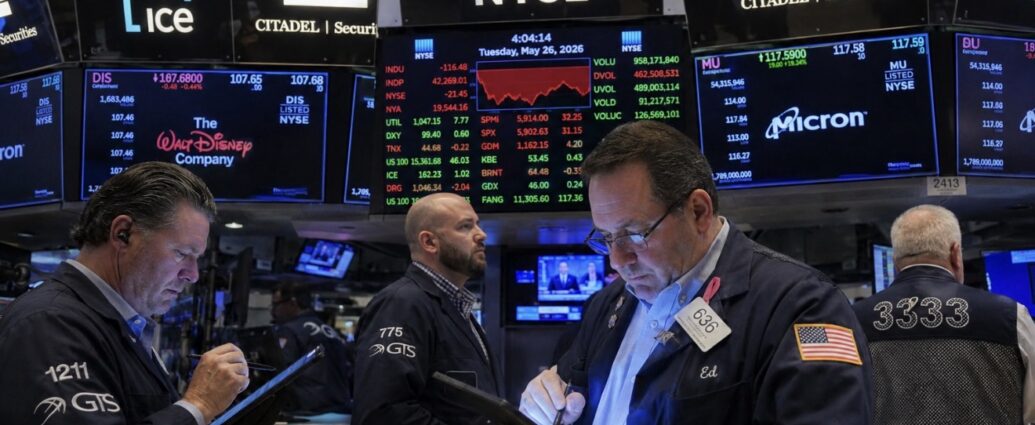
The U.S. stock market closed Wednesday with the Dow Jones Industrial Average powering to another all-time high, while the broader S&P 500 and Nasdaq Composite barely moved as weakness in banks and semiconductor stocks offset a sharp drop in oil prices triggered by developments tied to the Strait of Hormuz.
The Dow gained 182.60 points, or 0.36%, to close at a record 50,644.28 after also reaching a new intraday high. The S&P 500 edged up 0.02% to finish at 7,520.36, while the Nasdaq Composite added 0.07% to close at 26,674.73. All three major U.S. indexes are now sitting at record highs, though Wednesday’s session reflected a market increasingly sensitive to geopolitical headlines, bank commentary, and the sustainability of the AI-driven rally.
The biggest driver of the session came from Iran. Iranian state media reported that Tehran intends to restore commercial shipping traffic through the Strait of Hormuz to pre-war levels within one month, sending crude prices sharply lower as traders rushed to remove part of the geopolitical risk premium that has fueled energy markets for months. U.S. crude oil fell 5.55% to settle at $88.68 per barrel.
The Strait of Hormuz remains one of the world’s most critical energy chokepoints, carrying roughly 20% of globally traded seaborne crude oil. Any indication of normalization immediately impacts pricing expectations across energy markets, transportation costs, inflation forecasts, and broader global trade sentiment.
The White House quickly disputed the Iranian report, calling it inaccurate, but markets largely traded on the expectation that supply disruptions may ease. Energy stocks remained under pressure while investors rotated back into technology and industrial names. Six of the eleven major S&P sectors finished positive, led by technology, industrials, and materials, while energy, healthcare, and consumer staples lagged.
Another major story weighing on sentiment came from JPMorgan Chase CEO Jamie Dimon, who spoke Wednesday at the Bernstein Strategic Decisions Conference in Manhattan. Dimon said the bank could deploy between $10 billion and $20 billion toward a major acquisition over the next several years, potentially marking the largest deal of his tenure.
“I do think there might be opportunities,” Dimon said. “There might be, in the next couple years, a chance to put $10 or $20 billion to work buying something.”
While the acquisition comments initially drew attention, investors focused more heavily on Dimon’s disclosure that JPMorgan now expects 2026 spending to rise to approximately $106 billion, above prior guidance. JPMorgan shares fell roughly 2%, weighing on the broader financial sector and making the stock one of the weakest performers in the KBW Bank Index.
Dimon also disclosed that JPMorgan currently has approximately 1,000 artificial intelligence use cases in development, with 50 to 60 considered significant, underscoring how aggressively major financial institutions are moving into AI deployment.
Semiconductor stocks also cooled after an extraordinary rally that has dominated markets throughout 2026. Micron Technology, which had surged 19% in the prior session and briefly crossed a $1 trillion market capitalization, traded more cautiously Wednesday as investors debated whether portions of the AI trade have become overheated.
Software stocks also remained in focus after the closing bell. Salesforce shares fell roughly 2.8% in after-hours trading after issuing softer-than-expected guidance, while Snowflake continued to benefit from enthusiasm surrounding its recent earnings report and a major Amazon Web Services commitment tied to AI infrastructure expansion.
Industrial companies helped support the Dow throughout the session. Caterpillar rose 3.26%, Honeywell gained 1.61%, and 3M advanced 1.08%, reflecting continued investor confidence in broader economic activity beyond the technology sector.
The broader picture heading into Thursday remains a market sitting at all-time highs across every major benchmark while becoming increasingly dependent on a narrow group of AI-driven technology names and rapidly shifting geopolitical headlines. Bond yields remained relatively stable, the U.S. dollar strengthened, and gold prices fell roughly 1.6% as safe-haven demand eased following the Hormuz developments.
For now, the Dow, the S&P 500, and the Nasdaq all remain at record levels. Whether the rally continues may depend less on economic data and more on geopolitical developments in the Middle East, corporate AI spending, and whether investors continue rewarding a market increasingly concentrated around a handful of dominant technology and semiconductor companies.
New York — JBizNews Desk
© JBizNews.com All Rights Reserved. Reproduction or distribution without written permission is prohibited.